What is Computer Vision: How it Works & Explained
Published: 30 Mar 2026
You may have heard the term “computer vision” and wondered how computers can see and understand images like humans.
In this guide, we will explain what computer vision is, how it works, its components, types, applications, advantages, limitations, and future possibilities. By the end, even beginners will clearly understand how this technology works and why it is important.
What is Computer Vision?
In this section, we will explain the basic meaning of computer vision and why it is important today.
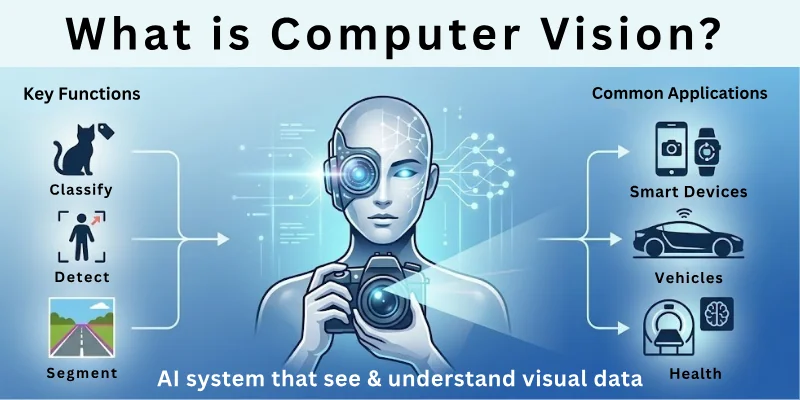
Computer Vision is a field of computer science that enables machines to see, process, and interpret visual information from the world. It allows computers to analyze images and videos and make decisions based on what they “see”.
Key Points
- Enables machines to “see” and understand images and videos.
- Uses cameras, sensors, and algorithms to process visuals.
- Can detect objects, recognize patterns, and make decisions.
- Widely used in industries, robotics, healthcare, and security.
- Helps automate tasks that require visual perception.
How Computer Vision Works
This section explains how machines process visual information step by step.
Computer vision works by capturing visual data, analyzing it using algorithms, and producing actionable results.
Main Steps
- Image Acquisition: Cameras or sensors capture images or videos.
- Preprocessing: Improves image quality and removes noise.
- Feature Extraction: Identifies patterns, shapes, or objects in the visual data.
- Classification/Recognition: Algorithms detect or classify objects or patterns.
- Decision Making: Produces output like alerts, object counts, or automated actions.
Example: In retail stores, computer vision can track customer movement and identify which products are frequently picked or ignored. This helps stores improve layouts and marketing strategies.
Components of Computer Vision Systems
This section explains the main components of computer vision systems.
- Cameras and Sensors: Capture images or video from the environment.
- Lighting: Ensures clear and consistent image quality.
- Processing Unit: Computer or processor that runs analysis algorithms.
- Software and Algorithms: Detects patterns, recognizes objects, and makes decisions.
- Output Devices: Displays results, triggers alarms, or controls machines based on analysis.
Types of Computer Vision
This section explains different types of computer vision technologies.
- Object Detection: Identifies and locates objects in an image or video.
- Image Classification: Categorizes images into different classes or types.
- Face Recognition: Detects and recognizes human faces.
- Motion Detection: Detects movement in images or video sequences.
- Semantic Segmentation: Divides images into regions for detailed analysis.
Applications of Computer Vision
This section explains real-world uses of computer vision.
Main Applications
- Healthcare: Analyzing medical scans for disease detection.
- Autonomous Vehicles: Detecting lanes, obstacles, and traffic signs.
- Security: Surveillance and facial recognition.
- Retail: Customer tracking and inventory monitoring.
- Agriculture: Crop monitoring and health analysis.
- Robotics: Guiding robots to pick, place, or assemble objects.
- Manufacturing: Quality inspection of products.
Advantages of Computer Vision
This section explains why computer vision is important and valuable.
Key Advantages
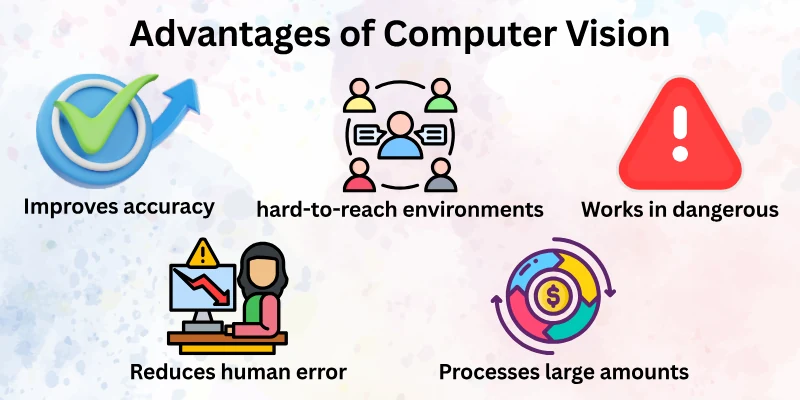
- Improves accuracy in visual tasks compared to humans.
- Reduces human error in inspections and monitoring.
- Works in dangerous or hard-to-reach environments.
- Processes large amounts of visual data quickly.
- Enables automation in many industries.
Limitations of Computer Vision
This section explains the challenges of using computer vision.
Main Limitations
- Requires high-quality images and proper lighting.
- Can struggle with cluttered or complex environments.
- Needs strong computing power for real-time analysis.
- Algorithms may fail with unusual or unexpected objects.
- Initial setup and training can be expensive.
Future of Computer Vision
This section explains how computer vision is evolving.
Future Possibilities
- Smarter autonomous vehicles with better obstacle detection.
- Advanced healthcare imaging for faster and more accurate diagnosis.
- Improved security systems with real-time monitoring.
- Enhanced robotics for flexible and accurate automation.
- Integration with AI for decision-making in dynamic environments.
Final Note
In this guide, we have covered what computer vision is and how it works in detail. You now understand its meaning, working process, components, types, applications, advantages, limitations, and future possibilities. Computer vision helps machines interpret the world visually, making processes faster, more accurate, and safer.
Learning step by step makes this advanced technology simple and accessible. Stay curious, explore, and see how computer vision is shaping industries and everyday life.
Goodbye and keep discovering the amazing world of computer vision.
FAQs: What is Computer Vision
Here are some of the most commonly asked questions related to the computer vision:
Computer Vision in AI allows machines to see, interpret, and understand images or videos. It helps computers detect objects, recognize patterns, and make decisions based on visual input.
It works by capturing images or videos, processing them with algorithms, and producing useful results. Each step helps the system identify objects, detect movements, or analyze scenes accurately.
The main components include cameras, sensors, lighting systems, processing units, and software algorithms. Cameras capture visuals, software analyzes them, and the system generates outputs like object detection or alerts.
Computer vision is used in autonomous vehicles, security systems, healthcare imaging, manufacturing quality control, and retail analytics. It helps automate tasks and improve accuracy in visual analysis.
It increases accuracy, reduces human error, and can process large amounts of visual data quickly. Computer vision also works in dangerous or difficult environments where humans cannot operate safely.
It requires high-quality images, proper lighting, and strong computing power. Complex or cluttered environments can reduce accuracy, and setting up these systems can be costly.
It helps cars detect lanes, obstacles, traffic signs, and pedestrians. This allows autonomous vehicles to navigate safely and respond to changing conditions in real time.
Computer vision analyzes medical images like X-rays or MRIs to detect diseases and anomalies. It improves diagnosis accuracy and reduces the time required for manual inspections.
AI algorithms make computer vision smarter by learning patterns and improving recognition accuracy. This allows machines to handle complex tasks like facial recognition, object detection, and motion tracking.
The future includes smarter robotics, advanced healthcare diagnostics, autonomous vehicles, real-time surveillance, and better industrial automation. Computer vision will play a bigger role in daily life and industry efficiency.






- Be Respectful
- Stay Relevant
- Stay Positive
- True Feedback
- Encourage Discussion
- Avoid Spamming
- No Fake News
- Don't Copy-Paste
- No Personal Attacks
- Be Respectful
- Stay Relevant
- Stay Positive
- True Feedback
- Encourage Discussion
- Avoid Spamming
- No Fake News
- Don't Copy-Paste
- No Personal Attacks
