Artificial Intelligence Terms: Beginner-Friendly Tech Glossary
Published: 25 Dec 2025
Artificial Intelligence (AI) is changing how the world works. From self-driving cars to virtual assistants like Siri and ChatGPT, AI is everywhere. But behind these technologies lies a world of complex words and ideas. Understanding them helps you see how AI really works.
This guide is a full artificial intelligence dictionary. It explains the most used AI terminologies, concepts, and keywords from A to Z in the simplest way possible. Whether you’re a beginner or a tech lover, this will help you understand all the words related to artificial intelligence and use them confidently.
A Terms in Artificial Intelligence
Before we explore, let’s understand the importance of “A” in AI. Many foundation words in AI start with the letter A, from Algorithm to Anomaly Detection.
These terms form the building blocks of machine learning and automation. Below is a complete list with simple meanings and real-world context.
- Accuracy: Accuracy means how close an AI model’s predictions are to the actual results. High accuracy means the model makes correct predictions most of the time. It’s one of the most basic measures to judge AI performance.
- Activation Function: An activation function decides whether a neuron in a neural network should activate or not. It helps the AI system make non-linear decisions and learn complex relationships within data.
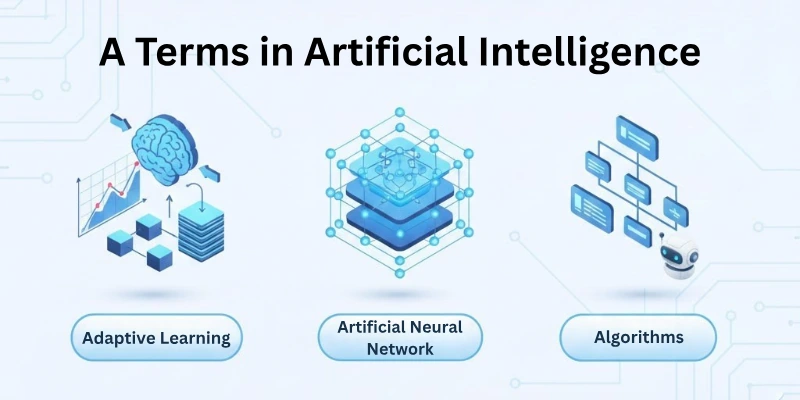
- Adaptive Learning: Adaptive learning is when an AI system adjusts itself automatically to new data or patterns without human help. For example, Netflix recommendations improving over time as you watch more shows.
- Adversarial Attack: An adversarial attack happens when someone tricks an AI model using false input data. For instance, showing a modified image to confuse facial recognition software.
- Agent: An agent is any software or machine that can take actions intelligently based on data. Chatbots and self-driving cars are examples of intelligent agents.
- AI Ethics: AI Ethics refers to the moral principles that guide how artificial intelligence should behave. It ensures that AI systems are fair, transparent, and respect human values.
- AI Model: An AI model is a trained system that uses data to make predictions or decisions. For example, a spam filter model predicts which emails are spam and which are not.
- AI Pipeline: The AI pipeline is the process of collecting, cleaning, training, and deploying AI models. It’s like a step-by-step factory line where data turns into intelligence.
- Algorithm: An algorithm is a set of instructions that a computer follows to solve a problem. Every AI model depends on algorithms to process data and learn from it.
- AlphaGo: AlphaGo is a famous AI system built by Google DeepMind that defeated the world champion of the game Go. It proved the power of deep learning and reinforcement learning.
- Analytics: Analytics is the science of studying data to find trends or patterns. AI analytics helps businesses make decisions using large amounts of data.
- Anomaly Detection: Anomaly detection is used to find unusual patterns or outliers in data. Banks use this technique to detect fraud or suspicious transactions.
- Artificial General Intelligence (AGI): AGI is the idea of a machine that can perform any task a human can do, with full understanding and reasoning. It’s still theoretical and not yet achieved.
- Artificial Intelligence (AI): AI is the ability of a computer to think, learn, and act like a human. It covers everything from machine learning and robotics to natural language processing. This is the foundation of all AI terminologies.
- Artificial Neural Network (ANN): An ANN is a computing system inspired by the human brain. It has layers of “neurons” that process data to recognize patterns, such as in voice or image recognition.
- Artificial Superintelligence (ASI): ASI refers to AI systems that could surpass human intelligence in every field, logic, creativity, and social skills. It’s still a future concept, often discussed in AI safety research.
- Association Rule Learning: This AI technique finds hidden relationships between data items. For example, if customers buy bread, they might also buy butter, a concept used in recommendation engines.
- Attention Mechanism: An attention mechanism allows AI models to focus on the most important parts of data, like specific words in a sentence, to improve understanding. It’s key to modern language models.
- Augmented Intelligence: Augmented Intelligence is AI designed to assist humans, not replace them. It improves human decision-making instead of automating it completely.
- Automation: Automation is using AI and software to perform repetitive tasks automatically. From customer support bots to factory robots, automation saves time and effort.
- Autoencoder: An autoencoder is a type of neural network that learns to compress and reconstruct data. It’s often used for image noise removal or data compression.
- Autonomous System: An autonomous system works without human control. Examples include drones, self-driving cars, and automated delivery robots.
- Average Precision: Average precision is a metric that evaluates how accurate an AI model’s ranked predictions are, especially in classification and search models.
- API (Application Programming Interface): An API allows one software system to connect and communicate with another. Many AI tools, like OpenAI’s GPT models, are accessed through APIs.
- Artificial Life (A-Life): Artificial Life studies digital systems that mimic biological life. It explores how machines or simulations can show lifelike behaviors such as evolution or reproduction.
B Terms in Artificial Intelligence
The letter B in AI covers terms mostly linked to data, decision-making, and automation systems. Many technical foundations in machine learning, such as bias, backpropagation, and big data, begin with B. These words are essential for anyone learning how computers think, analyze, and improve performance.
Below are the most important and detailed B-related AI terms.
- Backpropagation: Backpropagation is a learning process used by neural networks. It adjusts the internal weights after each prediction by comparing the predicted result to the actual answer. This feedback loop helps the AI model learn from its mistakes and become more accurate over time.
- Bandit Algorithm: A bandit algorithm is used for decision-making when there are several uncertain options. It balances exploring new possibilities and exploiting known results, like showing different ads to find the one that performs best.
- Baseline Model: A baseline model is a simple starting model used to compare performance with advanced models. If a complex model doesn’t outperform the baseline, it needs more improvement.
- Batch Learning: Batch learning is when an AI model learns from all available data at once instead of learning continuously. It’s often used when the data does not change frequently.
- Bayesian Network: A Bayesian Network is a graphical model that shows relationships between different variables and calculates probabilities. It’s used in AI to reason under uncertainty, such as predicting medical diagnoses.
- Benchmarking: Benchmarking means comparing the performance of an AI model against a standard test or dataset. It helps identify strengths, weaknesses, and progress in research.
- Bias: Bias occurs when AI produces unfair or inaccurate results due to wrong data or assumptions. For example, a hiring AI trained only on male candidates may unintentionally prefer men.
- Big Data: Big Data refers to extremely large and complex data sets that traditional tools can’t handle. AI uses big data to train smarter models and uncover deep insights.
- Binary Classification: Binary classification is the process of sorting data into two categories, for example, “spam” or “not spam.” It’s one of the simplest machine learning problems.
- Bioinformatics: Bioinformatics combines AI and biology to study genes, proteins, and diseases. Machine learning helps identify patterns in DNA and predict health risks.
- Biometric Authentication: This refers to verifying identity using physical or behavioral traits, like fingerprints, face, or voice recognition. AI improves biometric systems by increasing accuracy and speed.
- Black Box Model: A black box model is an AI system whose inner decision process is not visible or understandable to humans. Deep learning models are often considered black boxes.
- Blockchain AI: Blockchain AI combines artificial intelligence with blockchain technology to improve transparency and trust in automated systems.
- Bot: A bot is a software application that performs repetitive tasks automatically. In AI, bots like chatbots and web crawlers are programmed to interact and learn from users.
- Bottleneck Layer: In neural networks, the bottleneck layer is the narrowest part that compresses information. It helps the model learn only the most important features.
- Brute Force Algorithm: A brute force algorithm solves problems by trying all possible options until it finds the correct one. It’s simple but often slow and resource-heavy.
- Business Intelligence (BI): Business Intelligence uses AI tools to analyze company data and help managers make informed decisions. It includes dashboards, data visualization, and prediction reports.
- Bayesian Inference: Bayesian inference updates the probability of a hypothesis as more data becomes available. It’s widely used in AI to improve predictions dynamically.
- Behavioral Analytics: Behavioral analytics studies user actions and patterns. AI uses it to personalize content, detect fraud, or improve marketing campaigns.
- Bias-Variance Tradeoff: This is a balance between underfitting (too simple) and overfitting (too complex) in machine learning models. A good model should generalize well to new data.
- Bit (Binary Digit): A bit is the smallest unit of digital data, representing either 0 or 1. Every AI system relies on bits to store and process information.
- Blending Models: Blending is a technique where multiple models are combined to make a stronger prediction. It’s commonly used in competitions like Kaggle for top-performing AI systems.
- Boosting: Boosting is a machine learning method that improves weak models by combining them into one strong model. Examples include AdaBoost and Gradient Boosting.
- Botnet Detection: AI helps detect and prevent botnets, networks of infected computers used for cyberattacks, by analyzing unusual traffic patterns.
- Bayesian Optimization: This is a technique used to find the best model parameters using probability and past results. It’s more efficient than random guessing.
- Backward Chaining: Backward chaining starts from a goal and works backward to find the facts that support it. It’s used in rule-based AI systems and expert systems.
- Behavioral Cloning: Behavioral cloning teaches machines by observing human behavior. Self-driving cars, for example, learn from recordings of human drivers.
- Batch Normalization: This process standardizes data between layers in a neural network, helping models train faster and more reliably.
- Bayesian Regression: Bayesian regression applies probability principles to regression models, improving prediction confidence and interpretation.
- Binary Tree: A binary tree is a data structure used in algorithms where each node has up to two children. It’s the base for decision trees in AI.
- Bridge Neural Network: A bridge neural network links multiple smaller networks together to share knowledge between them.
- Business Process Automation (BPA): This uses AI and automation to handle repetitive business tasks like data entry or invoice processing. It increases efficiency and reduces errors.
- Bytecode: Bytecode is a form of computer code that can be run by a virtual machine. AI systems often use it for faster and platform-independent execution.
- Bias Correction: Bias correction is adjusting data or algorithms to fix unfair or skewed results. It’s essential for building ethical AI.
C Terms in Artificial Intelligence
The letter C covers many core ideas in AI, especially those linked to computation, communication, and creativity. From chatbots that talk like humans to complex models that learn from images, most modern technologies depend on these “C” concepts.
Below is a complete list of important C-related AI terms with clear, detailed meanings.
- Chatbot: A chatbot is an AI program that interacts with users through text or voice. It uses natural language processing to understand questions and respond intelligently. Chatbots are commonly used in customer service, online stores, and apps like WhatsApp or Facebook Messenger.
- Classification: Classification is a machine learning process that sorts data into categories. For example, AI can classify emails as “spam” or “not spam.” It is widely used in image, voice, and text recognition systems.
- Clustering: Clustering is grouping similar data points together based on shared features. It’s often used for customer segmentation, pattern discovery, and market analysis.
- Cognitive Computing: Cognitive computing refers to systems designed to simulate human thought processes. These systems use reasoning, learning, and language understanding to solve complex problems like humans do.
- Computer Vision: Computer vision allows AI to interpret and understand visual data such as photos and videos. It powers facial recognition, object detection, and medical image analysis.
- Convolutional Neural Network (CNN): A CNN is a special type of deep neural network that processes images. It detects edges, shapes, and patterns m,aking it key for visual AI tasks like self-driving cars and medical scans.
- Corpus: A corpus is a large collection of text used to train language models. For instance, AI models like ChatGPT are trained on massive corpora of text from the internet to understand human language.
- Contextual AI: Contextual AI focuses on understanding the situation or environment before responding. For example, if you ask “Is it hot today?” your phone’s AI checks your location before answering.
- Constraint Satisfaction Problem (CSP): CSP involves finding a solution that satisfies a set of conditions or rules. AI uses it in scheduling, planning, and optimization tasks.
- Cross-Validation: Cross-validation tests how well an AI model performs on new data. It splits data into training and testing sets to ensure the model generalizes properly.
- Cognitive Bias: Cognitive bias in AI occurs when systems reflect human errors or assumptions present in the data. It’s an ongoing challenge in ethical AI design.
- Collaborative Filtering: Collaborative filtering predicts what a user might like based on the behavior of other users. Netflix uses this technique to recommend movies or shows.
- Computational Linguistics: This is the study of how computers understand and process human language. It’s the base for natural language processing (NLP).
- Control System: A control system manages the behavior of machines or processes using feedback. AI-driven control systems are used in robotics and automation.
- ChatGPT: ChatGPT is an advanced conversational AI model developed by OpenAI. It uses deep learning to generate human-like responses in real-time based on user input.
- Capsule Network (CapsNet): A capsule network improves on CNNs by keeping spatial relationships between objects. It helps AI models better understand visual structures like shapes or poses.
- Concept Drift: Concept drift happens when data patterns change over time. For instance, an AI model predicting online sales may become less accurate as customer habits evolve.
- Computational Neuroscience: This field uses AI to study how the human brain works. It helps build neural networks based on biological models of learning and memory.
- Confidence Score: A confidence score shows how sure an AI system is about its prediction. A high score means the model is confident; a low score signals uncertainty.
- Correlation: Correlation measures how two variables move together. In AI, it helps identify which features affect predictions or outcomes.
- Cognitive Architecture: A cognitive architecture is a framework that defines how AI systems think and learn, similar to how a brain structures memory, reasoning, and decision-making.
- Conversational AI: Conversational AI powers systems that can talk, listen, and understand human speech. Examples include Siri, Alexa, and virtual assistants used in businesses.
- Continuous Learning: Continuous learning means an AI system keeps updating its knowledge from new data instead of training only once. It’s vital for long-term learning systems.
- Cost Function: A cost function measures how far off an AI model’s predictions are from actual results. The lower the cost, the better the model performs.
- Curriculum Learning: Curriculum learning trains AI step by step, starting with easy tasks and moving to harder ones. This mimics how humans learn.
- Cloud AI: Cloud AI means running artificial intelligence systems on cloud platforms like Google Cloud, AWS, or Azure. It allows access to powerful computing without needing local hardware.
- Cognitive Search: Cognitive search improves traditional search engines using AI, allowing them to understand context, intent, and meaning instead of just matching keywords.
- Chat Log Data: Chat log data includes past conversations that AI chatbots study to learn how people interact. It helps improve future communication quality.
- Class Imbalance: Class imbalance occurs when one category has much more data than another. For example, if 90% of emails are not spam, the AI must handle the imbalance carefully to avoid bias.
- Cloud Robotics: Cloud robotics uses the power of cloud computing to control and train multiple robots remotely. It allows robots to share information and learn faster.
- Computational Complexity: This term measures how much time and memory an algorithm needs to run. Efficient algorithms are key for large-scale AI projects.
- Confidence Interval: A confidence interval shows the range within which an AI model expects the true result to lie. It expresses how reliable a prediction is.
- Cross-Entropy Loss: This is a loss function used in classification problems. It measures how well the predicted probabilities match the actual classes.
- Chat Interface: A chat interface is the screen or platform where users type messages to talk to AI — such as a chatbot window or support bot on a website.
- Cognitive Robotics: Cognitive robotics combines AI with robotics to create machines that can reason, plan, and learn from their experiences.
D Terms in Artificial Intelligence
The letter D in Artificial Intelligence represents data, decision, and deep learning, three pillars of how machines understand, learn, and act. From data-driven algorithms to deep neural networks, every “D” concept builds the foundation for smarter and more adaptive AI systems.
Here’s a detailed list of D-related AI terms with full, easy-to-read explanations.
- Data: Data is the raw information that AI systems use to learn and make decisions. It can be text, images, audio, or numbers. Without data, no AI model can be trained or tested.
- Dataset: A dataset is an organized collection of data used for training or evaluating an AI model. For example, a dataset of animal images helps AI learn to recognize species.
- Data Mining: Data mining is the process of discovering useful patterns, trends, or relationships in large datasets using AI techniques.
- Data Preprocessing: Data preprocessing means cleaning, formatting, and organizing data before it’s used to train a model. This step removes errors and makes learning more accurate.
- Data Labeling: Data labeling involves tagging or annotating data with meaningful information. For instance, labeling “cat” and “dog” images helps AI learn to identify animals.
- Data Augmentation: Data augmentation artificially increases the size of a dataset by creating modified versions of existing data, such as flipping or rotating images to train visual models.
- Decision Tree: A decision tree is a model that splits data into branches based on conditions, leading to a final decision or prediction. It’s often used for classification and regression tasks.
- Deep Learning: Deep learning is a subset of machine learning that uses multiple layers of neural networks to analyze complex patterns in data. It powers modern AI like speech and image recognition.
- Dimensionality Reduction: This process reduces the number of input variables while keeping important information. It helps speed up computation and reduce overfitting.
- Domain Adaptation: Domain adaptation allows an AI model trained on one dataset to perform well on another, even when the data distribution changes.
- Drift Detection: Drift detection identifies changes in incoming data patterns that may affect an AI model’s accuracy, prompting updates or retraining.
- Dynamic Programming: Dynamic programming is a mathematical approach used to solve complex problems by breaking them into smaller, overlapping parts. AI uses it for optimization and planning.
- Decision Support System (DSS): A DSS is a system that helps humans make better choices by analyzing data and offering insights, often powered by AI.
- Data Ethics: Data ethics focuses on using data responsibly, protecting privacy, preventing bias, and ensuring fairness in AI decision-making.
- Distributed Computing: Distributed computing divides large AI tasks across multiple machines to process them faster. It’s the backbone of large-scale deep learning models.
- Deep Neural Network (DNN): A DNN is a type of neural network with many hidden layers. It can detect complex patterns, making it essential in speech recognition and computer vision.
- Data Normalization: Data normalization adjusts numerical data to a common scale, improving consistency and training stability in machine learning models.
- Data Bias: Data bias occurs when training data is not diverse or balanced, leading to unfair or inaccurate AI predictions.
- Data Visualization: Data visualization represents information using graphs or charts to make AI results more understandable to humans.
- Decision Boundary: A decision boundary is the line or surface that separates different classes in a model’s prediction space, showing how it divides input data.
- Dropout: Dropout is a regularization method in deep learning that randomly ignores certain neurons during training to prevent overfitting.
- Data Analytics: Data analytics is the practice of examining datasets to draw insights and conclusions, often using AI to automate the process.
- Data Science: Data science is a field that combines statistics, AI, and computer programming to extract knowledge from data.
- Differential Privacy: Differential privacy protects individual data in AI systems by adding random noise, ensuring no single person’s data can be identified.
- Deep Reinforcement Learning: Deep reinforcement learning merges deep learning and reinforcement learning to let systems learn complex actions through trial and error, like in robotics or game AI.
- Decision-Making Algorithm: This is an algorithm that helps machines choose the best action from available options, similar to how humans make choices.
- Data Governance: Data governance defines how data is managed, stored, and protected within an organization using AI systems.
- Discriminative Model: A discriminative model focuses on learning boundaries between different classes instead of modeling the full data distribution.
- Data Pipeline: A data pipeline automates the flow of data from collection to analysis. It ensures the data used by AI systems is accurate and up to date.
- Deepfake: A deepfake is synthetic media generated by AI that replaces someone’s likeness or voice, often used in videos. It uses generative adversarial networks (GANs).
- Data Imputation: Data imputation fills missing or incomplete data with estimated values to maintain dataset integrity during AI training.
- Data Integrity: Data integrity ensures that data remains accurate, consistent, and reliable across its lifecycle.
- Dense Layer: A dense layer is a fully connected neural network layer where each neuron connects to all neurons in the next layer.
- Dependency Parsing: Dependency parsing analyzes the grammatical structure of sentences to identify relationships between words, a key NLP task.
- Dimensional Modeling: Dimensional modeling organizes data for analysis, often used in AI-driven business intelligence systems.
- Data Fusion: Data fusion combines data from multiple sources to produce more accurate and complete information for AI systems.
- Dynamic Learning Rate: This adjusts how quickly a model learns during training, helping balance speed and accuracy.
- Domain Knowledge: Domain knowledge refers to expertise in the field where AI is applied, such as healthcare, finance, or education, to improve model performance.
- Data-driven AI: Data-driven AI emphasizes learning patterns and making decisions directly from data rather than using predefined rules.
- Data Privacy: Data privacy ensures personal information is collected, stored, and used ethically and securely in AI applications.
E Terms in Artificial Intelligence
The letter E in AI mainly focuses on evaluation, efficiency, and ethical considerations. Many AI systems rely on “E” concepts to measure performance, make predictions, and act responsibly.
Below is a detailed list of E-related AI terms with clear explanations.
- Edge AI: Edge AI refers to running AI computations directly on devices (like smartphones or IoT devices) instead of on a central cloud server. This reduces latency and improves real-time decision-making.
- Embedding: Embedding is the process of converting data (like words or images) into numerical vectors so AI models can understand relationships and similarities.
- Ensemble Learning: Ensemble learning combines multiple models to improve predictions. Methods like bagging, boosting, and stacking increase accuracy and reliability.
- Error Analysis: Error analysis involves examining AI mistakes to understand why predictions were wrong. This helps improve model performance.
- Explainable AI (XAI): Explainable AI ensures that AI decisions are transparent and understandable. It allows humans to see why a model made a specific choice, improving trust.
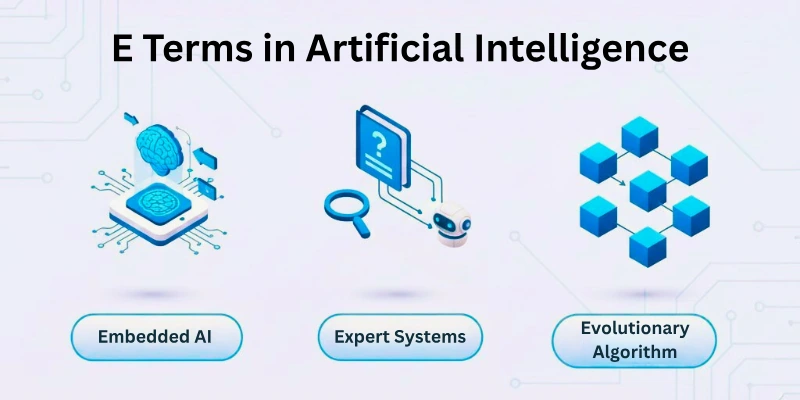
- Expert System: An expert system is a rule-based AI that uses knowledge from human experts to solve specific problems, like medical diagnosis or troubleshooting.
- Evolutionary Algorithm: Evolutionary algorithms mimic natural evolution to find solutions. They use mutation, selection, and crossover to improve AI models over generations.
- Exploratory Data Analysis (EDA): EDA is the process of analyzing data to discover patterns, detect anomalies, and summarize key insights before training AI models.
- Error Rate: Error rate measures how often an AI model makes incorrect predictions. Lower error rates indicate higher model accuracy.
- Entropy: In AI, entropy measures uncertainty in data or predictions. Models aim to reduce entropy to improve decision-making.
- Event-Driven AI: Event-driven AI reacts to specific events or triggers in real-time, like alerting a user when unusual activity is detected.
- Evolutionary Robotics: This field combines evolutionary algorithms and robotics to automatically design and improve robot behavior over generations.
- Explanatory Model: Explanatory models provide insights into how AI predictions are generated, helping humans understand AI logic.
- Exploratory Search: Exploratory search allows AI systems to suggest insights or patterns beyond direct user queries, useful in research and analytics.
- Exponential Smoothing: Exponential smoothing is a statistical technique used in AI for forecasting time series data by giving more weight to recent observations.
- Extended Reality (XR) AI: XR AI combines AI with AR (Augmented Reality) and VR (Virtual Reality) to create intelligent, immersive experiences.
- Edge Detection: Edge detection is a computer vision technique that identifies boundaries within images, helping AI recognize shapes and objects.
- Error Backpropagation: Error backpropagation is a key step in training neural networks, allowing the system to adjust weights based on errors in output.
- Ethical AI: Ethical AI ensures that artificial intelligence operates without causing harm, bias, or discrimination. It emphasizes fairness, accountability, and transparency.
- Euclidean Distance: Euclidean distance is a metric that measures the straight-line distance between two points. AI models use it in clustering and nearest-neighbor algorithms.
- Evolution Strategy: An evolution strategy is an optimization technique that adjusts AI parameters iteratively to find the best solution.
- Entity Recognition: Entity recognition is an NLP task where AI identifies and categorizes names, dates, locations, or other key information in text.
- Ensemble Model Voting: In ensemble models, voting combines the outputs of multiple AI models to make the final prediction more robust.
- Early Stopping: Early stopping is a technique in training AI models that stops learning when performance stops improving, preventing overfitting.
- Experience Replay: Experience replay stores past actions in reinforcement learning so the AI can learn from them multiple times, improving performance.
- Evolutionary Computation: Evolutionary computation refers to AI methods inspired by biological evolution, used to solve optimization and search problems.
- Explainability Metric: An explainability metric evaluates how well an AI system can justify its predictions to humans, a key part of XAI.
- Event Extraction: Event extraction identifies specific events from text or data streams. For example, detecting “earthquake” or “stock crash” in real-time news.
- Embedding Layer: An embedding layer in neural networks converts raw input into vectors, making it easier for models to process complex data like language.
- Error Function: The error function calculates the difference between predicted and actual values during model training. Minimizing this error is the goal of AI learning.
- Edge Detection Algorithm: This algorithm finds significant changes in pixel intensity in images, a foundation for AI vision tasks like object recognition.
- Event-Condition-Action (ECA): ECA is a rule used in AI systems where specific actions are triggered when certain conditions occur in response to events.
- Empirical Risk Minimization (ERM): ERM is a principle in machine learning where the model tries to minimize the average loss on training data to improve predictions.
- Evaluation Metric: Evaluation metrics are used to measure how well an AI model performs. Examples include accuracy, precision, recall, and F1 score.
- Embodied AI: Embodied AI refers to systems that interact with the physical world, like robots that can see, move, and manipulate objects intelligently.
F Terms in Artificial Intelligence
The letter F in AI covers concepts related to features, functions, and frameworks. These terms are essential for understanding how AI models learn from data, make predictions, and operate efficiently.
Here’s a complete list of F-related AI terms with detailed explanations.
- Feature: A feature is an individual measurable property or characteristic of data. For example, in a dataset of houses, features could include size, number of rooms, and location.
- Feature Engineering: Feature engineering is the process of selecting, modifying, or creating features to improve the performance of AI models.
- Feature Extraction: Feature extraction transforms raw data into informative and manageable features that AI models can use for learning.
- Feature Selection: Feature selection is the process of choosing the most relevant features while ignoring irrelevant ones to reduce complexity and improve model accuracy.
- F1 Score: The F1 score is a performance metric that balances precision and recall. It’s used in classification tasks to evaluate the model’s accuracy on imbalanced datasets.
- Forecasting: Forecasting uses AI models to predict future events based on historical data. Common examples include weather forecasts and sales predictions.
- Facial Recognition: Facial recognition is a computer vision task where AI identifies or verifies a person’s identity using their facial features.
- Fast R-CNN: Fast R-CNN is a deep learning model for object detection in images. It is faster and more accurate than earlier R-CNN versions.
- Fuzzy Logic: Fuzzy logic allows AI to reason in situations that are uncertain or approximate rather than strictly true or false. It’s used in control systems and decision-making.
- Few-Shot Learning: Few-shot learning enables AI models to learn from only a small number of examples, making it useful when data is limited.
- Federated Learning: Federated learning allows AI models to train across multiple devices without sharing raw data. This protects privacy while leveraging distributed learning.
- Factorization Machine: A factorization machine models interactions between variables, often used in recommendation systems to predict user preferences.
- False Positive: A false positive occurs when an AI model incorrectly predicts a positive outcome, like flagging a normal email as spam.
- False Negative: A false negative occurs when a model misses a positive case, such as failing to detect a disease in medical diagnosis.
- Feature Map: In convolutional neural networks (CNNs), a feature map is the output produced by applying filters to input data, highlighting important patterns.
- Fine-Tuning: Fine-tuning involves taking a pre-trained AI model and adjusting it for a specific task, saving time and resources.
- Feedforward Neural Network: A feedforward neural network is a type of neural network where data moves in one direction, from input to output, without loops.
- Factor Analysis: Factor analysis is a statistical method used to identify underlying relationships between variables, aiding AI in reducing dimensionality.
- Feature Scaling: Feature scaling adjusts the range of features so they contribute equally to model learning, improving stability and convergence.
- Functional Programming in AI: Functional programming emphasizes using functions and immutability, which helps AI developers write cleaner and more reliable code.
- Feature Importance: Feature importance shows which features have the most influence on the predictions made by an AI model.
- Forecast Error: Forecast error measures the difference between predicted and actual values in forecasting, helping improve model accuracy.
- Feedforward Propagation: Feedforward propagation is the process in neural networks where input passes through layers to produce an output before backpropagation adjusts weights.
- FastText: FastText is an NLP tool developed by Facebook that converts words into vector representations, improving AI’s understanding of text.
- Fuzzy Clustering: Fuzzy clustering allows data points to belong to multiple clusters with varying degrees of membership, unlike traditional clustering where each point belongs to one cluster.
- Factor Graph: A factor graph represents relationships between variables in a probabilistic model, helping AI solve complex inference problems.
- Feature Vector: A feature vector is an array of numerical values representing features of an object or data point, used as input for AI models.
- Fault Tolerance: Fault tolerance allows AI systems to continue operating even if part of the system fails, ensuring reliability in real-world applications.
- Frame Problem: The frame problem in AI refers to the difficulty of deciding what information is relevant when making decisions in dynamic environments.
- Fast Fourier Transform (FFT): FFT is a mathematical method used in AI to analyze frequency components of signals, such as in audio processing.
- Factorization: Factorization decomposes matrices or data structures to identify patterns, commonly used in recommendation systems and NLP.
- Feature Space: Feature space is the multi-dimensional space where each dimension corresponds to a feature, helping visualize and analyze AI data.
- Fuzzy Rule-Based System: A fuzzy rule-based system uses fuzzy logic to make decisions based on approximate reasoning instead of precise rules.
- Forward Chaining: Forward chaining starts with known facts and applies rules to infer new knowledge, often used in expert systems.
- Filter Layer: In convolutional neural networks, a filter layer applies filters to input data to detect features like edges, textures, or shapes.
G Terms in Artificial Intelligence
The letter G in AI focuses on generative models, graph-based structures, and generalization. These terms are essential for understanding how AI creates, connects, and predicts complex data patterns.
Here’s a complete list of G-related AI terms with clear and detailed explanations.
- Generative Adversarial Network (GAN): A GAN is a deep learning model with two parts — a generator that creates data and a discriminator that evaluates it. They compete, making the AI capable of generating realistic images, videos, or text.
- Gradient Descent: Gradient descent is an optimization algorithm used to minimize the error in AI models by adjusting weights step by step during training.
- Gradient Boosting: Gradient boosting combines weak predictive models, typically decision trees, to create a strong predictive model. It’s widely used for structured data tasks.
- Graph Neural Network (GNN): GNNs are neural networks designed to work on graph data, like social networks or molecular structures, to understand relationships between nodes.
- Gaussian Process: A Gaussian process is a statistical model used for predicting outcomes with uncertainty estimates. It’s popular in regression and optimization tasks.
- Generative Model: A generative model creates new data points similar to a given dataset. Examples include generating synthetic images, text, or music.
- Gradient Clipping: Gradient clipping prevents the gradients from becoming too large during neural network training, helping stabilize learning.
- Genetic Algorithm: A genetic algorithm is an optimization method inspired by natural selection. It evolves solutions over generations to improve AI performance.
- Ground Truth: Ground truth refers to the actual, correct labels in data used to train or evaluate AI models. It serves as a reference for measuring accuracy.
- Graph Embedding: Graph embedding converts graph nodes and edges into numerical vectors so AI models can process relational data efficiently.
- Greedy Algorithm: A greedy algorithm makes the best choice at each step, hoping to find the overall optimal solution. It’s used in AI for pathfinding and optimization.
- Gaussian Mixture Model (GMM): GMM is a probabilistic model that assumes data points come from multiple Gaussian distributions. It’s used for clustering and density estimation.
- Gradient Checking: Gradient checking is a method to verify that gradients computed during backpropagation are correct, ensuring neural network training is accurate.
- Goal-Oriented AI: Goal-oriented AI is designed to achieve specific objectives by making decisions and planning actions to reach a desired outcome.
- Graph Theory: Graph theory studies relationships between objects represented as nodes and edges. AI uses it to model social networks, knowledge graphs, and transport systems.
- Generative Pre-trained Transformer (GPT): GPT is a type of AI language model trained to generate human-like text. It predicts the next word in a sentence based on context.
- Gaussian Noise: Gaussian noise is a type of random noise with a normal distribution. AI uses it to simulate uncertainty or for data augmentation.
- Geometric Deep Learning: Geometric deep learning extends deep learning methods to non-Euclidean data like graphs and manifolds, enabling complex relational data analysis.
- Greedy Layer-Wise Training: This technique trains deep neural networks one layer at a time, making it easier to optimize very deep architectures.
- Gradient Checking Point: A gradient checking point is a reference used during network training to ensure calculated gradients match expected results.
- Generative Model Evaluation: This evaluates how well generative models produce realistic and diverse outputs, often using metrics like FID (Fréchet Inception Distance).
- Gaussian Distribution: Gaussian distribution, or normal distribution, describes data that clusters around a mean. AI assumes Gaussian distributions in many statistical models.
- Guided Policy Search: Guided policy search is a reinforcement learning method that uses supervised learning to guide policies for faster and more reliable learning.
- Graph Convolution: Graph convolution is a technique in GNNs that applies filters to nodes and their neighbors, extracting useful information from graphs.
- Gradient Explosion: Gradient explosion occurs when gradients in a neural network become excessively large, leading to unstable training. Techniques like clipping are used to fix it.
- Greedy Best-First Search: A search algorithm that selects the most promising node at each step to quickly reach the goal. Common in pathfinding problems.
- Gaussian Blur (in AI Vision): Gaussian blur smooths images by reducing noise. AI uses it in preprocessing to enhance image recognition and feature extraction.
- Goal Recognition: Goal recognition enables AI systems to predict the intentions or objectives of agents by analyzing their actions.
- Graph Matching: Graph matching aligns nodes and edges of two graphs to identify similarities, commonly used in bioinformatics and pattern recognition.
- Gradient Penalty: Gradient penalty is a regularization technique in training GANs to stabilize learning by controlling the gradient magnitude.
H Terms in Artificial Intelligence
The letter H in AI focuses on heuristics, human-computer interaction, and hybrid models. These terms are important for understanding how AI makes smart decisions, interacts with people, and combines multiple techniques.
Here’s a detailed list of H-related AI terms with clear explanations.
- Heuristic: A heuristic is a problem-solving method that uses practical rules or shortcuts to find good solutions quickly, even if they are not perfect.
- Hyperparameter: Hyperparameters are settings used to control how an AI model learns, like learning rate, batch size, or number of layers. They are chosen before training begins.
- Hypothesis: A hypothesis is an assumption or statement that an AI model tries to test or validate using data.
- Human-in-the-Loop (HITL): Human-in-the-loop refers to AI systems that involve humans in decision-making to improve accuracy, safety, or fairness.
- Hyperplane: A hyperplane is a boundary that separates data points into different classes in algorithms like support vector machines (SVM).
- Hybrid Model: A hybrid model combines multiple AI techniques, such as combining machine learning and rule-based systems, to improve performance.
- Hidden Layer: A hidden layer in a neural network is a layer of neurons between input and output that processes information and extracts features.
- Hebbian Learning: Hebbian learning is a neural learning principle that strengthens connections between neurons that fire together, inspired by the brain.
- Hardware Acceleration: Hardware acceleration uses specialized devices like GPUs or TPUs to speed up AI computations, especially for deep learning models.
- Histogram of Oriented Gradients (HOG): HOG is a feature descriptor used in computer vision for object detection by analyzing the direction of edges in images.
- Hyperparameter Tuning: Hyperparameter tuning adjusts hyperparameters systematically to find the combination that gives the best model performance.
- Hierarchical Clustering: Hierarchical clustering groups data into nested clusters based on similarity, forming a tree-like structure called a dendrogram.
- Hashing Trick: The hashing trick converts large datasets into a smaller, fixed-size representation for efficient processing, commonly used in NLP.
- Hopfield Network: A Hopfield network is a type of recurrent neural network that stores patterns and retrieves them from partial or noisy input.
- Heterogeneous Data: Heterogeneous data refers to data from different sources or types, such as text, images, and audio, used together in AI models.
- High-Dimensional Space: High-dimensional space refers to datasets with many features, which can make AI training more complex and computationally intensive.
- Heuristic Search: Heuristic search uses heuristics to efficiently explore possible solutions, often in AI planning or game-playing algorithms.
- Hypertext Processing: Hypertext processing is used in AI to analyze and understand linked text data, such as web pages and documents.
- Hamming Distance: Hamming distance measures the difference between two binary strings. AI uses it in error detection and pattern recognition.
- Hierarchical Reinforcement Learning: Hierarchical reinforcement learning breaks complex tasks into simpler subtasks, making it easier for AI to learn and plan.
- Hyperparameter Optimization: Hyperparameter optimization automates finding the best hyperparameters to maximize model performance using techniques like grid search or Bayesian optimization.
- Human-Centered AI: Human-centered AI focuses on designing AI systems that align with human values, needs, and ethics.
- Hidden Markov Model (HMM): An HMM is a statistical model that represents systems with hidden states. It’s widely used in speech recognition and sequence prediction.
- Hierarchical Feature Learning: This method lets AI learn features in layers, from simple to complex, improving recognition tasks in images, text, or audio.
- Homomorphic Encryption: Homomorphic encryption allows AI systems to perform calculations on encrypted data without decrypting it, ensuring data privacy.
- Human-Like Reasoning: Human-like reasoning refers to AI systems mimicking human problem-solving and decision-making processes.
- Hyperparameter Sensitivity: Hyperparameter sensitivity measures how changes in hyperparameters affect AI model performance, helping to choose robust settings.
- Histogram Equalization: Histogram equalization enhances image contrast, making features more visible for computer vision tasks.
- Hypergraph: A hypergraph is a generalization of a graph where edges can connect multiple nodes, used in complex relational AI tasks.
- Heuristic Evaluation: Heuristic evaluation assesses AI systems, interfaces, or algorithms against a set of best practices or rules for usability and performance.
I Terms in Artificial Intelligence
The letter I in AI focuses on intelligence, inference, and integration. These terms help explain how AI systems think, predict outcomes, and connect data from multiple sources.
Here’s a detailed list of I-related AI terms with clear explanations.
- Intelligent Agent: An intelligent agent is an AI system that perceives its environment, makes decisions, and takes actions to achieve specific goals.
- Image Recognition: Image recognition is the process where AI identifies objects, people, or features in images using computer vision techniques.
- Information Retrieval: Information retrieval involves AI searching and retrieving relevant data or documents from a large collection, like search engines.
- Inference Engine: An inference engine is the part of an AI system that applies logic rules to a knowledge base to deduce new information or make decisions.
- Incremental Learning: Incremental learning allows AI models to learn continuously from new data without retraining from scratch.
- Intelligent Tutoring System (ITS): An ITS is an AI system designed to provide personalized teaching or guidance to learners based on their performance and behavior.
- Instance-Based Learning: Instance-based learning stores examples and uses them to make predictions for new cases, such as in k-nearest neighbors (KNN).
- Interactive AI: Interactive AI engages with humans in real-time, like chatbots, virtual assistants, or gaming AI.
- Interpretability: Interpretability is the degree to which humans can understand how an AI model makes decisions or predictions.
- Imbalanced Dataset: An imbalanced dataset occurs when one class has significantly more examples than others, which can bias AI predictions.
- Inductive Learning: Inductive learning is a machine learning approach where AI generalizes rules from observed examples to make predictions on new data.
- Instance Segmentation: Instance segmentation is a computer vision task that detects and separates each object in an image individually, unlike simple object detection.
- Input Layer: The input layer is the first layer of a neural network where data enters the model for processing.
- Isolation Forest: Isolation forest is an AI algorithm for detecting anomalies or outliers in a dataset.
- Information Gain: Information gain measures how much a feature improves the decision-making process in models like decision trees.
- Image Classification: Image classification is the process of assigning a label to an entire image, such as identifying whether an image contains a cat or dog.
- Inverse Reinforcement Learning (IRL): IRL is a method where AI learns a reward function by observing expert behavior instead of being given explicit rewards.
- Intelligent Automation: Intelligent automation combines AI with robotic process automation (RPA) to perform complex tasks autonomously.
- Iterative Algorithm: An iterative algorithm solves problems through repeated steps, gradually improving the solution, commonly used in training AI models.
- Implicit Feedback: Implicit feedback refers to data collected indirectly from users’ actions, like clicks or browsing history, used in recommendation systems.
- Inference: Inference is the process of using a trained AI model to make predictions or decisions on new, unseen data.
- Image Generation: Image generation is the process where AI creates new images based on learned patterns, commonly done with generative models like GANs.
- Information Bottleneck: The information bottleneck principle compresses input information while retaining the most relevant features for prediction, improving AI efficiency.
- Instance Weighting: Instance weighting assigns different importance to data samples during training to address imbalance or emphasize critical cases.
- Interactive Learning: Interactive learning allows AI systems to learn through feedback from humans or the environment in real-time.
- Input Normalization: Input normalization scales and adjusts data so that features contribute equally to AI model training, improving stability.
- Interpretive Model: An interpretive model is designed to make its reasoning clear and understandable to humans.
- Inductive Bias: Inductive bias is the set of assumptions an AI model uses to generalize from limited data to unseen situations.
- Information Fusion: Information fusion combines data from multiple sources to produce more accurate and comprehensive insights for AI models.
- Instance-Based Reasoning: Instance-based reasoning solves new problems by comparing them to previously encountered examples, often used in case-based reasoning.
J Terms in Artificial Intelligence
The letter J in AI focuses on judgment, jobs, and joint models. These terms are important for understanding how AI makes decisions, collaborates across systems, and automates tasks.
Here’s a detailed list of J-related AI terms with clear explanations.
- Joint Probability: Joint probability measures the likelihood of two or more events happening together. In AI, it’s used in probabilistic models to understand relationships between variables.
- Jaccard Similarity: Jaccard similarity is a metric used to compare the similarity between two sets of data. It’s often applied in clustering, recommendation, and document comparison.
- JSON (JavaScript Object Notation) in AI: JSON is a lightweight data format used to store and exchange AI data such as model configurations, predictions, or datasets.
- Job Automation: Job automation refers to AI systems performing repetitive or structured tasks, such as data entry, customer service chatbots, or industrial robots.
- Judgment-Based AI: Judgment-based AI involves decision-making systems that use rules, heuristics, or learned patterns to make choices similar to human judgment.
- Joint Embedding: Joint embedding maps different types of data (like images and text) into a shared space, enabling AI to compare and connect them effectively.
- Jitter (in Neural Networks): Jitter refers to small variations or noise in input data, often introduced deliberately to improve neural network robustness through data augmentation.
- Job Scheduling AI: Job scheduling AI optimizes the allocation of tasks across resources, such as in cloud computing or manufacturing, for efficiency and productivity.
- Jumping Knowledge Network: A jumping knowledge network is a type of graph neural network that allows combining information from multiple layers for better learning.
- Java AI Libraries: Java AI libraries, like Deeplearning4j and Weka, provide tools for developing AI models, machine learning, and data analysis in Java programming.
- Joint Distribution: Joint distribution describes the probability distribution of multiple variables together, essential in statistical modeling and probabilistic AI.
- Jupyter Notebook in AI: Jupyter Notebook is a popular tool for AI development that allows coding, documentation, and visualization in an interactive environment.
- Just-In-Time Learning: Just-in-time learning trains AI models dynamically as data arrives, enabling systems to adapt quickly to changing conditions.
- Jumpstart AI Models: Jumpstart AI models refer to pre-built AI models or templates that help developers quickly start building solutions without training from scratch.
- Job Recommendation Systems: Job recommendation systems use AI to suggest suitable employment opportunities to candidates based on skills, experience, and preferences.
- Joint Action Learning: Joint action learning is a reinforcement learning approach where multiple agents learn to act together to achieve shared goals.
- JavaScript in AI: JavaScript is used for deploying AI models on web platforms, enabling real-time interaction and AI-powered applications in browsers.
- Joint Optimization: Joint optimization optimizes multiple objectives simultaneously, such as accuracy and efficiency, in AI model training or system design.
- Judgment Tree: A judgment tree is a variant of a decision tree that emphasizes reasoning and prioritization, often used in decision-support AI systems.
- Jittering in Data Augmentation: Jittering introduces small variations like shifting, rotating, or scaling in data to improve the robustness of AI models, especially in vision tasks.
- Job Matching AI: Job matching AI analyzes resumes and job descriptions to pair candidates with the best opportunities, streamlining recruitment.
- Java AI APIs: Java AI APIs provide developers access to AI functionalities like natural language processing, image recognition, and predictive analytics.
- Joint Learning: Joint learning refers to training multiple AI models together to improve overall system performance and knowledge sharing.
- Jitter Buffer AI: Jitter buffer AI is used in streaming or communication systems to manage variations in data packet arrival, ensuring smooth delivery of audio or video.
- Job Prioritization AI: Job prioritization AI determines which tasks should be executed first based on importance, deadlines, or resources, often in enterprise systems.
- Jigsaw Puzzle Solving AI: This refers to AI systems that reconstruct fragmented data or images, solving puzzles by analyzing patterns and relationships.
- Java Machine Learning: Java machine learning involves building AI and ML applications using Java libraries for data analysis, modeling, and prediction.
- Joint Feature Representation: Joint feature representation combines features from multiple sources into a unified format for AI model learning and prediction.
- Jumping Nodes (Graph AI): Jumping nodes are techniques in graph neural networks to allow flexible connections across layers, improving learning on complex graphs.
- Job Allocation AI: Job allocation AI automates assigning tasks to workers or machines based on skill, availability, and efficiency metrics.
K Terms in Artificial Intelligence
The letter K in AI focuses on knowledge, kernel methods, and key learning concepts. These terms are essential for understanding how AI systems store, process, and utilize information effectively.
Here’s a detailed list of K-related AI terms with clear explanations.
- Knowledge Base: A knowledge base is a structured repository of information that AI systems use to make decisions or answer questions, often in expert systems.
- K-Means Clustering: K-Means is an unsupervised learning algorithm that divides data into K clusters based on similarity, commonly used for grouping and pattern recognition.
- Kernel Trick: The kernel trick is a method used in support vector machines (SVMs) to transform data into higher dimensions, making it easier to separate classes.
- Knowledge Graph: A knowledge graph is a network of entities and their relationships, enabling AI to understand and reason about complex information.
- K-Nearest Neighbors (KNN): KNN is an algorithm that classifies data points based on the majority class of their nearest neighbors in the feature space.
- Knowledge Representation: Knowledge representation is the way AI systems store information about the world so they can reason, learn, and make decisions.
- Kernel Density Estimation (KDE): KDE is a non-parametric method to estimate the probability density function of a dataset, useful in AI for modeling distributions.
- Knowledge-Based System: A knowledge-based system is an AI system that relies on a knowledge base and inference rules to solve complex problems.
- Key Performance Indicator (KPI) in AI: KPIs are metrics used to measure the effectiveness of AI systems, such as accuracy, precision, recall, or F1 score.
- Knowledge Discovery in Databases (KDD): KDD is the process of extracting useful patterns and knowledge from large datasets using AI and data mining techniques.
- K-Fold Cross Validation: K-Fold cross-validation is a method to evaluate AI models by splitting data into K parts and testing the model K times, ensuring robust performance metrics.
- Knowledge Distillation: Knowledge distillation is a technique where a smaller AI model learns from a larger, pre-trained model to improve efficiency without losing accuracy.
- Kernel Function: A kernel function measures similarity between data points in transformed spaces, widely used in SVMs and other kernel-based methods.
- Knowledge Transfer: Knowledge transfer allows AI models to use knowledge gained from one task to improve performance on another related task.
- Kappa Statistic: Kappa statistic measures the agreement between predicted and actual classifications, accounting for chance agreement in AI evaluations.
- Knowledge-Infused Learning: Knowledge-infused learning integrates human knowledge into AI models to improve accuracy, interpretability, and reasoning capabilities.
- Kalman Filter: Kalman filter is an algorithm used in AI for predicting and updating the state of dynamic systems based on noisy measurements.
- Keyword Extraction: Keyword extraction is an NLP task where AI identifies the most important words or phrases from text, useful in search and summarization.
- Kernel PCA (Principal Component Analysis): Kernel PCA is a dimensionality reduction technique that uses kernel methods to capture non-linear patterns in data.
- Knowledge Reasoning: Knowledge reasoning involves applying logic and rules to the knowledge stored in AI systems to infer new insights or make decisions.
- K-Means++ Initialization: K-Means++ is an improved method for initializing cluster centers in K-Means, resulting in faster convergence and better clustering.
- Knowledge Base Completion: Knowledge base completion uses AI to fill in missing information in knowledge graphs or databases, improving system understanding.
- Knowledge-Driven AI: Knowledge-driven AI relies on structured knowledge and rules rather than just learning from raw data, often used in expert systems.
- Kernel Ridge Regression: Kernel ridge regression combines ridge regression with kernel methods for solving non-linear regression problems in AI.
- Keypoint Detection: Keypoint detection is used in computer vision to identify important points in images, such as corners, edges, or human joints.
- K-Means Clustering Evaluation: Evaluation of K-Means clustering uses metrics like silhouette score or inertia to determine the quality of the clustering results.
- Knowledge Embedding: Knowledge embedding transforms entities and relationships from knowledge graphs into numerical vectors, enabling AI to process relational data.
- Kernel Methods: Kernel methods are algorithms that rely on kernel functions to process non-linear data efficiently, including SVMs, PCA, and regression.
- Knowledge Extraction: Knowledge extraction involves identifying useful patterns, relationships, or insights from raw data to feed AI decision-making systems.
- K-L Divergence: Kullback-Leibler (K-L) divergence measures how one probability distribution differs from another, often used in AI for comparing predicted vs. true distributions.
L Terms in Artificial Intelligence
The letter L in AI focuses on learning, layers, and logic. These terms are essential for understanding how AI models learn from data, structure their computations, and make intelligent decisions.
Here’s a detailed list of L-related AI terms with clear explanations.
- Learning Rate: Learning rate is a hyperparameter that determines how much the AI model’s weights are updated during training. Choosing the right rate is crucial for effective learning.
- LSTM (Long Short-Term Memory): LSTM is a type of recurrent neural network that remembers long-term dependencies in sequence data, commonly used in NLP and time-series prediction.
- Loss Function: A loss function measures the difference between predicted and actual values. AI models aim to minimize this value during training.
- Label: A label is the output or target value in supervised learning, representing the correct answer for each input in a dataset.
- Logistic Regression: Logistic regression is a statistical model used for binary classification, predicting the probability that an input belongs to a specific class.
- Latent Variable: A latent variable is an unobserved variable inferred from observed data, used in probabilistic models like factor analysis and variational autoencoders.
- Labeled Dataset: A labeled dataset contains input data with corresponding labels, used for training supervised AI models.
- Linear Regression: Linear regression predicts a continuous value based on the relationship between input features and the target variable.
- Layer Normalization: Layer normalization is a technique that normalizes the inputs across a layer in a neural network, improving training stability and convergence.
- Language Model: A language model predicts the probability of sequences of words, enabling applications like text generation, translation, and speech recognition.
- Learning Algorithm: A learning algorithm is a procedure that enables AI models to learn patterns from data and make predictions or decisions.
- Logistic Loss: Logistic loss, also known as log loss, is used in classification tasks to measure the difference between predicted probabilities and actual labels.
- Lagrange Multiplier: Lagrange multipliers are used in optimization problems, including support vector machines, to find maximum or minimum values under constraints.
- Linear Discriminant Analysis (LDA): LDA is a method for dimensionality reduction and classification, projecting data onto a lower-dimensional space while maximizing class separability.
- Learning Rate Scheduler: A learning rate scheduler adjusts the learning rate during training to improve convergence and prevent overshooting.
- Label Smoothing: Label smoothing reduces overconfidence in AI models by slightly adjusting labels, improving generalization and robustness.
- Local Minima: Local minima are points in the loss function where the value is lower than nearby points but not the absolute lowest. AI models aim to avoid getting stuck here.
- Laplace Smoothing: Laplace smoothing is used in probabilistic models to handle zero probabilities by adding a small constant to counts.
- Latent Space: Latent space is the compressed representation of data in models like autoencoders, capturing essential features for reconstruction or generation.
- Learning Curve: A learning curve plots model performance against training progress or data size, helping assess if more data or tuning is needed.
- Local Outlier Factor (LOF): LOF is an algorithm that detects anomalies by comparing the density of a data point to its neighbors.
- Lexical Analysis: Lexical analysis is the process of breaking text into tokens, such as words or symbols, for natural language processing.
- Layered Architecture: Layered architecture in AI organizes neural networks into multiple layers, each performing specific transformations on the data.
- Learning Vector Quantization (LVQ): LVQ is a prototype-based supervised learning algorithm used for classification, representing classes with representative vectors.
- Linear Kernel: A linear kernel is a kernel function used in SVMs for linearly separable data, simplifying computation while maintaining accuracy.
- Label Propagation: Label propagation is a semi-supervised learning technique where known labels spread through a graph to infer unknown labels.
- Lattice Model: A lattice model represents discrete data points in structured layers, often used in probabilistic graphical models and speech recognition.
- Logistic Activation: Logistic activation is a sigmoid function used in neural networks to convert inputs into a probability between 0 and 1.
- Long-Term Dependency: Long-term dependency refers to relationships in sequential data that span long intervals, handled effectively by LSTM and attention mechanisms.
- Laplacian Eigenmaps: Laplacian eigenmaps are a dimensionality reduction technique preserving local neighborhood structure, useful in manifold learning.
M Terms in Artificial Intelligence
The letter M in AI focuses on models, machine learning methods, and metrics. These terms are essential for understanding how AI systems predict, measure, and improve performance.
Here’s a detailed list of M-related AI terms with clear explanations.
- Machine Learning (ML): Machine learning is a branch of AI where models learn patterns from data to make predictions or decisions without being explicitly programmed.
- Model Training: Model training is the process of teaching an AI model using data so it can make accurate predictions on new, unseen data.
- Model Evaluation: Model evaluation measures the performance of an AI model using metrics such as accuracy, precision, recall, and F1 score.
- Mean Squared Error (MSE): MSE is a common loss function that calculates the average squared difference between predicted and actual values.
- Multi-Layer Perceptron (MLP): MLP is a type of feedforward neural network with multiple layers, capable of learning complex patterns.
- Model Deployment: Model deployment is the process of putting a trained AI model into production so it can make real-world predictions.
- Model Overfitting: Overfitting occurs when a model learns the training data too well, including noise, resulting in poor generalization to new data.
- Model Underfitting: Underfitting occurs when a model is too simple to capture the underlying patterns, resulting in poor performance on both training and test data.
- Markov Decision Process (MDP): MDP is a mathematical framework used in reinforcement learning to model decision-making problems with states, actions, and rewards.
- Memory Networks: Memory networks are AI models that include a memory component to store information for reasoning over longer sequences or tasks.
- Multi-Task Learning: Multi-task learning is a training approach where one model learns to perform multiple related tasks simultaneously, improving efficiency and accuracy.
- Model Compression: Model compression reduces the size of AI models for faster computation and deployment, using techniques like pruning or quantization.
- Meta-Learning: Meta-learning, or “learning to learn,” is an approach where AI models improve their ability to learn new tasks quickly.
- Monte Carlo Methods: Monte Carlo methods are computational algorithms that use random sampling to approximate solutions for complex AI problems.
- Mean Absolute Error (MAE): MAE measures the average absolute difference between predicted and actual values, offering another way to evaluate model accuracy.
- Model Interpretability: Model interpretability refers to how easily humans can understand the reasoning behind a model’s predictions.
- Multi-Head Attention: Multi-head attention is a mechanism in transformer models that allows the model to focus on different parts of the input simultaneously.
- Masked Language Model (MLM): MLM is a language model trained to predict missing words in a sentence, commonly used in NLP tasks like BERT.
- Memory Augmented Neural Networks: These neural networks enhance standard models with external memory, enabling better reasoning and complex task performance.
- Model Selection: Model selection is the process of choosing the best AI model from several candidates based on evaluation metrics and task requirements.
- Margin in SVM: Margin in support vector machines is the distance between the separating hyperplane and the nearest data points. Larger margins generally improve generalization.
- Maximum Likelihood Estimation (MLE): MLE is a statistical method to estimate model parameters that maximize the likelihood of observing the given data.
- Modular Neural Networks: Modular neural networks are composed of separate modules or sub-networks that specialize in different tasks, improving efficiency and interpretability.
- Multimodal AI: Multimodal AI combines different types of data, like text, images, and audio, for more comprehensive understanding and prediction.
- Minibatch Gradient Descent: Minibatch gradient descent divides the training data into small batches, updating model weights more efficiently and with less memory use.
- Model Regularization: Regularization techniques, such as L1 or L2, prevent overfitting by adding penalties to the model’s complexity.
- Memory Replay: Memory replay stores previous experiences in reinforcement learning to improve stability and learning efficiency.
- Multi-Agent Systems: Multi-agent systems involve multiple AI agents interacting and cooperating to solve complex tasks or simulate environments.
- Matrix Factorization: Matrix factorization decomposes a large matrix into smaller factors, commonly used in recommendation systems to predict user preferences.
- Model Drift: Model drift occurs when the performance of an AI model degrades over time due to changes in data distribution, requiring retraining or adaptation.
N Terms in Artificial Intelligence
The letter N in AI focuses on networks, natural language, and nodes. These terms are essential for understanding how AI models process data, learn relationships, and interact with language and systems.
Here’s a detailed list of N-related AI terms with clear explanations.
- Neural Network: A neural network is a set of interconnected nodes or neurons that process data and learn patterns, inspired by the human brain.
- Natural Language Processing (NLP): NLP is a field of AI that allows machines to understand, interpret, and generate human language in text or speech.
- Node: A node is a single processing unit in a neural network or graph structure that performs computations or stores data.
- Normalization: Normalization is the process of scaling data to a standard range, improving AI model training stability and performance.
- Named Entity Recognition (NER): NER is an NLP technique that identifies and classifies proper nouns, such as names, locations, and organizations, in text.
- Naive Bayes: Naive Bayes is a probabilistic classifier based on Bayes’ theorem, assuming features are independent, often used in text classification.
- Noise Reduction: Noise reduction removes irrelevant or random data from inputs, improving the accuracy and robustness of AI models.
- Neural Machine Translation (NMT): NMT is a type of AI model that translates text from one language to another using deep learning techniques.
- Network Architecture: Network architecture refers to the structure of a neural network, including the number of layers, types of neurons, and connections.
- Nonlinear Activation Function: Nonlinear activation functions, like ReLU or sigmoid, allow neural networks to learn complex patterns beyond linear relationships.
- N-gram: An N-gram is a sequence of N words or characters used in NLP for modeling and predicting text sequences.
- Noise Injection: Noise injection is a regularization technique where random noise is added to inputs or weights during training to improve generalization.
- Node Embedding: Node embedding converts nodes in a graph into numerical vectors so that AI models can process relational data efficiently.
- Neural Architecture Search (NAS): NAS automates the design of neural network architectures to find the most effective structure for a given task.
- Normal Equation: The normal equation is a method in linear regression to calculate model parameters directly without iterative optimization.
- Nesterov Accelerated Gradient (NAG): NAG is an optimization technique that improves gradient descent by considering the future position of parameters for faster convergence.
- Natural Language Generation (NLG): NLG enables AI to automatically generate human-like text from structured data or context.
- Non-Parametric Model: Non-parametric models do not assume a fixed form for the data distribution, allowing more flexibility in learning from data.
- Neural Style Transfer: Neural style transfer is an AI technique that applies the artistic style of one image to the content of another image.
- Node Classification: Node classification assigns labels to nodes in a graph based on features and connections, widely used in social network analysis.
- Normalization Layer: Normalization layers in neural networks, such as batch normalization, standardize inputs to stabilize and speed up training.
- Noise Contrastive Estimation (NCE): NCE is a method for training models by distinguishing data from noise, often used in NLP and embedding learning.
- Neural Collaborative Filtering: Neural collaborative filtering is a recommendation technique using neural networks to predict user-item interactions.
- Network Pruning: Network pruning reduces the size of a neural network by removing less important connections, making it faster and more efficient.
- Nondeterministic AI: Nondeterministic AI produces different outputs for the same input due to randomness in algorithms or training.
- Nested Cross-Validation: Nested cross-validation is a method to evaluate AI models while tuning hyperparameters, reducing bias in performance estimation.
- Neural Turing Machine (NTM): NTM combines neural networks with external memory, enabling AI to perform algorithmic tasks like reading and writing sequences.
- Noise Robustness: Noise robustness measures how well an AI system performs under noisy or corrupted input data.
- Negative Sampling: Negative sampling is used in NLP and embedding models to train on a subset of negative examples for efficient learning.
- Network Flow AI: Network flow AI analyzes and optimizes the movement of data, resources, or traffic through a network efficiently.
O Terms in Artificial Intelligence
The letter O in AI focuses on optimization, objectives, and output analysis. These terms are essential for understanding how AI models improve performance, make decisions, and evaluate results.
Here’s a detailed list of O-related AI terms with clear explanations.
- Optimization Algorithm: Adjusts model parameters to minimize or maximize an objective, like a loss function in AI.
- Overfitting: Happens when an AI model learns training data too deeply, including noise, and performs poorly on new data.
- Online Learning: Enables AI models to learn continuously from incoming data, adapting to new information over time.
- Objective Function: Defines what an AI model aims to achieve, such as minimizing prediction errors or maximizing accuracy.
- One-Hot Encoding: Converts categorical data into binary numeric form, where each category is represented as a separate vector.
- Outlier Detection: Finds unusual or rare data points that differ greatly from the main dataset pattern.
- OpenAI: A leading AI research company that created models like GPT, focusing on safe and beneficial AI development.
- Ordinal Regression: Predicts outcomes that follow a natural order, such as customer satisfaction levels or rating scales.
- Optimization Problem: Involves finding the best possible solution from many alternatives based on a defined goal.
- Overparameterization: Occurs when a model has more parameters than needed, improving flexibility but risking overfitting.
- Out-of-Sample Testing: Evaluates model performance using unseen data to ensure real-world accuracy.
- Ontology in AI: A structured way of representing knowledge by defining concepts, relationships, and logical rules.
- Ordinary Least Squares (OLS): A regression method that minimizes the squared difference between predicted and actual results.
- Online Reinforcement Learning: Allows AI agents to learn and improve in real-time from continuous environmental feedback.
- Orthogonalization: Makes features independent of one another, improving clarity and model performance.
- Object Detection: Identifies and locates objects in an image or video, widely used in computer vision.
- Overlapping Clusters: Occur when data points can belong to multiple groups, often handled with fuzzy clustering methods.
- Out-of-Distribution (OOD) Detection: Identifies inputs that differ from training data to prevent inaccurate AI predictions.
- Optimization Constraints: Rules or boundaries that limit possible solutions in an optimization process.
- Objective Evaluation Metrics: Quantitative measures like accuracy, recall, and precision used to assess model success.
- Online Gradient Descent: A version of gradient descent that updates model parameters continuously as data streams in.
- Overlap Measure: Calculates how much two datasets or groups share similarities, often used in clustering.
- Operator in AI: Performs specific actions in algorithms, like mathematical or logical transformations.
- Out-of-Core Learning: Lets AI models train on massive datasets by processing them in smaller memory-friendly batches.
- Optimization Landscape: Represents how an objective function changes as model parameters adjust during training.
- One-Shot Learning: Allows AI systems to learn from just one or very few examples instead of large datasets.
- Ordinal Encoding: Converts ordered categorical data into numbers while keeping their natural ranking.
- Online Feature Selection: Dynamically picks the most useful features as new data is received.
- Output Layer: The final layer of a neural network that generates predictions, such as class labels or scores.
- Optimization Heuristic: A simplified rule or strategy used to find near-optimal solutions efficiently in complex problems.
P Terms in Artificial Intelligence
The letter P in AI focuses on prediction, processing, and probabilistic models. These terms are essential for understanding how AI systems analyze data, make forecasts, and handle uncertainty.
- Predictive Modeling: Uses AI to forecast future outcomes based on patterns found in past data.
- Precision: Measures how many of the AI model’s positive predictions are actually correct.
- Pattern Recognition: Enables AI to identify regularities, shapes, or trends in data.
- Perceptron: One of the earliest neural network models used for simple binary classification.
- Probabilistic Model: Represents data and predictions in terms of probabilities to handle uncertainty.
- Pooling Layer: Reduces the size of feature maps in neural networks to improve efficiency and generalization.
- Preprocessing: Prepares raw data for modeling through cleaning, scaling, and feature extraction.
- Policy (in Reinforcement Learning): Defines the actions an AI agent should take in different states to gain the best rewards.
- Principal Component Analysis (PCA): Reduces data dimensions while keeping most of its meaningful variance.
- Predictive Maintenance: Uses AI to predict equipment failures before they occur, preventing downtime.
- Parametric Model: Assumes a specific mathematical form for data and learns fixed parameters from it.
- Pooling Operation: Summarizes data in convolutional networks through max or average pooling.
- Pretrained Model: A model trained on large datasets and later fine-tuned for new, related tasks.
- Probability Density Function (PDF): Describes the likelihood of different continuous outcomes in a dataset.
- Pattern Mining: Discovers frequent or interesting patterns in data, such as trends in customer behavior.
- Positional Encoding: Helps transformer models understand the order of words or tokens in sequences.
- Policy Gradient: Improves reinforcement learning agents by directly optimizing their decision-making policies.
- Pooling Layer Variants: Includes global, max, and average pooling — each summarizing feature maps differently.
- Parameter Tuning: Adjusts model parameters to achieve the best performance.
- Prediction Interval: Shows a range of possible future outcomes around a predicted value.
- Probabilistic Graphical Model: Represents variable dependencies using graphs like Bayesian or Markov networks.
- Pretraining: Trains AI models on general data first, then fine-tunes them for specific purposes.
- Pooling Window: The small area of data considered when summarizing features in a pooling operation.
- Principal Component: The transformed variables from PCA that capture the maximum variance in data.
- Performance Metrics: Standard measures like accuracy, recall, and F1 score used to evaluate models.
- Proximal Policy Optimization (PPO): A reinforcement learning method that balances learning speed with stability.
- Pattern Matching: Detects or compares repeating sequences or structures in data.
- Predictive Analytics: Uses AI and statistical tools to anticipate future trends and user behaviors.
- Probabilistic Programming: Lets developers define models that can reason and make predictions under uncertainty.
- Preprocessing Pipeline: A series of steps to prepare data, including cleaning, normalization, and feature engineering.
Q Terms in Artificial Intelligence
The letter Q in AI focuses on query, quality, and Q-learning. These terms are important for understanding how AI searches data, evaluates information, and learns through reinforcement.
- Q-Learning: A reinforcement learning algorithm that learns the value of actions in states to maximize rewards.
- Query Processing: Allows AI systems to retrieve and manipulate data efficiently from databases or knowledge bases.
- Quantum AI: Combines quantum computing with AI algorithms to solve complex problems faster than classical computers.
- Quality Assurance in AI: Ensures AI models perform reliably, accurately, and ethically in real-world scenarios.
- Q-Function: Represents the expected cumulative reward of taking an action in a specific state in reinforcement learning.
- Quadratic Programming: Solves optimization problems with a quadratic objective function and linear constraints.
- Query Expansion: Improves information retrieval by adding related terms to the user query.
- Quantization (in Neural Networks): Reduces the precision of weights and activations, making AI models smaller and faster.
- Q-Table: Stores the expected rewards for state-action pairs in tabular reinforcement learning methods.
- Queue Management AI: Optimizes the order of tasks or processes in systems like call centers or manufacturing.
- Quick Propagation (QuickProp): Accelerates neural network training using second-order derivatives.
- Quantile Regression: Predicts conditional quantiles of a response variable, capturing uncertainty in predictions.
- Question Answering Systems (QA): Use AI to provide answers to natural language questions by understanding context and retrieving relevant information.
- Query Optimization: Improves efficiency in retrieving relevant data from large databases.
- Q-Learning Variants: Include Deep Q-Networks (DQN) and Double Q-Learning, improving learning stability and performance.
- Quality Metrics: Assess AI outputs for correctness, relevance, consistency, and fairness.
- Quantitative Analysis: Uses numerical methods and AI techniques to understand patterns and make predictions.
- Qubit Representation: Represents 0 and 1 simultaneously, serving as the basic unit of quantum computing used in quantum AI algorithms.
- Quasi-Newton Methods: Optimize AI models by approximating second-order derivatives to improve convergence.
- Query Understanding: Interprets user intent in search or conversational AI systems.
- Q-Learning Exploration: Ensures AI agents try new actions to discover better rewards through exploration strategies.
- Quality of Service (QoS) in AI: Measures AI system performance in terms of speed, accuracy, reliability, and user satisfaction.
- Quantized Neural Network: Uses quantized weights and activations for faster and memory-efficient deployment.
- Query Embedding: Converts user queries into vectors for semantic search and matching in AI systems.
- Quadratic Loss Function: Penalizes the difference between predicted and actual values in regression tasks using squared error.
- Q-Learning Policy: Maps states to actions to maximize expected rewards.
- Quantum-Inspired Algorithms: Use concepts from quantum computing to improve classical AI performance.
- Quick Evaluation Metrics: Provide fast performance assessments during AI model training or testing.
- Query Clustering: Groups similar user queries for search optimization or recommendation systems.
- Quality Control AI: Monitors and ensures product, service, or process quality automatically.
R Terms in Artificial Intelligence
The letter R in AI focuses on reinforcement, reasoning, and representation. These terms are essential for understanding how AI models learn from experience, make decisions, and represent knowledge.
- Reinforcement Learning (RL): A type of AI where agents learn by interacting with the environment and receiving rewards or penalties.
- Regression Analysis: Predicts a continuous outcome based on input features, commonly used in forecasting and modeling.
- Recurrent Neural Network (RNN): Neural networks designed to process sequential data by maintaining a memory of previous inputs.
- Reward Function: Defines the feedback given to an AI agent in reinforcement learning for performing actions.
- Random Forest: An ensemble learning method that combines multiple decision trees to improve prediction accuracy.
- Representation Learning: Enables AI to automatically discover useful features or representations from raw data.
- Regularization: Techniques like L1 and L2 prevent overfitting by penalizing complex models.
- Residual Network (ResNet): A deep neural network architecture with skip connections that allow effective training of very deep models.
- ReLU (Rectified Linear Unit): An activation function that outputs zero for negative inputs and the input value for positive ones.
- R-squared (R²): Measures the proportion of variance in the dependent variable explained by the model, used in regression evaluation.
- Rule-Based System: Uses predefined rules to make decisions or infer new information.
- Reinforcement Signal: Provides feedback to an AI agent in reinforcement learning, guiding it toward better decisions.
- Robustness: Measures an AI model’s ability to perform well under varying or noisy conditions.
- Reparameterization Trick: A technique used in variational autoencoders to allow backpropagation through stochastic nodes.
- Random Initialization: Assigns initial weights to neural network layers randomly, aiding in effective training.
- Recurrent Convolutional Network: Combines recurrent layers with convolutional layers for processing sequential image or video data.
- Rank Correlation: Evaluates how well the order of predicted values matches the actual order, useful in recommendation systems.
- Residual Block: A component of ResNet containing layers and a shortcut connection to prevent vanishing gradient problems.
- Reinforcement Policy: Defines how an AI agent chooses actions based on states in reinforcement learning.
- Recursive Neural Network: Applies the same set of weights recursively over structured data like trees or graphs.
- Rejection Sampling: A probabilistic technique to generate samples from complex distributions by rejecting some proposals.
- Random Walk: A stochastic process often used in graph-based AI algorithms like PageRank.
- RNN Encoder-Decoder: An architecture for sequence-to-sequence tasks such as translation, using an encoder to process input and a decoder to generate output.
- Reward Shaping: Modifies the reward function to make reinforcement learning training more efficient.
- Robust Optimization: Ensures AI models perform reliably under uncertainty and varying conditions.
- RBF (Radial Basis Function) Network: Neural networks that use radial basis functions as activation functions for function approximation.
- Relevance Feedback: Improves search results based on user feedback in information retrieval systems.
- Regression Tree: A decision tree that predicts continuous values rather than categories.
- Reinforcement Learning Environment: Provides the context and rules for AI agents to interact and learn.
- RNN Variants: Include LSTM and GRU architectures, designed to handle long-term dependencies in sequential data.
S Terms in Artificial Intelligence
The letter S in AI focuses on supervised learning, statistics, and system design. These terms are crucial for understanding how AI models are trained, evaluated, and deployed.
- Supervised Learning: Trains AI models using labeled data to predict outcomes accurately and efficiently.
- Support Vector Machine (SVM): A classification algorithm that finds the optimal hyperplane separating different classes in the data.
- Softmax Function: Converts a vector of values into probabilities, often used in classification layers of neural networks.
- Stochastic Gradient Descent (SGD): An optimization algorithm that updates model parameters using randomly sampled subsets of data.
- Semantic Analysis: Helps AI understand the meaning and context of words or sentences in natural language processing.
- Sequence-to-Sequence (Seq2Seq): Models that transform input sequences into output sequences, commonly used in translation and summarization.
- Self-Supervised Learning: Generates labels automatically from input data, allowing models to learn without manual labeling.
- Soft Clustering: Assigns data points to multiple clusters with different degrees of membership rather than a single cluster.
- Sentiment Analysis: Identifies the emotional tone of text, such as positive, negative, or neutral.
- Sparse Representation: Encodes data using only a few active features, reducing complexity and improving model efficiency.
- Stacking Ensemble: Combines multiple models to improve prediction accuracy by learning from their outputs.
- Sliding Window: A technique used in time-series and NLP tasks to process sequences incrementally.
- Signal Processing in AI: Transforms and analyzes signals such as audio or sensor data for intelligent interpretation.
- Swarm Intelligence: Uses collective behavior of agents, inspired by nature, to solve optimization problems efficiently.
- State Representation: Encodes environmental information for reinforcement learning agents to make better decisions.
- Sparse Neural Network: A network with many inactive weights, reducing computation while maintaining accuracy.
- Supervised Metric Learning: Learns distance metrics between data points based on labeled pairs to enhance classification or retrieval.
- Stochastic Process: Models random events over time, commonly used in AI for prediction and simulation tasks.
- Subspace Learning: Reduces data dimensionality by projecting it into a more compact and meaningful space.
- Semantic Segmentation: Labels every pixel in an image according to the object or region it belongs to.
- Softmax Cross-Entropy Loss: Combines softmax activation with cross-entropy loss for training classification models.
- Supervised Dimensionality Reduction: Reduces data dimensions while preserving class information for better learning performance.
- Sampling Methods: Select subsets of data for model training or testing, using random or stratified sampling approaches.
- Sequential Model: Processes input data in sequence, such as in RNNs or transformers, commonly used in NLP.
- State-Action Pair: In reinforcement learning, represents a specific decision an agent makes at a given state.
- Self-Attention Mechanism: Allows models to focus on relevant parts of input sequences when making predictions, a key part of transformers.
- Stochastic Regularization: Techniques like dropout deactivate neurons randomly during training to avoid overfitting.
- Semantic Web: Uses AI to interpret, link, and organize web content for smarter search and knowledge reasoning.
- Sparse Coding: Represents data as a combination of a few key basis functions for efficiency and interpretability.
- Simulated Annealing: An optimization technique inspired by the metal cooling process, used to find global optima in AI problems.
T Terms in Artificial Intelligence
The letter T in AI focuses on training, transformers, and technology-related terms. These terms are essential for understanding how AI models learn, process data, and handle advanced tasks.
- Training Data: The dataset used to teach AI models, containing input features and often labels.
- Transformer Model: Deep learning models using attention mechanisms to process sequences efficiently, widely applied in NLP tasks.
- Tokenization: Splits text into smaller units, like words or subwords, for processing by AI language models.
- Transfer Learning: Uses knowledge from a pretrained model to improve performance on a new, related task.
- Test Data: Evaluates AI model performance on unseen examples to measure generalization.
- Thresholding: Converts continuous model outputs into categorical predictions, such as classifying probabilities into classes.
- Turing Test: Assesses whether a machine’s behavior is indistinguishable from a human’s in intelligent tasks.
- Temporal Data: Includes time-related information, such as sequences or time series, used in forecasting and analysis.
- Top-k Sampling: In text generation, selects the next word from the top k probable choices, adding controlled randomness.
- Text Embedding: Converts words, sentences, or documents into numerical vectors for AI processing.
- Training Loss: Measures the error between predictions and actual values during model training.
- Topic Modeling: Identifies hidden themes in large collections of text documents.
- Temporal Difference Learning (TD): A reinforcement learning method that updates value estimates based on differences between consecutive predictions.
- Transformer Encoder: Processes input sequences in a transformer to create contextual representations.
- Transformer Decoder: Generates output sequences from encoded representations, used in translation and text generation.
- Tensor: A multi-dimensional array used to store data in AI and deep learning frameworks.
- Training Epoch: A complete pass through the entire training dataset during model learning.
- Tree-Based Models: Models like decision trees, random forests, and gradient boosting that use tree structures for predictions.
- Teacher Forcing: Speeds up training in sequence models by using the true previous output as input instead of predicted output.
- Text Classification: Assigns predefined labels to text documents, such as spam detection or sentiment analysis.
- Transfer Function: Defines the output of a neuron based on its input in neural networks.
- Top-p Sampling (Nucleus Sampling): Chooses the next word from the smallest set of words whose cumulative probability exceeds a threshold p.
- Tensor Decomposition: Breaks down high-dimensional data into simpler components for analysis or compression.
- Time Series Forecasting: Predicts future values based on historical temporal data using AI models.
- Target Variable: The output the AI model is trained to predict.
- Text Generation: Creates human-like text automatically using AI language models.
- Truncated Backpropagation Through Time (TBPTT): Used in RNNs to manage long sequences by limiting how far back gradients are propagated.
- Topology in Neural Networks: Defines the arrangement and connection of neurons and layers in a neural network.
- Training Pipeline: A structured workflow for preparing data, training models, and evaluating results.
- Term Frequency-Inverse Document Frequency (TF-IDF): Measures the importance of a word in a document relative to a collection of documents, commonly used in NLP.
U Terms in Artificial Intelligence
The letter U in AI focuses on uncertainty, unsupervised learning, and user-focused AI concepts. These terms are important for understanding how AI handles unknown data, discovers patterns, and interacts with users.
- Unsupervised Learning: Trains AI models on unlabeled data to find patterns, clusters, or representations.
- User Modeling: Predicts user preferences, behavior, and intent for personalized recommendations.
- Uncertainty Quantification: Measures the confidence of AI predictions, highlighting potential risks.
- Update Rule: Defines how model parameters are adjusted during training, often using gradient descent.
- Utility Function: In reinforcement learning, measures the desirability of different outcomes or states.
- Unigram: A single word or token in text analysis, forming the simplest N-gram unit.
- Unsupervised Clustering: Groups data points based on similarity without using labeled data.
- Unbalanced Dataset Handling: Techniques like oversampling or undersampling address datasets where classes are not equally represented.
- Unfolding: Expands sequences in RNNs for training or visualization purposes.
- Uniform Distribution: Assigns equal probability to all outcomes, often used in initialization or sampling.
- Uncertainty Propagation: Analyzes how input uncertainty affects AI predictions.
- Unitary Transformation: In quantum AI, preserves the norm of quantum states during computation.
- Univariate Analysis: Examines one variable at a time to understand its distribution and characteristics.
- Upper Confidence Bound (UCB): Balances exploration and exploitation in reinforcement learning by considering both estimated rewards and uncertainty.
- Unfolded Graph Representation: Represents sequential data in a graph structure for processing in graph-based neural networks.
- Unlabeled Data Utilization: Using unlabeled data effectively to improve model learning through semi-supervised or self-supervised methods.
- User Intent Recognition: Recognizes the purpose behind user input in NLP or recommendation systems.
- Uncertainty-Aware AI: AI models that incorporate uncertainty in predictions to make more informed and reliable decisions.
- Unnormalized Probability: A probability measure that has not been scaled to sum to one, used in some probabilistic models.
- Unrolled RNN: An RNN expanded over time steps to perform backpropagation and sequence processing.
- Unsupervised Feature Learning: Automatically discovers useful features from unlabeled data for downstream tasks.
- User-Centric AI: AI designed with the user’s needs, experience, and behavior as the central focus.
- Unstructured Data Processing: AI techniques to handle data that lacks predefined format, such as text, images, or audio.
- Update Frequency: The rate at which AI models update their parameters or knowledge in online learning or reinforcement learning.
- Unbiased Estimator: An estimator that, on average, equals the true value of the parameter being estimated.
- Uncertainty Sampling: An active learning strategy where the model selects the most uncertain examples to label next.
- Unpooling Layer: In neural networks, reverses pooling operations to restore spatial dimensions for tasks like segmentation.
- User Behavior Analytics: Analyzing user interactions to improve AI system recommendations or personalization.
- Unsupervised Dimensionality Reduction: Reduces the number of features in unlabeled data while retaining essential structure, like with PCA.
- Uniform Random Sampling: Selecting random samples from data with equal probability, used in training and evaluation.
V Terms in Artificial Intelligence
The letter V in AI focuses on validation, vectorization, and visualization. These terms are important for understanding how AI models are verified, data is transformed, and results are interpreted.
- Validation Data: Used during training to tune model hyperparameters and check performance before testing.
- Variational Autoencoder (VAE): A generative model that learns latent representations and can generate new, similar data.
- Vectorization: Converts data, such as text or images, into numerical vectors for AI models.
- Voting Classifier: Combines predictions from multiple models to make a final decision.
- Variance: Measures how much predictions vary for different datasets, indicating model stability.
- Visual Question Answering (VQA): An AI task where models answer questions about images by understanding both text and visual content.
- Virtual Agent: An AI system that interacts with humans through text, speech, or other interfaces.
- Viterbi Algorithm: Finds the most probable sequence of states in Hidden Markov Models (HMMs).
- Vanilla Neural Network: Refers to a simple feedforward network without special modifications.
- Validation Loss: Measures the model error on the validation dataset to monitor overfitting or underfitting.
- Variational Inference: Approximates complex probability distributions for probabilistic AI models.
- Visual Embedding: Converts images or video frames into numerical representations for AI processing.
- Vector Space Model: Represents objects, like words or documents, as vectors in high-dimensional space for analysis.
- Variational Bayes: A Bayesian method that approximates posterior distributions for complex probabilistic models.
- Video Analytics: AI techniques analyze video streams for tasks like object detection, tracking, or behavior recognition.
- Variational Graph Autoencoder: A graph-based VAE used to learn representations of nodes and relationships in graphs.
- Voice Recognition: AI systems that understand and process human speech into text or commands.
- Value Function: In reinforcement learning, estimates the expected reward of states or state-action pairs.
- Vocabulary Embedding: Converts words in a vocabulary into numerical vectors for NLP tasks.
- Validation Curve: A curve showing model performance as hyperparameters change, used to select optimal settings.
- Vanilla RNN: A simple recurrent neural network without enhancements like LSTM or GRU.
- Variance Reduction: Techniques to reduce prediction variability, improving model robustness.
- Vector Quantization: Approximates vectors with a limited set of representative vectors for compression or clustering.
- Visual Analytics: Combines visualization and AI techniques to explore and interpret complex datasets.
- VQA Dataset: Datasets used to train Visual Question Answering models, containing images and related questions.
- Value Iteration: A reinforcement learning method for computing the optimal policy by iteratively updating value functions.
- Virtual Reality AI: AI techniques used in VR environments for simulation, interaction, and analysis.
- Voting Mechanism: Mechanism in ensemble models to combine predictions from multiple classifiers.
- Vector Embedding: General term for representing data as vectors to capture semantic or structural information.
- Variational Policy Gradient: A reinforcement learning method that combines variational inference with policy optimization.
W Terms in Artificial Intelligence
The letter W in AI focuses on weighting, word embeddings, and workflow systems. These terms are essential for understanding how AI models prioritize information, represent language, and organize processes.
- Weight Initialization: Assigning initial values to neural network weights before training to ensure proper learning.
- Word Embedding: Converts words into numerical vectors that capture semantic meaning, used in NLP.
- Workflow Automation: AI systems automate sequences of tasks or processes to increase efficiency and reduce errors.
- Weight Decay: A regularization technique that penalizes large weights to prevent overfitting in neural networks.
- Wasserstein Distance: A metric measuring the difference between two probability distributions, used in generative models.
- Word2Vec: A popular method for creating word embeddings based on the context of words in text.
- Weak Supervision: Training AI models using noisy, limited, or imprecise labels instead of fully labeled data.
- Weight Sharing: Sharing the same weights across different parts of a neural network to reduce parameters and improve efficiency.
- Wide & Deep Model: A neural network architecture combining memorization (wide) and generalization (deep) for better predictions.
- Word Attention: An attention mechanism that focuses on relevant words in a sequence for NLP tasks.
- Weighted Loss Function: A loss function that assigns different importance to different classes or samples during training.
- WaveNet: A deep generative model for audio and speech synthesis developed by Google.
- Word Sense Disambiguation (WSD): Determining the correct meaning of a word in context using AI and NLP techniques.
- Weak AI: AI designed to perform specific tasks without general intelligence or consciousness.
- Weight Pruning: Removing small or unimportant weights from neural networks to reduce complexity and improve efficiency.
- Workflow Orchestration: Coordinating multiple AI processes or tasks to run smoothly in a sequence or pipeline.
- Word Frequency Analysis: Analyzing how often words appear in a text corpus, useful in NLP preprocessing.
- Wasserstein GAN (WGAN): A type of GAN that uses the Wasserstein distance to stabilize training and improve output quality.
- Windowing: Processing data in small segments or windows, common in time-series analysis and NLP.
- Word Segmentation: Dividing text into meaningful units or words, especially in languages without spaces.
- Weighted Average: Combining values by assigning weights to prioritize more important or relevant items.
- Word Prediction: AI predicting the next word in a sequence, used in keyboards, chatbots, and NLP models.
- Wide Neural Network: A neural network with many neurons in a single layer, focusing on memorization and parallel feature learning.
- Word Alignment: In translation tasks, aligning words from source and target languages to improve model accuracy.
- Weight Matrix: A matrix of parameters in neural networks that transforms inputs to outputs.
- Workflow Monitoring: Tracking and evaluating AI workflows for efficiency, errors, and performance.
- Word Similarity: Measuring semantic closeness between words using embeddings or similarity metrics.
- Weak Labeling: Providing approximate or noisy labels to train AI models in situations with limited high-quality labels.
- Word Clustering: Grouping similar words based on embeddings or co-occurrence in text for NLP tasks.
- Wavenet Vocoder: An AI model for high-quality speech synthesis using neural networks.
X Terms in Artificial Intelligence
The letter X in AI focuses on explainability, XML processing, and extra features in models. These terms are important for understanding model transparency, data formats, and advanced AI functionalities.
- Explainable AI (XAI): Makes AI model decisions understandable to humans, increasing trust and transparency.
- XML Parsing: Processes structured XML data so AI systems can extract and analyze information.
- Xavier Initialization: A method for initializing neural network weights to improve convergence during training.
- XGBoost: A powerful gradient boosting algorithm used for structured data prediction tasks.
- Explainability Metrics: Metrics that measure how interpretable and understandable an AI model’s predictions are.
- Cross-Validation (X-fold): Dividing data into multiple subsets to evaluate model performance reliably.
- XML-Based Data Integration: Using XML files as input to integrate and process data in AI applications.
- XOR Problem: A classic problem in AI showing the limitations of simple perceptrons in modeling non-linear patterns.
- Extended Kalman Filter: An algorithm to estimate the state of a system with non-linear dynamics, used in robotics and tracking.
- Explainable Neural Networks: Neural networks designed with interpretable layers or features to explain predictions.
Y Terms in Artificial Intelligence
The letter Y in AI focuses on yield optimization, YAML data, and reinforcement outcomes. These terms are important for improving model performance, handling structured configurations, and evaluating results.
- Y-Axis Analysis: Visualizing or analyzing data along the vertical axis in charts, often used in AI analytics.
- YOLO (You Only Look Once): A real-time object detection model that identifies objects in images and videos.
- YAML Processing: Processing structured YAML data for AI configurations and pipelines.
- Yield Prediction: AI predicting outcomes or production quantities, commonly used in agriculture or manufacturing.
- Y-Labeling: Refers to assigning target labels (Y) to data in supervised learning.
- Yottabyte Data Handling: Handling extremely large datasets (yottabytes) with AI systems for big data applications.
- Y-Gradient: Gradient computation along the Y-axis in image processing or neural networks.
- Yield Optimization Models: Models that optimize resource usage or output efficiency in AI-driven applications.
- Yaw Prediction: Predicting rotation angles (yaw) in autonomous vehicles or robotics.
- YAML Configuration for AI: Using YAML files to define AI model architectures, hyperparameters, and pipelines.
Z Terms in Artificial Intelligence
The letter Z in AI focuses on zero-shot learning, z-score, and zones in reinforcement learning. These terms are important for understanding advanced AI learning techniques, statistics, and spatial reasoning.
- Zero-Shot Learning: AI can recognize classes it has never seen during training by leveraging knowledge transfer.
- Z-Score Normalization: A statistical method to standardize data by subtracting the mean and dividing by the standard deviation.
- Zone of Proximal Development (ZPD) in AI: A concept used in educational AI to model learning stages or capabilities.
- Zero-Sum Game: A scenario in game theory where one player’s gain is another’s loss, used in AI strategy modeling.
- Zooming in Reinforcement Learning: Focusing on specific regions of the state space for better learning efficiency.
- Zonal Clustering: Grouping spatial data into zones or regions for analysis or decision-making.
- Z-Transformation: Converting data into a standard normal distribution, used in statistical preprocessing.
- Zero Padding: Adding zeros to input data in neural networks, often used in convolutional layers to maintain dimensions.
- Z-Indexing: Sorting or ordering objects along the Z-axis, used in 3D modeling and spatial AI applications.
- Z-Tree Modeling: Simulating multi-agent games or strategies using AI frameworks inspired by Z-Tree methodology.
Final Note
In this guide, we have covered AI terms with great detail from A to Z. You now have a complete glossary of AI terms, including artificial intelligence key words, ai vocabulary, words related to artificial intelligence, ai terms and definitions, and ai jargons.
This guide is designed to help beginners, students, and professionals understand ai related words and build strong AI knowledge.
FAQs
Here are some of the most commonly asked questions related to the top ai terminologies:
An artificial intelligence words list is a collection of key terms and concepts used in AI. It helps beginners and professionals understand the field faster. This list usually includes words related to machine learning, neural networks, natural language processing, and robotics. It is a useful reference for study or practical AI work.
Artificial intelligence key words are terms that describe essential concepts, techniques, and tools in AI. Examples include “neural network,” “reinforcement learning,” and “data preprocessing.” Knowing these key words helps learners read AI research, follow tutorials, and communicate effectively with AI professionals.
Improving your AI vocabulary means learning and understanding terms used in AI research and applications. You can read AI articles, take online courses, or study glossaries of AI terms. A strong AI vocabulary makes it easier to understand papers, code, and technical discussions in the field.
A glossary of AI terms is a reference guide that lists AI concepts along with simple explanations. It is helpful for students, developers, or anyone new to AI. Many AI textbooks, online tutorials, and websites provide comprehensive glossaries for free. Using a glossary ensures you understand AI words correctly.
Words related to artificial intelligence include terms like “machine learning,” “deep learning,” “chatbots,” and “automation.” These words describe technologies, methods, and applications in AI. Knowing these words helps you understand AI discussions, news, and research more clearly.
AI related words are terms connected to AI concepts and tools. You can find them by reviewing AI articles, textbooks, or online dictionaries. Including AI related words in your project or documentation helps others understand the technology you are using.
Words associated with AI are terms that explain how AI works or what it does. Examples include “prediction,” “automation,” “robotics,” and “data analysis.” These words give a clear idea of AI applications and make technical discussions easier to follow.
AI terms and definitions explain the meaning of specific AI concepts in a simple way. They cover areas like algorithms, data processing, machine learning, and natural language processing. Learning these terms helps you understand AI research papers, tutorials, and projects.
AI jargons are specialized words used by AI professionals to discuss complex ideas quickly. Learning these jargons helps you communicate clearly and understand AI discussions or technical articles. Without understanding AI jargons, it can be hard to follow courses, conferences, or research papers.
The correct spelling of artificial intelligence is A-R-T-I-F-I-C-I-A-L I-N-T-E-L-L-I-G-E-N-C-E. This term refers to computer systems designed to perform tasks that usually require human intelligence. Knowing how to spell it correctly is important for writing, documentation, and communication in AI studies or projects.






- Be Respectful
- Stay Relevant
- Stay Positive
- True Feedback
- Encourage Discussion
- Avoid Spamming
- No Fake News
- Don't Copy-Paste
- No Personal Attacks
- Be Respectful
- Stay Relevant
- Stay Positive
- True Feedback
- Encourage Discussion
- Avoid Spamming
- No Fake News
- Don't Copy-Paste
- No Personal Attacks
