How AI Helps in Market Segmentation: 15 Ways to Target Customers
Published: 7 May 2026
Market segmentation is crucial for businesses to target the right audience with tailored products, services, and marketing strategies. Traditionally, segmentation relied on surveys, demographic data, and manual analysis, which were slow and often incomplete.
Today, AI helps analyze vast datasets, identify patterns, and create precise segments quickly. This detailed guide explains how AI helps in market segmentation, its benefits, and practical ways to implement it for better marketing results.
Let us cover all key methods so you can reach the right customers effectively.
How AI Helps in Market Segmentation
Here are the 15 ways AI improves market segmentation and audience targeting:
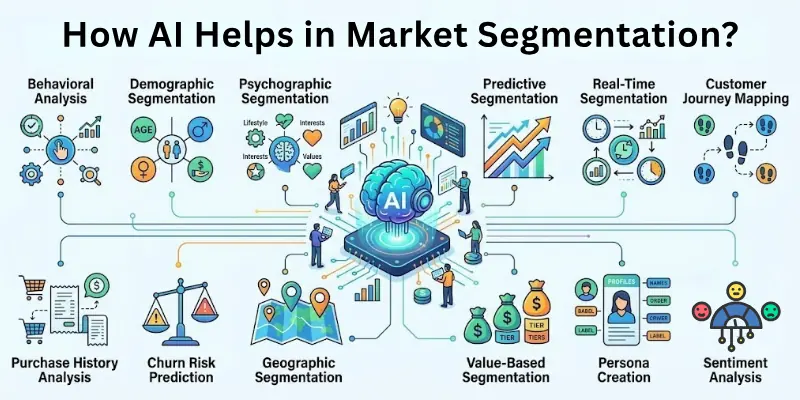
- Behavioral Analysis
- Demographic Segmentation
- Psychographic Segmentation
- Predictive Segmentation
- Real-Time Segmentation
- Customer Journey Mapping
- Purchase History Analysis
- Churn Risk Prediction
- Geographic Segmentation
- Value-Based Segmentation
- Persona Creation
- Sentiment Analysis
- Engagement Segmentation
- Campaign Optimization
- Continuous Segmentation and Learning
Let us learn about each method in detail.
1. Behavioral Analysis
Traditional segmentation often missed user behaviors. AI analyzes browsing patterns, clicks, and interactions automatically. This identifies active and engaged customers. Marketing becomes more targeted. Campaigns reach users based on actual behavior. Conversions improve.
Prompts you can use:
- Analyze website and app usage
- Track click patterns
- Segment by engagement level
- Identify repeat visitors
- Suggest behavior-driven strategies
2. Demographic Segmentation
Manual demographic segmentation relied on surveys. AI uses large datasets to segment by age, gender, income, or education. Results are more accurate. Businesses understand their audience better. Targeting improves. Ad spend becomes more efficient.
Prompts you can use:
- Segment by age, gender, income
- Identify key demographic trends
- Analyze demographic performance
- Adjust campaigns per segment
- Optimize audience targeting
3. Psychographic Segmentation
Understanding attitudes and interests manually is difficult. AI analyzes interests, lifestyle, and values from social media and engagement data. Campaigns are tailored to motivations. Personalization increases. Engagement improves. Messaging resonates with the audience.
Prompts you can use:
- Identify audience interests
- Segment by lifestyle and values
- Suggest content themes
- Track psychographic engagement
- Personalize offers and messaging
4. Predictive Segmentation
Traditionally, predictions about customer behavior were guesswork. AI predicts which segments are likely to purchase or churn. Businesses act proactively. Campaigns are optimized for highest potential. Resource allocation improves. Sales increase.
Prompts you can use:
- Predict potential buyers
- Identify churn risks
- Forecast segment behavior
- Allocate marketing budget
- Suggest proactive strategies
5. Real-Time Segmentation
Manual segmentation updates were slow. AI updates customer segments in real time. Businesses react instantly to behavior changes. Campaigns adjust automatically. Engagement improves. Marketing becomes agile and responsive.
Prompts you can use:
- Update segments continuously
- Track recent behavior
- Trigger instant campaigns
- Adjust messaging in real time
- Optimize live targeting
6. Customer Journey Mapping
Mapping journeys manually was complex. AI tracks interactions across touchpoints. Segments are based on where customers are in their journey. Marketing becomes context-specific. Conversions increase. Customer experience improves.
Prompts you can use:
- Map user journeys
- Segment by stage in funnel
- Suggest tailored messaging
- Track journey progress
- Optimize journey-specific campaigns
7. Purchase History Analysis
Traditional analysis relied on simple transaction records. AI examines purchase frequency, volume, and preferences. Segments identify loyal and high-value customers. Upselling and cross-selling improve. Marketing becomes more precise. Revenue grows.
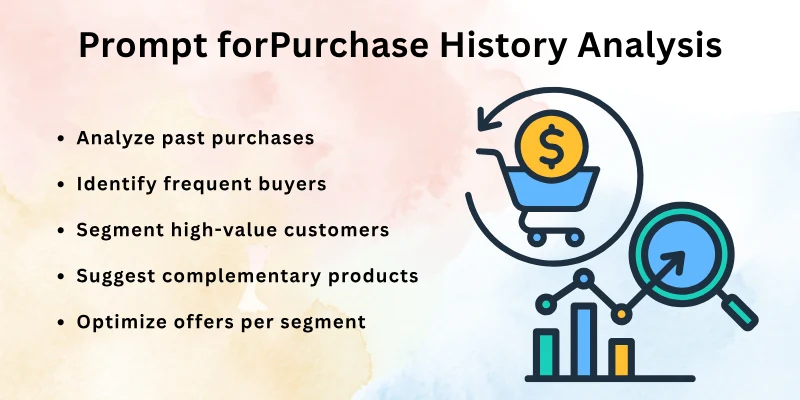
Prompts you can use:
- Analyze past purchases
- Identify frequent buyers
- Segment high-value customers
- Suggest complementary products
- Optimize offers per segment
8. Churn Risk Prediction
Manual churn tracking was reactive. AI predicts which segments are likely to churn. Businesses target retention strategies effectively. Engagement increases. Churn decreases. Loyalty improves.
Prompts you can use:
- Identify at-risk segments
- Track disengagement metrics
- Suggest retention campaigns
- Allocate resources to prevent churn
- Monitor churn trends
9. Geographic Segmentation
Manual segmentation relied on broad location data. AI analyzes geographic trends and patterns. Segments reflect city, region, or country preferences. Campaigns are localized. Relevance increases. Marketing ROI improves.
Prompts you can use:
- Segment by location
- Track regional preferences
- Localize campaigns
- Optimize delivery and offers
- Identify geographic trends
10. Value-Based Segmentation
Traditional value segmentation used average sales. AI calculates lifetime value, profit potential, and segment contribution. High-value customers receive targeted strategies. Resources focus on most profitable segments. ROI improves. Marketing becomes strategic.
Prompts you can use:
- Calculate customer lifetime value
- Identify top contributors
- Segment by profitability
- Allocate marketing budget
- Suggest premium offers
11. Persona Creation
Manual persona creation was time-consuming. AI generates detailed personas based on behavior and demographics. Marketing messages are personalized. Campaign effectiveness improves. Engagement increases. Teams have clear audience profiles.
Prompts you can use:
- Generate customer personas
- Include demographics and behavior
- Suggest content for each persona
- Track persona performance
- Refine personas over time
12. Sentiment Analysis
Traditional segmentation ignored customer emotions. AI analyzes feedback, reviews, and social media sentiment. Segments reflect positive, negative, or neutral attitudes. Marketing messages align with sentiment. Engagement improves. Brand perception is managed.
Prompts you can use:
- Analyze customer sentiment
- Segment by positive or negative feedback
- Adjust messaging per sentiment
- Track changes over time
- Optimize engagement strategies
13. Engagement Segmentation
Manual tracking of engagement was limited. AI measures clicks, shares, and interaction frequency. Segments identify highly engaged vs. low-engagement users. Campaigns are tailored accordingly. Engagement improves. Conversion likelihood increases.
Prompts you can use:
- Track interaction frequency
- Segment active and inactive users
- Personalize engagement campaigns
- Monitor engagement metrics
- Optimize communication frequency
14. Campaign Optimization
Campaign performance was generalized previously. AI uses segments to optimize targeting, messaging, and channels. Marketing becomes more efficient. ROI improves. Resources are allocated wisely. Campaigns perform better.
Prompts you can use:
- Optimize campaign per segment
- Adjust messaging and channels
- Track segment-specific ROI
- Recommend campaign improvements
- Allocate budget efficiently
15. Continuous Segmentation and Learning
Manual segmentation updates were infrequent. AI continuously analyzes data and refines segments. Marketing stays relevant. Audience changes are captured. Performance improves over time. Strategies evolve with insights.
Prompts you can use:
- Update segments regularly
- Learn from customer behavior
- Adjust campaigns automatically
- Monitor performance trends
- Optimize segmentation continuously
Best AI Tools for Market Segmentation
Here are the 10 best AI tools for market segmentation.
- HubSpot – AI-powered segmentation and CRM automation.
- Salesforce Einstein – Predictive segmentation and customer insights.
- Segment – Customer data platform for AI segmentation.
- Marketo – Marketing automation with AI segmentation.
- ActiveCampaign – Behavioral and predictive segmentation.
- Freshworks CRM – AI-driven segmentation and insights.
- Pega Marketing – Real-time customer segmentation.
- Optimove – Customer segmentation and retention automation.
- Zoho CRM – AI-based audience and behavior segmentation.
- Exponea (Bloomreach) – Personalized segmentation platform.
Final Note
In this guide, we explained how AI helps in market segmentation with practical methods and examples. We covered behavioral, demographic, psychographic, predictive, and continuous segmentation strategies. Each method ensures marketing is more targeted, efficient, and data-driven.
My personal advice is to start with high-impact segments first, test your campaigns, and gradually expand. Continuous learning and AI insights will refine targeting over time.
Thank you for reading. I hope this guide helps you reach the right customers effectively and improve business results.
FAQs
Here are some of the most commonly asked questions related to how AI helps in market segmentation:
AI market segmentation uses data to divide customers into meaningful groups. It studies behavior, demographics, and preferences. Businesses understand their audience better. Segmentation becomes more accurate and actionable. Marketing campaigns target the right people effectively.
AI analyzes large data sets quickly and precisely. It identifies patterns that humans might miss. Segments are more relevant and focused. Businesses make better marketing decisions. Accuracy improves targeting and reduces wasted effort.
Yes, AI creates segments based on behavior, interests, and purchase history. Each segment gets tailored messaging. Engagement increases as customers receive relevant offers. Sales conversion improves. Personalization helps build stronger customer relationships.
Yes, AI tools are affordable and easy to use. Small businesses can segment customers without extra staff. Decisions become data-driven and precise. Marketing becomes more effective. Teams save time and resources.
Yes, AI tracks browsing, clicks, and purchase patterns. It groups customers who act similarly. Marketing messages become more targeted. Campaigns perform better with relevant offers. Behavioral insights guide future strategies.
Yes, AI ensures campaigns reach the most valuable segments. Resources are used efficiently. Engagement and conversions increase. ROI improves consistently. Marketing becomes smarter and more cost-effective.
Yes, AI processes thousands or millions of customer records. Segmentation stays accurate and fast. Teams can work with big data easily. Scaling marketing efforts becomes simple. Insights remain consistent across large audiences.
Many AI tools offer free or affordable plans. Small businesses can use AI without high investment. ROI usually exceeds the cost. Segmentation becomes faster and more reliable. Businesses save money by targeting effectively.
Yes, AI forecasts trends and potential purchases. Segments can be adjusted proactively. Campaigns stay ahead of customer needs. Sales teams plan better. Future strategies become data-driven and accurate.
Yes, AI helps deliver relevant content to each segment. Messages feel tailored and timely. Engagement increases and conversions improve. Customers respond better to personalized offers. Campaigns become more effective and memorable.




- Be Respectful
- Stay Relevant
- Stay Positive
- True Feedback
- Encourage Discussion
- Avoid Spamming
- No Fake News
- Don't Copy-Paste
- No Personal Attacks
- Be Respectful
- Stay Relevant
- Stay Positive
- True Feedback
- Encourage Discussion
- Avoid Spamming
- No Fake News
- Don't Copy-Paste
- No Personal Attacks
