What is Predictive Intelligence in AI: How it Works & Explained
Published: 31 Mar 2026
You may have heard about predictive intelligence and wondered how machines or systems can forecast the future. In this guide, we will explain what predictive intelligence is, how it works, its components, techniques, applications, benefits, limitations, and future potential.
By the end, even beginners will clearly understand this concept and how it is applied in real life.
What is Predictive Intelligence in AI?
In this section, we will explain the basic meaning of predictive intelligence and why it is important today.
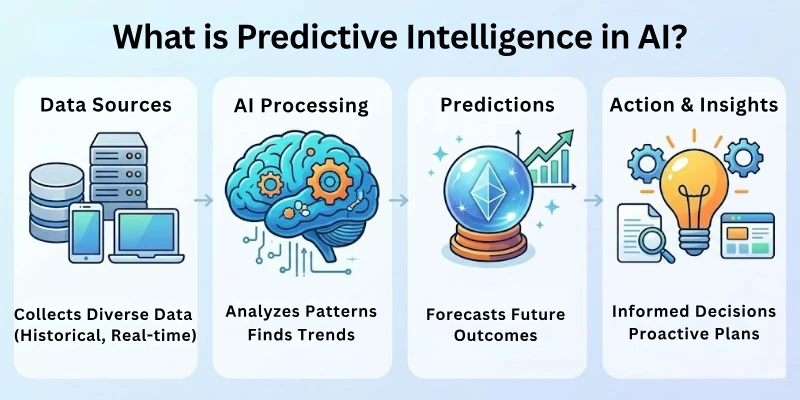
Predictive intelligence refers to systems or tools that analyze historical and current data to make predictions about future events. These systems find patterns, detect trends, and generate insights that help individuals and businesses make informed decisions.
Key Points
- Uses past and present data to forecast future events.
- Helps in planning and making smarter decisions.
- Can identify risks, opportunities, and trends early.
- Widely applied in business, healthcare, finance, marketing, and operations.
- Enables proactive strategies rather than reactive actions.
How Predictive Intelligence Works
This section explains how predictive intelligence systems analyze data and generate predictions.
Predictive intelligence works by collecting data, analyzing it for patterns, applying predictive models, and producing insights or forecasts.
Main Steps
- Data Collection: Gather data from multiple sources such as databases, IoT devices, and user interactions.
- Data Cleaning and Preparation: Remove errors, duplicates, and irrelevant information for accurate analysis.
- Pattern Detection: Identify trends, correlations, or repeated behaviors in the data.
- Modeling: Apply predictive algorithms such as regression, decision trees, or machine learning models.
- Prediction and Action: Forecast outcomes and provide insights to support decision-making.
Example: A retail company uses predictive intelligence to analyze customer purchase history. It predicts which products will be popular next season, helping the store manage inventory and increase sales efficiently.
Components of Predictive Intelligence Systems
This section explains the key components that make predictive intelligence work.
- Data Sources: Historical data, real-time data, and external data feeds like market reports.
- Data Storage: Databases or cloud storage systems to store large volumes of data.
- Predictive Models: Statistical models, machine learning models, or neural networks that analyze data.
- Analytics Tools: Software for visualization, reporting, and interpreting predictive results.
- Decision Support Systems: Tools or dashboards that provide actionable insights for businesses or organizations.
Techniques Used in Predictive Intelligence
This section explains the main methods and techniques used to make predictions.
- Regression Analysis: Predicts numerical values based on patterns in historical data.
- Classification: Categorizes data into predefined groups or outcomes.
- Time Series Analysis: Analyzes data points collected over time to forecast future trends.
- Machine Learning: Uses algorithms to learn patterns and improve predictions automatically.
- Data Mining: Extracts hidden patterns or relationships in large datasets.
- Predictive Analytics Platforms: Tools and software that combine data analysis, modeling, and visualization.
Applications of Predictive Intelligence
This section explains where predictive intelligence is applied in real life.
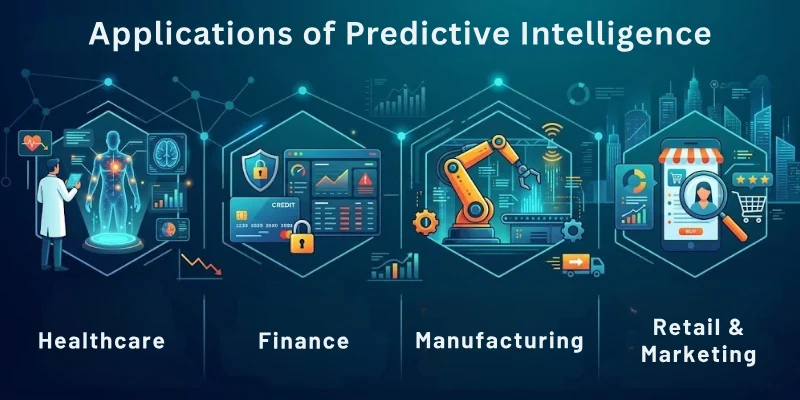
Key Applications
- Business Forecasting: Predicting sales, demand, and customer behavior.
- Healthcare: Predicting disease outbreaks, patient risks, and treatment outcomes.
- Finance: Forecasting stock trends, loan defaults, and credit risks.
- Marketing: Personalizing offers and campaigns based on predicted behavior.
- Supply Chain Management: Optimizing inventory, logistics, and production schedules.
- Energy Management: Forecasting energy demand and production efficiency.
- Risk Management: Predicting and mitigating operational or financial risks.
Advantages of Predictive Intelligence
This section explains why predictive intelligence is valuable.
Key Advantages
- Helps organizations make informed and proactive decisions.
- Reduces risks by identifying potential problems early.
- Improves efficiency in operations, sales, and marketing.
- Saves time and resources by predicting outcomes accurately.
- Provides a competitive advantage in fast-paced industries.
Limitations of Predictive Intelligence
This section explains the challenges and drawbacks of predictive intelligence.
Main Limitations
- Accuracy depends on quality, quantity, and relevance of data.
- Requires strong computing power for large datasets.
- Cannot always predict unexpected events or external shocks.
- Models require continuous updates and monitoring.
- Over-reliance on predictions can lead to poor decisions if forecasts fail.
Future of Predictive Intelligence
This section explains how predictive intelligence is evolving and what to expect in the coming years.
Future Possibilities
- Smarter predictive analytics integrated with real-time data from IoT devices.
- AI-driven automation based on predictive insights.
- Better healthcare outcomes using predictive models for early diagnosis.
- More accurate forecasting in finance, marketing, and supply chain.
- Integration with other technologies like machine vision and NLP for multi-dimensional predictions.
Final Note
In this guide, we have covered what predictive intelligence in AI is in great detail. You now understand its meaning, working process, components, techniques, applications, advantages, limitations, and future possibilities. Predictive intelligence helps businesses, organizations, and individuals anticipate future events and make smarter decisions.
By learning step by step, even beginners can understand this complex technology. Stay curious, explore more, and see how forecasting with data is shaping industries and our daily lives.
Goodbye and keep discovering the exciting world of predictive intelligence!
FAQs: Predictive Intelligence in AI
Here are some of the most commonly asked questions related to the what is predictive intelligence in AI:
Predictive Intelligence in AI is the ability of systems to analyze past and present data to forecast future events. It helps organizations make smarter decisions by understanding patterns and trends in data.
It works by collecting historical and real-time data, analyzing patterns, applying predictive models, and generating insights. This process helps predict outcomes like sales, risks, or customer behavior.
Key components include data sources, storage, predictive models, analytics tools, and decision support systems. Each part ensures accurate forecasting and actionable insights.
Predictive intelligence is used in healthcare for disease forecasting, finance for risk assessment, business for demand prediction, and marketing for customer targeting. It helps improve efficiency and decision-making.
It helps organizations make informed decisions, reduce risks, save time and resources, and gain a competitive advantage. Predictions allow businesses to plan proactively rather than reactively.
Its accuracy depends on data quality, model design, and external factors. Unexpected events or poor data can lead to inaccurate predictions, and systems require constant updates.
It can predict patient risks, forecast disease outbreaks, and suggest preventive measures. Hospitals and clinics use it to improve patient outcomes and manage resources efficiently.
Financial institutions use it to forecast stock trends, predict loan defaults, and manage credit risks. This helps them reduce losses and make informed investment decisions.
Traditional analytics shows what happened in the past, while predictive intelligence forecasts what is likely to happen in the future. This makes decision-making proactive rather than reactive.
The future includes real-time predictions using IoT data, smarter business forecasting, advanced healthcare analytics, and integration with other technologies like NLP and computer vision. Predictive intelligence will continue to shape industries and daily life.




- Be Respectful
- Stay Relevant
- Stay Positive
- True Feedback
- Encourage Discussion
- Avoid Spamming
- No Fake News
- Don't Copy-Paste
- No Personal Attacks
- Be Respectful
- Stay Relevant
- Stay Positive
- True Feedback
- Encourage Discussion
- Avoid Spamming
- No Fake News
- Don't Copy-Paste
- No Personal Attacks
