What is Online Learning in AI? How it Works & Explained
Published: 1 Apr 2026
You may have heard the term “online learning” in AI and wondered how machines can learn continuously from new information without starting over. In this guide, we will explain what online learning is, how it works, its types, techniques, applications, advantages, limitations, and future prospects.
By the end, even beginners will clearly understand this concept.
What is Online Learning in AI?
This section explains the basic meaning of online learning and why it is important.
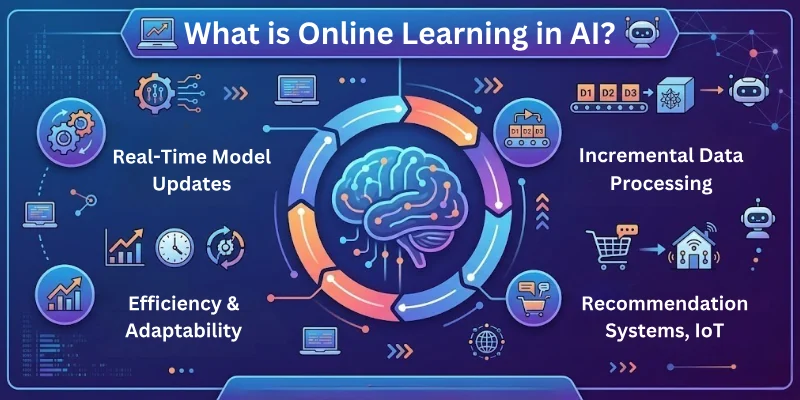
Online Learning in AI is a method where machines update their knowledge continuously as new data arrives. Unlike traditional models that are trained once and fixed, online learning models adapt dynamically, making them useful in changing environments.
Key Points
How Online Learning Works
This section explains the step-by-step process of online learning.
Online learning works by incrementally updating models rather than retraining from scratch. Each new piece of data improves the model gradually.
Main Steps
Example: An e-commerce website uses online learning to update product recommendations as users browse or make purchases, ensuring suggestions stay relevant.
Techniques Used in Online Learning
This section explains methods used to implement online learning effectively.
Types of Online Learning
This section explains the main types of online learning methods.
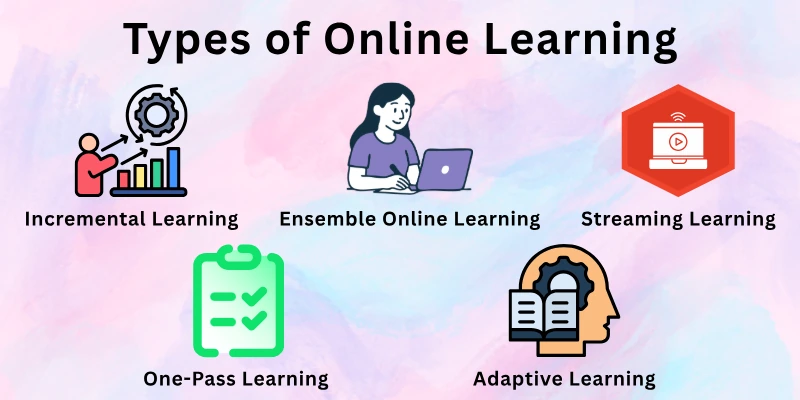
Streaming Learning: Processes continuous data streams for immediate predictions.
Applications of Online Learning in AI
This section explains how online learning is applied in real life.
Key Applications
Advantages of Online Learning
This section explains why online learning is valuable.
Key Advantages
Limitations of Online Learning
This section explains the challenges and drawbacks.
Main Limitations
Future of Online Learning
This section explains how online learning is evolving and what to expect.
Future Possibilities
Final Note
In this guide, we have covered what online learning in AI is in great detail. You now understand its meaning, working process, types, techniques, applications, advantages, limitations, and future possibilities. Online learning allows AI systems to adapt continuously, make decisions in real time, and handle changing environments efficiently.
Step by step, even beginners can understand this advanced concept. Stay curious, explore more, and see how continuous learning is shaping intelligent systems in the modern world.
Goodbye and keep discovering the fascinating world of online learning!
FAQs: Online Learning in Artificial Intelligence
Here are some of the most commonly asked questions related to online learning in AI:
Online learning in AI is a method where models learn continuously from new data rather than being trained once. It allows systems to adapt in real time and improve accuracy as more information arrives.
It works by updating the model incrementally with new data points or small batches. This avoids retraining from scratch and allows the system to respond quickly to changing information.
The main types include incremental learning, adaptive learning, streaming learning, one-pass learning, and ensemble learning. Each type is suited for different kinds of data and applications.
Online learning is widely used in recommendation systems, finance, healthcare monitoring, robotics, IoT devices, and marketing. It helps systems stay updated and make accurate real-time predictions.
It allows models to adapt quickly, handle dynamic data efficiently, save time on retraining, and improve prediction accuracy over time. Continuous learning ensures relevance in fast-changing environments.
Its accuracy depends on data quality and model settings. Continuous evaluation is required, and noisy or inconsistent data can lead to wrong predictions.
Traditional AI models are trained once on a fixed dataset, while online learning models update continuously as new data arrives. This makes online learning more flexible and adaptive.
It updates suggestions based on user behavior in real time, ensuring that recommendations stay relevant. Streaming services and e-commerce platforms often rely on online learning for this purpose.
In finance, it predicts stock trends or detects fraud instantly. In healthcare, it monitors patient data continuously to alert for potential risks or changes in health status.
The future includes real-time adaptive systems, smarter recommendation engines, IoT integration, large-scale streaming data analysis, and predictive decision-making. Online learning will continue to make AI more dynamic and responsive.


- Be Respectful
- Stay Relevant
- Stay Positive
- True Feedback
- Encourage Discussion
- Avoid Spamming
- No Fake News
- Don't Copy-Paste
- No Personal Attacks
- Be Respectful
- Stay Relevant
- Stay Positive
- True Feedback
- Encourage Discussion
- Avoid Spamming
- No Fake News
- Don't Copy-Paste
- No Personal Attacks
