What is Deep Learning and How It Works in AI
Published: 10 Jul 2026
Have you ever wondered how your phone unlocks your face or how YouTube knows what you want to watch next? Many people use these tools daily but still do not understand the technology behind them.
What is deep learning? It is a part of artificial intelligence where machines learn through multiple layers of data processing. These layers help the system understand complex patterns, similar to how the human brain learns from experience.
In this article we will discuss what is deep learning is in detail with practical examples and simple explanations. You will also see how this technology shapes daily life in ways you may not notice.
What is Deep Learning?
Deep learning is a branch of artificial intelligence (AI) and machine learning that allows computers to learn from massive amounts of data using structures called neural networks.
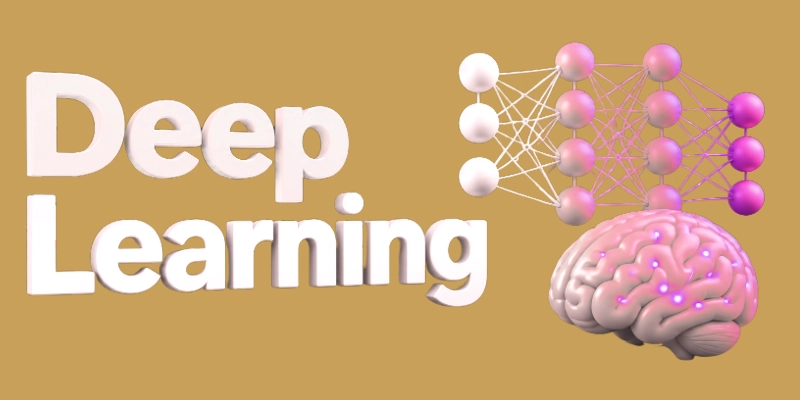
These systems are designed to work in a way that is inspired by the human brain. They can automatically learn patterns, recognize information, and improve performance over time without being manually programmed for every task.
Deep learning is responsible for many modern AI technologies people use daily, including:
- Voice assistants
- Facial recognition
- AI image generators
- Language translators
- Self-driving cars
- Smart chatbots
Unlike traditional software systems, deep learning models can handle complex tasks with high accuracy by learning directly from data.
Definition of Deep Learning
Deep learning refers to a type of machine learning that uses multi-layered neural networks to analyze data, identify patterns, and make intelligent decisions automatically.
These systems become more accurate as they process more data and continue learning from experience.
For example, deep learning systems can help
- Recognize human speech
- Translate languages
- Detect diseases from medical scans
- Generate realistic images
- Understand text and conversations
- Identify objects in photos and videos
Instead of following fixed rules, deep learning models learn from examples and improve continuously.
Why Is It Called “Deep Learning”?
It is called deep learning because the system uses many layers of neural networks to process information deeply and intelligently.
The word “deep” refers to the multiple hidden layers inside the neural network.
For example:
- A simple machine learning model may use one or two layers
- A deep learning model uses many layers to learn complex patterns
Just like the human brain learns from experience, deep learning systems learn from large amounts of data.
If you show thousands of images of cats and dogs to a deep learning model, it eventually learns to identify the difference automatically.
The more data it receives, the smarter it becomes.
Real-World Examples of Deep Learning
Deep learning is already part of everyday life, even if people do not notice it.
Here are some common examples:
1. Voice Assistants
Voice assistants like Siri, Alexa, and Google Assistant use deep learning to:
- Understand voice commands
- Recognize speech patterns
- Respond intelligently
2. Facial Recognition
Deep learning powers facial recognition systems used in:
- Smartphones
- Security systems
- Social media tagging
3. Self-Driving Cars
Self-driving vehicles use deep learning to:
- Detect roads
- Identify traffic signs
- Recognize pedestrians
- Avoid obstacles
4. AI Chatbots
Modern AI chatbots use deep learning to:
- Understand language
- Generate human-like responses
- Answer questions naturally
5. Medical Diagnosis
Hospitals use deep learning systems to:
- Analyze X-rays
- Detect diseases
- Identify cancer cells
- Assist doctors in diagnosis
6. Netflix and YouTube Recommendations
Platforms like Netflix and YouTube use deep learning to recommend content based on:
- Watch history
- User interests
- Viewing behavior
How Does Deep Learning Work?
Deep learning works by processing large amounts of data through neural networks that learn patterns step by step.
Although it may sound difficult, the overall process is easier to understand when broken down into stages.
The system mainly goes through the following:
- Data collection
- Data preparation
- Neural network training
- Pattern learning
- Prediction
- Continuous improvement
Let’s understand each step.
1. Data Collection
Data collection is the first and most important step in deep learning. Everything starts from data because models cannot learn without information. The quality and quantity of data directly affect the performance of the system.
Everything starts with data. Deep learning systems need huge amounts of information to learn effectively.
This data may come from:
- Images
- Videos
- Audio recordings
- Websites
- Sensors
- User activity
- Databases
For example, a facial recognition system needs thousands or millions of face images for training.
Without enough data, deep learning cannot perform accurately.
2. Data Preparation
Data preparation is the process of cleaning and organizing raw data before it is used for training. Since real-world data is often messy, this step is very important for improving model accuracy.
Collected data is usually messy or incomplete, so it must be cleaned and organized before training.
This process includes:
- Removing errors
- Fixing missing information
- Organizing files
- Formatting data correctly
Clean data improves the overall performance and accuracy of the model.
3. Neural Network Training
Neural network training is the core step where the model actually learns from data. In this stage, the system uses layers of artificial neurons to understand patterns and relationships.
This is the most important stage of deep learning.
The system uses artificial neural networks inspired by the human brain.
These networks contain:
- Input layers
- Hidden layers
- Output layers
The model studies data repeatedly and learns patterns through trial and error.
For example:
If a deep learning system sees thousands of cat images, it learns features like
- Eyes
- Ears
- Shape
- Fur patterns
Eventually, it becomes capable of identifying cats automatically.
Training may take hours, days, or even weeks depending on data size and system complexity.
4. Pattern Recognition
Pattern recognition is the stage where the trained model starts identifying hidden structures in data. It helps the system understand similarities and differences in information.
After training, the model starts recognizing hidden patterns in data.
For example:
- Speech patterns in audio
- Object patterns in images
- Language patterns in text
- Behavior patterns in users
Deep learning does not think like humans. Instead, it identifies relationships and patterns mathematically.
5. Prediction and Decision Making
In this stage, the trained model uses what it has learned to make predictions and decisions. This is where deep learning becomes practically useful in real-world applications.
Once trained, the model can make intelligent predictions.
Examples include:
- Predicting what users want to watch
- Detecting spam emails
- Translating languages
- Recognizing objects in photos
- Predicting customer behavior
The system uses past learning to make future decisions.
6. Continuous Improvement
Continuous improvement is the final stage where the system keeps learning and updating itself over time. This makes deep learning models more accurate and efficient.
Deep learning systems improve continuously as they receive more data.
They become smarter by:
- Learning from mistakes
- Updating patterns
- Improving predictions
- Adapting to new information
This is why AI systems become more accurate over time.
Types of Deep Learning Models
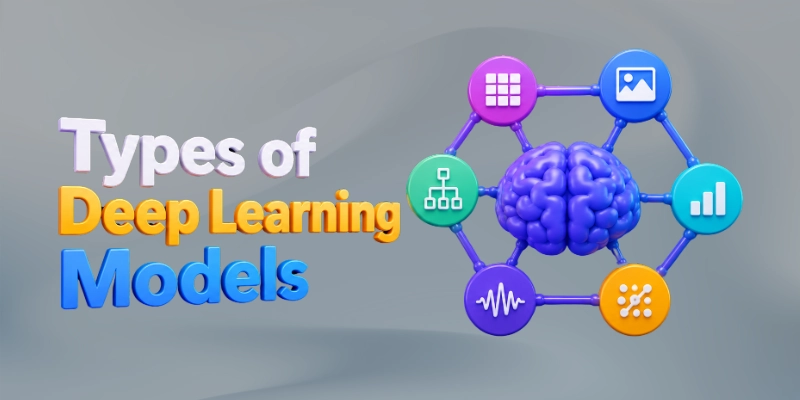
There are many types of deep learning models designed for different tasks and industries. Each model works differently depending on the type of data and the problem it needs to solve.
- Artificial Neural Networks (ANN)
- Convolutional Neural Networks (CNN)
- Recurrent Neural Networks (RNN)
- Generative Adversarial Networks (GAN)
- Long Short-Term Memory Networks (LSTM)
- Autoencoders
Now let’s understand each type in detail.
1. Artificial Neural Networks (ANN)
Artificial neural networks are the foundation of deep learning systems.
They are designed to simulate how the human brain processes information.
Uses include:
- Prediction systems
- Classification tasks
- Data analysis
2. Convolutional Neural Networks (CNN)
CNN models are mainly used for image-related tasks.
They can identify:
- Faces
- Objects
- Medical images
- Visual patterns
Uses include:
- Facial recognition
- Self-driving cars
- Image analysis
3. Recurrent Neural Networks (RNN)
RNN models are designed for sequence-based information.
They are commonly used in:
- Speech recognition
- Language translation
- Text generation
These models remember previous information to improve understanding.
4. Generative Adversarial Networks (GAN)
GAN models can create realistic content such as:
- AI-generated images
- Videos
- Music
- Art
These systems are widely used in creative AI technologies.
5. Long Short-Term Memory Networks (LSTM)
Long Short-Term Memory networks are a special type of recurrent neural network designed to remember information for a longer time.
Traditional RNN models sometimes forget older information, but LSTM networks solve this problem using memory cells.
LSTM models are commonly used in:
- Speech recognition
- Language modeling
- Time-series forecasting
- AI writing systems
- Weather prediction
These systems are highly effective for tasks where long-term information is important.
For example, AI chatbots and smart assistants often use LSTM models to understand conversations better.
6. Autoencoders
Autoencoders are deep learning models used for learning and compressing data automatically.
They work by:
- Encoding information into a smaller form
- Decoding it back into the original form
These models help systems understand the most important features inside data.
Autoencoders are commonly used in:
- Image compression
- Noise reduction
- Data recovery
- Feature extraction
- Anomaly detection
For example, autoencoders can remove noise from blurry images and improve image quality automatically.
They are also useful in cybersecurity systems for detecting unusual or suspicious activities.
What Can Deep Learning Do?
Deep learning is capable of solving many complex problems.
1. Image Recognition
Deep learning can analyze images and identify the following:
- Faces
- Objects
- Animals
- Medical scans
2. Speech Recognition
It can understand and process human speech.
This powers:
- Voice assistants
- Voice typing
- Smart speakers
3. Natural Language Processing
Deep learning helps systems understand human language.
It is used in:
- AI chatbots
- Language translators
- Search engines
4. Content Recommendation
Deep learning systems personalize content recommendations based on user behavior.
Examples include:
- Netflix recommendations
- YouTube suggestions
- Shopping recommendations
5. Fraud Detection
Banks and financial systems use deep learning to detect:
- Fraudulent transactions
- Suspicious activity
- Fake accounts
Popular Deep Learning Tools
Many tools and frameworks help developers build deep learning systems more efficiently.
Some popular deep learning tools include:
- TensorFlow
- PyTorch
- Keras
- Caffe
- MXNet
- OpenCV
- Theano
- Google Cloud AI
- Microsoft Azure AI
- IBM Watson
Some tools are beginner-friendly, while others are designed for advanced AI development.
Benefits of Deep Learning
Deep learning offers many powerful advantages across different industries and technologies. Some major benefits of deep learning are listed below:
- Automation – Reduces manual work, saves time, and improves overall efficiency.
- High Accuracy – Solves complex tasks with very high accuracy and fewer errors.
- Faster Decision-Making – Processes huge amounts of data quickly and efficiently.
- Advanced Problem Solving – Handles difficult problems that traditional systems cannot solve easily.
- Personalization – Improves user experience through customized recommendations and smart suggestions.
- Healthcare Improvements – Helps doctors detect diseases earlier and improves medical diagnosis accuracy.
- Continuous Learning – Systems improve automatically as they receive more data and experience.
Limitations of Deep Learning
Deep learning is a powerful technology, but it also has several limitations and challenges that affect its performance and reliability.
Some major limitations of deep learning are listed below:
- Requires Large Amounts of Data – Deep learning systems need huge datasets to train and perform accurately.
- High Cost – Training deep learning models requires expensive hardware, storage, and powerful computing systems.
- Time-Consuming Training – Some deep learning models take hours, days, or even weeks to train properly.
- Lack of Transparency – Many deep learning systems work like a “black box,” making it difficult to understand how decisions are made.
- High Energy Consumption – Advanced AI systems consume large amounts of electricity and computing resources.
- Privacy and Security Risks – Using large amounts of personal data may create privacy concerns and security issues.
- Dependency on Data Quality – Poor-quality or biased data can produce inaccurate and unfair results.
- Requires Skilled Experts – Building and maintaining deep learning systems requires experienced professionals and technical knowledge.
Industries Using Deep Learning
Deep learning is transforming many industries worldwide.
1. Healthcare
Used for:
- Disease detection
- Medical image analysis
- Drug discovery
2. Finance
Helps with:
- Fraud detection
- Risk analysis
- Banking security
3. Entertainment
Used in:
- Video recommendations
- Music suggestions
- AI-generated content
4. Transportation
Supports:
- Self-driving cars
- Traffic prediction
- Smart navigation systems
5. Education
Improves:
- Personalized learning
- Smart tutoring systems
- Student performance analysis
6. E-Commerce
Powers:
- Product recommendations
- Customer analysis
- Personalized shopping experiences
7. Cybersecurity
Used to detect:
- Cyber threats
- Malware attacks
- Suspicious online activity
Future of Deep Learning
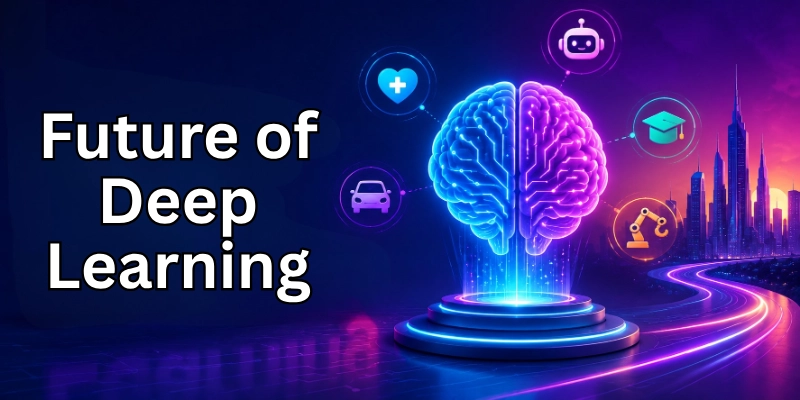
Deep learning is expected to grow rapidly in the future as AI technologies become more advanced.
Future trends include the following:
- Smarter AI assistants
- Fully autonomous vehicles
- Human-like robots
- Advanced healthcare systems
- Real-time AI decision systems
- AI-generated content creation
- Better cybersecurity systems
- Personalized education platforms
Deep learning is expected to become a core technology in almost every industry.
Is deep learning safe?
Deep learning is generally safe when it is developed and used responsibly. However, like any advanced technology, it also comes with certain challenges and risks that need proper attention.
Some major risks of deep learning are listed below:
- Data Privacy Issues – Personal and sensitive data may be misused if it is not properly protected and secured.
- Biased Results – If the training data is biased, the system may produce unfair or inaccurate decisions.
- Security Risks – Poorly designed deep learning systems can become vulnerable to cyberattacks and misuse.
- Lack of Human Control – AI systems still require human supervision for important decisions and critical tasks.
- Ethical Concerns – Technologies like deepfakes and AI-generated content can create ethical and social problems.
- Dependence on Data – Incorrect or low-quality data can negatively affect system performance and reliability.
Responsible AI development, proper security measures, and ethical guidelines are necessary to reduce these risks and ensure safe use of deep learning technologies.
Conclusion
In this guide, we have covered “Deep Learning” in simple and easy language. We explained what deep learning is, how it works, its types, applications, benefits, limitations, and future possibilities.
Deep learning is becoming an important part of modern technology and is used in many industries today. As AI continues to grow, deep learning will become even more powerful in the future.
Personal Recommendation: From my experience, understanding deep learning basics can help beginners prepare for future technology-driven opportunities. Even learning simple concepts today can open doors to AI, data science, and modern digital careers in the future.
If you found this article helpful, stay connected for more easy-to-understand AI and technology guides. 🚀💡
FAQs
Below are some frequently asked questions that will help you understand deep learning more clearly and remove common beginner confusion.
Deep learning is a type of artificial intelligence that allows computers to learn from large amounts of data using neural networks. It helps machines recognize patterns and make decisions automatically.
Deep learning works by training neural networks on large datasets. The system learns patterns, improves accuracy, and makes predictions based on previous information.
Machine learning is a broader AI technology that learns from data, while deep learning is a more advanced part of machine learning that uses multi-layered neural networks. Deep learning can handle more complex tasks and larger datasets with higher accuracy.
Main difference:
- Machine Learning uses simpler models
- Deep Learning uses advanced neural networks
Deep learning is used in voice assistants, facial recognition, self-driving cars, medical diagnosis systems, chatbots, and recommendation systems. Many modern apps and smart devices use deep learning technologies daily.
Deep learning helps solve complex problems that traditional computer systems cannot handle easily. It improves automation, accuracy, and intelligent decision-making.
Deep learning may seem difficult at first, but beginners can understand it step by step with simple concepts and practice.
Python is the most popular programming language for deep learning because it has powerful libraries like TensorFlow and PyTorch. It is beginner-friendly and widely used by AI developers around the world.
Other languages sometimes used include:
- R
- Java
- C++
- Julia
Yes, deep learning models usually need large amounts of high-quality data to perform accurately. More data helps the system learn better patterns and improve prediction accuracy.
For example, deep learning systems may require the following:
- Thousands of images
- Large text datasets
- Audio recordings
- User behavior data
Neural networks are computer systems inspired by the human brain. They help deep learning models process information and recognize patterns automatically.
A neural network mainly contains:
- Input layer
- Hidden layers
- Output layer
These layers work together to solve problems and make predictions.
The future of deep learning includes smarter AI systems, robotics, healthcare innovations, autonomous vehicles, and advanced human-computer interaction technologies. It is expected to become a major part of future digital systems and industries.
Future developments may include:
- More advanced AI assistants
- Better cybersecurity systems
- Human-like robots
- Faster real-time AI systems






- Be Respectful
- Stay Relevant
- Stay Positive
- True Feedback
- Encourage Discussion
- Avoid Spamming
- No Fake News
- Don't Copy-Paste
- No Personal Attacks
- Be Respectful
- Stay Relevant
- Stay Positive
- True Feedback
- Encourage Discussion
- Avoid Spamming
- No Fake News
- Don't Copy-Paste
- No Personal Attacks
