What is Generative AI, and How Does It Work? – Explained
Published: 10 Jul 2026
Many people feel overwhelmed by AI because new tools launch almost every week. One day people talk about ChatGPT; the next day, they discuss AI videos, AI coding tools, or AI image generators. Beginners often struggle to understand which tools matter, how they work, and whether AI will affect their jobs or businesses.
If you want a simple explanation of what generative AI is and how it works, this guide will help you. I spent years working with online tools, content systems, and AI platforms, and I noticed one common issue.
Most websites either oversimplify AI or explain it with difficult technical words. That approach only creates more confusion for readers who want practical knowledge.
In this article, we will discuss what generative AI is and how it works step by step. You will also learn how generative AI creates text, images, videos, and code, along with its benefits, risks, and future potential.
What is Generative AI?
Generative AI is a type of artificial intelligence that can create new content such as text, images, videos, music, code, and audio. Instead of only analyzing existing data or making predictions, it learns patterns from massive datasets and generates original outputs that resemble human-created work.
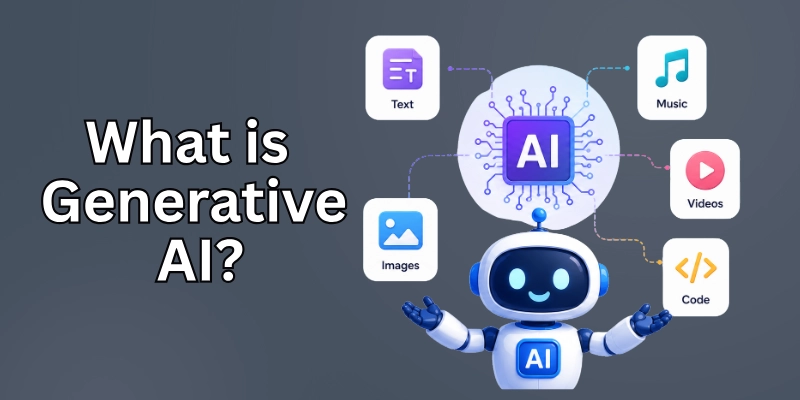
Today, generative AI powers tools used for writing, design, software development, customer support, research, entertainment, and content creation.
Simple Definition of Generative AI
Generative AI refers to AI systems that can produce new content based on prompts or instructions provided by users. These systems are trained on large amounts of data and use machine learning models to generate responses, images, videos, or other media.
For example, if you ask an AI tool to
- write a blog post,
- create an image,
- generate code,
- summarize a document, or
- produce a video,
The AI creates something new rather than simply retrieving existing information.
Why It Is Called “Generative”
It is called “generative” because the AI generates original outputs. Unlike traditional software that follows fixed rules, generative AI creates new material by predicting patterns learned during training.
For instance:
- A text model predicts the next words in a sentence.
- An image model predicts visual patterns and pixels.
- A music model predicts sound sequences and rhythms.
The result is content that appears creative and human-like.
Real-World Examples of Generative AI
Here are some of the most popular generative AI tools used today:
- ChatGPT: Developed by OpenAI, generates human-like text responses and helps with writing, coding, research, brainstorming, and customer support.
- Gemini: Created by Google DeepMind, Gemini can understand and generate text, images, and code while integrating with Google services.
- Midjourney: Midjourney is widely used for generating artistic and realistic AI images from text prompts.
- DALL·E: Built by OpenAI, DALL·E creates detailed images and artwork from written descriptions.
- Sora: Sora is an advanced AI model from OpenAI that can generate realistic videos from text prompts.
- Claude: Developed by Anthropic, Claude is designed for conversations, writing assistance, reasoning, and document analysis.
How Does Generative AI Work?
Generative AI works by learning patterns from massive amounts of data and using those patterns to create new content. It studies examples during training and then generates human-like responses, images, videos, or code based on user prompts.
Although Generative AI looks complex from the outside, its working process follows a clear structure. The system collects data, learns from it, identifies patterns, predicts possible outputs, and finally creates new content
The Basic Working Process
Generative AI follows several important steps before it produces useful results. Each step helps the AI system improve its understanding and generate more accurate outputs.
1. Data Collection
Everything starts with data. Generative AI systems need huge amounts of information to learn how humans write, speak, design, or create content.
The AI model collects data from sources such as the following:
- Books
- Articles
- Websites
- Images
- Videos
- Audio files
- Research papers
- Computer code
For example, a text-based AI model learns language from billions of words collected from online and offline sources. An AI image generator studies millions of images to understand colors, objects, styles, and visual patterns.
The quality of the data directly affects the quality of the AI output. Better data helps AI produce more accurate and useful content.
2. Training
After collecting data, the AI system enters the training phase. During training, the model studies the information repeatedly to understand relationships between words, images, sounds, and patterns.
For example, if the AI sees the sentence
“The sky is blue.”
It learns that the word “blue” often connects with “sky.”
This training process may take weeks or even months because modern AI models process billions of data points. Companies use powerful computers and graphics processing units (GPUs) to train these systems faster.
Training helps the AI improve its ability to generate realistic responses and reduce mistakes over time.
3. Pattern Recognition
Once training begins, the AI starts recognizing patterns inside the data. Pattern recognition allows the model to understand structures, behaviors, and connections between different pieces of information.
For example:
- Text AI learns grammar, sentence structure, and writing styles.
- Image AI learns shapes, colors, lighting, and artistic styles.
- Music AI learns rhythm, tones, and sound patterns.
This step is very important because Generative AI does not “think” like humans. Instead, it identifies patterns from past examples and uses them to predict future outputs.
The stronger the pattern recognition process becomes, the better the AI performs.
4. Prediction
Prediction is the core process behind Generative AI. After learning patterns, the AI predicts what should come next based on the user’s prompt.
For example, when someone types:
“Write a paragraph about climate change.”
The AI predicts the next word one step at a time until it creates a full response.
Text-based AI models predict:
- Words
- Sentences
- Context
Image-based AI models predict:
- Colors
- Shapes
- Visual elements
Video AI models predict:
- Motion
- Frames
- Scene transitions
This prediction system allows AI tools to generate content that feels natural and human-like.
5. Content Generation
After prediction, the AI finally generates the output. This output may include:
- Articles
- Images
- Videos
- Music
- Audio
- Computer code
- Designs
For example:
- ChatGPT generates text responses.
- Midjourney creates digital artwork.
- Sora generates AI videos.
- AI coding assistants generate programming code.
The final content depends on:
- The quality of training data
- The AI model
- The user’s prompt
- The system’s processing ability
This entire process happens within seconds, which explains why Generative AI tools feel fast and interactive for users.
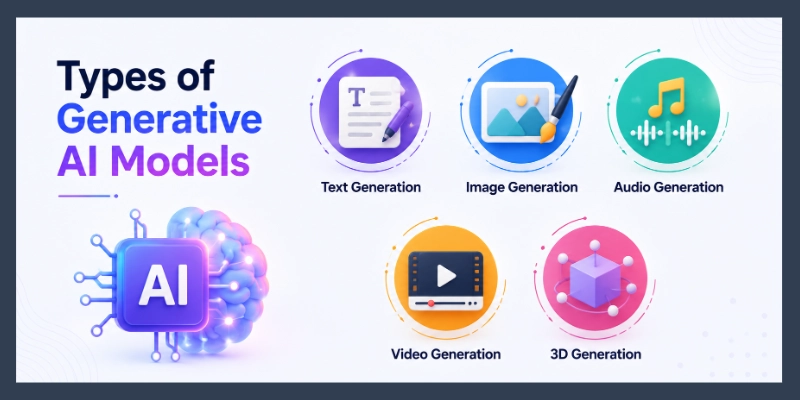
Types of Generative AI Models
The following are the main types of generative AI models used to create text, images, videos, audio, and other forms of digital content:
1. Large Language Models (LLMs)
- Definition: AI models trained on massive text datasets to understand and generate human-like language.
- Main Use: Text generation, chatbots, translation, coding, and content writing.
- Popular Examples: ChatGPT, Gemini, Claude
- One-Line Detail: LLMs predict the next word in a sequence to create natural and meaningful text responses.
2. Diffusion Models
- Definition: AI models that generate images by gradually removing noise from random data.
- Main Use: AI art, image creation, realistic graphics, and video generation.
- Popular Examples: DALL·E, Midjourney
- One-Line Detail: Diffusion models create high-quality visuals by transforming noisy patterns into clear images step by step.
3. GANs (Generative Adversarial Networks)
- Definition: AI systems made of two neural networks that compete with each other to generate realistic content.
- Main Use: Deepfakes, image enhancement, face generation, and animation.
- One-Line Detail: GANs improve generated content through a competition between a generator and a discriminator network.
4. Variational Autoencoders (VAEs)
- Definition: AI models designed to encode and recreate data while learning efficient representations.
- Main Use: Image generation, anomaly detection, and data compression.
- One-Line Detail: VAEs generate new data samples by learning patterns from compressed versions of existing data.
5. Multimodal AI Models
- Definition: AI models capable of understanding and generating multiple content types such as text, images, audio, and video.
- Main Use: Advanced assistants, visual understanding, AI search, and interactive applications.
- Popular Examples: Gemini, ChatGPT
- One-Line Detail: Multimodal AI combines different forms of data to deliver more intelligent and human-like interactions.
What Can Generative AI Create?
Generative AI can create many types of digital content by learning patterns from large datasets. Today, businesses, creators, students, and developers use AI tools to produce text, images, videos, music, software code, and synthetic data within seconds.
Below are the main types of content that Generative AI can create.
1. Text Content
Generative AI can generate human-like written content for different purposes.
- Blog posts and articles
- Emails and business documents
- Social media captions
- Product descriptions
- Website content
- Scripts and storytelling
- Chatbot responses
Tools like OpenAI ChatGPT and Anthropic Claude help users create content faster while improving productivity.
2. Images and Art
AI image generators can create realistic visuals, artwork, illustrations, and graphic designs from simple text prompts.
- Digital artwork
- Marketing graphics
- Logos and branding designs
- Realistic human images
- Concept art
- Social media visuals
Popular platforms like Midjourney and OpenAI DALL·E allow users to generate professional-quality images within seconds.
3. Videos
Generative AI now creates videos using text instructions, images, and animations.
- Short AI-generated clips
- Marketing videos
- Animated scenes
- Educational videos
- AI avatars and presenters
- Video editing effects
Advanced tools like OpenAI Sora show how AI can generate realistic video scenes with movement and cinematic quality.
4. Music and Audio
AI models can create music, sound effects, and voice content.
- Background music
- AI voiceovers
- Podcast audio
- Sound effects
- Instrumental tracks
- AI-generated songs
Many businesses use AI audio tools for content creation, advertising, gaming, and entertainment projects.
5. Computer Code
Generative AI helps developers write and improve software code faster.
- Website code
- App development
- Bug fixing
- Code suggestions
- Automation scripts
- Software testing support
AI coding assistants help programmers save time and improve productivity during software development.
6. Synthetic Data
Generative AI can create artificial datasets that look similar to real-world data.
- Training datasets for AI models
- Simulated customer behavior
- Medical research data
- Financial testing data
- Cybersecurity simulations
Companies use synthetic data when real data becomes expensive, limited, or sensitive due to privacy concerns.
Popular Generative AI Tools
Many Generative AI tools now help people create content, design visuals, write code, and improve productivity. Some tools focus on text generation, while others specialize in images, videos, or creative design.
Below are some of the most popular Generative AI tools used worldwide.
1. OpenAI ChatGPT
ChatGPT is one of the most widely used Generative AI tools today. It helps users generate text-based content and answer questions in a conversational style.
Key uses of ChatGPT include:
- Writing articles and emails
- Generating ideas and outlines
- Coding assistance
- Research and summaries
- Customer support automation
- Language translation
Students, freelancers, marketers, and businesses use ChatGPT daily to save time and improve productivity.
2. Google Gemini
Gemini is Google’s advanced AI model designed for text, research, coding, and multimodal tasks.
Main features of Gemini include:
- AI-powered search assistance
- Content generation
- Coding support
- Image understanding
- Integration with Google Workspace
- Real-time information support
Google continues to expand Gemini across products like Gmail, Docs, Android, and Search.
3. Anthropic Claude
Claude is a Generative AI assistant developed by Anthropic. It focuses on safe, reliable, and helpful AI interactions.
Popular uses of Claude include:
- Document analysis
- Business writing
- Long-form content generation
- Research support
- Workflow automation
- Customer communication
Many companies prefer Claude for handling large documents and detailed conversations.
4. Midjourney
Midjourney is a popular AI image generation platform that creates high-quality visuals from text prompts.
Users commonly create:
- Digital art
- Marketing graphics
- Social media visuals
- Character designs
- Concept artwork
- Product mockups
Designers and content creators widely use Midjourney for creative projects because of its artistic image quality.
5. Adobe Adobe Firefly
Adobe Firefly is a Generative AI tool focused on creative design and image editing.
Its main features include the following:
- AI image generation
- Text effects
- Background editing
- Graphic design support
- Commercial-safe AI content
- Integration with Adobe products
Adobe integrated Firefly into tools like Photoshop and Illustrator to improve creative workflows.
6. Microsoft Microsoft Copilot
Microsoft Copilot is an AI assistant integrated into Microsoft products and services.
Key capabilities include:
- Writing assistance in Word
- AI support in Excel
- Email drafting in Outlook
- Coding help for developers
- Business productivity automation
- AI-powered workplace assistance
Microsoft designed Copilot to help users complete tasks faster across business and office applications.
Benefits of Generative AI
Generative AI offers many advantages for businesses, creators, students, and professionals. It helps users complete tasks faster, improve efficiency, reduce manual work, and create high-quality content with less effort. As AI technology continues to improve, more industries now use Generative AI to increase productivity and support innovation.
1. Faster Content Creation
Generative AI helps users create content within seconds instead of spending hours on manual work.
It can quickly generate:
- Blog posts
- Emails
- Product descriptions
- Social media captions
- Marketing copy
- Images and graphics
- Video scripts
Tools like OpenAI’s ChatGPT and Midjourney help creators produce content much faster while maintaining quality.
Businesses use these tools to speed up content production and manage large workloads more efficiently.
2. Improved Productivity
Generative AI improves productivity by helping users complete tasks in less time and with less effort.
AI tools assist with:
- Research and summaries
- Data analysis
- Writing and editing
- Coding support
- Customer communication
- Workflow management
Professionals can focus on important decisions while AI handles routine tasks in the background. This support allows teams to work faster and improve overall efficiency.
3. Automation of Repetitive Tasks
Many daily business tasks repeat again and again. Generative AI automates these tasks and reduces manual effort.
Common automated tasks include:
- Email responses
- Report generation
- Customer support replies
- Data entry assistance
- Meeting summaries
- Content formatting
Automation helps companies save time, reduce operational costs, and improve workflow consistency.
4. Personalized User Experiences
Generative AI creates personalized experiences by understanding user behavior, preferences, and interests.
AI systems can personalize:
- Product recommendations
- Marketing campaigns
- Learning experiences
- Customer support interactions
- Website content
- Shopping experiences
For example, AI chatbots can respond differently based on customer questions and preferences, which improves user satisfaction and engagement.
5. Innovation Across Industries
Generative AI supports innovation in many industries by helping companies solve problems faster and develop new ideas.
Industries using Generative AI include:
- Healthcare
- Education
- Finance
- Marketing
- Entertainment
- Software development
- E-commerce
Businesses now use AI to create smarter products, improve services, and develop new digital experiences. This rapid innovation continues to change how industries operate worldwide.
Limitations of Generative AI
Although generative AI offers many benefits, it also has several limitations and challenges. AI systems still depend heavily on training data, computing power, and human supervision. In some situations, AI-generated content may become inaccurate, biased, or unsafe if users do not review it carefully.
Below are some of the major limitations of Generative AI.
1. AI Hallucinations
AI hallucinations happen when Generative AI produces false or misleading information that sounds correct but is actually wrong.
For example, AI tools may:
- Create fake facts
- Generate incorrect statistics
- Invent sources or references
- Provide inaccurate answers
This problem occurs because AI predicts responses based on patterns instead of real understanding. Users should always verify important information before using AI-generated content in professional or academic work.
2. Bias and Inaccuracies
Generative AI models learn from existing datasets, and those datasets may contain biased or inaccurate information.
As a result, AI systems may:
- Show cultural bias
- Produce unfair responses
- Generate misleading content
- Reflect outdated information
If the training data contains errors or social bias, the AI may repeat the same problems in its outputs. Developers continue working to reduce bias and improve fairness in AI systems.
3. Copyright Concerns
Many people worry about how AI models use copyrighted material during training.
Generative AI may sometimes:
- Create content similar to existing work
- Use styles inspired by artists or writers
- Raise ownership questions for AI-generated content
Writers, musicians, photographers, and designers continue debating how copyright laws should apply to AI-generated material. This issue remains one of the biggest legal challenges in the AI industry.
4. Data Privacy Risks
Generative AI systems often process large amounts of user data, which creates privacy concerns.
Possible risks include:
- Exposure of sensitive information
- Data leaks
- Unauthorized access
- Misuse of personal data
Businesses must carefully manage user information when using AI tools, especially in industries like healthcare, finance, and education, where privacy protection is very important.
5. Lack of Human Understanding
Generative AI can imitate human language and creativity, but it still lacks real understanding and emotions.
AI systems cannot:
- Think like humans
- Feel emotions
- Understand context perfectly
- Make ethical judgments independently
AI generates outputs by recognizing patterns from data, not by having real awareness or personal experiences. Because of this limitation, human supervision remains necessary.
6. High Computing Costs
Training and running advanced AI models requires huge computing power and expensive hardware.
Companies often need:
- Powerful GPUs
- Large data centers
- Massive storage systems
- High electricity usage
Building advanced generative AI systems costs millions of dollars. Smaller businesses may struggle to afford the infrastructure needed to develop or train large AI models.
Ethical Concerns Around Generative AI
Generative AI continues to grow rapidly, but it also raises serious ethical concerns. While AI tools improve productivity and creativity, they can also create harmful content, spread misinformation, and affect jobs. Governments, businesses, and technology companies now focus more on responsible AI development to reduce these risks.
Below are some of the biggest ethical concerns related to generative AI.
1. Deepfakes
Deepfakes are AI-generated images, videos, or audio clips that imitate real people in a highly realistic way.
Deepfake technology can:
- Create fake celebrity videos
- Copy human voices
- Manipulate public speeches
- Produce misleading visual content
Although some creators use deepfakes for entertainment and filmmaking, others misuse them for scams, fraud, and misinformation. Deepfakes make it harder for people to identify real and fake content online.
2. Misinformation
Generative AI can quickly produce large amounts of false or misleading information.
AI-generated misinformation may include:
- Fake news articles
- False social media posts
- Manipulated images
- Incorrect facts and statistics
Because AI content often sounds convincing, many users may trust inaccurate information without verifying it. This problem creates risks for journalism, education, politics, and public trust.
3. Job Displacement
Many workers worry that Generative AI may replace certain jobs and reduce employment opportunities.
AI systems now automate tasks related to:
- Content writing
- Customer support
- Graphic design
- Data analysis
- Software coding
- Administrative work
While AI may create new career opportunities, it may also reduce demand for repetitive and routine jobs. Workers may need new skills to adapt to changing industries.
4. AI Bias
AI systems can show bias if their training data contains unfair or unbalanced information.
Biased AI may:
- Produce unfair responses
- Favor certain groups
- Reinforce stereotypes
- Deliver inaccurate recommendations
This issue becomes especially serious in industries like healthcare, hiring, banking, and law enforcement, where fairness matters greatly. Developers continue working to reduce bias and improve transparency in AI systems.
5. Responsible AI Usage
Responsible AI usage means developing and using AI systems in safe, ethical, and transparent ways.
Responsible AI practices include:
- Protecting user privacy
- Reducing harmful content
- Preventing misinformation
- Improving fairness and accuracy
- Following legal and ethical standards
Technology companies, researchers, and governments now create policies to make AI systems safer for users. Human oversight remains important because AI still cannot fully understand ethics, emotions, or real-world consequences.
Industries Using Generative AI
Generative AI now plays an important role in many industries. Businesses use AI tools to improve productivity, automate tasks, reduce costs, and create better customer experiences. From healthcare to e-commerce, generative AI continues to change how industries work and deliver services.
Below are some major industries using generative AI today.
1. Healthcare
Healthcare organizations use generative AI to improve patient care, medical research, and administrative work.
Common healthcare uses include:
- Medical report generation
- Drug discovery support
- AI-powered virtual assistants
- Patient data analysis
- Medical image analysis
- Healthcare chatbots
AI helps doctors and researchers process large amounts of medical information faster and more accurately.
2. Education
Educational institutions use generative AI to improve learning experiences for students and teachers.
AI tools support:
- Personalized learning
- AI tutoring systems
- Quiz and assignment generation
- Research assistance
- Language translation
- Study material summaries
Students use AI tools to understand complex topics more easily, while teachers use AI to save time on repetitive tasks.
3. Marketing
Marketing teams use generative AI to create content, improve campaigns, and understand customer behavior.
Popular marketing applications include:
- Blog writing
- Social media content
- Email marketing
- Ad copy generation
- Customer engagement
- SEO optimization
Tools like OpenAI ChatGPT help marketers produce content faster and manage campaigns more efficiently.
4. Software Development
Software developers use Generative AI to speed up coding and improve software workflows.
AI supports developers by helping with:
- Code generation
- Bug detection
- Code completion
- Software testing
- Technical documentation
- Automation scripts
AI coding assistants help programmers reduce manual work and improve development speed.
5. Entertainment
The entertainment industry uses Generative AI for content creation and digital production.
AI applications include:
- AI-generated music
- Video creation
- Animation support
- Script writing
- Visual effects
- Game design
Platforms like Midjourney and AI video tools help creators produce visual content more quickly.
6. Finance
Financial companies use Generative AI to improve customer service, risk analysis, and operational efficiency.
Common finance applications include:
- Fraud detection
- Financial forecasting
- Customer support chatbots
- Automated reporting
- Investment analysis
- Data processing
AI helps financial institutions analyze large datasets and improve decision-making processes.
7. E-commerce
E-commerce businesses use Generative AI to improve shopping experiences and increase sales.
AI helps with:
- Product recommendations
- AI-powered customer support
- Product description generation
- Personalized marketing
- Inventory management
- Visual product creation
Online stores use AI tools to better understand customer preferences and deliver more personalized shopping experiences.
Generative AI vs AI vs Machine Learning vs Deep Learning
Below is a simple comparison table that explains the difference between AI, machine learning, deep learning, and Generative AI.
| Feature | Artificial Intelligence (AI) | Machine Learning (ML) | Deep Learning (DL) | Generative AI |
| Definition | A broad technology that allows machines to mimic human intelligence | A subset of AI that learns from data | A subset of ML that uses neural networks | A type of AI that creates new content |
| Main Purpose | Simulate human intelligence | Learn patterns from data | Solve complex problems using deep neural networks | Generate text, images, videos, audio, and code |
| Human Involvement | High | Medium | Lower after training | Mainly prompt-based interaction |
| Data Requirement | Moderate | High | Very high | Extremely high |
| Learning Method | Rule-based and learning systems | Statistical learning from datasets | Multi-layer neural networks | Pattern recognition and prediction |
| Output Type | Decisions and automation | Predictions and recommendations | Advanced analysis and recognition | Creative content generation |
| Examples | Virtual assistants, robots | Spam filters, recommendation systems | Facial recognition, speech recognition | ChatGPT, Midjourney, DALL·E |
| Complexity Level | Basic to advanced | Moderate | High | Very high |
| Real-Time Creativity | Limited | Low | Medium | High |
| Common Applications | Automation, robotics | Forecasting, analytics | Image recognition, NLP | Content creation and media generation |
Future of Generative AI
The future of generative AI is expected to transform industries, improve automation, and create more intelligent digital experiences.
The following are some major trends shaping the future of this technology:
- AI Agents: Advanced AI agents will be able to perform tasks independently, make decisions, and handle complex workflows with minimal human input.
- Multimodal AI: Future AI systems will better understand and combine text, images, audio, video, and real-time data for more natural interactions.
- Personalized AI Assistants: AI assistants will become more personalized by learning user preferences, habits, and communication styles to provide customized support.
- AI in Business Operations: Companies will increasingly use generative AI for customer service, marketing, data analysis, automation, and productivity improvement.
- Future Challenges: Issues such as data privacy, misinformation, copyright concerns, AI bias, and ethical regulations will remain important challenges for the industry.
Is Generative AI Safe?
Generative AI offers many benefits, but it also raises important concerns related to security, privacy, ethics, and responsible usage. The following are key points to understand about AI safety:
- Security Risks: Generative AI can sometimes be misused for creating fake content, phishing emails, deepfakes, spam, or cyberattacks.
- Privacy Concerns: AI systems may process large amounts of user data, which can raise concerns about personal information, data storage, and unauthorized access.
- How Companies Are Regulating AI: Many technology companies and governments are introducing AI policies, safety guidelines, and ethical frameworks to reduce risks and improve transparency.
- Tips for Safe AI Usage: Users should avoid sharing sensitive information, verify AI-generated content, use trusted platforms, and follow responsible AI practices.
- Bias and Misinformation: AI models can sometimes produce biased, inaccurate, or misleading information based on the data they were trained on.
- Human Oversight: Human monitoring and review are important to ensure AI-generated content remains accurate, ethical, and reliable.
Conclusion
In this guide, we have covered “What is Generative AI and How Does It Work” in detail. We discussed how Generative AI creates text, images, videos, music, and code using advanced AI models and large datasets. We also explored its benefits, limitations, ethical concerns, popular AI tools, and the industries using this technology today.
As AI continues to grow rapidly, Generative AI will likely play a major role in shaping the future of business, education, healthcare, marketing, and digital creativity.
Personal Recommendation: From my experience, Generative AI works best as a support tool because human creativity, fact-checking, and decision-making still matter the most.
If you found this article useful, feel free to share it with others, leave your thoughts in the comments, and explore more AI-related guides on our website.
FAQs
Below are some of the most commonly asked questions about generative AI.
No, generative AI is only one branch of artificial intelligence. Traditional AI mainly focuses on prediction, automation, and data analysis, while generative AI creates new content like text, images, videos, music, and code. Popular examples of generative AI tools include OpenAI ChatGPT and Gemini.
Generative AI may automate some repetitive tasks, but it is unlikely to replace all human jobs completely. Most businesses still need human creativity, decision-making, emotional intelligence, and fact-checking. Many experts believe AI will create new career opportunities while changing how people work.
Here are some industries already using generative AI technology:
- Healthcare for medical research and patient support
- Marketing for content creation and advertising
- Education for AI tutoring and learning tools
- Software development for AI coding assistance
- E-commerce for personalized shopping experiences
Generative AI is growing rapidly across almost every digital industry.
No, most modern AI tools are beginner-friendly and designed for non-technical users. You simply enter a text prompt, and the AI generates content based on your instructions. Platforms like Midjourney and DALL·E make AI content creation simple for beginners.
Generative AI predicts responses based on patterns in training data, not real understanding. Because of this, AI can sometimes generate incorrect facts, fake references, or outdated information. This problem is commonly called an “AI hallucination” in the artificial intelligence industry.
The following are the best generative AI tools for beginners:
- ChatGPT – Best for writing and learning.
- Google Gemini – Good for students and Google users.
- Canva AI – Easy tool for graphic design.
- Claude AI – Great for long writing tasks.
- Grammarly – Helps improve English writing.
Beginners usually start with ChatGPT because it is easy to use for writing, learning, and brainstorming.
Yes, generative AI creates new content by combining learned patterns from massive datasets. It does not simply copy and paste existing material from the internet. However, AI-generated content may sometimes resemble existing work because it learns from previously available data.
Generative AI can be safe when used responsibly and with proper precautions. Users should avoid sharing sensitive information, verify important facts, and use trusted AI platforms. Many companies now implement AI safety policies to reduce privacy and security risks.
Generative AI learns through large-scale machine learning and deep learning models trained on billions of data points. During training, the AI studies patterns in text, images, audio, and videos to improve prediction accuracy. Powerful GPUs and cloud computing systems help train these AI models much faster.
The future of generative AI will likely include smarter AI assistants, AI agents, advanced automation, and multimodal AI systems. Experts expect AI to improve industries like healthcare, education, finance, and content creation over the next decade. At the same time, governments and tech companies will continue working on AI ethics, privacy protection, and responsible AI development.



- Be Respectful
- Stay Relevant
- Stay Positive
- True Feedback
- Encourage Discussion
- Avoid Spamming
- No Fake News
- Don't Copy-Paste
- No Personal Attacks
- Be Respectful
- Stay Relevant
- Stay Positive
- True Feedback
- Encourage Discussion
- Avoid Spamming
- No Fake News
- Don't Copy-Paste
- No Personal Attacks
