What is Machine Learning, and How Does It Work? – Explained
Published: 5 Jul 2026
Today, people hear about intelligent digital systems everywhere, from search engines and social media to online shopping and healthcare. These technologies are becoming a major part of modern life, yet many beginners still find it difficult to understand how they actually work.
If you want a simple explanation of modern AI systems without confusing technical terms, this guide will help you. Over the years, I have explored different digital technologies and noticed that many websites either make the topic sound too complex or explain it in a very limited way.
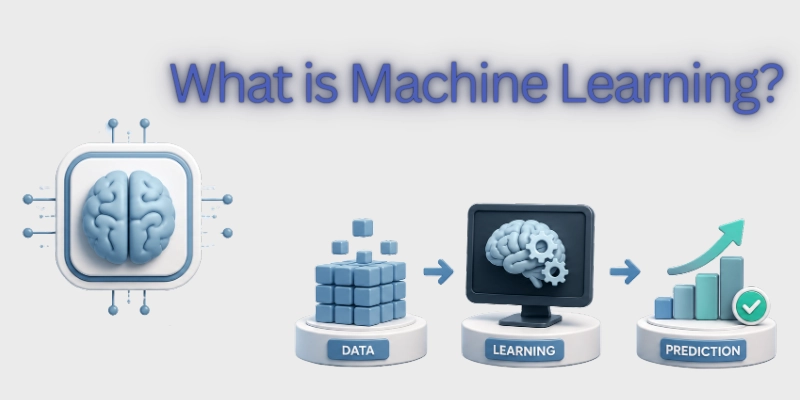
If you want a clear, simple, and detailed explanation of machine learning, this guide is for you. In this article, we will break everything down step by step so you can understand the concept from the ground up.
You will learn:
- What Machine Learning is
- How it works in real systems
- Different types of Machine Learning
- Real-world applications
- Benefits and limitations
- Future possibilities
Let’s start from the basics.
What is Machine Learning?
Machine learning is a branch of artificial intelligence (AI) that allows computers to learn from data and improve their performance without being directly programmed for every task.
Rather than relying on pre-programmed rules, these systems study data patterns, make smart decisions, and become more accurate through continuous learning and experience.
Today, machine learning powers many technologies people use daily, including recommendation systems, voice assistants, fraud detection systems, self-driving cars, and AI chatbots.
Definition of Machine Learning
Machine learning refers to computer systems that can learn from data, identify patterns, and make decisions with minimal human intervention.
These systems improve their accuracy over time as they process more information.
For example, machine learning can help systems
- Recommend videos on YouTube
- Detect spam emails
- Predict weather conditions
- Recognize human faces
- Translate languages
- Suggest products online
Instead of manually programming every possible situation, developers train machine learning models using large datasets.
Why It Is Called “Machine Learning”
It is called machine learning because machines actually “learn” from data patterns without human intervention.
For example:
- A human learns from experience
- A Machine Learning model learns from data
If you show a child many pictures of cats, they learn how a cat looks. Similarly, if you show a machine learning model thousands of cat images, it learns to recognize cats on its own.
The more data it receives, the better it becomes.
Real-World Examples of Machine Learning
Machine learning is already part of our daily life. You may be using it without even realizing it.
Here are some powerful examples:
1. Netflix Recommendations
Netflix uses machine learning to suggest movies and shows based on:
- Watch history
- Search behavior
- Ratings
- User preferences
2. YouTube Algorithm
YouTube uses machine learning to recommend videos based on:
- What you watch
- How long you watch
- What you skip
3. Google Search
Google uses machine learning to:
- Rank search results
- Understand search intent
- Show relevant answers
4. Amazon Shopping
Amazon recommends products using:
- Purchase history
- AIowsing behavior
- Similar customer behavior
5. Fraud Detection
Banks use machine learning to detect the following:
- Suspicious transactions
- Fake accounts
- Unusual spending patterns
6. Self-Driving Cars
Self-driving cars use machine learning to:
- Detect roads
- Recognize traffic signals
- Avoid obstacles
How Does Machine Learning Work?
Machine learning works by analyzing data, finding patterns, and using those patterns to make predictions.
Even though it sounds complex, the process follows a simple structure.
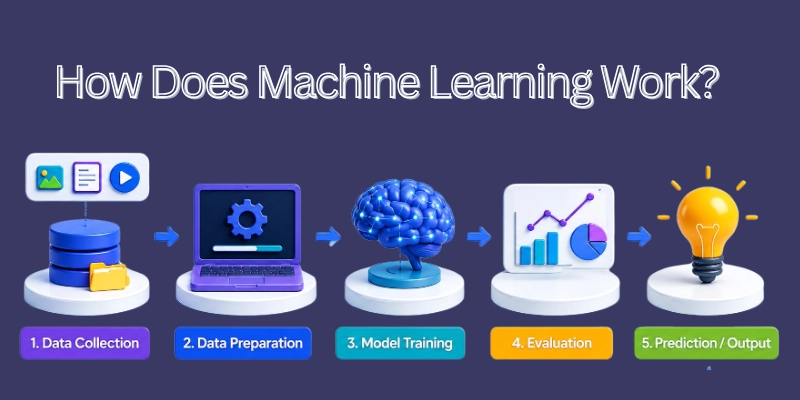
The system goes through the following:
- Data collection
- Training
- Pattern recognition
- Prediction
- Continuous improvement
Let’s understand it step by step.
1. Data Collection
The first step is gathering information from different sources so the system can learn from it. The quality and amount of data play a major role in how accurately the system performs later.
Everything starts with data. Machine learning systems need large amounts of data to learn effectively.
This data can come from:
- Websites
- Apps
- Sensors
- Images
- Videos
- Databases
- User behavior
For example, a recommendation system collects data about what users watch, click, and search.
Without data, machine learning cannot function.
2. Data Cleaning and Preparation
Collected data is not always perfect, so it needs to be organized before use. This step helps remove mistakes and makes the information easier for the system to understand. Proper preparation also improves the overall accuracy and performance of the system.
Raw data is often messy, incomplete, or inconsistent. Before training, it must be cleaned.
This includes:
- Removing errors
- Fixing missing values
- Organizing data
- Formatting data correctly
Clean data improves accuracy and performance.
3. Model Training
During training, the system studies the data again and again to understand how different pieces of information are connected. This process helps it learn patterns and improve decision-making.
In this stage, the machine learning model studies the data repeatedly.
It learns:
- Patterns
- Relationships
- Structures
For example:
If a system sees thousands of emails labeled “spam” and “not spam,” it learns how to identify spam emails.
Training may take hours, days, or even weeks depending on data size.
4. Pattern Recognition
Once the system understands patterns, it can start making smart guesses based on previous information. These predictions help businesses and platforms make better decisions.
After training, the model starts identifying hidden patterns.
For example:
- Text patterns in language
- Visual patterns in images
- Behavioral patterns in user activity
Machine learning does not “think” like humans. It simply recognizes patterns in data.
5. Prediction
Once the system understands patterns, it can start making smart guesses based on previous information. These predictions help businesses and platforms make better decisions.
Once trained, the model starts making predictions.
Examples:
- Predicting whether an email is spam
- Predicting movie recommendations
- Predicting weather changes
- Predicting customer behavior
It uses past data to predict future outcomes.
6. Continuous Improvement
One of the biggest advantages of intelligent systems is that they keep improving with new information. Over time, they become faster, smarter, and more accurate. Regular learning helps these systems provide better results and improve user experience.
Machine learning systems improve over time as they receive more data. The more they learn, the more accurate they become.
They continuously improve through:
- Learning from new data
- Correcting previous mistakes
- Updating predictions
- Improving user recommendations
- Adapting to changing behavior
This is why platforms like YouTube and Netflix become better at recommendations over time.
Types of Machine Learning
There are four main types of machine learning.
- Supervised Learning
- Unsupervised Learning
- Reinforcement Learning
- Deep Learning
1. Supervised Learning
Supervised learning is one of the most common types of intelligent learning systems. In this method, the system learns from examples where the correct answers are already provided. This helps it make accurate predictions in the future.
In supervised learning, the model is trained using labeled data.
That means:
- Input + correct output is provided
Example:
- Email labeled as spam or not spam
Uses:
- Classification
- Prediction
2. Unsupervised Learning
Unsupervised learning works differently because the system is not given correct answers. Instead, it studies the data on its own and tries to discover hidden patterns and relationships.
In unsupervised learning, the model is given data without labels.
It must find patterns on its own.
Uses:
- Customer grouping
- Market analysis
- Data clustering
3. Reinforcement Learning
Reinforcement learning is based on learning through experience. The system improves its performance by receiving rewards for correct actions and penalties for mistakes.
In reinforcement learning, the model learns through rewards and penalties.
Example:
- Gaming AI
- Robotics
- Self-driving systems
The system improves by trial and error.
4. Deep Learning
Deep learning is a more advanced approach that can handle large amounts of complex data. It is designed to solve difficult tasks that require higher accuracy and better decision-making.
Deep learning is an advanced form of machine learning that uses neural networks.
It is used in:
- Image recognition
- Speech recognition
- Natural language processing
It handles complex problems with high accuracy.
What Can Machine Learning Do?
Machine learning is capable of performing many powerful tasks.
1. Predict Outcomes
One of the most useful abilities of intelligent systems is predicting future results based on past data. Businesses and organizations use these predictions to make better decisions and plan ahead.
It can predict:
- Sales
- Weather
- Trends
2. Recognize Images
Modern systems can analyze images and identify different objects, people, and visual details. This technology is widely used in security, healthcare, and social media platforms.
It can identify:
- Faces
- Objects
- Medical scans
3. Understand Language
Intelligent systems can understand and process human language to improve communication between humans and computers. This makes digital interactions faster and more convenient.
It powers:
- Chatbots
- Translators
- Voice assistants
4. Detect Fraud
These systems can quickly identify unusual activities and suspicious behavior by analyzing patterns in data. This helps companies improve security and reduce financial risks.
It identifies:
- Fake transactions
- Suspicious activity
5. Personalize Content
Many online platforms use intelligent systems to show content based on user interests and behavior. This creates a more personalized and engaging experience for users.
It recommends:
- Videos
- Products
- Ads
Popular Machine Learning Tools
Various tools and frameworks are used to build, train, and improve intelligent systems. These tools help developers analyze data, create models, and solve complex problems more efficiently. Some tools are beginner-friendly, while others are designed for advanced projects.
The following are some popular machine learning tools:
- TensorFlow
- PyTorch
- Scikit-learn
- Keras
- Apache Spark
- RapidMiner
- Weka
- Google Cloud AI
- Microsoft Azure ML
- IBM Watson
Benefits of Machine Learning
Machine learning offers many advantages for businesses, organizations, and everyday users. It helps improve efficiency, reduce human effort, and make systems smarter over time. As technology continues to grow, its benefits are becoming more important in different industries.
Some major benefits of machine learning are listed below:
- Automation – Reduces manual work, saves time, and improves productivity.
- Better Accuracy – Helps systems make more accurate decisions with fewer errors.
- Faster Processing – Quickly analyzes and handles large amounts of data.
- Personalization – Creates customized experiences based on user interests and behavior.
- Business Growth – Improves efficiency, increases performance, and helps companies grow faster.
- Fraud Detection – Identifies unusual activities and helps prevent financial fraud in banking and online systems.
- Healthcare Improvement – Assists doctors in early disease detection and improves treatment accuracy using medical data.
Limitations of Machine Learning
Machine learning is powerful, but it also has some limitations that affect its performance and reliability. These challenges must be considered when using it in real-world applications.
Some major limitations of machine learning are listed below:
- Data Dependency – Requires large amounts of high-quality data to work effectively.
- Bias Problems – If the training data is biased, the results will also be unfair or inaccurate.
- High Cost – Needs strong hardware, storage, and computing power, which can be expensive.
- No Real Understanding – It does not truly understand information like humans; it only recognizes patterns.
- Privacy Issues – Using large amounts of personal data can raise security and privacy concerns.
- Requires Skilled Experts – Building and maintaining models needs experienced professionals, which can be difficult to find.
- Time-Consuming Training – Some models take a long time to train, especially with large datasets.
- Lack of Transparency – Many models work like a “black box,” making it hard to understand how they make decisions.
Industries Using Machine Learning
Machine learning is widely used across many industries today. It helps organizations improve decision-making, automate tasks, and deliver better services to users. From healthcare to entertainment, it is transforming the way different sectors operate and solve problems.
Some major industries using machine learning are listed below:
- Healthcare – Used for disease detection, medical image analysis, and patient data monitoring.
- Finance – Helps in fraud detection, risk analysis, and improving banking security systems.
- E-commerce – Powers product recommendations, customer behavior analysis, and personalized shopping experiences.
- Education – Supports personalized learning systems and smart tutoring platforms for students.
- Entertainment – Used for content recommendations on platforms like movies, music, and videos.
- Transportation – Helps in route optimization, traffic prediction, and self-driving vehicle systems.
- Agriculture – Assists in crop monitoring, weather prediction, and improving farming efficiency.
- Manufacturing – Improves quality control, predictive maintenance, and production efficiency in factories.
Future of Machine Learning
Machine learning is expected to play an even bigger role in the future as technology continues to evolve. It will become more advanced, faster, and more deeply integrated into everyday life. From smart devices to complex business systems, its impact will keep expanding across all fields.
Machine learning is expected to grow rapidly in the coming years.
Future trends include the following:
- Smarter AI systems
- Fully automated businesses
- Advanced robotics
- Personalized AI assistants
- Real-time decision systems
- Edge AI (faster processing directly on devices without cloud dependency)
- AI in cybersecurity for better threat detection
- Human-like conversational systems for better communication
It will become a core part of almost every industry.
Is Machine Learning Safe?
Machine learning is generally safe when it is designed and used responsibly. However, like any technology, its safety depends on how data is collected, processed, and applied. Proper guidelines and ethical use are important to reduce risks and ensure reliability.
Risk include:
- Depends on Data Quality – Safe systems require clean and accurate data to avoid wrong results.
- Privacy Concerns – Improper handling of personal data can create security risks.
- Bias Issues – Biased data can lead to unfair or unsafe outcomes.
- Human Control Needed – Systems still need human monitoring for safe decision-making.
- Secure Design Required – Poorly designed models can be vulnerable to misuse or attacks.
Conclusion
In this article, we explained what machine learning is and how it works in simple and detailed language.
We covered:
- Definition
- Working process
- Types
- Applications
- Benefits
- Limitations
- Future
Machine Learning is one of the most important technologies of the modern world. It is changing industries like healthcare, education, business, and entertainment.
However, it works best when combined with human intelligence, creativity, and ethical decision-making.
Personal Recommendation: From my experience, machine learning is most effective when combined with human intelligence, creativity, and ethical decision-making. Learning its basics today can help you build valuable skills for future technology-driven opportunities.
If you found this article helpful, don’t forget to share your thoughts in the comments and stay connected for more simple AI and machine learning guides. 🚀💡
FAQs
Below are some frequently asked questions that will help you understand machine learning more clearly and solve common beginner-level confusion.
Machine learning is a type of artificial intelligence that allows computers to learn from data and improve automatically without being explicitly programmed. It finds patterns in information and uses them to make predictions or decisions. In simple terms, it helps machines “learn from experience” like humans.
Machine learning works by collecting data, training a model, and then making predictions based on patterns. First, data is cleaned and prepared; then, the system learns from it through training. After that, it keeps improving with new data over time.
There are four main types of machine learning used in AI systems.
- Supervised Learning (uses labeled data)
- Unsupervised Learning (finds hidden patterns)
- Reinforcement Learning (learns through rewards)
- Deep Learning (uses neural networks):
Each type is used for different real-world tasks.
Machine learning is used in many everyday applications without users noticing it. It powers Netflix recommendations, Google search results, fraud detection systems, and self-driving cars. It is also widely used in healthcare, finance, and social media platforms.
Machine learning is used in both simple and advanced systems across industries. Examples include spam email detection, voice assistants like Siri, product recommendations on Amazon, and medical diagnosis tools. These systems improve accuracy by learning from user behavior and data patterns.
Yes, basic coding is usually required to work with machine learning models. Most developers use Python because it is simple and has powerful libraries like TensorFlow and Scikit-learn. However, beginners can start with no-code AI tools before moving to programming.
Artificial intelligence is the broader concept of machines performing intelligent tasks. Machine learning is a part of AI that focuses on learning from data and improving over time. In short, AI is the goal, while machine learning is one of the methods used to achieve it.
Machine learning can seem difficult at first, but it becomes easier with step-by-step learning. Beginners should start with basic concepts like data, algorithms, and simple models. With practice and real projects, understanding improves quickly.
Machine learning helps businesses improve efficiency and make better decisions using data. It can automate tasks, detect fraud, and improve customer experience through personalization. Many companies use it to increase profits and reduce manual work.
The future of machine learning is very advanced and promising with AI becoming more intelligent and automated. It will power smart cities, robotics, healthcare innovations, and real-time decision systems. Experts believe it will become a core technology in almost every industry.




- Be Respectful
- Stay Relevant
- Stay Positive
- True Feedback
- Encourage Discussion
- Avoid Spamming
- No Fake News
- Don't Copy-Paste
- No Personal Attacks
- Be Respectful
- Stay Relevant
- Stay Positive
- True Feedback
- Encourage Discussion
- Avoid Spamming
- No Fake News
- Don't Copy-Paste
- No Personal Attacks
