Originality AI vs Turnitin: Two Tools, Two Jobs
Published: 21 Aug 2026
Here’s an easy question to start with: who is actually checking your writing?
If it’s you, checking your own blog post before you share it with the world, you likely want Originality AI. It gives you fast answers, right when you need them, without waiting on anyone else.
If it’s a teacher, checking a pile of student papers before grading them, you likely need Turnitin. Schools trust it because it’s built to handle many papers at once, not just one person’s writing.
That one small fact, who is doing the checking, explains most of the mix-up when comparing Originality AI vs Turnitin. People often compare them like they’re the same thing. But once you know who each tool was really built for, the confusion starts to clear up fast.
But look a little closer, and you’ll see they were made for two very different groups of people, solving two very different problems.
Originality AI: Made for Writers
Think of Originality AI like a small helper tool. You add it like a browser extension. It’s made for people who write and post content: bloggers, marketers, and freelance writers.
You paste your writing in. In a few seconds, it shows two things: how much sounds like AI wrote it, and if any part matches text already online. No school sign-up needed. Just make an account and start.
A few simple facts:
- It checks for new AI tools often, like GPT and Claude.
- It looks at live pages on the web.
- Teams can share one account.
- You pay based on how much you check.
Best use: Many writers use AI tools to help write blogs, articles, or client work. But posting AI text without checking it can hurt trust and rankings. Originality AI checks your draft before you publish and gives a clear AI score.
This helps writers fix issues early and make the content feel more human.
Turnitin: Made for Schools
Turnitin works differently. Most people don’t pick it themselves. Schools give it to students to use.
What makes Turnitin special isn’t just AI checks. It’s the huge pile of old student papers stored inside it. If a paper matches something written years ago at another school, Turnitin can catch it. That’s hard for other tools to copy.
Simple facts to know:
- Schools buy it, not students.
- Teachers get grading tools built in.
- Its AI-check feature is newer.
- Most students can’t buy their own account.
Best use: Schools deal with thousands of essays every year, and some students copy old papers without teachers noticing. Turnitin solves this by checking new work against a huge archive built over many years, even papers from other schools.
This makes it easy to catch matches that a teacher could never spot alone. It’s a big reason schools trust Turnitin for keeping academic work honest.
Key Differences: Simple Look at Both Tools
Both tools try to check writing, but they don’t work the same way at all. Some parts feel almost the same on the surface. Other parts are very different once you look closer.
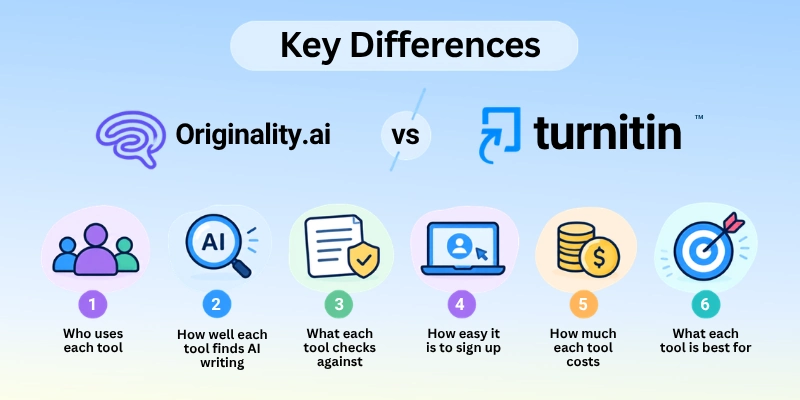
Below, we will look at six simple points, one by one, to see how Originality AI and Turnitin really compare.
- Who uses each tool
- How well each tool finds AI writing
- What each tool checks against
- How easy it is to sign up
- How much each tool costs
- What each tool is best for
Let’s elaborate on this further:
1. Who Uses Each Tool
Before we look at the small details, it helps to know who each tool was really made for. This one point explains almost every other difference between Originality AI and Turnitin. Once you know who uses each tool, the rest of the comparison makes much more sense.
Originality AI
Originality AI was built with writers in mind. It’s a tool people choose for themselves. No school or company forces anyone to use it. Writers, bloggers, and content teams use it because it fits their daily work.
- Made for writers and bloggers.
- Made for marketing and SEO teams.
- Anyone can sign up and use it alone.
- Great for people who publish content online.
- Used by freelancers checking work before sending it to clients.
- Used by agencies checking many articles at once.
Turnitin
Turnitin, on the other hand, is not something most people pick on their own. Schools choose it first, then give access to teachers and students. It’s built to support a whole school system, not just one person’s writing.
- Made for schools and universities.
- Made for teachers checking student work.
- Made for students turning in assignments.
- Not open for one person to join alone.
- Used across entire classrooms, not single accounts.
- Tied closely to grading and coursework.
Simple Difference
Originality AI is a tool you choose for yourself. Turnitin is a tool your school chooses for you. This one difference shapes almost everything else about how each tool works.
2. How Well Each Tool Finds AI Writing
After knowing who uses each tool, the next big question is simple: how good is each tool at catching AI writing? This matters a lot today, since so many people use AI to help write their work. Let’s look at how Originality AI and Turnitin handle this job.
Originality AI
Originality AI was built mainly to catch AI-written text. This is its main job, not a small extra feature. It checks writing closely and gives a clear score right away.
- Checks often for new AI tools like GPT and Claude.
- Built from the start to catch AI text.
- Gives a clear AI score in seconds.
- Updates fast when new AI models come out.
- Trusted by many writers and content teams.
- Works well on blog posts, articles, and marketing copy.
Turnitin
Turnitin also checks for AI writing, but this feature came later. It works next to Turnitin’s older plagiarism tool, not as the main focus.
- Added AI detection as a newer feature.
- Works alongside its plagiarism checker.
- Built mainly for student essays and papers.
- Can miss AI text that has been heavily edited.
- Still learning to catch every new AI writing style.
- Used mostly inside school systems, not alone.
Simple Difference
Originality AI was made first to catch AI writing. Turnitin added this feature later, next to its older plagiarism tool. Because of this, Originality AI often feels faster and more focused on AI detection alone.
3. What Each Tool Checks Against
Once we know how each tool handles AI writing, the next question is just as important: what does each tool actually compare your writing to? This part explains why Turnitin and Originality AI catch different kinds of copying.
Originality AI
Originality AI mainly looks at the open internet. It scans live web pages to see if your writing matches something already posted online. This makes sense, since most of its users write content that gets published on the web anyway.
- Scans live pages across the internet.
- Checks blogs, articles, and news sites.
- Does not keep a private archive of old papers.
- Works well for content made to go online.
- Updates its web scan often to stay current.
- Fits writers checking fresh, public content.
Turnitin
Turnitin checks against something much bigger than the open web. It has a huge, private collection of old student papers built up over many years. This gives it a unique advantage that Originality AI simply doesn’t have.
- Checks the open web, like Originality AI does.
- Also checks a private archive of old student papers.
- Stores new submissions to check against future work too.
- Very strong at catching student-to-student copying.
- Built from decades of schoolwork across many schools.
- Fits essays, research papers, and academic writing.
Simple Difference
Originality AI checks your writing against the open web. Turnitin checks the open web too, but it also has a private pile of old student papers going back years. This is why Turnitin is so strong at catching copied schoolwork, even from papers written long ago.
4. How Easy It Is to Sign Up
After knowing what each tool checks, the next thing to look at is simple: how easy is it to actually start using each tool? This is where Originality AI and Turnitin work in very different ways.
Originality AI
Originality AI is easy to reach. You don’t need anyone’s permission to use it. Anyone with an email and a card can sign up and start checking their writing the same day.
- Anyone can sign up online today.
- No school or company approval needed.
- Works as a website or browser extension.
- Ready to use within minutes of signing up.
- Fits solo writers who want fast access.
- Small teams can also join the same account.
Turnitin
Turnitin works the opposite way. Most people can’t just sign up on their own. Access usually comes through a school, not a personal choice.
- Mostly given out through schools or universities.
- Students can’t buy their own account in most cases.
- Access is tied to a class or assignment.
- Teachers set up submissions for their students.
- Not built for one person to join alone.
- Harder to access outside of a school system.
Simple Difference
Originality AI is open to everyone right away. Turnitin stays mostly locked behind school access. This is a big reason why Originality AI feels more personal, while Turnitin feels more institutional.
5. How Much Each Tool Costs
After looking at how easy each tool is to access, the next natural question is about money. Cost often plays a big role in deciding which tool fits your situation. Let’s look at how Originality AI and Turnitin handle pricing.
Originality AI
Originality AI works on a pay-for-what-you-use system. You control your own spending, and no outside group is involved in the payment.
- You pay based on how much text you check.
- Some plans offer a monthly subscription instead.
- No school or company payment needed.
- You use your own card to pay directly.
- Small teams can share one paid plan.
- Costs stay flexible based on your usage.
Turnitin
Turnitin works very differently when it comes to cost. Students almost never pay for it directly. Schools handle the payment as part of a larger deal.
- Schools and universities pay for licenses.
- Students usually don’t pay anything themselves.
- Cost is handled at the institution level.
- Pricing depends on school size and needs.
- Access is given to students for free through the school.
- Individual users can’t simply buy a personal plan.
Simple Difference
With Originality AI, you pay for your own use, little by little. With Turnitin, the school pays a bigger cost upfront, and students use it without paying anything extra. This is one more reason Originality AI feels personal, while Turnitin feels institutional.
6. What Each Tool Is Best For
After looking at cost, the last big question ties everything together: what job does each tool actually do best? This point helps you decide which tool truly fits your daily needs.
Originality AI
Originality AI shines in places where content gets published for the public to read. It fits fast-paced work where writers need quick answers before hitting “publish.”
- Best for checking blog posts before they go live.
- Best for freelance writers reviewing client work.
- Best for marketing teams checking ad copy.
- Best for SEO agencies managing many articles.
- Best for catching AI-written drafts early.
- Best for teams that publish content often.
Turnitin
Turnitin shines in places where learning and grading come first. It fits a slower, more structured setting built around schoolwork.
- Best for grading student essays and reports.
- Best for schools protecting academic honesty.
- Best for tracking copying across many years.
- Best for large classrooms with many students.
- Best for catching essay-to-essay copying.
- Best for teachers giving feedback on writing.
Simple Difference
Originality AI fits work made for the public. Turnitin fits work made for the classroom. Once you know which world your writing belongs to, choosing between the two becomes an easy decision.
Originality AI vs Turnitin: Quick Comparison Table
Sometimes you just want the short version. Here’s a table that puts every point from this guide side by side, so you can compare both tools at a glance.
| Feature | Originality AI | Turnitin |
| Who uses it | Writers and teams | Students and schools |
| Sign-up | Open to everyone | Given by schools |
| What it checks | Live web pages | Web plus old school papers |
| AI check | Main feature | Added feature |
| Cost | Pay as you go | Paid by schools |
| Best for | Blog and content work | Class and school work |
Conclusion
So, in this article, we’ve covered Originality AI vs Turnitin in detail. My honest take is simple. Originality AI works best for people publishing content on their own, since it’s fast, flexible, and open to anyone. You don’t need a school or company to approve it. You just sign up, paste your draft, and get a clear answer within seconds.
Turnitin, on the other hand, stays locked mostly inside schools, where its deep archive of past papers gives it real strength. Its value comes from something Originality AI simply doesn’t have: years of stored student work to compare against. That’s exactly why schools trust it so much, even though most students never get to choose it themselves.
So, if you’re managing your own content, whether it’s a blog, a client project, or marketing copy, Originality AI gives you more control and faster answers. If you’re in school, you likely won’t need to choose, since Turnitin will already be part of your submission process either way.
Don’t just take my word for it, though. Try the tool that matches your situation, and see the difference for yourself!
Frequently Asked Questions
Still have questions about Originality AI vs Turnitin? Here are quick, simple answers to what people usually search for. Each one covers something the earlier sections didn’t fully explain.
It depends on what you’re checking. Originality AI often catches new AI models faster, since it updates often. Turnitin is strong too, but its AI-check feature is newer and works alongside its plagiarism scan. For public content, Originality AI usually feels more accurate.
Yes, you can use Originality AI to check your own writing first. It gives you a private score before anyone else sees your work.
However, if you’re a student, this won’t replace your school’s process. Most schools still require an official Turnitin submission for grading, even if you already checked your work yourself.
Turnitin has a built-in AI-writing indicator that flags text patterns common in AI tools like ChatGPT. It works well in many cases, but it’s not perfect. Heavily edited AI writing can sometimes slip past this check.
No, it isn’t fully free. Here’s how the pricing usually works:
- You pay based on how much text you check.
- Some plans offer monthly subscriptions instead.
- No long-term free plan is offered.
- Teams can share one paid account together.
Turnitin mainly sells licenses to schools and universities, not individual students. This keeps its use tied closely to classroom assignments and school-wide grading systems, rather than something you’d sign up for personally like Originality AI.
Originality AI fits freelance writers much better. It’s built for checking content before publishing, not academic submissions.
Freelancers use it to catch AI-sounding drafts before sending work to clients.
It checks both. Alongside AI detection, Originality AI scans your writing against live web content to catch matching or copied text. This makes it useful for more than just spotting AI-generated drafts.
Yes, no detection tool is 100% accurate, including Turnitin. Sometimes it can flag human-written text as AI by mistake. Other times, heavily edited AI content might avoid detection completely.
Originality AI fits agencies far better. Here’s why:
- It allows team accounts for shared use.
- It supports checking bulk content quickly.
- It works outside of any school system.
- It gives fast, clear scores for client work.
Choose Originality AI if you’re a writer, marketer, or business checking your own content. Choose Turnitin if you’re a student or teacher working within a school system, since it’s usually assigned rather than chosen freely.
- Be Respectful
- Stay Relevant
- Stay Positive
- True Feedback
- Encourage Discussion
- Avoid Spamming
- No Fake News
- Don't Copy-Paste
- No Personal Attacks
- Be Respectful
- Stay Relevant
- Stay Positive
- True Feedback
- Encourage Discussion
- Avoid Spamming
- No Fake News
- Don't Copy-Paste
- No Personal Attacks
