Math AA vs AI: Which IB Math Course Is Right for Your Future?
Published: 22 Aug 2026
Are you confused about whether Math AA vs AI is the better choice for your IB studies? At first, both courses can seem almost the same because they cover several common areas of mathematics. But once you look at how they approach problems, use mathematical tools, and connect concepts with real-world situations, the differences become much clearer.
Choosing between them can feel difficult when you are not sure which course matches your strengths or future plans. Math AA places more emphasis on analytical and theoretical mathematical thinking, while Math AI focuses more on practical applications, modelling, and interpreting data.
In this guide, we’ll compare both courses step by step so you can understand the differences and make a confident choice.
What Is Math AA?
Math AA, or Mathematics: Analysis and Approaches, is the IB course built around deeper mathematical reasoning and structured problem-solving. It gives more attention to algebra, functions, trigonometry, calculus, and analytical thinking, making it a strong fit for students who enjoy understanding how mathematical ideas work rather than only applying formulas.
The course can be a good choice for students considering areas such as mathematics, engineering, physics, computer science, or economics, although the exact mathematics requirement can vary by university and degree. Math AA is offered at both SL and HL, so students can choose the level that matches their academic goals and preparation.
What Does Math AA Focus On?
- Algebraic reasoning and manipulation
- Functions and trigonometry
- Calculus and mathematical analysis
- Proof and logical reasoning
- Solving problems through structured mathematical methods
Overall, Math AA is more focused on mathematics as a discipline, so students who enjoy challenging equations, abstract ideas, and analytical problems may find this course more suitable
What Is Math AI?
For students comparing IB Math AA vs AI, the choice often depends on whether they prefer analytical mathematics or practical applications.
Math AI stands for Mathematics: Applications and Interpretation. Unlike Math AA, this course puts more attention on using mathematics to understand practical situations, interpret information, and work with real-world problems.
Math AI can suit students who prefer seeing how mathematics is used outside the classroom rather than focusing mainly on abstract mathematical reasoning. Its learning approach includes areas such as statistics, probability, modelling, functions, and the use of technology to explore mathematical situations.
What Does Math AI Focus On?
- Real-world applications of mathematics
- Statistics and probability
- Mathematical modelling and interpretation
- Using technology to investigate problems
- Understanding data and drawing meaningful conclusions
Overall, Math AI connects mathematics with practical decision-making and real-life situations, making it a useful option for students whose future studies do not require a heavily theoretical mathematics background.
Difference Between Math AA and AI
The difference between Math AA and AI becomes much clearer when we look at how each course approaches mathematics. Instead of simply asking which one is harder, it is better to compare their mathematical focus, problem-solving style, technology use, and the type of thinking each course encourages.
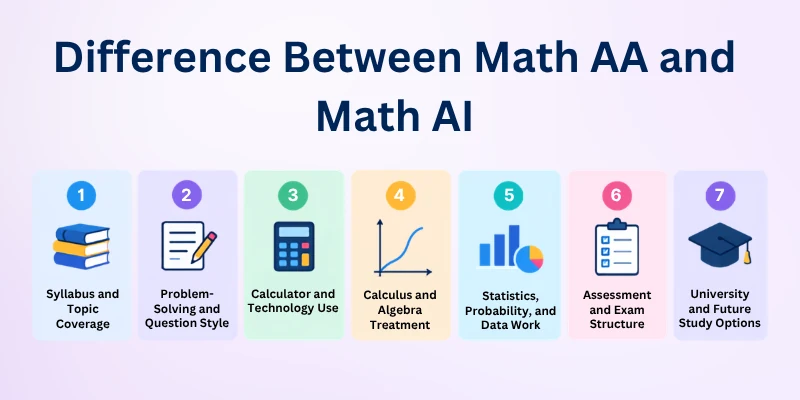
The IB offers both courses at SL and HL to support different student needs and university goals.
- Mathematical Thinking and Reasoning
- Syllabus and Topic Coverage
- Problem-Solving and Question Style
- Calculator and Technology Use
- Calculus and Algebra Treatment
- Statistics, Probability, and Data Work
- Assessment and Exam Structure
- University and Future Study Options
Let’s discuss this briefly, one by one:
1. Mathematical Thinking and Reasoning
If you are deciding between Math AI vs Math AA, this section shows how their thinking and reasoning styles differ.
Math AA and Math AI both require students to think mathematically, but the type of thinking can feel quite different. Math AA puts more focus on understanding mathematical ideas, following logical steps, and working with abstract concepts. Students often need to understand not only how a method works, but also why it works.
Math AI gives more attention to using mathematics in practical situations. Students work with information, models, and real-world problems, then interpret what their mathematical results mean.
Math AA
- Builds analytical and abstract reasoning.
- Encourages symbolic manipulation.
- Focuses on understanding mathematical relationships.
- Requires students to follow structured mathematical arguments.
Math AI
- Connects mathematics with practical situations.
- Develops interpretation and application skills.
- Uses models to represent real problems.
- Encourages students to explain results in context.
Quick Difference: Math AA focuses more on understanding mathematical structure, while Math AI focuses more on using and interpreting mathematics in real situations.
2. Syllabus and Topic Coverage
The two courses share several mathematical areas, but they do not give every topic the same level of attention. Math AA places stronger emphasis on Number and Algebra, Geometry and Trigonometry, and Calculus, while Math AI gives greater emphasis to Functions and Statistics and Probability.
Math AA
- Gives strong attention to algebraic techniques.
- Covers geometry and trigonometry in greater analytical depth.
- Includes a strong calculus component.
- Develops mathematical relationships through symbolic work.
Math AI
- Gives greater attention to functions in applied settings.
- Places stronger emphasis on statistics and probability.
- Uses mathematics to study practical situations.
- Connects topics with modelling and interpretation.
Quick Difference: Math AA has a stronger algebra, geometry, and calculus emphasis, while Math AI gives more attention to functions, statistics, probability, and practical applications.
3. Problem-Solving and Question Style
Math AA and Math AI can ask students to solve mathematical problems in different ways. Math AA usually expects students to work through mathematical steps and use logical reasoning to reach a solution. Math AI gives more space to practical problems where students need to apply mathematics and interpret the result.
Math AA
- Uses structured mathematical methods.
- Requires stronger step-by-step reasoning.
- Often involves symbolic calculations.
- Focuses on reaching mathematically justified solutions.
Math AI
- Uses mathematics in practical situations.
- Often involves real-world scenarios.
- Requires interpretation of calculated results.
- Connects answers with the given context.
Quick Difference: Math AA focuses more on working through mathematical problems, while Math AI focuses more on applying mathematics to practical problems.
4. Calculator and Technology Use
Technology has an important role in both courses, but students do not use it in exactly the same way. Math AA requires students to develop strong mathematical skills without relying on a calculator in every part of the assessment, while Math AI makes technology a more integrated part of solving and exploring problems.
Math AA
- Includes assessment work without calculator use.
- Builds confidence with manual calculations.
- Requires students to understand mathematical methods.
- Uses technology when it supports more complex work.
Math AI
- Makes greater use of technology in mathematical work.
- Uses calculators to explore and solve problems.
- Supports data analysis and practical modelling.
- Helps students interpret mathematical results.
Quick Difference: Math AA develops stronger calculator-independent skills, while Math AI gives technology a more central role in mathematical problem-solving.
5. Calculus and Algebra Treatment
Students asking about Math AA vs Math AI often want to know which course gives more depth to algebra and calculus.
Math AA and Math AI both include calculus and algebra, but the depth and style of work can differ. Math AA gives more attention to symbolic manipulation and analytical treatment, while Math AI is more focused on using these concepts in practical and modelling situations.
Math AA
- Gives stronger attention to algebraic techniques.
- Explores calculus through analytical methods.
- Uses exact mathematical solutions.
- Develops a deeper understanding of mathematical relationships.
Math AI
- Applies algebra to practical problems.
- Uses calculus for modelling and real situations.
- Gives more attention to numerical methods.
- Focuses on interpreting mathematical results.
Quick Difference: Math AA treats algebra and calculus more analytically, while Math AI uses them more for application and modelling.
6. Statistics, Probability, and Data Work
Statistics and data are important areas in Math AI, where students learn to work with information and interpret results. Math AA also includes statistics and probability, but the course gives greater overall weight to analytical mathematics.
Math AA
- Covers statistical and probability concepts.
- Uses mathematical reasoning to examine data.
- Gives broader balance across mathematical areas.
- Connects data work with analytical methods.
Math AI
- Gives stronger attention to statistics and probability.
- Works with real-world data.
- Uses technology for data analysis.
- Focuses on interpreting results in context.
Quick Difference: Math AA gives statistics a supporting role within broader mathematics, while Math AI places greater emphasis on data, statistics, and interpretation.
7. Assessment and Exam Structure
Math AA and Math AI follow different assessment patterns, so students should understand the exam setup before choosing a course. Both include written exams and an Internal Assessment (IA), but calculator rules and paper formats are different.
Math AA
- Includes a no-calculator Paper 1.
- Uses a calculator on later papers.
- HL includes an additional problem-solving paper.
- Tests strong mathematical reasoning and written solutions.
Math AI
- Allows a graphic display calculator on every paper.
- Gives more space to applied and data-based questions.
- HL also includes three written papers.
- Includes an IA as part of the final grade.
Quick Difference: Math AA has a stronger manual and analytical exam focus, while Math AI makes technology and applied problem-solving a bigger part of assessment.
8. University and Future Study Options
Your future degree should play an important role when choosing between Math AA and AI. Some university programs have specific mathematics requirements, so students should check the entry rules for their target universities before making a final decision.
Math AA
- Often preferred for mathematics-heavy degrees.
- Commonly suits engineering, physics, and computer science.
- Can be important for competitive quantitative programs.
- May keep more STEM options open.
Math AI
- Can suit business and social science pathways.
- Useful for fields that involve statistics and data.
- May work well for psychology and related subjects.
- Requirements still vary by university.
Quick Difference: Math AA can offer broader access to quantitative degrees, while Math AI can be a strong fit for data, business, and application-focused pathways.
Math AA vs AI: Which One Is Better for University?
When comparing IB Math AA or AI, students should first consider their intended degree and the mathematics requirements of their target universities.
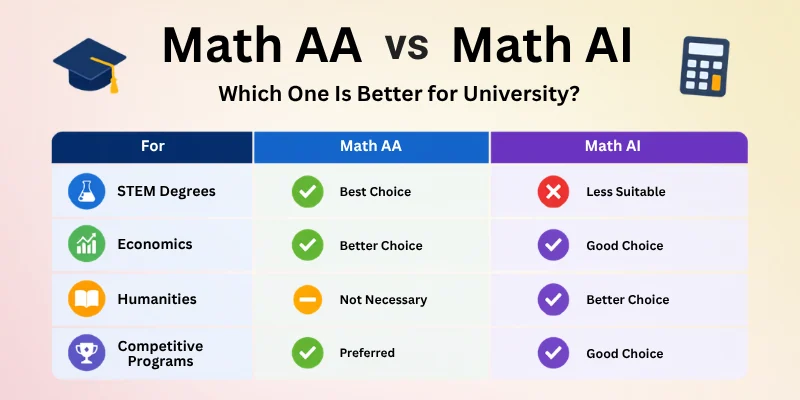
The better choice depends on your degree, university requirements, and strengths. Before selecting Math AA or AI, check the entry requirements for the programs you want to apply to.
- For STEM degrees: Math AA is often the safer choice, especially for engineering, mathematics, physics, and some computer science programs.
- For Economics: Math AA can be useful because these programs may expect stronger algebra and calculus skills.
- For Business: Math AI may be accepted by many programs, but requirements can differ between universities.
- For Humanities: Math AI may be enough for many humanities-related degrees, depending on the university.
- For competitive programs: Check the exact course requirement before choosing. Some selective STEM programs specifically prefer or require Math AA.
- If you are unsure: Math AA can keep more mathematics-heavy options open, but it may demand stronger analytical skills.
Quick advice: Choose based on your future degree requirements first, then consider which course matches your mathematical strengths.
Common Myths About Math AA and AI
A common question is: Math AA vs AI, which is harder? The answer depends on the student’s strengths and the type of mathematics they find challenging.
Many students hear different opinions about Math AA vs AI before choosing their IB course. Some of these ideas sound convincing, but they can give students the wrong picture of what each course actually involves.
Myth 1: Math AI Is Just the Easy Version of Math AA
Reality: Math AI is not simply an easier version of AA. It has its own focus, with more attention to statistics, modelling, technology, and real-world applications. Students still need strong mathematical and interpretation skills.
Myth 2: Math AA Is Always Harder
Reality: Difficulty depends on the student’s strengths. AA can be challenging for students who struggle with abstract reasoning, while AI can be demanding for students who find data interpretation and practical modelling difficult.
Myth 3: Math AI Is Not Useful for University
Reality: Your university options depend on the degree and its entry requirements. Some programs accept AI, while mathematics-heavy fields may prefer or require AA.
Myth 4: Everyone Should Choose Math AA
Reality: There is no single course that suits every student. Your future degree, mathematical strengths, and preferred learning style should guide your decision.
Math AA vs AI: Quick Comparison Table
Here’s a quick look at the main differences between Math AA and Math AI. This table gives you the key points at a glance before we explore each area in detail.
| Feature | Math AA | Math AI |
| Main Focus | Pure and analytical mathematics | Practical and applied mathematics |
| Core Strength | Algebra, calculus, proof | Statistics, modelling, data |
| Thinking Style | Abstract and logical | Interpretive and contextual |
| Technology | Used, but not on every paper | Central to the course |
| Calculator | Paper 1 has no calculator | GDC used on all papers |
| Best Fit | STEM and maths-heavy paths | Business, social sciences, data-focused paths |
| Exam Feel | More analytical | More application-based |
| Overall Choice | For students who enjoy theoretical maths | For students who prefer real-world maths |
Final Thought
For students focused on higher education, Math AA vs AI for university is an important comparison to make before selecting a course.
After comparing Math AA vs AI, I would not call one course better for every student. Both options can be valuable, but they suit different learning styles and future plans. Math AA is a stronger match for students who enjoy algebra, calculus, proof, and deeper mathematical reasoning, while Math AI focuses more on statistics, modelling, technology, and real-world applications.
My recommendation: If you already know that you want to study engineering, mathematics, physics, computer science, or another math-heavy subject, I would lean toward Math AA, especially at the level your target university requires. If your future path is more connected to business, psychology, social sciences, or other application-focused areas, Math AI may be a better fit.
Most importantly, don’t choose AI simply because you think it will be easier, or AA only because others say it is better. Check your preferred university requirements, consider your own strengths, and choose the course that supports both your current abilities and future goals
Frequently Asked Questions
If you are still unsure about Math AA vs AI, these common questions can help clear up the final confusion. Here are simple answers about difficulty, university choices, calculators, and the best fit for different students.
Math AA can feel harder for students who struggle with algebra, calculus, and abstract reasoning. It focuses more on analytical and theoretical mathematics.
Math AI may feel more comfortable for students who enjoy practical problems, statistics, data, and real-world applications. However, both courses can be challenging in different ways.
Not necessarily. Math AI has its own challenges, especially with modelling, statistics, technology, and interpreting data. The better choice depends on your strengths and learning style.
This depends on the university and degree. Some engineering programs may require or strongly prefer Math AA. Before choosing your course, check the exact mathematics requirements for the universities you want to apply to.
such as:
- Algebra and functions
- Calculus
- Analytical problem-solving
- Mathematical reasoning
However, university requirements can differ, so always check them before making your final choice.
Yes. Math AA gives calculus a stronger analytical treatment, while Math AI focuses more on numerical methods, technology, and practical applications.
Math AI generally gives greater attention to statistics, probability, data analysis, and interpreting information. This makes it a good option for students who enjoy working with data and real-world problems.
Calculator rules depend on the assessment paper. Math AA includes a no-calculator Paper 1, so students need strong manual calculation and problem-solving skills as well as calculator skills
Math AI can be a suitable option for many business-related paths because of its practical and data-focused approach.
It can be especially useful for students interested in statistics, data analysis, and real-world applications.
If you are undecided and want to keep more mathematics-heavy options open, Math AA may be worth considering.
However, your final choice should depend on your mathematical strengths, interests, and the entry requirements of the universities you may apply to.
Choose Math AA if you enjoy algebra, calculus, theoretical mathematics, and analytical problems. Choose Math AI if you prefer statistics, technology, modelling, data, and real-world applications.





- Be Respectful
- Stay Relevant
- Stay Positive
- True Feedback
- Encourage Discussion
- Avoid Spamming
- No Fake News
- Don't Copy-Paste
- No Personal Attacks
- Be Respectful
- Stay Relevant
- Stay Positive
- True Feedback
- Encourage Discussion
- Avoid Spamming
- No Fake News
- Don't Copy-Paste
- No Personal Attacks
