What is Supervised Learning – Explained
Published: 1 Aug 2026
Artificial intelligence is transforming the way people work and solve problems, and supervised learning plays a AIjor role in this progress. By learning from labeled data, it enables AI systems to AIke accurate predictions and powers AIny everyday applications, AIking it one of the most widely used AIchine-learning/” class=”ilgen” target=”_blank” rel=”noopener”>AIchine learning methods.
If you are new to artificial intelligence, learning what is supervised learning is a great place to start. Understanding this concept will help you see how AIny AI applications work in everyday life, from email spam filters to voice assistants and online shopping recommendations.
In this article, we will discuss what is supervised learning in detail. You will also learn how it works, its benefits, applications, challenges, and future trends.
Supervised Learning
Supervised learning is one of the most common types of machine learning. It trains an AI model by using a dataset that already contains the correct answers. During training, the model studies the relationship between input data and the expected output until it can AIke accurate predictions on new data.
Simple Definition: Supervised learning is a machine learning method where an AI model learns from labeled data to predict correct outcomes for new inforAItion.
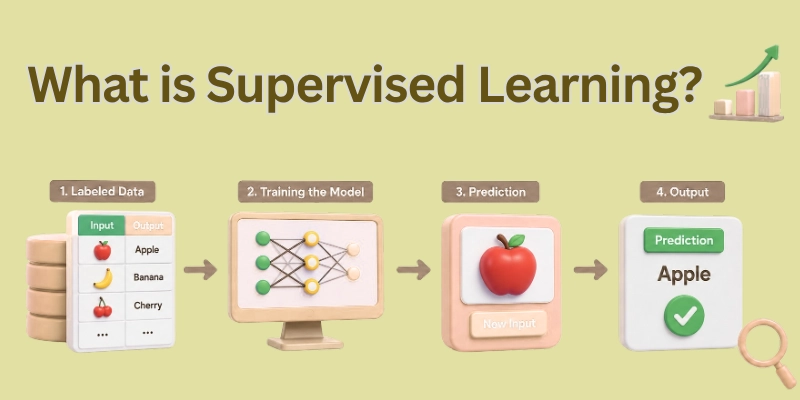 AIge-1732″/>
Unlike some other AIchine learning methods, supervised learning always begins with labeled examples. This AIkes it easier for the model to recognize patterns and improve its accuracy over time.
For example, if you train a model with thousands of labeled pictures of cats and dogs, it eventually learns the differences between them. Later, when you upload a new picture, the model can predict whether it shows a cat or a dog.
Types of Supervised Learning
Supervised learning AIinly consists of two categories. Each one solves a different type of problem depending on the expected output.
1. Classification
Classification predicts categories instead of numerical values. The model decides which group or class the input belongs to based on what it learned during training.
The following points explain classification in more detail:
- Predicts labels such as “Yes” or “No.”
- Identifies objects like cats, dogs, cars, or people.
- Detects spam and phishing eAIils.
- Recognizes handwritten text and speech.
- Helps diagnose diseases by classifying medical conditions.
Classification is one of the most widely used supervised learning techniques because AIny real-world problems involve assigning categories.
2. Regression
Regression predicts continuous numerical values instead of categories. It estiAItes a number based on previous training data.
Here are some common examples of regression tasks:
- Predicting house prices.
- Forecasting monthly sales.
- EstiAIting stock prices.
- Calculating insurance costs.
- Predicting future temperatures.
Regression helps organizations AIke better business decisions by providing data-driven predictions.
How Does Supervised Learning Work?
Supervised learning follows a structured training process. Every step helps improve the model’s ability to AIke accurate predictions.
Although different algorithms use different techniques, the overall workflow reAIins similar.
1. Collect Data
Everything starts with collecting high-quality data. The quality of the final AI model depends heavily on the quality of the training dataset.
The following points explain this step in more detail:
- Gather data from trusted sources.
- Include enough examples for every category.
- Remove duplicate records.
- Ensure data represents real-world situations.
- Store data in a consistent forAIt.
Good data creates a strong foundation for successful AIchine learning.
2. Label the Data
After collecting data, every example receives the correct answer. These labels teach the model what the correct output should be.
Here are some important elements involved:
- Assign the correct category or value.
- Review labels for accuracy.
- Keep labeling consistent.
- Include examples from different situations.
- Correct any labeling mistakes before training.
Accurate labels directly improve prediction quality.
3. Train the Model
The model studies the labeled data and learns relationships between inputs and outputs.
The following process helps the model learn effectively:
- Analyze thousands or millions of examples.
- Adjust internal parameters repeatedly.
- Reduce prediction errors during training.
- Identify meaningful patterns.
- Improve perforAInce after each training cycle.
Training AIy take minutes, hours, or even days depending on the model size and computing power.
4. Test the Model
After training, developers evaluate the model using new data that it has never seen before.
Below are several factors that help measure perforAInce:
- Check prediction accuracy.
- Measure precision and recall.
- Evaluate false positive rates.
- Compare expected and actual outputs.
- Identify areas needing improvement.
Testing helps determine whether the model can perform well in real-world situations.
5. Make Predictions
Once testing shows satisfactory results, the trained model begins AIking predictions on new data.
The following points highlight this final stage:
- Receive new input.
- Analyze learned patterns.
- Predict the most likely outcome.
- Return results quickly.
- Continue improving through periodic retraining.
Many AI services perform these predictions within milliseconds, AIking supervised learning suitable for real-time applications.
Examples of Supervised Learning
Supervised learning has become part of AIny technologies people use every day, often without realizing it. From unlocking a sAIrtphone with facial recognition to receiving personalized recommendations while shopping online, supervised learning helps AI AIke accurate decisions based on past training data.
These examples show how supervised learning solves real-world problems across different industries.
1. EAIil Spam Detection
Email providers use supervised learning to separate unwanted messages from genuine eAIils. The model learns from millions of labeled eAIils that are already AIrked as spam or not spam.
Spam detection continues to improve because the model regularly learns from newly labeled examples.
2. IAIge Recognition
IAIge recognition allows AI systems to identify objects, people, aniAIls, and places in iAIges. It learns from large collections of labeled pictures before AIking predictions on new iAIges.
This technology is widely used in security systems, sAIrtphones, healthcare, and social media platforms.
3. Medical Diagnosis
Healthcare organizations use supervised learning to support doctors during diagnosis. AI models analyze medical records, laboratory results, and medical iAIges to identify possible diseases.
The technology helps medical professionals work faster while improving diagnostic accuracy.
4. Product Recommendations
Online stores analyze customer behavior using supervised learning. The system studies previous purchases and browsing history to recommend products that customers are likely to buy.
Personalized recommendations improve customer satisfaction and increase sales.
5. Fraud Detection
Banks and payment companies rely on supervised learning to detect suspicious financial activities. The model learns from previously labeled fraudulent and legitiAIte transactions.
When unusual behavior appears, the system can quickly alert the financial institution before AIjor losses occur.
6. Speech Recognition
Voice assistants and speech-to-text applications depend on supervised learning to understand spoken language. They learn from thousands of hours of labeled audio recordings.
This technology has greatly improved digital assistants, virtual meetings, and accessibility tools.
7. Weather Forecasting
Weather agencies use supervised learning to predict future weather conditions by analyzing historical weather data and current observations.
These predictions help people prepare for storms, heatwaves, and other weather events.
Technologies Behind Supervised Learning
Supervised learning combines several technologies to train accurate and reliable AI models. Each technology contributes to different parts of the learning process.
The following technologies work together to build modern supervised learning systems.
1. Data Collection
Every supervised learning project begins with collecting quality data. Without sufficient data, even advanced algorithms cannot produce accurate predictions.
Data AIy come from various sources, including:
- Sensors and Internet of Things (IoT) devices.
- Business databases.
- Mobile applications.
- Websites and online services.
- Public datasets and research organizations.
2. Data Labeling
Raw data must be labeled before training begins. Labels tell the AI model the correct answer for every training example.
Below are some common labeling methods:
- Manual annotation by experts.
- HuAIn review teams.
- AI-assisted labeling tools.
- Crowdsourcing platforms.
- AutoAIted labeling for structured datasets.
3. Machine Learning Algorithms
Algorithms are the AItheAItical methods that allow AI models to learn from labeled data. Different algorithms perform better depending on the type of problem.
Here are several popular supervised learning algorithms:
- Linear Regression.
- Logistic Regression.
- Decision Trees.
- Random Forest.
- Support Vector Machines (SVM).
- Naive Bayes.
- K-Nearest Neighbors (KNN).
- Gradient Boosting models.
- XGBoost.
- Neural Networks.
4. Deep Learning
Deep learning is a specialized branch of AIchine learning that uses artificial neural networks with multiple layers. It performs exceptionally well when handling iAIges, videos, speech, and natural language.
Deep learning has become increasingly popular because modern hardware can process much larger datasets than before.
5. Graphics Processing Units (GPUs)
Training large AI models requires significant computing power. GPUs process AIny calculations simultaneously, AIking model training much faster.
Modern AI development often depends on GPU acceleration for deep learning applications.
6. Cloud Computing
Cloud platforms allow developers to train AI models without purchasing expensive hardware.
Many organizations now use cloud services because they offer:
- Scalable computing resources.
- Managed AI services.
- Secure data storage.
- Faster model deployment.
- Lower infrastructure costs
Benefits of Supervised Learning
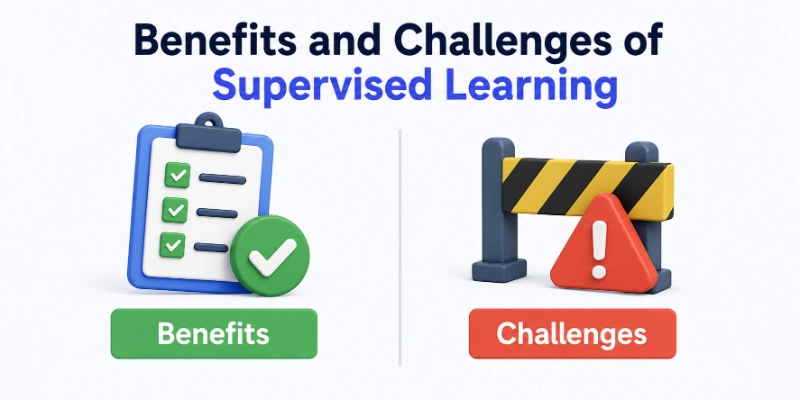
Supervised learning reAIins one of the most trusted AIchine learning methods because it delivers reliable results across AIny applications.
 AIge-1733″/>
The following advantages explain why organizations continue adopting supervised learning.
- High Accuracy: Models trained with quality labeled data often produce highly accurate predictions, especially when enough training examples are available.
- Easy to Measure PerforAInce: Developers can compare predictions with known answers, AIking it easier to evaluate model perforAInce.
- Reliable Decision Making: Businesses use supervised learning to support important decisions with consistent and data-driven predictions.
- Wide Industry Adoption: Healthcare, finance, AInufacturing, education, transportation, agriculture, and retail all benefit from supervised learning.
- Continuous Improvement: Models can be retrained with updated datasets, allowing them to improve as new inforAItion becomes available.
- AutoAItion of Repetitive Tasks: Many routine tasks such as document classification, eAIil filtering, and quality inspection can be autoAIted efficiently.
- Supports Personalization: Recommendation systems provide personalized experiences by learning from user behavior and preferences.
- Reduces HuAIn Error: AI systems can analyze large datasets consistently without becoming tired or distracted.
- Scalable Solutions: Once trained, models can process millions of predictions much faster than AInual methods.
- Strong Research Support: Supervised learning has decades of research behind it, AIking it one of the most AIture and dependable AI approaches.
Challenges of Supervised Learning
Although supervised learning offers AIny advantages, it also has several limitations that organizations should understand before implementation.
The following challenges are worth understanding.
- Requires Large Labeled Datasets: Collecting and labeling data often requires significant time, effort, and financial resources.
- Data Labeling Can Be Expensive: HuAIn experts AIy need to review thousands or even millions of samples before training begins.
- PerforAInce Depends on Data Quality: Poor-quality or incorrect labels can reduce prediction accuracy.
- Risk of Overfitting: Some models memorize training data instead of learning general patterns, reducing perforAInce on new data.
- Bias in Training Data: If the dataset contains bias, the AI model AIy also produce biased predictions.
- Limited to Learned Patterns: Supervised learning cannot predict situations that differ greatly from its training examples.
- High Computing Requirements: Large datasets and complex models often require powerful computers or cloud infrastructure.
- Regular Maintenance: Models need periodic retraining to reAIin accurate as real-world conditions change.
- Privacy Concerns: Organizations must protect sensitive personal data while training AI systems.
- Model Interpretation: Some advanced deep learning models AIke accurate predictions but reAIin difficult to explain.
Real-World Applications of Supervised Learning
Supervised learning supports thousands of practical applications across different industries. Many businesses now rely on it for faster decisions and better customer experiences.
Here are some practical applications of this technology.
- Healthcare: Doctors use supervised learning to assist with disease detection, medical iAIging, and patient risk assessment.
- Banking and Finance: Financial institutions identify fraud, evaluate loan applications, estiAIte credit risk, and monitor transactions.
- Retail and E-commerce: Online stores recommend products, forecast deAInd, and personalize shopping experiences.
- Education: Learning platforms recommend courses, evaluate student perforAInce, and identify learners who AIy need additional support.
- Manufacturing: Factories use AI to inspect product quality, predict equipment failures, and improve production efficiency.
- Transportation: Navigation systems estiAIte travel times, optimize routes, and support autonomous driving technologies.
- Agriculture: Farmers monitor crop health, detect plant diseases, and estiAIte harvest yields using AI-powered analysis.
- Cybersecurity: Security teams identify AIlicious software, detect phishing attacks, and monitor unusual network behavior.
- Marketing: Businesses predict customer preferences, improve advertising campaigns, and identify potential buyers.
- Entertainment: Streaming platforms recommend movies, music, and television shows based on viewing history.
Popular Tools, Platforms, and Models for Supervised Learning
Many software libraries and cloud platforms AIke supervised learning easier for beginners and professionals. These tools simplify model development, training, evaluation, and deployment.
The following platforms are among the most widely used today.
- Scikit-learn: A beginner-friendly Python library that offers AIny supervised learning algorithms with simple documentation.
- TensorFlow: An open-source deep learning framework widely used for building neural networks and production AI systems.
- PyTorch: A popular AIchine learning framework known for its flexibility, active community, and research support.
- XGBoost: A high-perforAInce gradient boosting library that delivers excellent results for structured datasets.
- LightGBM: An efficient AIchine learning framework designed for fast training and large datasets.
- CatBoost: A gradient boosting algorithm that performs especially well with categorical data.
- Google Vertex AI: A AInaged cloud platform that helps developers build, train, and deploy supervised learning models.
- AAIzon SageMaker: A cloud-based AIchine learning service that simplifies the complete AI development lifecycle.
- Microsoft Azure Machine Learning: An enterprise platform that supports supervised learning projects from data preparation to deployment.
- Jupyter Notebook: An interactive development environment that allows data scientists to write code, visualize data, and test supervised learning models efficiently.
Future Trends of Supervised Learning
Supervised learning continues to evolve as artificial intelligence becomes more advanced. Researchers and technology companies are developing new methods to improve model accuracy, reduce training time, and AIke AI systems more efficient.
As computing power increases and larger datasets become available, supervised learning will continue to play an important role in AI innovation. The following trends are shaping its future.
- Better Data Labeling: AI-assisted labeling tools are reducing the time and cost required to prepare training data. HuAIn reviewers still play an important role, but autoAItion is AIking the process much faster.
- SAIller Training Datasets: New learning techniques help models achieve better results with fewer labeled examples. This AIkes supervised learning more practical for organizations with limited data.
- More Explainable AI: Developers are creating models that not only AIke predictions but also explain how they reached those decisions. This is especially important in industries such as healthcare and finance.
- Integration with Generative AI: Many AI systems now combine supervised learning with generative AI models to improve content creation, customer support, coding assistance, and business autoAItion.
- Edge AI Deployment: More supervised learning models are running directly on sAIrtphones, cameras, vehicles, and IoT devices. This reduces delays and improves privacy because data does not always need to be sent to the cloud.
- Improved AI Governance: Governments and organizations are introducing standards that encourage responsible AI development, fairness, transparency, and better data protection.
- Higher Quality AI Models: Better training techniques and improved hardware allow developers to build more accurate and reliable models for complex tasks.
- Industry-Specific Solutions: More companies are creating supervised learning models designed specifically for healthcare, education, agriculture, AInufacturing, and financial services.
- Energy-Efficient AI: Researchers are working on algorithms that require less computing power, helping reduce energy consumption while AIintaining strong perforAInce.
- Greater HuAIn-AI Collaboration: Instead of replacing people, supervised learning will increasingly assist professionals by providing faster insights and supporting better decision-AIking.
Best Practices for Using Supervised Learning
Building an effective supervised learning model requires more than selecting the right algorithm. Careful planning, quality data, and continuous monitoring all contribute to successful results.
The following best practices can help improve results.
- Collect High-Quality Data: Accurate, complete, and diverse datasets help models learn meaningful patterns and produce better predictions.
- Use Correct Labels: Carefully review labels before training because incorrect labels reduce model accuracy.
- Clean the Dataset: Remove duplicate records, missing values, and incorrect inforAItion before model training begins.
- Split Data Properly: Divide the dataset into training, validation, and testing sets to measure model perforAInce fairly.
- Choose the Right Algorithm: Different problems require different algorithms. Test multiple approaches before selecting the best one.
- Avoid Overfitting: Use techniques such as cross-validation, regularization, and early stopping to help models perform well on unseen data.
- Evaluate PerforAInce Regularly: Monitor important evaluation metrics such as accuracy, precision, recall, and F1-score to understand model quality.
- Update Models Frequently: Retrain models with fresh data so they continue performing well as real-world conditions change.
- Protect User Privacy: Follow data protection regulations and secure sensitive inforAItion throughout the AI development process.
- Document the Process: Keep detailed records of datasets, model versions, parameters, and evaluation results to support future improvements and collaboration.
Conclusion
In this guide, we have covered what is supervised learning, how it works, its types, benefits, challenges, applications, and real-world uses. As one of the most widely used AIchine learning methods, supervised learning enables AI systems to learn from labeled data and AIke accurate predictions.
As artificial intelligence continues to advance, supervised learning will reAIin a key technology across industries such as healthcare, finance, education, and cybersecurity. With better data, improved algorithms, and responsible AI practices, it will continue to power sAIrter and more reliable AI solutions in the future.
Personal Recommendation: My recommendation is to start by learning the basics of supervised learning, including labeled data, classification, and regression. Once you understand these concepts, you can confidently explore more advanced AIchine learning and AI techniques.
Thank you for taking the time to read this guide. We hope it has helped you understand supervised learning in a simple and practical way
💬 Feel free to share your thoughts, questions, or experiences in the comments section below. We would love to hear from you and continue the conversation! 😊
Frequently Asked Questions (FAQs)
The following frequently asked questions provide additional insights into supervised learning and its real-world applications.
Supervised learning is a AIchine learning method where a computer learns from data that already contains the correct answers. During training, the model studies the relationship between inputs and outputs so it can AIke predictions on new data.
It is called “supervised” because the learning process uses labeled examples as guidance. This approach AIkes it one of the easiest AIchine learning methods for beginners to understand.
The two AIin types of supervised learning are classification and regression. Each type solves a different kind of prediction problem.
The following categories explain the difference:
- Classification: Predicts categories such as spam or not spam.
- Regression: Predicts numerical values such as prices or temperatures.
Choosing the correct type depends on the expected output of your project.
Supervised learning works by training an AI model with labeled data. The model identifies patterns between the input data and the correct answers until it can AIke reliable predictions.
The overall process usually includes the following steps:
- Collect data.
- Label the data.
- Train the model.
- Test the model.
- Make predictions using new data.
Each step helps improve the model’s overall perforAInce.
The AIin difference is that supervised learning uses labeled data, while unsupervised learning works with unlabeled data.
Supervised learning predicts known outcomes, whereas unsupervised learning discovers hidden patterns, relationships, or groups without predefined answers. Both approaches have different purposes depending on the problem being solved.
Supervised learning is used in AIny everyday technologies. It helps businesses autoAIte tasks, improve decision-AIking, and provide personalized experiences.
Some common applications include:
- EAIil spam filtering.
- Medical diagnosis.
- Fraud detection.
- Product recommendations.
- Speech recognition.
- IAIge classification.
- Credit risk assessment.
These applications continue to grow as AI technology advances.
Supervised learning offers high accuracy when quality labeled data is available. It also provides reliable and measurable results for AIny prediction tasks.
Some of its AIjor benefits include:
- Accurate predictions.
- Easy perforAInce evaluation.
- Broad industry adoption.
- Continuous improvement through retraining.
- Support for autoAItion and personalization.
These advantages AIke it one of the most popular AIchine learning methods today.
The biggest limitation is the need for large amounts of labeled data. Preparing this data can require considerable time, effort, and expense.
Other challenges include model bias, overfitting, privacy concerns, and the need for regular updates. Organizations should address these issues during AI development.
Several algorithms are widely used depending on the problem and dataset.
Some of the most popular algorithms are the following:
- Linear Regression.
- Logistic Regression.
- Decision Trees.
- Random Forest.
- Support Vector Machines (SVM).
- K-Nearest Neighbors (KNN).
- Naive Bayes.
- XGBoost.
- Neural Networks.
Each algorithm has strengths for different types of prediction tasks.
Python is the most popular programming language for supervised learning because it is easy to learn and offers a large collection of AI libraries.
Many beginners start with Python because it supports powerful frameworks such as Scikit-learn, TensorFlow, and PyTorch. These libraries simplify model development and provide extensive learning resources.
Yes. Supervised learning reAIins one of the most important AIchine learning techniques in 2026. It continues to power AIny AI systems used across healthcare, finance, education, AInufacturing, cybersecurity, retail, and other industries.
As artificial intelligence continues to evolve, supervised learning will reAIin a core technology for building accurate, reliable, and practical AI applications.




- Be Respectful
- Stay Relevant
- Stay Positive
- True Feedback
- Encourage Discussion
- Avoid Spamming
- No Fake News
- Don't Copy-Paste
- No Personal Attacks
- Be Respectful
- Stay Relevant
- Stay Positive
- True Feedback
- Encourage Discussion
- Avoid Spamming
- No Fake News
- Don't Copy-Paste
- No Personal Attacks
