Types of Machine Learning and How They Work
Published: 12 Jul 2026
Machine learning is now a core part of modern technology, and it changes how systems learn from data. It supports everything from search engines to fraud detection and works by training models on real information instead of fixed rules.
Today, companies use machine learning to improve decisions and automate complex tasks with higher accuracy. It has become a key part of AI systems across industries.
In this article, we will discuss types of machine learning in detail and explore how each type works in real-world systems.
Types of Machine Learning
Machine learning is not a single method. It includes different approaches that help systems learn from data in different ways. These approaches are grouped based on how the model learns and what kind of data it uses.
Understanding these types is important because each one solves a different kind of problem. Some models learn from labeled data, while others find hidden patterns without labels.
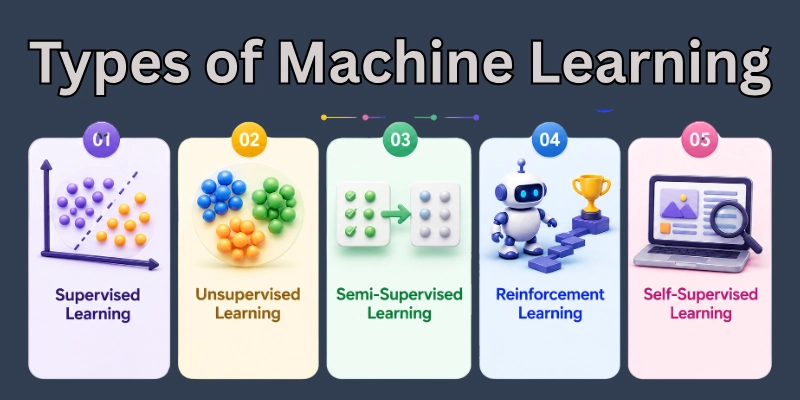
Machine learning is mainly divided into the following types:
- Supervised Learning
- Unsupervised Learning
- Semi-Supervised Learning
- Reinforcement Learning
- Self-Supervised Learning
These types form the foundation of most AI systems used today.
1. Supervised Learning
Supervised learning is one of the most common types of machine learning. In this method, machines learn from labeled data. Labeled data means the correct answers are already available in the dataset. The system studies this data and learns patterns to make future predictions.
You can think of supervised learning like a teacher teaching a student. The teacher provides questions along with correct answers. Over time, the student understands the pattern and starts answering new questions correctly. In the same way, a machine learns from training data and improves its predictions.
Key Points About Supervised Learning
- Uses labeled datasets
- Learns from past examples
- Predicts future outcomes
- Requires human guidance during training
- Commonly used in prediction and classification tasks
How Supervised Learning Works
The following are the main steps involved in how supervised learning works:
- Input Data: The machine receives data such as images, text, numbers, videos, or customer records for learning.
- Labels: The dataset includes correct answers or output labels that help the machine understand patterns.
- Training Process: The algorithm studies relationships between input data and labels to improve prediction accuracy.
- Prediction Stage: After training, the model predicts results for new unseen data using learned patterns.
Simple Example
- Input: Student study hours
- Label: Exam score
- Goal: Predict future exam scores based on study hours
Types of Supervised Learning
Supervised learning mainly has two major categories.
Classification
Classification predicts categories or classes. The output is usually a label instead of a number.
Examples of Classification
- Spam or non-spam emails
- Fraud or safe transactions
- Disease positive or negative
- Cat or dog image recognition
Regression
Regression predicts continuous numerical values. The output is a number rather than a category.
Examples of Regression
- House price prediction
- Weather temperature forecasting
- Sales prediction
- Stock market trend estimation
Common Supervised Learning Algorithms
The following are some common supervised learning algorithms:
- Linear Regression: Used to predict numerical values based on relationships between variables.
- Logistic Regression: Helps classify data into categories such as yes/no or spam/not spam.
- Decision Trees: Split data into branches to make decisions based on conditions.
- Random Forest: Combines multiple decision trees to improve prediction accuracy.
- Support Vector Machine (SVM): Finds the best boundary to separate different categories of data.
- Neural Networks: Mimic the human brain to solve complex tasks like image and speech recognition.
Real-World Examples of Supervised Learning
Supervised learning is used in many industries and daily applications.
- Spam Detection: Email services use supervised learning to identify spam messages by learning from previously labeled emails.
- Credit Scoring: Banks analyze customer financial history to predict whether a person can repay loans safely.
- Weather Prediction: Weather systems study historical climate data to forecast future weather conditions.
- Disease Diagnosis: Healthcare systems analyze patient data and medical reports to detect diseases early.
Other Popular Applications
- Face recognition systems
- Product recommendations
- Voice assistants
- Customer behavior prediction
- Online fraud detection
2. Unsupervised Learning
Unsupervised learning is a type of machine learning in which machines learn from unlabeled data. Unlike supervised learning, the dataset does not contain correct answers or labels. The system studies the data on its own and tries to find hidden patterns, similarities, and relationships.
You can think of unsupervised learning like a person exploring a new place without a guide. There are no instructions or predefined answers. The person observes things carefully and discovers patterns independently. In the same way, the machine analyzes data and groups similar information together without human guidance.
Key Points About Unsupervised Learning
- Uses unlabeled datasets
- Finds hidden patterns and relationships
- Does not require correct answers during training
- Works independently without human supervision
- Commonly used for clustering and pattern discovery
How Unsupervised Learning Works
The following are the main steps involved in how unsupervised learning works:
- Input Data: The machine receives raw data such as customer records, images, text, or shopping behavior without labels.
- Pattern Discovery: The algorithm studies the dataset to identify similarities, structures, and hidden relationships.
- Grouping Process: Similar data points are grouped together into clusters based on common features.
- Result Generation: After analysis, the system provides insights, categories, or patterns discovered from the data.
Simple Example
- Input: Customer shopping history
- No Labels: No predefined customer categories are given
- Goal: Group customers with similar buying behavior
Types of Unsupervised Learning
Unsupervised learning mainly has three major categories.
Clustering
Clustering groups similar data points together based on shared characteristics.
Examples of Clustering
- Customer segmentation
- Social media audience grouping
- Image organization
- Market research analysis
Association
Association identifies relationships between different data items and discovers how they are connected.
Examples of Association
- Product recommendation systems
- Market basket analysis
- Online shopping suggestions
- Customer buying patterns
Dimensionality Reduction
Dimensionality reduction reduces the number of input variables while keeping important information.
Examples of Dimensionality Reduction
- Data visualization
- Image compression
- Feature selection
- Big data analysis
Common Unsupervised Learning Algorithms
The following are some common unsupervised learning algorithms:
- K-Means Clustering: Groups similar data points into clusters based on patterns.
- Hierarchical Clustering: Creates a tree-like structure of grouped data for better analysis.
- Apriori Algorithm: Finds relationships between products or items frequently purchased together.
- Principal Component Analysis (PCA): Reduces complex data into simpler forms while preserving important information.
- DBSCAN: Identifies clusters in datasets based on density and distance between data points.
- Autoencoders: Neural network models used for feature learning and data compression.
Real-World Examples of Unsupervised Learning
Unsupervised learning is used in many industries and real-world applications.
- Customer Segmentation: Businesses group customers based on interests, behavior, and buying habits.
- Recommendation Systems: Platforms like Netflix and YouTube suggest content based on user activity patterns.
- Fraud Detection: Financial systems identify unusual transaction patterns that may indicate fraud.
- Market Basket Analysis: Retail stores analyze products that customers often purchase together.
Other Popular Applications
- Social network analysis
- Image compression
- Search engine optimization
- Cybersecurity threat detection
- Document categorization
3. Semi-Supervised Learning
Semi-supervised learning is a type of machine learning that combines supervised learning and unsupervised learning. In this method, the machine learns from both labeled and unlabeled data. A small portion of the dataset contains correct answers, while most of the data has no labels.
You can think of semi-supervised learning like a teacher helping students only in the beginning. After learning a few examples, the students start understanding patterns on their own. In the same way, the machine uses limited labeled data to learn and then improves itself using large amounts of unlabeled data.
Key Points About Semi-Supervised Learning
- Uses both labeled and unlabeled datasets
- Requires only a small amount of labeled data
- Reduces the cost of data labeling
- Improves learning accuracy with more data
- Commonly used when labeled data is limited
How Semi-Supervised Learning Works
The following are the main steps involved in how semi-supervised learning works:
- Input Data: The machine receives a combination of labeled and unlabeled data for training.
- Initial Learning: The algorithm first learns patterns from the small labeled dataset.
- Pattern Expansion: The system studies unlabeled data and connects it with learned patterns.
- Prediction Stage: After training, the model predicts outcomes more accurately using knowledge gained from both data types.
Simple Example
- Input: Thousands of photos with only a few labeled as cats or dogs
- Labeled Data: Some images contain correct labels
- Goal: Predict and classify unlabeled images correctly
Types of Semi-Supervised Learning
Semi-supervised learning mainly uses different approaches to combine labeled and unlabeled data.
Self-Training
Self-training allows the model to predict labels for unlabeled data and then use those predictions for further learning.
Examples of Self-Training
- Email spam filtering
- Image classification
- Text categorization
- Speech recognition
Co-Training
Co-training uses multiple models that learn from each other and improve predictions together.
Examples of Co-Training
- Web page classification
- Language processing systems
- Recommendation systems
- Customer behavior analysis
Graph-Based Methods
Graph-based methods connect similar data points and spread label information across related data.
Examples of Graph-Based Methods
- Social network analysis
- Fraud detection
- Image recognition
- Medical data analysis
Common Semi-Supervised Learning Algorithms
The following are some common semi-supervised learning algorithms:
- Self-Training Algorithm: Uses predicted labels from unlabeled data to continue learning.
- Co-Training Algorithm: Trains multiple models together to improve prediction performance.
- Label Propagation: Spreads label information across connected data points.
- Semi-Supervised Support Vector Machine (S3VM): Extends SVM by learning from both labeled and unlabeled data.
- Graph-Based Algorithms: Analyze relationships between connected data samples for better predictions.
- Pseudo-Labeling: Creates temporary labels for unlabeled data during training.
Real-World Examples of Semi-Supervised Learning
Semi-supervised learning is widely used in industries where labeled data is expensive or difficult to collect.
- Medical Imaging: Healthcare systems use a small amount of labeled scans and many unlabeled images to detect diseases.
- Speech Recognition: Voice assistants improve accuracy using limited labeled audio data and large speech datasets.
- Image Classification: AI systems identify objects in images using a mix of labeled and unlabeled pictures.
- Web Content Classification: Search engines organize web pages using partially labeled data.
Other Popular Applications
- Handwriting recognition
- Face recognition systems
- Product recommendation systems
- Video analysis
- Cybersecurity monitoring
4. Reinforcement Learning
Reinforcement learning is a type of machine learning in which an agent learns by interacting with an environment. The system makes decisions, receives feedback in the form of rewards or penalties, and improves its actions over time.
You can think of reinforcement learning like training a pet. When the pet performs the correct action, it receives a reward. If it makes a mistake, it does not receive a reward. Over time, the pet learns which actions produce the best results. In the same way, machines learn through trial and error.
Key Points About Reinforcement Learning
- Learns through rewards and penalties
- Improves decisions through experience
- Does not require labeled datasets
- Uses trial-and-error learning
- Commonly used in robotics and gaming AI
How Reinforcement Learning Works
The following are the main steps involved in how reinforcement learning works:
- Agent: The learning system or AI model that performs actions.
- Environment: The surrounding situation where the agent operates and learns.
- Action: The decision or step taken by the agent.
- Reward or Penalty: Feedback given after an action to guide learning.
- Learning Process: The agent continuously improves by choosing actions that maximize rewards.
Simple Example
- Agent: A robot
- Environment: A maze
- Goal: Find the correct path and receive rewards for successful moves
Types of Reinforcement Learning
Reinforcement learning mainly has two major categories.
Positive Reinforcement Learning
Positive reinforcement increases the chances of repeating correct actions by giving rewards.
Examples of Positive Reinforcement
- Game-winning rewards
- Robot task completion
- Customer recommendation systems
- AI learning successful strategies
Negative Reinforcement Learning
Negative reinforcement helps the system avoid incorrect actions by applying penalties or negative feedback.
Examples of Negative Reinforcement
- Penalties in games
- Avoiding obstacles in robotics
- Reducing system errors
- Preventing unsafe driving actions
Common Reinforcement Learning Algorithms
The following are some common reinforcement learning algorithms:
- Q-Learning: Helps the agent learn the best actions using rewards and penalties.
- Deep Q Network (DQN): Combines deep learning with Q-learning for complex decision-making tasks.
- SARSA: Learns actions based on the current and next state of the environment.
- Policy Gradient: Optimizes decision-making policies directly for better performance.
- Monte Carlo Method: Learns by analyzing complete episodes of actions and outcomes.
- Actor-Critic Algorithm: Combines value-based and policy-based learning methods for improved results.
Real-World Examples of Reinforcement Learning
Reinforcement learning is widely used in modern AI systems and automation technologies.
- Self-Driving Cars: Autonomous vehicles learn safe driving decisions through continuous feedback.
- Gaming AI: AI systems learn strategies to play games like chess, Go, and video games.
- Robotics: Robots improve movement and task performance through repeated practice.
- Stock Trading Bots: Financial systems learn trading strategies to maximize profits.
Other Popular Applications
- Smart traffic control systems
- Personalized recommendations
- Industrial automation
- Healthcare treatment planning
- Energy management systems
Difference Between All Types of Machine Learning
The following table highlights the major differences between all types of machine learning based on data usage, human involvement, goals, complexity, and real-world applications.
| Machine Learning Type | Data Type | Human Supervision | Main Goal | Complexity Level | Best Use Cases | |
| Supervised Learning | Labeled Data | High human supervision | Predict outcomes and classify data | Beginner to Medium | Prediction tasks, classification problems | |
| Unsupervised Learning | Unlabeled Data | No direct supervision | Discover hidden patterns and relationships | Medium | Pattern discovery, clustering, data analysis | |
| Semi-Supervised Learning | Small labeled + large unlabeled data | Partial supervision | Improve learning accuracy with limited labels | Medium to Advanced | Projects with limited labeled datasets | |
| Reinforcement Learning | Interactive environment data | Feedback-based supervision | Learn through rewards and penalties | Advanced | Decision-making and automation systems | |
| Self-Supervised Learning | Large unlabeled datasets | Minimal human supervision | Create labels automatically and learn patterns | Advanced | Large-scale AI training and modern AI systems |
5. Self-Supervised Learning
Self-supervised learning is a type of machine learning in which the system learns patterns from unlabeled data by creating its own labels automatically. Instead of depending on humans to provide correct answers, the model generates learning tasks from the available data itself.
You can think of self-supervised learning like solving a puzzle without instructions. By observing missing pieces and patterns, the person slowly understands the complete picture. In the same way, the machine studies data, creates internal labels, and learns useful patterns independently.
Key Points About Self-Supervised Learning
- Uses mostly unlabeled datasets
- Automatically creates labels from data
- Reduces the need for human labeling
- Learns hidden patterns and structures
- Commonly used in modern AI systems and language models
How Self-Supervised Learning Works
The following are the main steps involved in how self-supervised learning works:
- Input Data: The machine receives large amounts of unlabeled data such as text, images, audio, or videos.
- Automatic Label Creation: The system creates temporary labels or learning tasks from the data itself.
- Pattern Learning: The algorithm studies relationships and patterns within the dataset.
- Prediction Stage: After training, the model uses learned knowledge to understand and predict new information.
Simple Example
- Input: A sentence with missing words
- Automatic Label: The system predicts the missing word using surrounding text
- Goal: Learn language patterns and sentence structure
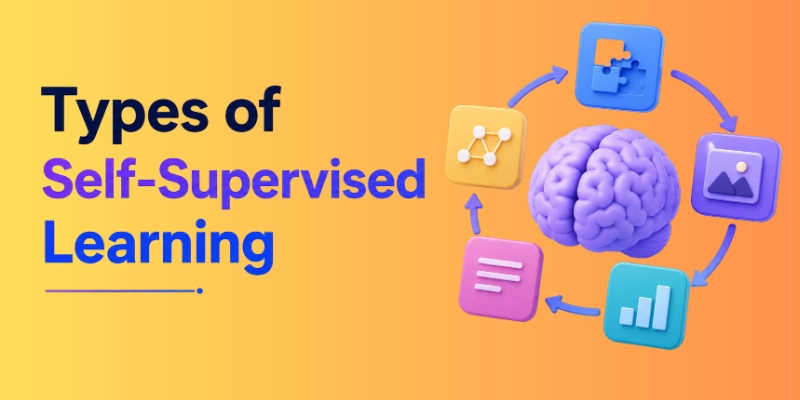
Types of Self-Supervised Learning
Self-supervised learning mainly uses different methods to create learning tasks automatically.
Contrastive Learning
Contrastive learning teaches the model to identify similarities and differences between data points.
Examples of Contrastive Learning
- Face recognition
- Image matching
- Voice recognition
- Recommendation systems
Generative Learning
Generative learning trains the system to generate missing or new data based on learned patterns.
Examples of Generative Learning
- Text generation
- AI chatbots
- Image creation
- Video generation
Predictive Learning
Predictive learning trains the model to predict hidden or missing parts of the input data.
Examples of Predictive Learning
- Next-word prediction
- Speech completion
- Image restoration
- Autocomplete systems
Common Self-Supervised Learning Algorithms
The following are some common self-supervised learning algorithms:
- Transformers: Powerful models used for language understanding and AI chatbots.
- BERT: Learns language patterns by predicting missing words in sentences.
- GPT Models: Generate human-like text using large-scale pattern learning.
- Autoencoders: Learn compressed representations of data for reconstruction tasks.
- SimCLR: Uses contrastive learning to improve image recognition performance.
- BYOL: Learns visual patterns without requiring labeled image datasets.
Real-World Examples of Self-Supervised Learning
Self-supervised learning is widely used in modern artificial intelligence systems and advanced technologies.
- AI Chatbots: Systems like chatbots learn language patterns from massive text datasets.
- Image Recognition: AI models identify objects and patterns in images without manual labeling.
- Voice Assistants: Digital assistants improve speech understanding using large audio datasets.
- Recommendation Systems: Platforms analyze user behavior to provide personalized suggestions.
Other Popular Applications
- Search engines
- Language translation systems
- Video analysis
- Medical image processing
- Autonomous vehicles
Which Type of Machine Learning Should You Use?
The choice of machine learning type depends on several important factors. The following points can help you select the most suitable approach for your project or business needs.
- Availability of Labeled Data: Use supervised learning when your dataset already contains correct answers or labels.
- Lack of Labeled Data: Use unsupervised learning when the dataset has no predefined labels and you want to discover hidden patterns.
- Limited Labeled Data: Use semi-supervised learning when only a small portion of your data is labeled but a large amount of unlabeled data is available.
- Need for Decision-Making Systems: Use reinforcement learning when the model must learn through rewards, actions, and continuous feedback.
- Large-Scale Unlabeled Data: Use self-supervised learning for advanced AI systems that train on massive unlabeled datasets.
- Prediction Tasks: Choose supervised learning for tasks like price prediction, spam detection, and sales forecasting.
- Pattern Discovery Tasks: Choose unsupervised learning for clustering, customer segmentation, and behavior analysis.
- Real-Time Learning Requirements: Reinforcement learning is useful for robotics, gaming AI, and autonomous systems that improve through experience.
- Budget and Data Labeling Cost: Semi-supervised and self-supervised learning reduce the need for expensive manual data labeling.
- Project Complexity: Simple prediction projects often use supervised learning, while complex AI systems may combine multiple learning types.
- Business Objectives: Select the learning type according to your goal, such as prediction, automation, personalization, or pattern recognition.
- Beginner-Friendly Approach: Supervised learning is usually the best starting point for beginners because it is easier to understand and implement.
Conclusion
In this guide, we have covered types of machine learning. We discussed all types in simple and easy words. We also explored how each type works, their algorithms, examples, and real-world applications.
Understanding these machine learning types can help beginners, students, and businesses choose the right approach for different AI tasks. As technology continues to grow, machine learning will become even more important in everyday life and modern industries.
Personal Recommendation: My personal recommendation is to start learning with supervised learning because it is the easiest and most beginner-friendly type. Once you understand the basics, exploring advanced learning methods becomes much easier.
Thank you so much for reading this guide. I hope this article helped you understand machine learning in a simple and practical way.
💬 We would love to hear your thoughts and opinions about this topic. Share your feedback or questions in the comments below. 😊
FAQs
The following are some frequently asked questions about types of machine learning that can help beginners understand the topic more clearly.
The four main types of machine learning are supervised learning, unsupervised learning, semi-supervised learning, and reinforcement learning. Modern AI systems also use self-supervised learning for advanced tasks. Each type works differently depending on the data and learning method.
The following points explain why supervised learning is considered best for beginners:
- It is easier to understand and implement
- Uses labeled data with clear answers
- Commonly used in real-world projects
- Helps learn basic machine learning concepts quickly
Supervised learning uses labeled data, while unsupervised learning works with unlabeled data. Supervised learning focuses on predictions and classifications, whereas unsupervised learning finds hidden patterns and relationships. Both are widely used in machine learning applications and AI systems.
Machine learning is used in many industries and daily technologies. It powers recommendation systems, chatbots, self-driving cars, fraud detection systems, healthcare tools, and voice assistants. Companies use machine learning algorithms to improve automation and decision-making.
The following machine learning methods are commonly used in AI chatbots:
- Self-supervised learning for language understanding
- Supervised learning for training conversations
- Reinforcement learning for improving responses
- Neural networks for natural language processing
Machine learning algorithms are programs that help computers learn patterns from data. Popular machine learning algorithms include linear regression, decision trees, random forest, support vector machines, and neural networks. Different algorithms are used for different prediction and classification tasks.
Labeled data provides correct answers that help the machine learn patterns accurately. The model compares inputs with labels during training and improves prediction performance over time. Without labeled data, supervised learning cannot work properly.
The following situations often require combining different machine learning types:
- Recommendation systems use supervised and unsupervised learning together
- AI assistants combine self-supervised and reinforcement learning
- Self-driving cars use multiple learning methods for better decisions
- Advanced AI projects often mix different algorithms for improved accuracy
Beginners should learn basic mathematics, statistics, and programming languages like Python. Understanding data analysis and machine learning concepts also helps build strong skills. Practice with real-world projects improves learning much faster.
The future of machine learning includes smarter AI systems, automation, robotics, and personalized technologies. Businesses are increasingly using machine learning for healthcare, cybersecurity, finance, and customer experiences. Self-supervised learning and generative AI are expected to grow rapidly in the coming years.





- Be Respectful
- Stay Relevant
- Stay Positive
- True Feedback
- Encourage Discussion
- Avoid Spamming
- No Fake News
- Don't Copy-Paste
- No Personal Attacks
- Be Respectful
- Stay Relevant
- Stay Positive
- True Feedback
- Encourage Discussion
- Avoid Spamming
- No Fake News
- Don't Copy-Paste
- No Personal Attacks
