What Is AI Orchestration? – Benefits, Tools and Uses
Published: 3 Aug 2026
Businesses no longer rely on one AI tool to complete a task. Many companies now use chatbots, AI agents, data tools, and automation platforms together to improve speed and accuracy. Reports show that more organizations are experimenting with multiple AI models and agents at the same time, which creates a growing need for better coordination between systems.
This is where “What Is AI Orchestration?” becomes an important question. AI orchestration helps different AI tools, models, and systems work together in the right order to complete tasks efficiently. Instead of running separate tools manually, businesses use orchestration to connect everything into one smooth workflow.
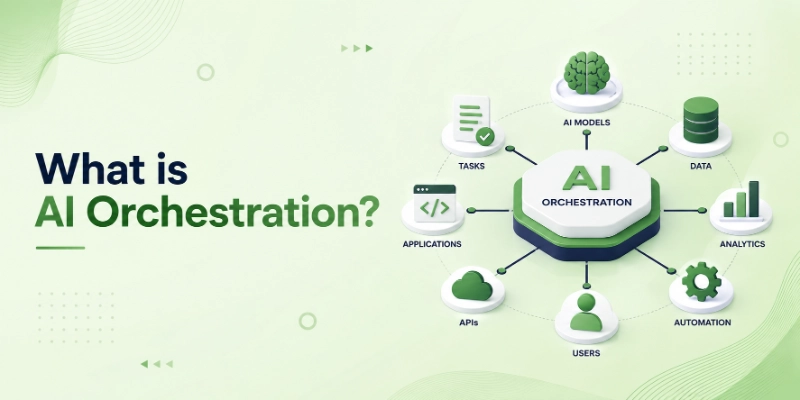
In this article, we will discuss what AI orchestration is in detail and explain how it works in modern businesses.
We will also explore its benefits, use cases, challenges, and the technologies that make AI systems work together successfully.
What Is AI Orchestration?
As businesses adopt more AI tools, managing them separately becomes difficult and time-consuming. Companies now use chatbots, AI agents, data analysis tools, and automation platforms together to complete tasks faster. This growing complexity has increased interest in AI orchestration, which helps these systems work as one connected workflow instead of operating in isolation.
Simple Definition: AI orchestration is the process of managing and coordinating multiple AI tools, models, and systems so they can work together to complete tasks efficiently.
Technical Definition: AI orchestration is a framework that automates the interaction between AI models, agents, data sources, APIs, and workflows to deliver a unified outcome with minimal human intervention.
The Orchestra Conductor Analogy
AI orchestration works much like an orchestra conductor who ensures every musician plays at the right time and in the right order.
- The conductor represents the orchestration platform.
- The musicians represent AI models and agents.
- The musical instruments represent data sources and tools.
- The music performance represents the final output.
- Without a conductor, the performance becomes unorganized and ineffective.
Why AI Systems Need Orchestration
As organizations use more AI solutions, they need a way to connect and manage them efficiently.
- Prevents AI tools from working in separate silos.
- Improves communication between systems.
- Reduces manual work and repetitive tasks.
- Speeds up decision-making processes.
- Increases accuracy and consistency.
- Supports complex multi-step workflows.
- Makes AI systems easier to scale and manage.
How Does AI Orchestration Work?
AI orchestration follows a structured process that helps different AI systems work together smoothly. Instead of handling every task manually, the orchestration layer decides what should happen next and which system should perform each action.
To understand the process better, let’s follow the journey of a request from the moment it enters the system until the final result reaches the user.
Step 1: Receive a Task or Trigger
Every AI workflow starts when the system receives a request or detects an event. Without a trigger, the orchestration process cannot begin.
The trigger tells the system that action is required and starts the sequence of tasks needed to produce a result.
- A customer submits a support ticket.
- A user asks a question in a chatbot.
- A business system detects new data.
- An automated event starts a workflow.
- An employee requests a report or analysis.
Think of this step as pressing the start button that sets the entire AI workflow in motion.
Step 2: Analyze the Request
After receiving the task, the system needs to understand exactly what the request means. This helps avoid mistakes and improves efficiency.
The orchestration layer studies the request and decides what actions are necessary to achieve the desired outcome.
- Identifies the user’s intent.
- Determines the complexity of the task.
- Breaks large requests into smaller actions.
- Decides which resources are required.
- Prioritizes urgent tasks when necessary.
At this stage, the system acts like a planner that creates a roadmap before work begins.
Step 3: Select the Best AI Model or Agent
Not every AI model performs well on every task. Different models have different strengths and capabilities.
AI orchestration evaluates the request and assigns it to the model or agent that can deliver the best result.
- Sends language tasks to language models.
- Routes image tasks to vision models.
- Assigns calculations to analytical systems.
- Uses specialized agents for specific tasks.
- Combines multiple agents when needed.
Rather than using one tool for everything, AI orchestration matches the right tool to the right job.
Step 4: Access Data Sources and Tools
Most AI models need additional information before they can produce accurate outputs. Data plays an important role in this process.
The orchestration system collects information from the required sources and prepares it for the selected models or agents.
- Connects with databases.
- Retrieves business records.
- Accesses external APIs.
- Collects real-time information.
- Uses internal company systems when required.
This step ensures that AI decisions rely on useful data instead of assumptions.
Step 5: Execute the Workflow
Once all resources become available, the system begins carrying out the planned actions. Each component performs its assigned task at the right time.
The orchestration layer manages the order of operations and keeps every part of the workflow connected.
- Runs tasks in the correct sequence.
- Shares information between systems.
- Coordinates multiple AI agents.
- Handles dependencies automatically.
- Adjusts workflows when conditions change.
This is the stage where separate AI components start working together as one connected team.
Step 6: Validate and Deliver Results
Producing an output is not the final goal. The system must first confirm that the result meets quality and accuracy standards.
AI orchestration performs checks and validations before sending the response to users or other business systems.
- Reviews outputs for errors.
- Verifies data consistency.
- Applies business rules and policies.
- Requests human review when necessary.
- Delivers the final result to the user or system.
The final step focuses on reliability, ensuring that users receive accurate and useful outcomes rather than incomplete responses.
Why Is AI Orchestration Important?
Businesses now use multiple AI models, tools, and agents to manage daily operations. While these technologies offer many benefits, managing them separately often creates delays, extra costs, and communication gaps between systems.
This growing complexity explains why AI orchestration has become an essential part of modern AI strategies rather than an optional addition.
- Eliminates Isolated AI Tools: AI orchestration connects separate AI systems and allows them to work together as a unified workflow instead of operating independently.
- Improves Efficiency: It reduces manual coordination and helps tasks move faster from one system to another without unnecessary delays.
- Reduces Operational Costs: Automation and better resource management lower the amount of time, effort, and money required to complete business processes.
- Enhances Accuracy: AI orchestration improves data sharing and validation, which helps reduce errors and inconsistencies in results.
- Enables Automation at Scale: Organizations can automate larger and more complex workflows without increasing operational complexity.
- Supports Multi-Agent Collaboration: Multiple AI agents can communicate, share information, and complete tasks together to achieve better outcomes.
Key Components of AI Orchestration
AI orchestration works by combining several technologies into one connected system. Each component has a specific role that helps the entire workflow run smoothly and efficiently.
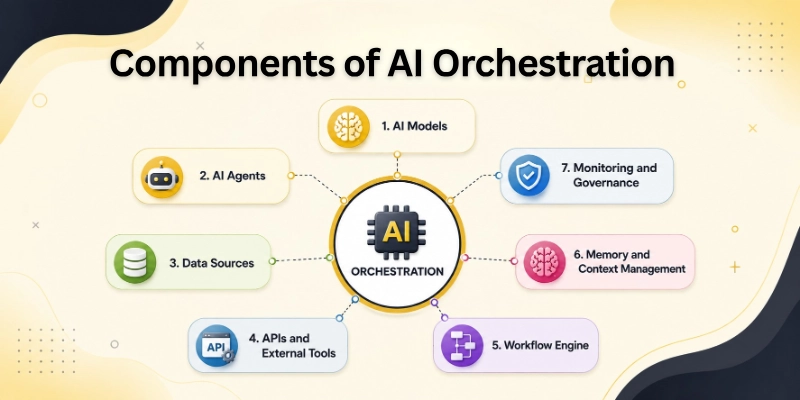
Together, these building blocks create the foundation that allows AI systems to communicate, share information, and complete tasks automatically.
1. AI Models
AI models perform the core intelligence tasks within the orchestration process. They process information and generate outputs based on the assigned task.
These models often specialize in different areas depending on business requirements.
- Generate text and content.
- Analyze images and videos.
- Process speech and audio.
- Perform predictions and forecasting.
- Support decision-making tasks.
At the center of every AI workflow sits an AI model responsible for turning data into useful results.
2. AI Agents
AI agents act as workers that perform specific tasks independently. They can make decisions and take actions based on predefined goals.
Modern orchestration systems often use multiple agents working together to complete complex workflows.
- Handle customer interactions.
- Perform research tasks.
- Execute automated actions.
- Coordinate with other agents.
- Manage specialized operations.
You can think of AI agents as team members that each focus on a particular responsibility.
3. Data Sources
AI systems need access to reliable information before they can produce accurate results. Data sources provide the knowledge required for decision-making.
The quality of the output often depends on the quality of the available data.
- Internal company databases.
- Customer records and documents.
- Cloud storage platforms.
- Business applications.
- Real-time data streams.
Without data sources, even the most advanced AI systems would have little information to work with.
4. APIs and External Tools
AI orchestration often requires communication with systems outside the main platform. APIs and external tools make these connections possible.
These integrations allow AI workflows to interact with existing business software and services.
- Connect with third-party applications.
- Retrieve external information.
- Send data between systems.
- Trigger automated actions.
- Extend platform capabilities.
These connections help AI systems move beyond analysis and take meaningful actions in the real world.
5. Workflow Engine
The workflow engine controls the order in which tasks are performed. It ensures that every process happens at the right time and in the correct sequence.
This component acts as the coordinator for the entire orchestration process.
- Assigns tasks to systems.
- Controls workflow sequences.
- Manages dependencies.
- Handles task routing.
- Coordinates multiple operations.
If AI orchestration were a city, the workflow engine would act as the traffic control system.
6. Memory and Context Management
Many AI tasks require information from previous interactions or earlier workflow steps. Memory and context management store and retrieve this information when needed.
This allows AI systems to provide more consistent and relevant responses.
- Store previous interactions.
- Track workflow history.
- Maintain user context.
- Share information across agents.
- Improve response quality.
This component gives AI systems the ability to remember rather than start from zero every time.
7. Monitoring and Governance
AI systems need supervision to maintain reliability and compliance. Monitoring and governance help organizations track performance and reduce risks.
These controls become more important as AI environments continue to grow.
- Monitor system performance.
- Detect errors and failures.
- Enforce security policies.
- Maintain compliance standards.
- Generate audit records.
Strong governance ensures that AI orchestration remains secure, transparent, and trustworthy.
Types of AI Orchestration
AI orchestration does not follow a single approach for every business or workflow. Organizations choose different orchestration methods depending on their goals, systems, and level of complexity.
As AI environments continue to grow, businesses often combine multiple orchestration styles to achieve better results and flexibility.
To understand how organizations manage different AI workflows, let’s explore the main types of AI orchestration used today.
- Single-Agent Orchestration: A single AI agent manages the entire workflow and performs all required tasks independently.
- Multi-Agent Orchestration: Multiple AI agents collaborate, share information, and divide responsibilities to complete complex tasks more efficiently.
- Workflow-Based Orchestration: Tasks follow a predefined sequence where each action happens in a specific order to achieve the desired outcome.
- Event-Driven Orchestration: The workflow starts automatically when a specific event, trigger, or condition occurs within the system.
- Hybrid Orchestration: This approach combines multiple orchestration methods to provide greater flexibility, scalability, and performance.
Real-World Examples of AI Orchestration
AI orchestration is no longer limited to research labs or technology companies. Businesses across different industries already use it to manage complex workflows and improve decision-making.
From customer service to healthcare, organizations rely on orchestration to connect AI models, agents, and business systems into one efficient process.
The best way to understand its value is to see how AI orchestration solves real business challenges in the real world.
- Customer Support Automation: AI orchestration connects chatbots, knowledge bases, ticketing systems, and support agents to deliver faster and more accurate customer service.
- Healthcare Diagnosis Systems: Healthcare organizations use AI orchestration to combine medical records, diagnostic tools, and AI models to support doctors with faster diagnoses.
- Financial Fraud Detection: Banks and financial institutions use orchestration to analyze transactions, identify suspicious activity, and trigger alerts in real time.
- Supply Chain Optimization: Businesses use AI orchestration to monitor inventory, predict demand, and coordinate logistics operations more efficiently.
- Personalized E-commerce Recommendations: Online stores use orchestration to analyze customer behavior and deliver personalized product recommendations based on preferences and purchase history.
Industries Using AI Orchestration
AI orchestration is becoming an important part of digital transformation across many sectors. Organizations use it to connect AI systems, automate workflows, and improve operational efficiency.
As businesses continue to invest in AI technologies, the demand for orchestration solutions is growing rapidly across industries of all sizes.
The following industries are among the biggest adopters of AI orchestration today:
- Healthcare
- Banking
- Retail
- Manufacturing
- Marketing
- Logistics
- Education
Benefits of AI Orchestration
AI orchestration helps organizations get more value from their AI investments by improving coordination between systems and workflows. It allows businesses to automate processes, reduce complexity, and increase overall performance.
As companies continue to adopt multiple AI tools and agents, the benefits of orchestration become even more noticeable across daily operations.
- Faster Decision Making: AI orchestration processes information quickly and delivers insights faster, helping businesses make timely decisions.
- Better Resource Utilization: It ensures that AI models, data sources, and computing resources are used efficiently without unnecessary waste.
- Improved Customer Experiences: Connected AI systems provide faster responses, personalized interactions, and more consistent customer support.
- Higher Scalability: Organizations can expand AI workflows and handle larger workloads without significantly increasing complexity.
- Reduced Human Intervention: Automation reduces the need for manual coordination and allows employees to focus on higher-value tasks.
- Stronger Governance and Compliance: AI orchestration helps businesses maintain security policies, compliance requirements, and operational transparency.
Challenges of AI Orchestration
AI orchestration offers many advantages, but organizations also face several challenges during implementation and management. Businesses must address these issues carefully to ensure smooth operations and long-term success.
As AI environments become more complex, managing multiple systems, models, and workflows requires proper planning and continuous oversight.
- Integration Complexity: Connecting different AI models, platforms, databases, and business systems can be difficult and time-consuming.
- Data Security Risks: Sharing data between multiple systems increases the need for strong security measures and access controls.
- Governance Issues: Organizations must establish clear policies to ensure responsible AI usage and regulatory compliance.
- High Initial Costs: Setting up orchestration infrastructure and integrating existing systems often requires significant investment.
- Model Monitoring Difficulties: Businesses need continuous monitoring to track model performance and detect errors or performance issues.
- Vendor Lock-In: Depending heavily on a single platform or provider can limit flexibility and make future migrations more difficult.
Popular AI Orchestration Tools and Platforms
As AI adoption continues to grow, businesses need platforms that can manage workflows, coordinate agents, and connect multiple systems efficiently. This demand has led to the rise of several AI orchestration tools designed for different use cases and technical requirements.
Some platforms focus on AI agents and large language models, while others specialize in workflow automation and enterprise process management.
The following tools and platforms are among the most widely used solutions for AI orchestration today:
- LangGraph
- CrewAI
- AutoGen
- Semantic Kernel
- n8n
- Temporal
- Apache Airflow
Best Practices for Successful AI Orchestration
Organizations achieve better results from AI orchestration when they focus on planning, flexibility, and long-term management rather than automation alone.
- Start with Small Workflows: Begin with simple and manageable workflows before expanding orchestration across larger business processes.
- Use Modular Architectures: Design systems with independent components so they can be updated, replaced, or expanded more easily.
- Implement Monitoring: Track workflow performance continuously to identify issues and maintain reliability.
- Maintain Human Oversight: Keep humans involved in important decisions to improve accountability and reduce risks.
- Prioritize Security and Governance: Apply strong security policies and governance frameworks to protect data and ensure compliance.
Future Trends in AI Orchestration
AI orchestration continues to evolve as businesses look for smarter, faster, and more autonomous ways to manage AI systems.
The next generation of orchestration platforms will focus on greater intelligence, adaptability, and control across complex AI environments.
- Autonomous AI Agents: AI agents will handle more tasks independently with less need for human intervention.
- Multi-Agent Collaboration: Multiple AI agents will work together and share information to solve complex problems more efficiently.
- Dynamic Model Routing: Orchestration systems will automatically select the most suitable AI model for each task based on performance and requirements.
- Self-Healing Workflows: AI workflows will detect issues automatically and make adjustments to maintain smooth operations.
- AI Governance Layers: Organizations will add stronger governance frameworks to improve security, compliance, and transparency in AI systems.
Conclusion
In this guide, we have covered what AI orchestration is and examined how it enables organizations to coordinate AI models, agents, data sources, and workflows within a unified system. We also explored its key components, benefits, challenges, real-world applications, and the technologies that support successful orchestration strategies.
As businesses continue to expand their AI capabilities, orchestration will become a critical layer for managing complexity, improving efficiency, and scaling intelligent operations. Organizations that establish strong orchestration practices today will be better positioned to adapt to future developments in AI and automation.
My recommendation is to approach AI orchestration with clear business objectives and a phased implementation strategy. Starting with focused use cases allows organizations to demonstrate value quickly while building the foundation for larger initiatives.
Thank you for reading this guide. I hope it has provided valuable insights into the role of AI orchestration in modern business environments.
💬 We welcome your perspectives and experiences on this topic, so feel free to share your thoughts in the discussion section below.
🚀 If you found this guide useful, join the conversation and share your feedback with us.
FAQs
Below are some of the most frequently asked questions about AI orchestration and their answers.
AI orchestration is the process of coordinating multiple AI models, tools, agents, and data sources so they can work together efficiently. It manages workflows and automates interactions between systems. This helps organizations complete complex tasks with less manual effort.
AI orchestration starts by receiving a task or trigger and then analyzing the request. It selects the appropriate AI models, gathers the required data, executes the workflow, and validates the results. The final output is then delivered to the user or business system.
Traditional automation follows predefined rules and workflows. AI orchestration adds intelligence by allowing systems to make decisions, adapt to changes, and coordinate multiple AI components. This makes it more flexible and capable of handling complex processes.
AI agent orchestration focuses on managing multiple AI agents that work together to complete tasks. The orchestration layer assigns responsibilities, shares information between agents, and coordinates their activities. This approach is common in advanced AI systems.
AI orchestration helps businesses connect isolated AI tools and create efficient workflows. It improves productivity, reduces operational costs, and supports large-scale automation. It also makes AI systems easier to manage and scale.
The main components include AI models, AI agents, data sources, APIs, workflow engines, memory systems, and governance tools. Each component plays a specific role in the orchestration process. Together, they create a connected AI ecosystem.
Many industries use AI orchestration to improve operations and automate processes.
- Healthcare
- Banking
- Retail
- Manufacturing
- Logistics
- Education
The technology continues to expand into new sectors every year.
AI orchestration offers several important advantages.
- Faster decision-making
- Better resource utilization
- Improved customer experiences
- Higher scalability
- Reduced manual work
These benefits help organizations maximize the value of their AI investments.
Several platforms support AI orchestration for different business needs.
- LangGraph
- CrewAI
- AutoGen
- Semantic Kernel
- n8n
- Temporal
- Apache Airflow
The ideal platform depends on the complexity of your workflows and technical requirements.
The future of AI orchestration includes autonomous AI agents, multi-agent collaboration, dynamic model routing, and self-healing workflows. Organizations are also investing heavily in AI governance and compliance solutions. These trends will shape the next generation of intelligent business systems.




- Be Respectful
- Stay Relevant
- Stay Positive
- True Feedback
- Encourage Discussion
- Avoid Spamming
- No Fake News
- Don't Copy-Paste
- No Personal Attacks
- Be Respectful
- Stay Relevant
- Stay Positive
- True Feedback
- Encourage Discussion
- Avoid Spamming
- No Fake News
- Don't Copy-Paste
- No Personal Attacks
