Narrow AI vs General AI: Key Differences
Published: 6 Jul 2026
If ChatGPT can write articles, answer questions, and solve problems, does that mean we already have general AI? Many people ask this question because modern AI tools look smart from the outside. This confusion has made the debate around narrow AI vs. general AI more important than ever.
I have worked with AI-related content and research for a long time, and I notice that most users mix up task-based AI with human-like intelligence.
Current AI systems can only follow patterns and perform trained tasks. They cannot think, feel, or reason like humans. That is why experts still classify today’s AI as narrow AI.
In this article, we will discuss narrow AI vs. general AI in detail. You will also discover the biggest differences, real-world examples, and the challenges researchers face in building true general AI.
What Is Narrow AI?
Narrow AI, also called Artificial Narrow Intelligence (ANI), is an AI system built to handle one specific task or a limited range of tasks.
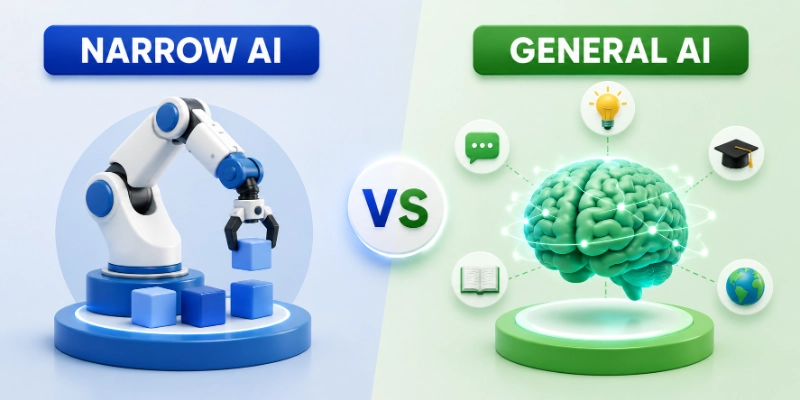
It works within a fixed boundary and does not possess general understanding or awareness. For example, a language translation tool can translate text but cannot drive a car or analyze financial markets.
Popular examples include:
- AI chatbots
- Voice assistants like Siri or Alexa
- Recommendation systems on Netflix or YouTube
- Image recognition tools
- Generative AI tools like OpenAI ChatGPT
What Is General AI (AGI)?
General AI refers to a hypothetical AI system that can think, learn, and solve problems across multiple domains just like a human being.
It would not be limited to one task. Instead, it could:
- Learn new skills without retraining
- Understand complex concepts
- Apply knowledge in different situations
- Perform a wide range of intellectual tasks
In simple terms, AGI would behave like a machine with human-level intelligence and flexibility.
How Narrow AI Works
Narrow AI works by using large amounts of data and trained algorithms to perform specific tasks.
The basic working process includes:
- Collecting relevant data for a specific task
- Training a machine learning model on that data
- Identifying patterns and relationships in the data
- Making predictions or generating outputs based on input
For example, a spam email filter learns from thousands of labeled emails and then predicts whether a new email is spam or not.
Narrow AI does not understand meaning like humans. Instead, it uses statistical patterns to produce accurate results within its limited scope.
How AGI Work Theoretically?
In theory, AGI would work by combining advanced learning systems that allow it to understand and reason across different types of data.
It would:
- Learn from experience, similar to humans
- Combine knowledge from multiple fields
- Adapt to new environments without manual updates
- Improve itself over time through continuous learning
Unlike current AI systems, AGI would not depend on a single trained model for one task. Instead, it would use a unified intelligence system capable of general thinking.
Core Characteristics of Narrow AI
Below are the key features of Narrow AI.
1. Task-specific
- Narrow AI is designed to perform one specific task
- It cannot operate outside its trained function
- Example: A translation tool only translates language
2. Data-dependent
- It requires large amounts of training data
- The quality of output depends on data quality
- Better data leads to better performance
3. Limited adaptability
- It cannot easily adapt to new or unrelated tasks
- It needs retraining for new functions
- It does not transfer knowledge like humans
4. Pattern recognition focused
- Narrow AI works by identifying patterns in data
- It does not truly understand content
- It predicts outputs based on learned relationships
Narrow AI is powerful within its limits, but it does not have general intelligence or self-awareness.
Characteristics of General AI
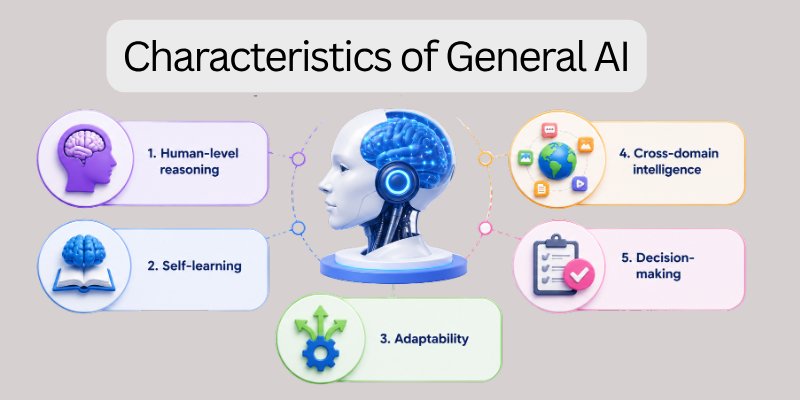
The following are the main characteristics of General AI that describe how it would think, learn, and perform like human intelligence.
1. Human-level reasoning
- AGI would think and reason like a human
- It could solve complex problems and make logical decisions
2. Self-learning
- It would learn new skills without human retraining
- Experience would help it improve over time
3. Adaptability
- AGI could adjust to new situations quickly
- It would not be limited to fixed tasks or environments
4. Cross-domain intelligence
- It could apply knowledge from one field to another
- For example, using medical knowledge in engineering problems
5. Decision-making
- AGI would evaluate options and make independent decisions
- It could handle complex real-world scenarios
Real-world examples of Narrow AI
Narrow AI is already part of everyday life, even when people do not notice it. It powers many tools and systems that handle specific tasks very efficiently.
1. Chatbots
- Chatbots answer customer questions in real time on websites and apps
- They handle FAQs, support requests, and basic troubleshooting
- Many businesses use them to reduce response time and improve customer service
2. Recommendation engines
- Recommendation systems suggest content based on user behavior
- They are widely used on platforms like Netflix, YouTube, and Amazon
- These systems analyze your past activity to show relevant movies, videos, or products
3. Siri & Alexa
- Voice assistants like Siri and Alexa respond to voice commands
- They help with tasks like setting reminders, playing music, or checking the weather
- They use speech recognition and natural language processing to understand users
4. Self-driving features
- Modern cars use Narrow AI for driving assistance
- Features include lane detection, parking assist, and collision warning
- These systems help improve safety but still require human supervision
5. Fraud detection systems
- Banks and financial apps use AI to detect suspicious activity
- The system analyzes transaction patterns to identify unusual behavior
- It helps prevent fraud and protects user accounts in real time
6. Facial recognition
- Facial recognition systems identify or verify a person’s identity
- It is used in smartphones, security systems, and airport checks
- The system compares facial features with stored data to match identities
All these examples show how narrow AI focuses on specific tasks and performs them with high accuracy, making daily digital services faster and more efficient.
Examples of AGI in Theory and Fiction
AGI is often explored in science fiction and theoretical discussions. These examples help people imagine what fully intelligent machines might look like.
1. Jarvis
- An advanced AI assistant from fictional stories
- Capable of understanding, reasoning, and managing complex systems
2. HAL 9000
- A fictional AI from science fiction
- Known for advanced decision-making and human-like interaction
3. Skynet
- A fictional AI system from movies
- Represents highly intelligent machines with global control capabilities
4. Human-like robots
- Theoretical robots designed to think and act like humans
- Often used in discussions about future AGI development
These examples are not real AGI but help illustrate how powerful and complex general intelligence could become in the future.
Advantages of Narrow AI
Narrow AI offers several practical benefits because it is designed to perform specific tasks with high accuracy and speed.
- High efficiency: It completes tasks quickly and reliably without human effort
- Cost-effective: It reduces the need for large human teams in repetitive work
- Improved accuracy: It performs specific tasks with fewer errors when well-trained
- Automation: It handles repetitive tasks like customer support, data entry, and filtering
- Easy to use: Most Narrow AI systems work in the background and require little user input
- Widely available: It is already integrated into apps, devices, and online platforms
Narrow AI is widely used because it improves productivity and helps businesses operate more smoothly.
Potential advantages of AGI
Artificial General Intelligence (AGI) could bring major changes because it would match or even exceed human-level thinking across many tasks. If developed successfully, it could transform industries and solve complex global problems.
- Solving complex problems: AGI could help find solutions for issues like climate change, disease control, and energy shortages
- High-level automation: It could manage entire systems such as businesses, cities, or research labs with minimal human input
- Faster scientific discovery: AGI could analyze massive data and accelerate breakthroughs in medicine, physics, and technology
- Better decision-making: It could support humans with highly accurate and data-driven decisions
- Improved productivity: It could handle multiple tasks across different fields at the same time
- Personal assistance: It could act as a highly intelligent assistant in daily life, education, and work
Limitations of Narrow AI
Despite its usefulness, narrow AI has several important limitations that restrict its capabilities.
- Limited to specific tasks: It cannot perform tasks outside its training area
- No general intelligence: It cannot think, reason, or understand like humans
- Requires large data: It depends heavily on high-quality training data
- Lacks adaptability: It struggles to adjust to new or unexpected situations
- No true understanding: It works based on patterns, not real comprehension
- Needs retraining: Any major change requires updating or retraining the model
Because of these limitations, Narrow AI cannot function independently like human intelligence and always requires human design and supervision.
Risks and challenges of AGI
While AGI has great potential, it also comes with serious risks and challenges that researchers and governments are actively discussing.
- Loss of control: A highly intelligent system may behave in ways humans cannot fully predict or control
- Job displacement: AGI could replace many jobs across industries, leading to economic disruption
- Ethical concerns: Decisions made by AGI may raise moral and ethical questions
- Security risks: AGI could be misused for cyberattacks, surveillance, or harmful purposes
- Unequal access: Only a few organizations or countries may control advanced AGI systems
- Uncertain behavior: Since AGI does not exist yet, its real-world behavior is unpredictable
Because of these risks, many experts emphasize the importance of strict safety rules, global cooperation, and responsible development before AGI becomes a reality.
Does General AI Exist Today?
No, General AI does not exist today.
All current AI systems, including advanced tools like OpenAI’s ChatGPT, are examples of narrow AI. They can perform many tasks but still lack true understanding, consciousness, and human-like reasoning.
Researchers are still working toward AGI, but it remains a long-term scientific challenge with many technical and ethical barriers.
Narrow AI vs General AI: Major Differences
Although both Narrow AI and General AI are forms of artificial intelligence, they differ greatly in terms of intelligence, learning ability, adaptability, and overall capabilities.
To better understand these differences, the following points compare Narrow AI and General AI across several important factors.
1. Scope of intelligence
When we compare how wide their intelligence is, narrow AI and general AI work in very different ways.
- Narrow AI: It focuses on one specific task or a limited area of work and cannot go beyond that boundary.
- General AI: It is designed to understand and perform any intellectual task across different fields like a human.
2. Learning capability
Learning ability shows how each system improves over time.
- Narrow AI: It learns only from the data it is trained on and cannot easily learn new skills without retraining.
- General AI: It would be able to learn new skills on its own and continuously improve through experience.
3. Adaptability
Adaptability explains how well the system handles new situations.
- Narrow AI: It has limited flexibility and often fails when faced with unfamiliar tasks.
- General AI: It would adjust easily to new environments and different types of problems.
4. Reasoning ability
Reasoning ability shows how each system processes information and makes sense of it.
- Narrow AI: It uses pattern recognition and does not truly understand meaning.
- General AI: It would think more like a human and use logic to solve complex problems.
5. Self-awareness
Self-awareness refers to whether the system understands itself.
- Narrow AI: It has no awareness, emotions, or sense of self.
- General AI: It is a theoretical idea where AI could possibly have human-like awareness.
6. Decision-making
Decision-making shows how independently each system can act.
- Narrow AI: It makes decisions based on trained data and fixed patterns.
- General AI: It would be able to make independent and flexible decisions in different situations.
7. Training requirements
Training requirements explain how each system learns and improves.
- Narrow AI: It requires large datasets and specific training for each task.
- General AI: It would learn continuously without needing constant retraining.
8. Performance across tasks
This compares how many types of tasks each system can handle.
- Narrow AI: It performs well only in its specific trained area.
- General AI: It could handle many different tasks across multiple domains.
9. Human dependency
Human dependency shows how much the system relies on people.
- Narrow AI: It depends heavily on humans for training, updates, and supervision.
- General AI: It would require much less human involvement once fully developed.
10. Real-world availability
This highlights whether the technology exists today.
- Narrow AI: It is already widely used in real-world applications like chatbots and recommendation systems.
- General AI: It does not exist yet and remains a future research goal.
Narrow AI vs General AI: Comparison Table
| Feature | Narrow AI | General AI |
| Intelligence Scope | Specific tasks | Broad human-like intelligence |
| Learning Ability | Limited | Adaptive |
| Multitasking | Restricted | Flexible |
| Creativity | Minimal | Advanced |
| Current Status | Exists today | Theoretical |
| Examples | Siri, Netflix AI | Hypothetical AGI systems |
Ethical Concerns Around Narrow AI and AGI
To understand the risks and challenges of artificial intelligence, it is important to examine the key ethical concerns associated with both narrow AI and AGI.
- Bias and discrimination: AI systems may produce unfair results if trained on biased data, leading to discrimination in hiring, healthcare, and other critical areas.
- Privacy concerns: AI often relies on large amounts of personal data, raising risks about data misuse, unauthorized access, and lack of user privacy protection.
- Job displacement: Automation driven by AI can replace human workers in repetitive jobs, potentially affecting employment in several industries.
- Autonomous weapons: AI-powered weapons that can operate without human control raise serious concerns about misuse, safety, and global security risks.
- Control and safety risks: Advanced AI systems, especially future AGI, may behave unpredictably if not properly controlled, creating potential safety challenges.
Narrow AI vs. General AI: What Matters More Today?
To better understand how AI is used today and how it may evolve in the future, it is important to evaluate narrow AI and general AI from multiple perspectives.
- Business perspective: Narrow AI is more important today because companies use it to automate tasks, improve customer service, and increase efficiency in real-world operations. General AI is still theoretical and not yet available for business use.
- Research perspective: Both are important, but most current research focuses on improving narrow AI systems like machine learning and deep learning, while AGI remains a long-term research goal.
- Economic impact: Narrow AI already has a strong economic impact by boosting productivity, reducing costs, and creating new AI-driven industries. General AI has no direct economic impact yet because it does not exist.
- Which companies are investing in it: Companies are heavily investing in narrow AI technologies such as chatbots, automation tools, recommendation systems, and data analytics, while AGI research is mostly limited to specialized research labs and long-term innovation projects.
- Technology maturity: Narrow AI is highly developed and widely used in real-world systems, while general AI is still in the conceptual and experimental stage.
- Feasibility and risk level: Narrow AI is practical and safe for deployment in controlled environments, whereas general AI presents higher uncertainty and long-term ethical and safety risks due to its theoretical nature.
Conclusion
In this guide, we have covered narrow AI vs. general AI. Narrow AI is designed to handle specific tasks efficiently, while General AI aims to achieve human-like intelligence across a wide range of activities. The main differences between them include scope, learning ability, adaptability, reasoning, and real-world usage. Currently, most AI systems in use today are based on narrow AI, powering tools like virtual assistants, recommendation systems, and automation technologies.
On the other hand, General AI is still a theoretical concept and has not yet been developed, though it remains an important goal for future research. As AI continues to evolve, it is essential to focus on responsible development, ensuring safety, ethics, and proper control in future advancements.
Personal Recommendation: From a personal perspective, it is best to focus on understanding narrow AI first, as it is already shaping industries and daily life. At the same time, staying aware of AGI helps prepare for future technological shifts.
Goodbye, and thank you for reading. 👋😊
👉 If you found this helpful, consider exploring more topics on artificial intelligence to deepen your understanding.
FAQs
These FAQs explain Narrow AI, General AI, and AGI in simple words. They also help beginners understand the future of artificial intelligence.
Narrow AI is built for specific tasks like voice search, AI chatbots, and recommendation systems. General AI, also known as Artificial General Intelligence (AGI), would be able to think and learn across different subjects like a human brain. In simple words, Narrow AI focuses on one task, while AGI would handle multiple tasks with human-level intelligence.
- ChatGPT is an example of narrow AI.
- It is trained mainly for language processing, content writing, and conversations.
- Even though it sounds intelligent, it does not have real human understanding or self-awareness like AGI.
No, true General AI has not been created yet. Today’s AI tools use machine learning and deep learning to solve limited problems only. Many tech companies and AI researchers are still exploring how to build real AGI systems.
Here are a few important points:
- Narrow AI is already improving rapidly in fields like automation and robotics.
- However, AGI would require reasoning, emotions, and human-like adaptability.
- Experts believe future AI advancements may eventually lead toward artificial general intelligence.
Artificial Super Intelligence (ASI) is a future AI concept where machines become smarter than humans in nearly every field. ASI could outperform humans in science, creativity, decision-making, and problem-solving. Right now, it remains a theoretical topic in future AI technology and AI ethics research.
AGI is challenging because human intelligence is extremely complex. Scientists must solve problems related to:
- Human reasoning and emotions
- Learning without massive training data
- Creativity and decision-making
- Understanding real-world situations naturally
That is why creating artificial general intelligence is still one of the hardest goals in AI development.





- Be Respectful
- Stay Relevant
- Stay Positive
- True Feedback
- Encourage Discussion
- Avoid Spamming
- No Fake News
- Don't Copy-Paste
- No Personal Attacks
- Be Respectful
- Stay Relevant
- Stay Positive
- True Feedback
- Encourage Discussion
- Avoid Spamming
- No Fake News
- Don't Copy-Paste
- No Personal Attacks
