How AI Helps in Ad Targeting – Complete Practical Guide
Published: 3 May 2026
Advertising has changed a lot in recent years. Earlier, ads reached a large audience without knowing who was actually interested. This caused wasted budget and poor results.
Today, artificial intelligence studies user behavior, interests, and intent before showing ads. This detailed guide explains how AI helps in ad targeting in a clear and practical way. You will learn real methods, real use cases, and simple ideas you can apply to improve ad performance.
Let us cover everything in detail and help you target the right audience with confidence.
How AI Helps in Ad Targeting
Here are the 15 proven ways AI improves ad targeting for businesses and marketers.
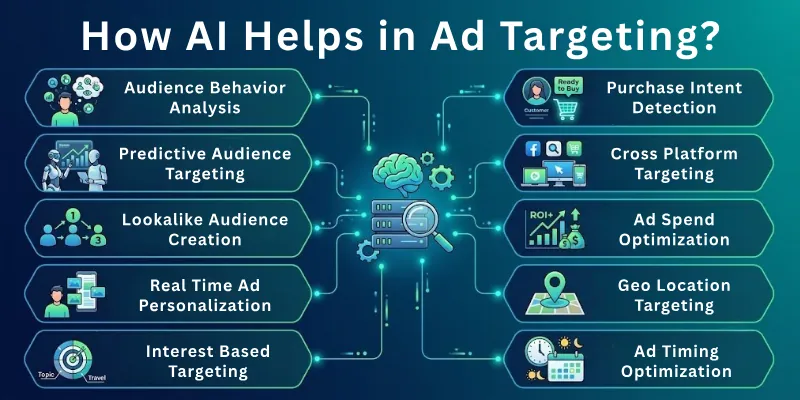
- Audience Behavior Analysis
- Predictive Audience Targeting
- Lookalike Audience Creation
- Real Time Ad Personalization
- AI Based Demographic Targeting
- Interest Based Targeting
- Purchase Intent Detection
- Cross Platform Targeting
- Dynamic Creative Optimization
- Ad Spend Optimization
- Fraud Detection and Prevention
- Geo Location Targeting
- Ad Timing Optimization
- A B Testing Automation
- Continuous Performance Learning
Let us learn about each method in detail.
1. Audience Behavior Analysis
Traditionally, advertisers relied on basic data like age and location. This information alone could not explain user intent. AI now analyzes browsing history, clicks, searches, and engagement. It understands what users like and how they behave online. This helps ads reach people who show real interest.
Prompts you can use:
- Analyze user browsing behavior
- Identify content engagement patterns
- Track user interaction with ads
- Predict interest categories
- Improve audience relevance
2. Predictive Audience Targeting
Earlier, ads targeted users after they showed interest. This caused delayed engagement. AI predicts future behavior using historical data. It identifies users likely to take action soon. Advertisers reach users before competitors. Conversion chances increase.
Prompts you can use:
- Predict users likely to convert
- Identify high intent audiences
- Forecast audience behavior
- Prioritize valuable users
- Improve targeting accuracy
3. Lookalike Audience Creation
Creating similar audiences manually was limited and slow. AI now analyzes existing customers deeply. It finds users with similar behavior and interests. These lookalike audiences perform better. Reach expands without losing quality.
Prompts you can use:
- Analyze best customers
- Create similar audience profiles
- Expand reach safely
- Improve campaign scale
- Maintain lead quality
4. Real Time Ad Personalization
Traditional ads showed the same message to everyone. This reduced engagement. AI personalizes ads in real time based on user actions. Content changes instantly. Ads feel relevant and timely. Click rates improve.
Prompts you can use:
- Personalize ad copy dynamically
- Adjust visuals based on interest
- Customize offers per user
- Match ads to behavior
- Improve engagement rates
5. AI Based Demographic Targeting
Manual demographic targeting depended on assumptions. It often missed real buyers. AI refines demographic data using behavior signals. It updates targeting automatically. Ads reach accurate age and income groups. Results improve.
Prompts you can use:
- Refine demographic data
- Combine behavior with demographics
- Update targeting automatically
- Improve audience accuracy
- Reduce wasted impressions
6. Interest Based Targeting
The selection of interests was done manually from predetermined lists in the past. AI is now able to identify interests based on actual activity. Continuously updating interest profiles is a common feature. Advertisements continue to be relevant. The level of engagement rises.
Prompts you can use:
- Detect user interests automatically
- Update interest categories
- Match ads to interests
- Improve relevance
- Increase click rates
7. Purchase Intent Detection
During the early stages of research, traditional advertisements targeted users. The signals of purchase intent are identified by AI. It is aimed at users who are prepared to make a purchase. Ads are delivered to decision makers. There is an increase in conversions.
Prompts you can use:
- Detect buying signals
- Identify ready to purchase users
- Prioritize high intent traffic
- Improve conversion focus
- Reduce low intent clicks
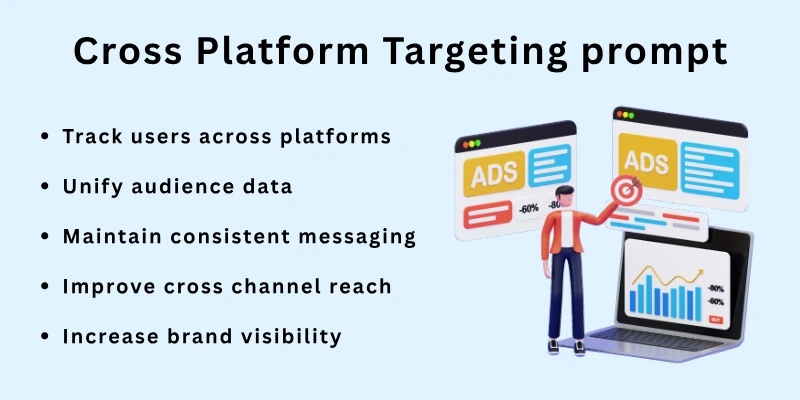
8. Cross Platform Targeting
Ads were inconsistently and manually managed across platforms. AI follows users across channels and devices. It produces a single, cohesive view. Everywhere, advertisements remain the same. Recall of the brand increases.
Prompts you can use:
- Track users across platforms
- Unify audience data
- Maintain consistent messaging
- Improve cross channel reach
- Increase brand visibility
9. Dynamic Creative Optimization
It used to take weeks to conduct creative testing. AI automatically tests formats, images, and headlines. It frequently features top-performing creatives. Stupid creatives pause on their own. Performance gets better more quickly.
Prompts you can use:
- Test multiple ad creatives
- Optimize headlines automatically
- Improve visual performance
- Pause low performing ads
- Scale winning creatives
10. Ad Spend Optimization
Allocating funds was done by hand, which took time. AI automatically modifies budgets and bids. Spend is transferred to ads that perform well. Waste decreases. The return on advertising expenditure increases.
Prompts you can use:
- Optimize bidding strategy
- Allocate budget dynamically
- Reduce wasted spend
- Improve return on investment
- Control ad costs
11. Fraud Detection and Prevention
Ad fraud resulted in fraudulent clicks and financial waste. It was challenging to detect by hand. AI can quickly identify odd patterns. It stops fraudulent traffic. Ad spend is safeguarded.
Prompts you can use:
- Detect invalid clicks
- Identify bot traffic
- Block fraudulent sources
- Protect ad budget
- Improve traffic quality
12. Geo Location Targeting
Broad areas were previously used for location targeting. AI fine-tunes targeting to pinpoint areas. It investigates regional behavior. Advertisements reach users in the vicinity. Conversions locally rise.
Prompts you can use:
- Target users by precise location
- Analyze local behavior
- Optimize local campaigns
- Improve store visits
- Increase local engagement
13. Ad Timing Optimization
In the past, advertisements were broadcast at predetermined times. AI monitors the times when users are engaged. It schedules advertisements to appear at the most appropriate times. The engagement level rises. Savings are made.
Prompts you can use:
- Analyze user activity time
- Schedule ads intelligently
- Optimize ad delivery timing
- Improve response rate
- Reduce wasted impressions
14. A B Testing Automation
It took a lot of time and effort to perform manual A B testing. AI is capable of automatically running continuous tests. It acquires knowledge more quickly. The best versions continue to be available. Performance continues to steadily improve.
Prompts you can use:
- Automate A B tests
- Compare ad variations
- Identify winning ads
- Improve conversion rates
- Reduce testing time
15. Continuous Performance Learning
In the past, campaigns would stop learning after they were set up. Artificial intelligence is constantly gaining knowledge from new data. Continuous adjustments are made to the targeting. Over time, advertisements become more effective. It is consistent with the results.
Prompts you can use:
- Learn from campaign data
- Adjust targeting automatically
- Improve long term performance
- Adapt to market changes
- Maintain ad efficiency
Best AI Tools for Ad Targeting
Here are the 10 best AI tools for ad targeting:
- Google Ads AI for smart bidding
- Meta Ads AI for audience targeting
- AdRoll for cross channel ads
- Smartly.io for creative optimization
- Albert AI for autonomous advertising
- Skai for performance marketing
- Pattern89 for predictive insights
- Revealbot for ad automation
- Madgicx for campaign optimization
- WordStream AI for ad management
Final Note
In this guide, we explained how AI helps in ad targeting using practical and proven methods. We covered audience analysis, personalization, optimization, and automation. Each method shows how AI improves accuracy and saves budget.
My personal advice is to start with clear goals before using AI. Test one campaign at a time. Focus on relevance over reach for better results.
Thank you for reading. I hope this guide helps you run smarter and more profitable ads.
FAQs
Here are some of the most commonly asked questions related to How AI helps in ad targeting:
AI ad targeting uses data and user behavior to show ads to the right people. It studies interests, searches, and actions. This helps ads reach users who care. Results become more relevant.
AI adjusts targeting, timing, and ad creatives. It learns what works and what fails. This reduces wasted budget. Ads perform better over time.
Many ad platforms already include AI features. Even small budgets can benefit from AI. You do not need extra tools. Results often justify the cost.
Yes, AI analyzes real user behavior. It improves accuracy with more data. Targeting becomes more focused. Ads reach interested users only.
AI works very well for small businesses. It saves time and effort. Campaigns become easier to manage. Budgets stay under control.
Most platforms follow privacy rules. They protect user data. Businesses must follow data laws. Always use trusted ad platforms.
Some improvements appear within days. Full optimization needs testing time. AI learns continuously. Consistent use brings better results.
Most AI ad tools are easy to use. Dashboards stay simple and clear. No coding is required. Anyone can manage campaigns.
Yes, AI detects fake clicks and unusual activity. It blocks invalid traffic. This protects ad budgets. Campaign quality improves.
AI optimizes bidding and targeting. It reduces wasted impressions. Ads reach high intent users. Return on ad spend improves.





- Be Respectful
- Stay Relevant
- Stay Positive
- True Feedback
- Encourage Discussion
- Avoid Spamming
- No Fake News
- Don't Copy-Paste
- No Personal Attacks
- Be Respectful
- Stay Relevant
- Stay Positive
- True Feedback
- Encourage Discussion
- Avoid Spamming
- No Fake News
- Don't Copy-Paste
- No Personal Attacks
