Best AI Tools for Exam Preparation: Boost Scores Fast
Published: 12 May 2026
Artificial intelligence is rapidly transforming how students prepare for exams. From helping with memorization to creating personalized study plans, AI tools make learning faster, smarter, and more efficient. Students no longer need to spend endless hours flipping textbooks or searching for practice questions online. With the right AI tools, exam preparation can be organized, interactive, and highly effective.
This guide will cover the best AI tools for exam preparation, explaining how each tool works and how you can use it to maximize your study results.
Best AI Tools for Exam Preparation
Guys, here are the best AI tools that can help you prepare for exams more effectively:
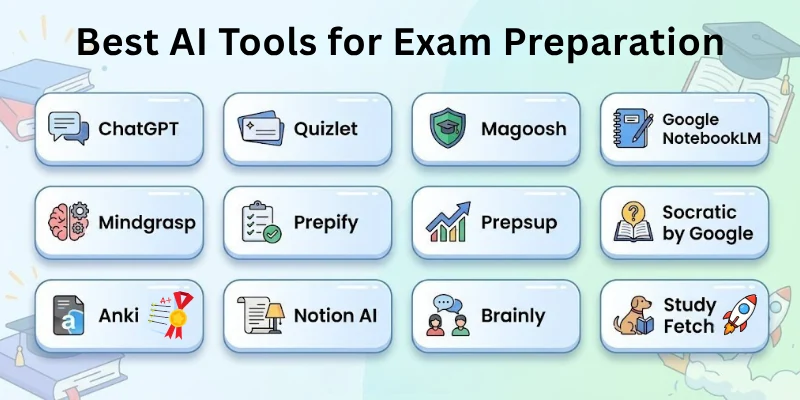
- ChatGPT
- Quizlet
- Magoosh
- Google NotebookLM
- Mindgrasp
- Prepify
- Prepsup
- Socratic by Google
- Anki
- Notion AI
- Brainly
- Study Fetch
So guys, let us learn about each in detail.
1. ChatGPT
ChatGPT is a conversational AI that can assist students in understanding complex topics and creating study materials. It can generate practice questions, explain concepts in simple terms, and even help with essay writing. ChatGPT allows students to interactively learn by asking questions and receiving instant answers. This makes revision faster and helps reinforce learning. The AI can also help plan study schedules and generate summaries of large topics. Overall, ChatGPT is like having a personal tutor available 24/7.
How to Use It:
- Ask ChatGPT to explain difficult concepts in simple language
- Generate practice questions for specific topics
- Request study summaries or key points
- Create a daily or weekly study plan
- Use it to brainstorm essay ideas or assignments
2. Quizlet
Quizlet uses AI to create flashcards, quizzes, and interactive study sets. It helps students memorize concepts through active recall and spaced repetition. The AI can generate suggested study sets based on your topic or textbook. Quizlet also tracks progress and adjusts practice difficulty automatically. Students can use Quizlet to prepare for standardized tests or school exams. Its interactive approach makes learning fun and engaging.
How to Use It:
- Search for or create a study set for your topic
- Use flashcards for memorization
- Take AI-generated practice quizzes
- Track your performance and review mistakes
- Enable spaced repetition for better retention
3. Magoosh
Magoosh is an AI-enhanced platform focused on standardized exams like GRE, SAT, GMAT, and TOEFL. It provides personalized practice questions, video lessons, and analytics on performance. Magoosh adapts to your strengths and weaknesses to focus your study time effectively. The AI ensures that you are practicing the right questions at the right difficulty level. It also offers detailed explanations for every question. This makes it ideal for test-focused students.
How to Use It:
- Select the exam you are preparing for
- Take initial diagnostic tests
- Follow AI-recommended practice questions
- Watch video lessons for difficult concepts
- Review performance analytics to improve
4. Google NotebookLM
Google NotebookLM is an AI tool that uses your uploaded documents to generate summaries, flashcards, and study prompts. It minimizes time spent searching for important information and helps avoid AI hallucination. NotebookLM can turn your notes, PDFs, and study guides into actionable learning material. This helps students focus on understanding rather than copying. The tool also allows interactive questioning to reinforce learning. It’s great for comprehensive exam preparation.
How to Use It:
- Upload notes, PDFs, or textbooks
- Ask AI to summarize chapters or topics
- Generate flashcards from key points
- Ask clarifying questions on any section
- Review summaries before exams
5. Mindgrasp
Mindgrasp converts lecture notes and textbooks into quizzes, flashcards, and summaries using AI. It creates an interactive learning experience that reinforces memory. The tool also helps students track progress and identify weak areas. Mindgrasp is especially useful for long-term revision strategies. By generating practice material automatically, it saves time. Students can also customize quizzes to focus on challenging topics.
How to Use It:
- Upload lecture notes or study material
- Generate AI-powered flashcards and quizzes
- Take practice tests generated by AI
- Review performance and focus on weak areas
- Customize quizzes for targeted practice
6. Prepify
Prepify creates personalized quizzes and summaries from your study content. The AI adapts based on your performance, ensuring efficient learning. It helps students focus on topics where improvement is needed most. Prepify also tracks time spent on each topic and suggests adjustments. This makes exam preparation organized and effective. Students can revise faster without missing critical points.
How to Use It:
- Enter your study material into Prepify
- Generate topic-based quizzes
- Review answers and explanations
- Track performance for improvement
- Adjust focus based on AI suggestions
7. Prepsup
Prepsup is an AI tool that generates customized flashcards and practice quizzes. It allows students to engage in active recall and spaced repetition. The AI adjusts difficulty based on your learning progress. Prepsup also offers summary notes and practice schedules. It is helpful for both school exams and competitive tests. Consistent use improves retention and reduces last-minute cramming.
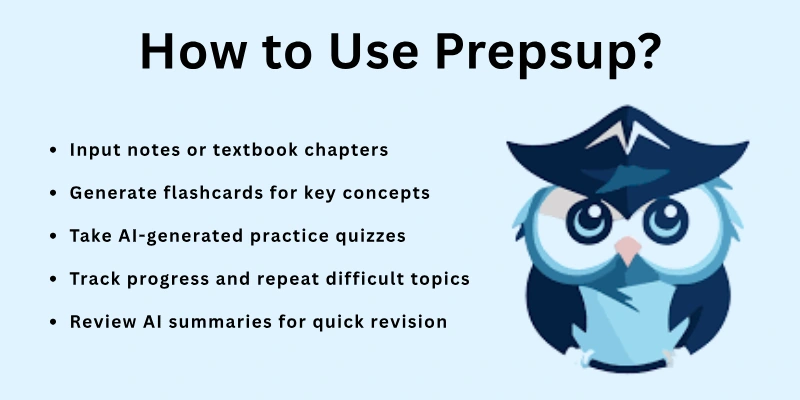
How to Use It:
- Input notes or textbook chapters
- Generate flashcards for key concepts
- Take AI-generated practice quizzes
- Track progress and repeat difficult topics
- Review AI summaries for quick revision
8. Socratic by Google
Socratic by Google helps students solve homework and understand concepts instantly. You can scan questions or type them, and the AI provides step-by-step solutions. It also includes videos and explanations from trusted sources. Socratic supports multiple subjects including math, science, and languages. It’s ideal for clearing doubts on the go. The interactive approach makes learning quick and efficient.
How to Use It:
- Scan or type the question into Socratic
- Review AI-provided solutions and explanations
- Watch related video tutorials
- Save explanations for future reference
- Practice similar questions suggested by AI
9. Anki
Anki uses spaced repetition for flashcards to boost long-term memory retention. AI can help generate question-answer pairs from study material. Anki is particularly useful for memorization-heavy subjects like languages, biology, or history. The AI ensures repetition intervals are optimal for memory. Students can track progress and adjust difficulty. Consistent use makes exam preparation highly effective.
How to Use It:
- Create or import flashcard decks
- Enable spaced repetition mode
- Review cards daily based on AI schedule
- Add new cards for new topics
- Monitor retention and adjust difficulty
10. Notion AI
Notion AI is a smart note-taking assistant that can summarize lectures, generate outlines, and organize study plans. It allows students to consolidate notes from multiple sources efficiently. AI also suggests reminders, task lists, and study schedules. Notion AI can convert notes into flashcards or quizzes for active revision. This makes it an all-in-one study management tool. Students benefit from both organization and AI learning support.
How to Use It:
- Take or import notes into Notion
- Ask AI to summarize or outline topics
- Generate flashcards or quizzes from notes
- Create study schedules and checklists
- Review and adjust plans as needed
11. Brainly
Brainly combines community support with AI-powered learning assistance. Students can post questions and get answers from both peers and AI. The AI also provides explanations and step-by-step guidance. Brainly is useful for clearing doubts quickly and verifying answers. Students benefit from collaborative learning while using AI suggestions. It’s helpful for understanding difficult topics and exam preparation.
How to Use It:
- Post homework or study questions
- Review AI and community answers
- Ask for detailed explanations
- Save answers for later review
- Track trending questions in your subject
12. Study Fetch
Study Fetch generates instant summaries, flashcards, and practice questions from your study material. It is designed to save time and improve retention. The AI adapts content to your learning style and helps target weak areas. Students can use Study Fetch for quick revision before exams. It also helps convert notes into interactive learning material. Overall, it streamlines preparation effectively.
How to Use It:
- Upload notes or textbooks into Study Fetch
- Generate summaries and flashcards
- Take practice quizzes created by AI
- Focus on weak areas highlighted by AI
- Use summaries for final review
Final Thoughts
Using AI tools for exam preparation allows students to study smarter, not harder. These tools save time, improve understanding, and make learning interactive. Combining multiple tools like ChatGPT for explanations, Quizlet for memorization, and Magoosh for test practice creates a powerful study ecosystem.
Students should always review AI-generated content critically and personalize it to their learning style. With consistent use, AI can significantly boost exam performance.
FAQs
Here are some of the most commonly asked questions related to the best AI tools for exam preparation:
AI cannot fully replace traditional studying but enhances it. It provides personalized help, instant explanations, and practice material. Combining AI with textbooks and teachers yields the best results.
Yes, most AI tools cover multiple subjects like math, science, languages, and history. Some tools specialize in exams like GRE or SAT. Students can pick tools based on subject and exam type.
Absolutely. AI generates notes, flashcards, and practice quizzes quickly. Students spend less time on manual research and more on focused study.
Yes, most tools are beginner-friendly. Clear instructions are enough to generate study material. Students can learn gradually while using AI assistance.
Some tools like ChatGPT and Quizlet offer free versions, while others like Magoosh require subscriptions. Free versions often provide enough features for effective study.
Tools like Quizlet and Anki use spaced repetition and active recall techniques. AI schedules optimal review intervals to boost long-term retention.
Yes, many AI platforms analyze performance and highlight weak areas. Students can monitor progress and focus on topics needing improvement.
Most AI tools generate reliable practice questions, especially for standardized exams. Students should cross-check answers when necessary.
AI creates study schedules and sets reminders. Students can follow structured plans, ensuring balanced preparation across topics.
Use AI for explanations (ChatGPT), memorization (Quizlet/Anki), and test practice (Magoosh/Prepify). This combination covers understanding, retention, and performance efficiently.



- Be Respectful
- Stay Relevant
- Stay Positive
- True Feedback
- Encourage Discussion
- Avoid Spamming
- No Fake News
- Don't Copy-Paste
- No Personal Attacks
- Be Respectful
- Stay Relevant
- Stay Positive
- True Feedback
- Encourage Discussion
- Avoid Spamming
- No Fake News
- Don't Copy-Paste
- No Personal Attacks
