How AI Helps in STEM Learning in 15 Effective Ways
Published: 7 Jun 2026
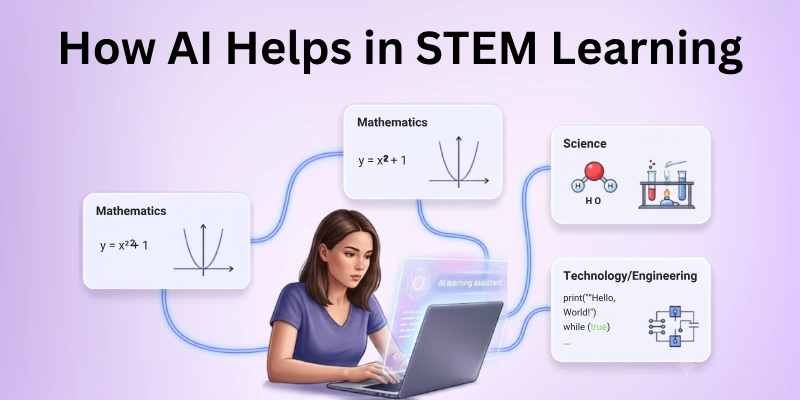
Learning STEM subjects can sometimes be challenging because they require strong problem-solving, critical thinking, and practical understanding. Students often struggle to grasp complex concepts in science, technology, engineering, and mathematics. Today, artificial intelligence is transforming how students learn these subjects.
Understanding how AI helps in STEM learning allows students and educators to use advanced tools to make education more interactive and effective. AI can provide personalized learning paths, instant feedback, and smart tutoring systems. It also helps teachers create better lessons and identify learning gaps quickly.
In this guide, we will explore the different ways AI supports STEM education and improves the learning experience.
Let’s explore each method in detail.
How AI Helps in STEM Learning
Here are 15 major ways AI supports STEM learning:
- Personalized Learning Paths
- Intelligent Tutoring Systems
- Automated Problem Solving
- Interactive Simulations
- Instant Feedback and Assessment
- Virtual STEM Laboratories
- Data-Driven Learning Insights
- Homework Assistance
- Concept Simplification
- Coding and Programming Support
- Adaptive Practice Exercises
- Research Assistance
- Collaborative Learning Tools
- Visual Learning Support
- Skill Gap Identification
Let us understand each method in detail.
1. Personalized Learning Paths
Traditionally, classrooms follow a fixed learning pace for all students. Some learners may struggle to keep up, while others may progress faster. AI helps create personalized learning paths based on individual strengths and weaknesses. It analyzes student performance and recommends lessons accordingly. This helps students learn STEM concepts at their own pace. Personalized learning improves understanding and confidence.
Prompts You Can Use:
- “Explain this physics concept based on beginner level.”
- “Create a personalized study plan for learning calculus.”
- “Suggest learning steps for mastering algebra.”
- “Adjust explanation of this concept for high school level.”
- “Provide a learning roadmap for robotics.”
- “Recommend practice exercises based on my skill level.”
2. Intelligent Tutoring Systems
Traditionally, students rely on teachers or tutors for help with difficult topics. AI-powered tutoring systems act as virtual tutors that provide guidance anytime. These systems answer questions, explain concepts, and provide step-by-step solutions. Students can learn independently and receive instant support. AI tutors make STEM learning more accessible and convenient.
Prompts You Can Use:
- “Explain this chemistry formula step by step.”
- “Teach me the basics of calculus.”
- “Help me understand Newton’s laws simply.”
- “Guide me through solving this equation.”
- “Explain programming loops in simple terms.”
- “Teach this topic like a tutor.”
3. Automated Problem Solving
Traditionally, solving complex math or science problems requires significant practice and manual calculation. AI tools can analyze problems and provide step-by-step solutions. This helps students understand how problems are solved. It also allows learners to check their answers quickly. AI encourages better problem-solving skills.
Prompts You Can Use:
- “Solve this algebra equation step by step.”
- “Explain the solution to this physics problem.”
- “Show the calculation for this math problem.”
- “Break down this engineering equation.”
- “Guide me through solving this statistics question.”
- “Explain the reasoning behind this solution.”
4. Interactive Simulations
Traditionally, understanding scientific experiments requires physical labs and equipment. AI-powered simulations allow students to explore experiments virtually. These simulations demonstrate complex processes visually. Students can experiment safely and repeatedly. This improves comprehension of scientific concepts.
Prompts You Can Use:
- “Explain how a virtual chemistry lab works.”
- “Show a simulation explanation of photosynthesis.”
- “Describe how physics simulations help learning.”
- “Explain how students can experiment with AI simulations.”
- “Demonstrate a simple virtual science experiment.”
- “Explain a simulation for electricity circuits.”
5. Instant Feedback and Assessment
Traditionally, students wait for teachers to review assignments and provide feedback. AI systems can evaluate answers instantly. Students receive corrections and suggestions immediately. This helps them identify mistakes and improve faster. Instant feedback encourages continuous learning.
Prompts You Can Use:
- “Check this math solution and give feedback.”
- “Evaluate my programming code.”
- “Review my science answer.”
- “Identify mistakes in this solution.”
- “Provide feedback on this engineering calculation.”
- “Explain where my answer is incorrect.”
6. Virtual STEM Laboratories
Traditionally, laboratory access is limited by equipment and resources. AI-powered virtual labs allow students to perform experiments online. These labs simulate real-world scientific processes. Students can test theories without physical materials. Virtual labs make STEM education accessible anywhere.
Prompts You Can Use:
- “Explain how virtual science labs work.”
- “Describe the benefits of AI lab simulations.”
- “Guide me through a virtual biology experiment.”
- “Explain a digital chemistry experiment.”
- “Show how students can learn physics using virtual labs.”
- “Explain a virtual engineering lab activity.”
7. Data-Driven Learning Insights
Traditionally, teachers analyze student performance manually. AI can process large amounts of learning data quickly. It identifies patterns in student performance and highlights areas needing improvement. Teachers can use these insights to improve lesson plans. Data-driven learning helps optimize STEM education.
Prompts You Can Use:
- “Analyze this student performance data.”
- “Identify learning gaps in this math report.”
- “Suggest improvements based on these scores.”
- “Explain how data helps improve learning.”=
- “Highlight areas where students struggle.”
- “Recommend learning strategies based on results.”
8. Homework Assistance
Traditionally, students complete homework independently and may struggle without help. AI tools provide assistance while solving homework problems. Students receive hints, explanations, and examples. This helps them learn while completing assignments. AI homework help improves understanding and confidence.
Prompts You Can Use:
- “Help me solve this math homework problem.”
- “Explain this science question.”
- “Guide me through this coding assignment.”
- “Provide hints for this engineering problem.”
- “Check my answer and explain mistakes.”
- “Give examples to solve this problem.”
9. Concept Simplification
Traditionally, complex STEM concepts are difficult to understand from textbooks alone. AI can simplify complicated topics into easy explanations. It breaks concepts into smaller steps and uses simple language. Students can learn faster and retain knowledge better.
Prompts You Can Use:
- “Explain quantum physics in simple words.”
- “Break down this engineering concept.”
- “Teach this math concept like a beginner lesson.”
- “Explain this formula step by step.”
- “Simplify this biology topic.”
- “Describe this concept with easy examples.”
10. Coding and Programming Support
Traditionally, learning programming requires trial and error and teacher guidance. AI tools can assist with writing, debugging, and improving code. Students can understand programming logic more easily. AI also provides examples and explanations for coding tasks.
Prompts You Can Use:
- “Explain how this Python code works.”
- “Fix errors in this programming code.”
- “Teach me basic JavaScript concepts.”
- “Provide examples of loops in programming.”
- “Explain how algorithms work.”
- “Help me debug this code.”
11. Adaptive Practice Exercises
Traditionally, practice exercises are the same for all students. AI systems adapt questions based on student performance. If a student struggles, easier questions appear. If they improve, more challenging problems are provided. Adaptive exercises help students progress gradually.
Prompts You Can Use:
- “Create practice problems for algebra.”
- “Generate math exercises for beginners.”
- “Provide difficult calculus questions.”
- “Give practice questions for physics.”
- “Create a quiz on chemistry concepts.”
- “Generate problem-solving exercises.”
12. Research Assistance
Traditionally, STEM research requires searching multiple academic sources. AI helps summarize research papers and highlight key insights. Students can quickly understand complex studies. This improves research efficiency and learning.
Prompts You Can Use:
- “Summarize this scientific research paper.”
- “Explain findings from this study.”
- “Provide key points from this article.”
- “Highlight important concepts from this research.”
- “Explain this technical report simply.”
- “Summarize the results of this experiment.”
13. Collaborative Learning Tools
Traditionally, group projects require manual coordination and communication. AI tools support collaborative learning environments. Students can share ideas, analyze data together, and receive suggestions. This improves teamwork and learning outcomes.
Prompts You Can Use:
- “Help us organize this group project.”
- “Suggest roles for a STEM team project.”
- “Analyze data collected by our group.”
- “Provide ideas for a science project.”
- “Summarize discussion points from our team.”
- “Suggest improvements for our project.”
14. Visual Learning Support
Traditionally, STEM concepts are explained through text and static diagrams. AI can generate visual explanations such as charts, graphs, and diagrams. Visual learning improves understanding of complex relationships and data.
Prompts You Can Use:
- “Create a diagram explaining this concept.”
- “Visualize this math equation.”
- “Explain this biology process with a diagram.”
- “Show a graph explaining this data.”
- “Provide a visual explanation of this physics concept.”
- “Create a simple learning chart.”
15. Skill Gap Identification
Traditionally, identifying skill gaps requires manual assessment by teachers. AI systems analyze student performance and detect areas where improvement is needed. This helps learners focus on weak topics. Teachers can provide targeted guidance and resources.
Prompts You Can Use:
- “Analyze my test results and identify weak areas.”
- “Suggest topics I need to improve.”
- “Evaluate my STEM learning progress.”
- “Identify gaps in my math knowledge.”
- “Provide recommendations for improvement.”
- “Create a study plan for weak topics.”
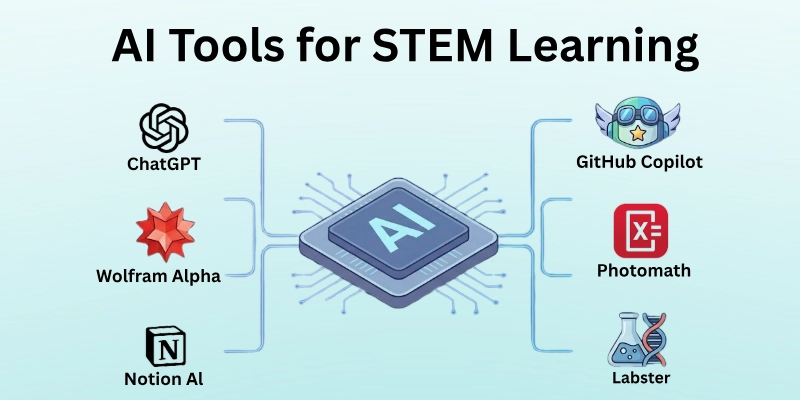
Best AI Tools for STEM Learning
Here are some AI tools that support STEM education:
- Khan Academy (Khanmigo): AI-powered tutor that helps students learn math, science, and programming concepts.
- ChatGPT: AI assistant that explains STEM topics, solves problems, and helps with coding and research.
- Wolfram Alpha: Advanced computational engine that solves complex math and science problems.
- Photomath: AI tool that solves math equations step by step using a smartphone camera.
- Brilliant: Interactive learning platform for math, science, and engineering concepts.
- Coursera AI Tools: Courses and AI-based learning support for STEM subjects.
- Notion AI: Tool for organizing research notes and STEM study materials.
- GitHub Copilot: AI coding assistant that helps students learn programming.
- Google Bard / Gemini: AI tool that explains scientific concepts and research topics.
- Labster: Virtual laboratory platform for science education.
Final Note
In this guide we explored how AI helps in STEM learning in many different ways. AI improves education through personalized learning, virtual labs, intelligent tutoring, automated problem solving, and instant feedback.
Using AI in STEM education allows students to understand complex subjects more easily. It also helps teachers create more engaging lessons and identify learning gaps.
My advice is to combine AI tools with traditional study methods. Practice regularly, explore simulations, and use AI to clarify difficult concepts. This approach will help you learn STEM subjects faster and more effectively.
FAQs
Here are some commonly asked questions related to how AI helps in STEM learning:
AI improves STEM education by providing personalized learning experiences and instant feedback. It helps students understand complex topics through simulations and explanations. AI also assists teachers in analyzing student performance.
Yes, AI tools can solve equations, explain solutions step by step, and generate practice problems. Students can understand concepts more easily. AI also provides instant feedback on answers.
Yes, AI tutors provide guidance anytime students need help. They explain difficult topics and assist with problem-solving. This makes learning more accessible and flexible.
Yes, AI-powered virtual labs allow students to perform experiments digitally. These simulations help students understand scientific processes. They are useful when physical labs are not available.
AI tools can suggest code, explain programming logic, and detect errors. Students can learn coding faster. AI also provides examples and practice exercises.
Yes, AI tools provide hints, explanations, and step-by-step solutions. Students can understand homework problems better. This improves learning outcomes.
Yes, AI analyzes student performance data to identify skill gaps. Teachers and students can focus on areas that need improvement.
Yes, AI can break complex topics into simple explanations. This helps beginners understand difficult STEM subjects easily.
Yes, AI can summarize research papers and highlight important findings. This helps students understand complex studies quickly.
No, AI supports teachers rather than replacing them. Teachers provide guidance, mentoring, and real-world experience. AI simply enhances the learning process.




- Be Respectful
- Stay Relevant
- Stay Positive
- True Feedback
- Encourage Discussion
- Avoid Spamming
- No Fake News
- Don't Copy-Paste
- No Personal Attacks
- Be Respectful
- Stay Relevant
- Stay Positive
- True Feedback
- Encourage Discussion
- Avoid Spamming
- No Fake News
- Don't Copy-Paste
- No Personal Attacks
