How Does Artificial Intelligence Work? Simple Beginner’s Guide
Published: 28 Sep 2026
Have you ever wondered how your phone unlocks when it sees your face, or how streaming services seem to know exactly what show you want to watch next? It can feel a bit like magic, or perhaps like a science fiction movie coming to life right on your screen.
Many people hear the phrase “artificial intelligence” and picture sentient robots taking over the world. The reality is much more practical, grounded in data, and easier to understand than you might think.
In this guide, we will break down how artificial intelligence works in simple, clear language. We will explore the fundamental concepts behind AI, look at real-world examples, and clear up common misunderstandings so you can confidently understand the technology shaping our world.
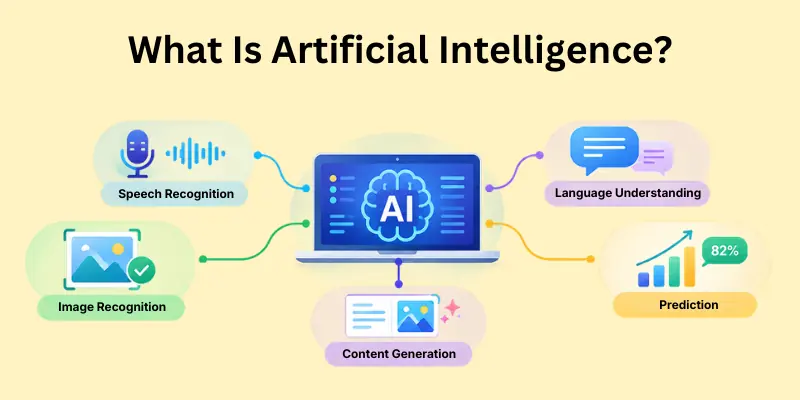
What Is Artificial Intelligence?
At its core, artificial intelligence is a broad field of computing focused on creating systems that can perform tasks commonly associated with human intelligence.
These tasks can include:
- Recognizing speech
- Understanding and generating language
- Identifying objects in images
- Translating languages
- Detecting patterns in data
- Making predictions
- Recommending products or content
- Helping with complex decisions
- Generating text, images, audio, video, or code
Traditional computer programs often rely heavily on rules written by programmers. For example, a simple program might be explicitly instructed: “If X happens, do Y.”
Machine learning takes a different approach. Instead of manually writing every rule, developers can train a model using data so that it learns useful patterns and relationships.
However, not every AI system learns in the same way. Some systems use machine learning, while others may rely on rules, search, optimization, planning, or combinations of different techniques.
How Does Artificial Intelligence Work?
A useful way to understand modern AI is to look at the overall process:
Data → Training → Trained Model → New Input → Inference → Output
For many machine-learning systems, the process begins with data. Developers prepare that data, choose a suitable model and training method, and use computing resources to train the model.
During training, the model’s parameters are adjusted so that its outputs become more useful for the task.
Once training is complete, the model can process new information during a stage called inference.
For example, an image-recognition model might be trained using many labeled images. After training, it can receive a new image and predict what it contains.
The exact process varies depending on the type of AI system, but the following stages provide a useful beginner-friendly framework.
Step 1: Data Collection and Preparation
For many modern AI systems, data is a critical resource used to train models.
Data can include:
- Text documents
- Images
- Audio recordings
- Videos
- Sensor readings
- Financial transactions
- Customer interactions
- Scientific measurements
Raw data is rarely ready to use immediately. It may contain missing values, duplicate records, inconsistent formatting, errors, or irrelevant information.
Data preparation can therefore involve cleaning, organizing, labeling, transforming, and sometimes reducing the data.
Important considerations include:
- Data Quality: Poor-quality or inaccurate data can lead to unreliable results.
- Data Diversity: Data should represent the situations the system is expected to encounter.
- Data Labels: Some learning methods require examples with known answers.
- Normalization: Numerical values may be scaled to make training more effective.
- Bias: If training data contains problematic biases or does not adequately represent relevant groups or situations, model performance can be affected.
A simple rule is often used to describe this problem: garbage in, garbage out. A sophisticated model cannot automatically turn poor input data into reliable results.
Step 2: Choosing an Algorithm and Model
Once the data is prepared, developers select an appropriate machine-learning method and model architecture.
An algorithm is a procedure or set of mathematical steps used to solve a problem or optimize a model.
A model is the learned mathematical system that ultimately uses patterns from the training process to produce predictions or other outputs.
For example, a spam-detection system might learn relationships between features such as message content, sender information, and other signals.
Different problems require different approaches. A simple prediction task may use a relatively straightforward machine-learning model, while image recognition or language generation may require a large neural network.
Step 3: Training the AI Model
During training, the model processes examples and adjusts its parameters to improve its performance.
Consider a model designed to recognize cats and dogs.
It might receive thousands or millions of training examples. Depending on the training approach, those examples may include labels such as “cat” or “dog.”
The model makes a prediction, compares that prediction with the available training signal, calculates an error or loss, and adjusts its parameters.
This process is repeated many times.
The goal is not simply to memorize the training examples. A useful model should learn patterns that allow it to perform well on new data it has not previously seen.
Common Learning Approaches
- Supervised Learning: The model learns from labeled data where the correct answers are already provided.
- Unsupervised Learning: The model analyzes unlabeled data to discover patterns, similarities, or groups on its own.
- Self-Supervised Learning: The model creates learning signals from the data itself, allowing it to learn from large amounts of unlabeled information.
- Reinforcement Learning: The model learns through trial and error by receiving rewards for useful actions and penalties for poor ones.
Step 4: How Neural Networks Process Information
For many complex AI tasks, especially those involving images, language, and audio, neural networks are extremely important.
An artificial neural network consists of interconnected computational units arranged into layers.
A simplified neural network contains:
- Input layer: Receives information.
- Hidden layers: Transform the information through mathematical operations.
- Output layer: Produces a prediction or other result.
The connections between these units have numerical parameters commonly called weights. Training adjusts these parameters so that the network becomes better at the task.
For example, when processing an image, different parts of a neural network may learn representations related to edges, shapes, textures, and more complex visual patterns.
This is a simplified explanation. Modern neural networks learn distributed representations, and their internal processing is often much more complex than a simple sequence of “edges → shapes → objects.”
Step 5: Backpropagation and Optimization
During neural-network training, the model produces an output and compares it with the target or training signal.
The difference is represented using a loss function.
The model then uses backpropagation to calculate how changes in its parameters would affect the loss.
An optimization algorithm, such as a gradient-based optimizer, uses this information to update the model’s parameters.
This process is repeated over many training examples and iterations.
The important distinction is that these parameter updates happen during training. A separate validation dataset can help developers tune the model and make design decisions, while a test dataset is normally kept separate for final evaluation.
Step 6: Model Evaluation and Fine-Tuning
A model that performs well on its training data is not necessarily a good model.
It may have overfit, meaning it has learned the training examples too closely instead of learning patterns that generalize to new data.
To evaluate generalization, developers typically use separate validation and test data.
Common evaluation measures include:
- Accuracy: The percentage of predictions that are correct.
- Precision: How often positive predictions are correct.
- Recall: How effectively the model identifies relevant positive cases.
- F1 Score: A combined measure of precision and recall.
- Loss: A mathematical measure of prediction error.
- Task-Specific Metrics: Other measures may be more appropriate depending on the application.
There is no single metric that works for every AI system. The appropriate evaluation method depends on what the model is designed to do.
Developers may then improve the system by changing the data, model architecture, training process, parameters, or other parts of the system.
Step 7: Inference and Real-World Use
After a model has been trained and evaluated, it can be used to process new inputs. This process is called inference.
For example, a trained image-recognition model can receive a new photograph and predict what objects appear in it.
Similarly, a speech system can receive audio and use trained models to convert speech into text or interpret a spoken request.
Depending on the system, AI processing may happen:
- Directly on a device
- On a remote cloud server
- Through a combination of local and remote processing
A major goal during deployment is to balance performance, accuracy, cost, privacy, and speed.
Important considerations include:
- Latency: How quickly the system responds.
- Compute Efficiency: How efficiently it uses processing resources.
- Scalability: Whether the system can handle increasing numbers of users or requests.
- Privacy: How sensitive information is stored and processed.
- Reliability: How consistently the system performs under real-world conditions.
The Core Ingredients of Artificial Intelligence
A simple way to think about modern AI is that several components work together:
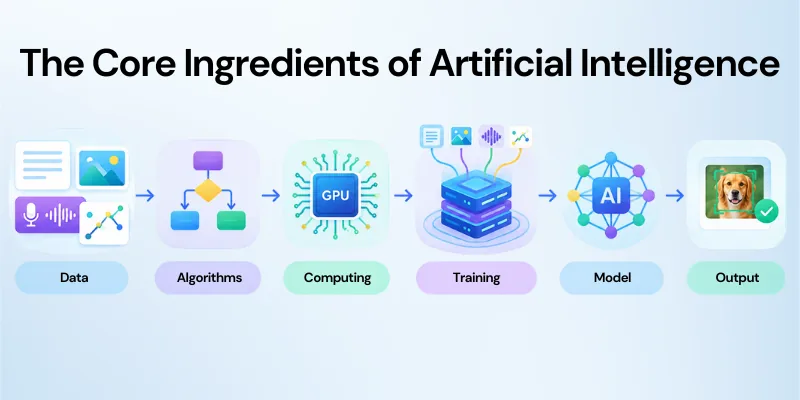
Data + Algorithms/Model Architecture + Computing Resources → Training → Trained Model → Inference → Output
Data: The Learning Material
Data provides examples or information from which many AI systems learn.
Depending on the task, this could include text, images, audio, video, sensor readings, or other forms of information.
Algorithms: The Methods
Algorithms provide mathematical procedures for training models, processing information, optimizing parameters, or solving problems.
Models: The Learned System
A model is the mathematical system that has been trained to perform a particular task.
For machine-learning models, training typically involves adjusting parameters based on data and a chosen learning objective.
Computing Power: The Processing Resources
Training and running modern AI models can require significant computing resources.
Specialized hardware such as GPUs and other accelerators can perform the large number of mathematical operations required by many AI workloads.
The amount of computing power required varies considerably depending on the model and task.
AI vs. Machine Learning vs. Deep Learning
The terms artificial intelligence, machine learning, and deep learning are related but not identical.
A useful simplified hierarchy is:
Artificial Intelligence
↓
Machine Learning
↓
Deep Learning
Artificial Intelligence
AI is the broad field concerned with creating systems capable of performing tasks associated with intelligence.
AI can include machine learning as well as other approaches, such as rules, search, planning, optimization, and reasoning systems.
Machine Learning
Machine learning is a major approach within AI in which models learn patterns from data rather than relying entirely on manually written rules for every situation.
Machine learning can use supervised, unsupervised, self-supervised, reinforcement, and other learning approaches.
Deep Learning
Deep learning is a branch of machine learning that uses multilayer neural networks.
Deep-learning models are especially useful for complex tasks involving large amounts of data, including image processing, speech recognition, language modeling, and generative AI.
Practical Examples of AI in Daily Life
Artificial intelligence is already integrated into many everyday technologies.
| Category | How It Works | Example |
| Recommendation Systems | Analyze user behavior and other signals to estimate preferences | Streaming and shopping platforms |
| Computer Vision | Processes visual information to identify patterns or objects | Face recognition and image search |
| Natural Language Processing | Processes and generates human language | Email assistance and chatbots |
| Speech Recognition | Converts spoken audio into text or commands | Voice assistants |
| Fraud Detection | Identifies unusual patterns in transactions | Banking and payment systems |
| Navigation | Uses data and algorithms to estimate routes and travel conditions | Maps and navigation apps |
| Generative AI | Produces new content based on learned patterns | AI writing and image-generation tools |
These examples demonstrate that AI is not a single technology. Different applications use different models, algorithms, datasets, and system architectures.
Common Challenges and Limitations of AI
While modern AI is powerful, it is not flawless. Understanding its limits helps set realistic expectations for what the technology can achieve.
Keep the following limitations in mind when assessing AI performance:
- Data Bias: If training data contains human biases, the AI will mirror and amplify those flaws.
- Lack of True Reasoning: AI models recognize statistical patterns; they do not possess common sense, emotional understanding, or true comprehension.
- The “Black Box” Problem: Deep learning models can be so complex that even their creators cannot fully explain how a specific decision was reached.
- High Resource Demands: Training cutting-edge models requires massive electrical power and computing infrastructure.
Does AI Actually Think Like a Human?
Not in the ordinary human sense.
AI systems process information using mathematical models, algorithms, and computational procedures. Some modern systems can perform tasks that appear to involve reasoning, planning, or understanding, but their internal mechanisms are fundamentally different from the human brain.
It is therefore more accurate to describe AI in terms of what it does rather than assuming that it thinks or experiences the world exactly as humans do.
AI Training vs. AI Inference
One of the most useful concepts for understanding AI is the difference between training and inference.
Training
Training is the process of developing or adapting a model by adjusting its parameters based on data and a learning objective.
It can require substantial computing resources and may take a long time for large models.
Inference
Inference happens when the trained model is used to process new input and produce an output.
For example:
Training:
Thousands or millions of examples → Model learns useful patterns
Inference:
New input → Trained model → Prediction or generated output
This distinction is important because an AI application does not necessarily retrain itself every time someone uses it.
Conclusion
In this guide, we have covered how AI works from data collection and model training to neural networks, inference, generative AI, real-world applications, and ongoing evaluation. The basic process is to learn useful patterns from data and then apply those patterns to new inputs to produce predictions, recommendations, decisions, or generated content.
The most important point is that AI is not one technology that magically “thinks.” Different AI systems use different methods, and their performance depends on data, models, computing resources, evaluation, and the context in which they operate.
My practical recommendation: Start by understanding the difference between training, inference, machine learning, and deep learning because these concepts make the rest of AI much easier to understand.
If you are learning AI, try applying this framework to a familiar tool such as a chatbot, recommendation system, or image-recognition app and identify what happens at each stage.
Frequently Asked Questions
Still wondering how artificial intelligence works? These answers cover some of the most common questions beginners ask about AI.
Artificial intelligence works by using algorithms and models to process information and produce useful outputs. Modern AI systems often learn patterns from data during training and then use those learned patterns to make predictions, recommendations, or classifications or generate content from new inputs.
AI learns from data by adjusting the parameters of a model during training. The model processes examples, produces predictions, measures errors or other training signals, and updates its parameters to improve its performance.
The exact process depends on the learning method, such as supervised, unsupervised, self-supervised, or reinforcement learning.
Machine learning allows an AI system to learn patterns from data instead of requiring developers to manually program every possible rule. During training, an algorithm adjusts a model based on data, and the trained model can later make predictions or other outputs from new information.
Neural networks process information through interconnected computational units arranged in layers. Each connection has parameters such as weights, and training adjusts these parameters so the network can produce more useful outputs.
Deep neural networks use many layers to represent increasingly complex patterns, which makes them useful for tasks involving images, language, audio, and other complex data.
Not always. An AI application may require an internet connection when its model runs on a remote server or needs online data and services, but some AI models can run locally on computers, smartphones, or other devices.
The requirement depends on how the particular system is designed and where its model and supporting services are hosted.
AI can produce incorrect answers because its model may have learned incomplete patterns, received ambiguous input, encountered unfamiliar information, or simply made an error. Generative AI can also produce plausible-sounding content that is not factually correct.
For important decisions, AI output should therefore be checked against appropriate reliable sources rather than accepted solely because it sounds confident.
AI is the broad field concerned with creating systems that perform tasks associated with intelligence. Deep learning is a subset of machine learning that uses multilayer neural networks.
In simple terms:
- AI: The broad field.
- Machine learning: One major approach within AI.
- Deep learning: A machine learning approach based on multilayer neural networks.
This nested relationship is a useful starting point for understanding the terminology.
Generative AI uses models trained on large amounts of data to learn patterns and relationships. When a user provides an input such as a prompt, the model processes that input and generates an output based on the patterns represented in its learned parameters.
Depending on the system, the output may be text, an image, audio, video, code, or another type of content.
Yes, an AI system can be improved through activities such as retraining, fine-tuning, updating data, adjusting model architecture, improving prompts or system instructions, and evaluating errors. However, an AI system does not necessarily learn continuously from every interaction.
Whether a particular AI tool updates its model from user interactions depends on how that system is designed and the policies governing it.
AI generally needs an appropriate combination of relevant data, algorithms, a model, computing resources, software infrastructure, and evaluation. More advanced systems may also require extensive monitoring, security controls, human oversight, and governance.
The most important requirement is not simply having a large amount of data or computing power. The system needs to be designed for the specific task and evaluated on realistic conditions so its results are useful and trustworthy.
Start by testing established consumer tools for daily tasks like drafting emails, summarizing text, or organizing schedules.
A simple checklist can keep your initial exploration safe and effective:
- Avoid sharing sensitive personal or financial information with public tools.
- Double-check important facts against trusted sources.
- Focus on how the tool assists your personal workflow.






- Be Respectful
- Stay Relevant
- Stay Positive
- True Feedback
- Encourage Discussion
- Avoid Spamming
- No Fake News
- Don't Copy-Paste
- No Personal Attacks
- Be Respectful
- Stay Relevant
- Stay Positive
- True Feedback
- Encourage Discussion
- Avoid Spamming
- No Fake News
- Don't Copy-Paste
- No Personal Attacks
