How To Use AI For Customer Retention – Step-by-Step Guide
Published: 19 Jul 2026
Customer retention has become one of the biggest priorities for businesses in 2026. Studies show that keeping existing customers often costs much less than finding new ones, and loyal customers usually spend more over time. That is why many companies now look for smarter ways to improve customer relationships.
Learning how to use AI for customer retention can help you understand customer behavior, send personalized messages, and reduce customer churn. I have seen businesses improve customer loyalty by using AI in practical and simple ways instead of relying on manual processes.
In this article, we will discuss how to use AI for customer retention in detail. You will also learn practical steps, useful AI tools, and proven strategies that you can apply to your own business.
AI for Customer Retention
Keeping existing customers has become just as important as gaining new ones. Businesses now use AI to better understand customer behavior, predict future actions, and deliver personalized experiences that encourage customers to stay loyal.
Definition: AI for customer retention is the use of artificial intelligence to analyze customer data, predict customer needs, automate engagement, and reduce customer churn.
How AI Improves Customer Loyalty
AI helps businesses build stronger relationships by understanding what customers want and responding at the right time. Below are some of the main ways AI improves customer loyalty.
- Personalized recommendations: Suggests products or services based on customer interests.
- Predictive insights: Identifies customers who may stop buying and helps businesses take action early.
- Faster customer support: AI chatbots provide quick answers and improve customer satisfaction.
- Personalized communication: Sends relevant emails, offers, and messages to each customer.
- Better customer experience: Uses customer data to make every interaction more useful and engaging.
AI vs Traditional Retention Strategies
The following points show the main differences between AI-powered and traditional customer retention strategies.
- AI retention strategies: Analyze customer data in real time, automate engagement, and deliver personalized experiences at scale.
- Traditional retention strategies: Depend on manual analysis, general marketing campaigns, and slower decision-making with limited personalization.
How to Use AI for Customer Retention (Step by Step)
Using AI for customer retention is not just about adding new technology to your business. It starts with understanding your customers, collecting the right data, and using AI to make better decisions at every stage of the customer journey. When you follow a structured approach, AI can help you reduce customer churn, improve customer satisfaction, and increase repeat purchases.
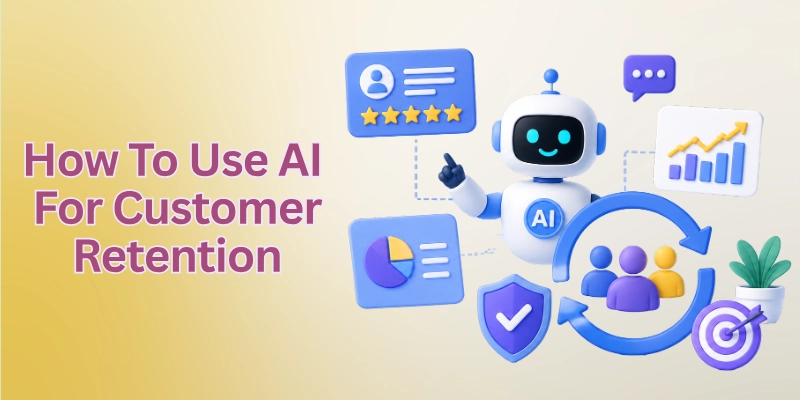
Follow the steps below to learn how to use AI for customer retention effectively.
Step 1: Collect Customer Data
The first step in using AI for customer retention is collecting accurate and relevant customer data. AI depends on quality data to identify customer behavior, predict future actions, and deliver personalized experiences. The more complete and organized your data is, the better AI can help you keep customers engaged.
Below are the main types of customer data you should collect before using AI.
- Website activity: Track the pages customers visit, products they view, time spent on your website, and actions they take.
- Purchase history: Analyze previous orders, buying frequency, average order value, and favorite products to understand shopping patterns.
- Customer support interactions: Review chat conversations, support tickets, complaints, and feedback to identify common issues and improve customer service.
- Email engagement: Monitor email opens, link clicks, responses, and unsubscribe rates to measure customer interest and improve future campaigns.
- Social media behavior: Analyze likes, comments, shares, mentions, and direct messages to understand customer preferences and engagement across social platforms.
Pro Tip: AI is only as good as the data you provide. Keeping your customer data accurate, complete, and updated will help AI deliver more reliable insights and better retention results.
Step 2: Segment Your Customers Using AI
After collecting customer data, the next step is to organize your customers into different groups. AI makes this process faster and more accurate by analyzing customer behavior, purchase history, and engagement patterns. Instead of treating every customer the same, AI helps you deliver the right message, offer, or support to the right people at the right time.
Below are the main customer segments that AI can identify to improve customer retention.
- New customers: Identify first-time buyers and send welcome messages, onboarding guides, or special offers to encourage a second purchase.
- Loyal customers: Recognize customers who buy regularly and reward them with exclusive discounts, loyalty programs, or early access to new products.
- High-value customers: Find customers who spend the most over time and provide personalized recommendations, premium support, and VIP rewards.
- Inactive customers: Detect customers who have not interacted with your business for a while and re-engage them with targeted campaigns or special incentives.
- Customers likely to churn: Use AI to identify customers showing signs of leaving, such as reduced activity or fewer purchases, and take action before they stop buying completely.
Pro Tip: Customer segments change over time. Use AI to update your audience automatically so every customer receives relevant offers based on their latest behavior, not outdated data.
Step 3: Predict Customer Churn Before It Happens
One of the biggest advantages of AI is its ability to identify customers who may leave before they actually do. Instead of waiting until customers stop buying, AI analyzes their behavior and highlights early warning signs. This allows businesses to take quick action and improve customer retention.
The following methods help AI predict customer churn more accurately.
- Warning signs: AI monitors changes such as fewer website visits, lower email engagement, reduced purchases, or negative support interactions that may indicate a customer is losing interest.
- AI churn prediction models: These models analyze customer data, compare behavior patterns, and estimate the likelihood that a customer will stop using your product or service.
- Risk scoring: AI assigns each customer a churn risk score, helping businesses prioritize high-risk customers and focus retention efforts where they matter most.
- Real example: An ecommerce store can use AI to identify customers who have not placed an order in the last 90 days. The system can automatically send a personalized discount or product recommendation to encourage another purchase.
Expert Tip: Predicting churn early gives you more time to rebuild customer relationships. Even a simple personalized offer or follow-up message can make a significant difference.
Step 4: Personalize Every Customer Experience
Customers expect businesses to understand their preferences and provide relevant experiences. AI makes personalization possible by analyzing customer behavior and delivering content, products, and offers that match individual interests. This helps businesses increase engagement, customer satisfaction, and repeat purchases.
Here are some of the most effective ways AI personalizes the customer experience.
- Product recommendations: AI suggests products based on browsing history, previous purchases, and customer preferences to increase the chances of another sale.
- Personalized homepage: AI displays customized banners, featured products, and content based on each visitor’s interests and past activity.
- AI-generated emails: AI creates personalized email subject lines, product suggestions, and follow-up messages that improve open rates and customer engagement.
- SMS personalization: AI sends timely text messages with personalized offers, reminders, order updates, or exclusive promotions based on customer behavior.
- Dynamic offers: AI automatically adjusts discounts, rewards, or special promotions according to each customer’s purchase history, loyalty level, or shopping habits.
Best Practice: Personalization works best when it provides real value. Use AI to recommend helpful products and relevant offers instead of sending the same promotional message to every customer.
Step 5: Automate Customer Communication
Consistent communication helps customers stay connected with your business. AI automates routine interactions, sends timely messages, and keeps customers engaged without requiring constant manual effort. This saves time while delivering a better customer experience.
The following AI-powered communication methods can help improve customer retention.
- Email automation: AI sends welcome emails, abandoned cart reminders, product recommendations, and re-engagement campaigns based on customer actions.
- Push notifications: AI delivers timely alerts about new products, special offers, order updates, or reminders when customers are most likely to respond.
- WhatsApp: AI automates personalized messages for order confirmations, customer support, promotions, and appointment reminders through WhatsApp.
- Chatbots: AI chatbots answer common questions instantly, provide product information, and assist customers at any time of the day.
- Follow-up messages: AI automatically sends follow-up emails or messages after purchases, support requests, or customer inquiries to maintain engagement.
Pro Tip: Automate routine communication, but keep important conversations personal. Customers appreciate quick responses, but they also value genuine human interaction when needed.
Step 6: Improve Customer Support Using AI
Fast and helpful customer support plays a major role in customer retention. AI helps businesses resolve issues more quickly, reduce response times, and provide consistent support across multiple channels.
Below are some of the most effective ways AI improves customer support.
- AI chatbots: Handle common questions instantly and provide support around the clock without long waiting times.
- AI ticket routing: Automatically directs customer requests to the right support team based on the issue, priority, or topic.
- AI knowledge bases: Suggest relevant help articles and answers so customers can solve simple problems on their own.
- Sentiment analysis: AI analyzes customer messages to detect frustration, satisfaction, or urgency and helps support teams respond appropriately.
- Human handoff: When AI cannot solve a complex issue, it smoothly transfers the conversation to a human support agent with the full conversation history.
Best Practice: Use AI to handle repetitive support tasks while allowing human agents to manage complex or sensitive customer issues for the best overall experience.
Step 7: Build Loyalty Programs with AI
A well-designed loyalty program encourages customers to return and make repeat purchases. AI improves loyalty programs by understanding customer behavior and delivering rewards that match each customer’s interests and shopping habits.
These AI-powered strategies can make your loyalty program more effective.
- Personalized rewards: AI offers rewards based on individual purchase history, preferences, and engagement instead of providing the same reward to every customer.
- Smart discounts: AI determines the right discount for different customer segments to increase conversions without reducing profits unnecessarily.
- VIP customer identification: AI identifies high-value customers and provides exclusive benefits, early access, or premium services to strengthen long-term loyalty.
- Referral optimization: AI identifies customers who are most likely to recommend your business and encourages referrals with personalized incentives.
Expert Tip: Loyalty programs become more successful when rewards feel personal. AI helps deliver offers that customers actually value, increasing both satisfaction and retention.
Step 8: Predict the Best Time to Re-engage Customers
Reaching customers at the right moment can make a significant difference in engagement and retention. AI analyzes customer behavior and communication history to determine when and how customers are most likely to respond.
AI uses the following insights to improve customer re-engagement campaigns.
- Best sending time: AI identifies the days and times when each customer is most likely to open emails, read messages, or make a purchase.
- Best communication channel: AI recommends whether to contact customers through email, SMS, WhatsApp, push notifications, or another channel based on their previous interactions.
- Next-best action prediction: AI predicts the most effective next step, such as sending a discount, recommending a product, offering support, or requesting feedback.
Remember: Sending the right message at the right time is often more effective than sending multiple messages. AI helps you communicate when customers are most likely to take action.
Step 9: Use AI to Gather Customer Feedback
Customer feedback helps businesses understand what customers like, what they expect, and where improvements are needed. AI makes this process easier by analyzing large amounts of feedback from different sources and identifying valuable insights in less time.
The following AI features help businesses collect and analyze customer feedback more effectively.
- AI survey analysis: AI reviews survey responses, identifies common trends, and highlights the areas that need immediate attention.
- Review analysis: AI analyzes customer reviews from websites, online stores, and social media to discover recurring compliments and complaints.
- Sentiment detection: AI determines whether customer feedback is positive, negative, or neutral, helping businesses understand overall customer satisfaction.
- Voice of Customer (VoC): AI combines feedback from surveys, reviews, emails, chats, and social media to create a complete picture of customer expectations and experiences.
Pro Tip: Do not collect customer feedback just for reporting. Use AI insights to make meaningful improvements that show customers their opinions truly matter.
Step 10: Continuously Improve Using AI Analytics
Customer retention is an ongoing process, not a one-time task. AI analytics help businesses measure performance, identify new opportunities, and refine retention strategies based on real customer data. Regularly tracking the right metrics ensures your retention efforts continue to deliver better results.
Monitor the following key metrics to measure and improve customer retention.
- Churn rate: Measures the percentage of customers who stop doing business with you during a specific period.
- Retention rate: Tracks the percentage of customers who continue buying from your business over time.
- Customer Lifetime Value (CLV): Estimates the total revenue a customer is expected to generate throughout their relationship with your business.
- Repeat purchase rate: Shows how often existing customers return to make additional purchases.
- Net Promoter Score (NPS): Measures how likely customers are to recommend your business to others, indicating customer loyalty.
- Customer Satisfaction Score (CSAT): Evaluates customer satisfaction based on surveys completed after purchases, support interactions, or other experiences.
Best Practice: Review your retention metrics regularly instead of waiting for problems to appear. AI analytics help you identify trends early so you can improve customer retention before small issues become major challenges.
Common Mistakes to Avoid
AI can improve customer retention, but it does not guarantee success on its own. Many businesses make simple mistakes that reduce the effectiveness of their AI strategy. Avoiding these mistakes will help you build stronger customer relationships and achieve better long-term results.
Watch out for the following common mistakes when using AI for customer retention.
- Depending only on automation
- Ignoring customer feedback
- Sending too many personalized messages
- Using outdated customer data
- Not measuring results
- Choosing the wrong AI tools
Future of AI in Customer Retention
AI continues to evolve, and customer retention strategies are becoming more intelligent every year. Businesses are moving beyond basic automation and using advanced AI technologies to create stronger customer relationships, predict customer needs, and deliver highly personalized experiences. Companies that adopt these innovations early will be better prepared to keep customers engaged and loyal.
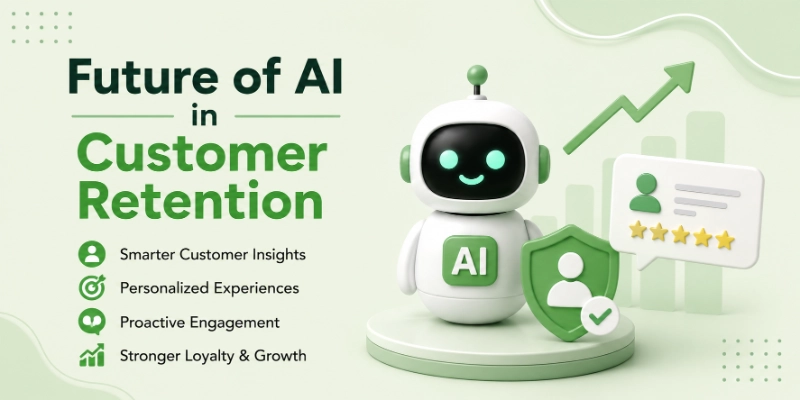
Here are some of the key AI trends shaping the future of customer retention.
- AI agents: AI agents will manage routine customer tasks, answer questions, solve simple issues, and provide personalized assistance with minimal human involvement.
- Predictive customer success: AI will identify potential problems before they affect customers, allowing businesses to take proactive steps that improve satisfaction and reduce churn.
- Hyper-personalization: AI will use real-time customer data to deliver highly personalized recommendations, offers, and experiences based on each customer’s unique preferences and behavior.
- Voice AI: Voice assistants and AI-powered customer support will provide faster, more natural conversations, making it easier for customers to get help whenever they need it.
- Generative AI for customer engagement: Generative AI will create personalized emails, product descriptions, marketing messages, and customer responses that improve engagement while saving time.
- Autonomous marketing automation: AI will automatically plan, launch, optimize, and adjust marketing campaigns based on customer behavior without requiring constant manual updates.
Conclusion
In this guide, we have covered how to use AI for customer retention. We explored how AI helps businesses understand customer behavior, reduce churn, personalize customer experiences, automate communication, and build long-term loyalty. We also discussed practical steps, useful AI tools, common mistakes to avoid, and future trends that can help you create a stronger retention strategy.
Using AI for customer retention does not have to be complicated. Start with one area, such as customer segmentation or personalized communication, measure the results, and gradually expand your AI strategy as your business grows.
My Recommendation: I recommend focusing on high-quality customer data before investing in advanced AI tools. A strong data foundation will help AI deliver more accurate insights and better retention results over time.
Thank you for taking the time to read this guide. I hope it helps you build stronger customer relationships and grow your business with confidence.
💬 Have a question or want to share your experience with AI for customer retention? Drop your thoughts in the comments below. We’d love to hear from you! 😊
Frequently Asked Questions (FAQs)
To make things even clearer, below are the answers to some of the most searched questions about how to use AI for customer retention.
AI customer retention is the process of using artificial intelligence to keep existing customers engaged and loyal. It analyzes customer data, predicts future behavior, and helps businesses deliver personalized experiences. This leads to higher customer satisfaction, lower churn, and more repeat purchases.
AI identifies customers who may leave by analyzing their behavior and engagement patterns. It can detect warning signs before customers stop buying.
AI helps reduce customer churn by:
- Predicting customers at risk of leaving
- Sending personalized offers and reminders
- Improving customer support
- Recommending relevant products
Several AI tools help businesses improve customer loyalty and engagement. The best choice depends on your business goals.
Some popular AI customer retention tools include:
- ChatGPT for customer communication
- HubSpot AI for CRM and automation
- Klaviyo AI for e-commerce marketing
- Zendesk AI for customer support
- Salesforce Einstein for predictive analytics
AI studies customer behavior, purchase history, and preferences to deliver personalized experiences. It recommends products, customizes emails, and displays relevant offers based on individual interests. This helps businesses build stronger relationships with their customers.
AI works best when it has accurate and relevant customer information to analyze.
The most useful data includes:
- Purchase history
- Website activity
- Email engagement
- Customer support interactions
- Social media engagement
AI improves many retention tasks by analyzing data faster and automating repetitive work. Traditional methods still play an important role because personal relationships and human support remain valuable. The best results come from combining AI with a strong customer service strategy.
Tracking the right metrics helps you understand whether your AI strategy is working.
Important metrics include:
- Customer retention rate
- Customer churn rate
- Customer Lifetime Value (CLV)
- Repeat purchase rate
- Customer Satisfaction Score (CSAT)
Yes, AI plays a major role in e-commerce customer retention. It recommends products, sends personalized promotions, recovers abandoned carts, and predicts future buying behavior. These features encourage customers to return and make additional purchases.
AI is expected to become even more intelligent and personalized in the coming years. Businesses will increasingly use AI agents, predictive customer success, Voice AI, and generative AI to improve customer engagement. Companies that adopt these technologies early can build stronger customer loyalty and stay ahead of the competition.





- Be Respectful
- Stay Relevant
- Stay Positive
- True Feedback
- Encourage Discussion
- Avoid Spamming
- No Fake News
- Don't Copy-Paste
- No Personal Attacks
- Be Respectful
- Stay Relevant
- Stay Positive
- True Feedback
- Encourage Discussion
- Avoid Spamming
- No Fake News
- Don't Copy-Paste
- No Personal Attacks
