Negative Impact of Artificial Intelligence
Published: 18 Jul 2026
Artificial intelligence is now part of daily life. People use it for writing, searching, shopping, healthcare, education, and business. As AI becomes more powerful, it helps people work faster and automate many tasks. However, its rapid growth has also raised serious concerns across different industries.
Many people focus only on the benefits, but they often ignore the negative impact of artificial intelligence. Issues like job displacement, privacy risks, biased decisions, and fake content continue to grow as AI becomes more common. Understanding these challenges helps individuals and businesses use AI more responsibly.
In this article, we will discuss the negative impact of artificial intelligence in detail. We will also explain the major risks, real-world examples, and practical ways to reduce them.
Why Does Artificial Intelligence Have Negative Effects?
Artificial intelligence offers many benefits, but it also creates several challenges when it is developed or used without proper planning and oversight. Understanding these causes helps explain why AI can sometimes have negative effects on people, businesses, and society.
Below are the main reasons behind the negative impact of artificial intelligence.
- Heavy Dependence on Data: AI depends on large amounts of data, and poor or biased data can lead to unfair or inaccurate results.
- Automation Replacing Repetitive Work: AI automates routine tasks, which can reduce the need for workers in certain jobs.
- Lack of Transparency: Many AI systems do not clearly explain how they make decisions, making them difficult to trust.
- Human Misuse: Some people use AI for scams, cyberattacks, fake content, and other harmful activities.
- Weak Regulations: Limited AI laws and policies allow some technologies to be used without proper safety measures.
- Rapid AI Development: AI is advancing so quickly that regulations, security, and ethical standards often struggle to keep up.
Top Negative Impact of Artificial Intelligence
Artificial intelligence is changing the way people live and work. While it improves efficiency and saves time, it also creates challenges that affect employees, businesses, and society. Understanding these impacts helps people prepare for the changes AI is bringing.
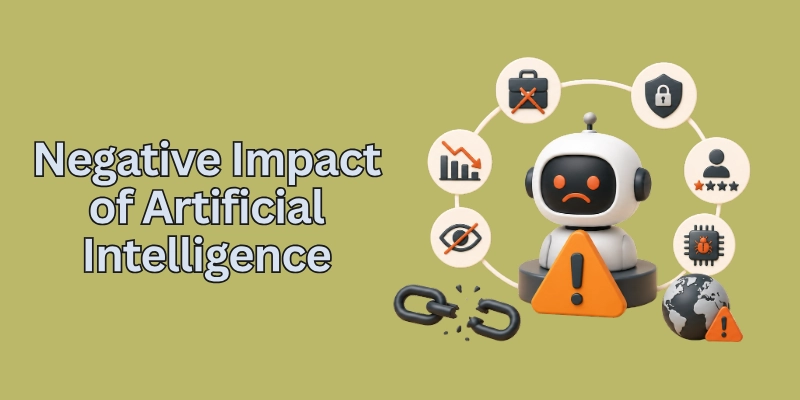
Below are some of the most important negative impacts of artificial intelligence that everyone should know.
1. Job Displacement and Unemployment
One of the biggest concerns about AI is its effect on employment. As businesses adopt AI-powered tools and automation, many routine tasks no longer require human workers. This creates uncertainty for employees whose jobs depend on repetitive work.
Automation Replacing Routine Jobs
AI can complete repetitive tasks faster, more accurately, and without breaks. As a result, companies often automate jobs that involve predictable processes.
The following are some routine jobs that AI is replacing:
- Data entry and record management
- Basic customer support through AI chatbots
- Manufacturing and assembly line work
- Cashier and self-checkout services
- Simple bookkeeping and administrative tasks
Industries Most Affected
Some industries are adopting AI faster than others because automation helps reduce costs and improve productivity. This makes certain sectors more likely to experience workforce changes.
Below are the industries most affected by AI automation:
- Manufacturing and production
- Retail and eCommerce
- Banking and financial services
- Customer service and call centers
- Transportation and logistics
- Media and content creation
Future Workforce Changes
Although AI may replace some jobs, it will also create new career opportunities that require different skills. Workers who adapt and learn modern technologies will have better chances of staying competitive.
The following workforce changes are expected in the coming years:
- Growing demand for AI and technology professionals
- Higher need for digital and analytical skills
- Increased focus on creativity and problem-solving
- More collaboration between humans and AI systems
- Continuous learning and upskilling becoming essential
2. Privacy and Data Security Risks
Artificial intelligence depends on large amounts of personal and business data to deliver accurate results. While this improves AI performance, it also increases concerns about how information is collected, stored, and protected. Poor data handling can expose users to serious privacy and security risks.
Massive Data Collection
Many AI systems collect and process large amounts of user data to improve their accuracy and personalize services. If this data is not managed responsibly, it can affect user privacy.
Here are some common ways AI collects large amounts of data:
- Browsing and search history
- Location information
- Voice recordings and commands
- Shopping and payment activity
- Social media interactions
Facial Recognition
Facial recognition technology helps identify people by analyzing their facial features. Although it improves security in some situations, it also raises concerns about privacy and unauthorized surveillance.
Some common concerns related to facial recognition include:
- Monitoring people without consent
- Incorrect identification
- Loss of personal privacy
- Misuse by unauthorized organizations
- Limited transparency in how data is used
User Tracking
Many websites, apps, and online services use AI to monitor user behavior. This allows companies to personalize content and advertisements, but it also increases concerns about online privacy.
The following are common examples of AI-based user tracking:
- Tracking browsing habits
- Monitoring app usage
- Recording online purchases
- Analyzing user preferences
- Delivering targeted advertisements
Data Leaks
AI systems often store valuable personal and business information. If hackers gain access to these systems or security measures fail, sensitive data can be exposed.
Below are some possible consequences of AI-related data leaks:
- Identity theft
- Financial fraud
- Exposure of confidential information
- Loss of customer trust
- Legal and compliance issues
3. AI Bias and Discrimination
Artificial intelligence makes decisions based on the data it learns from. If that data contains errors or unfair patterns, AI can produce biased results that affect people differently. This can lead to unfair treatment in areas where accuracy and equality are essential.
Biased Datasets
AI systems learn from existing data, so the quality of that data directly affects their decisions. Biased or incomplete datasets can cause AI to repeat or even strengthen unfair outcomes.
Some common causes of biased datasets include:
- Incomplete or outdated information
- Unbalanced training data
- Human bias during data collection
- Limited representation of different groups
- Poor data quality
Hiring Bias
Many companies use AI to screen resumes and shortlist candidates. If the AI is trained on biased hiring data, it may unfairly favor certain applicants while rejecting others.
The following are common examples of hiring bias in AI:
- Favoring specific genders or backgrounds
- Rejecting qualified candidates unfairly
- Prioritizing certain universities or locations
- Ignoring skills that are not in historical data
- Reducing diversity in recruitment
Loan Approval Bias
Banks and financial institutions use AI to evaluate loan applications and assess financial risk. A biased AI system may make unfair lending decisions that affect deserving applicants.
Below are some risks of AI bias in loan approvals:
- Unfair rejection of loan applications
- Unequal treatment of customers
- Inaccurate credit risk assessment
- Reduced financial opportunities
- Loss of customer confidence
Healthcare Bias
AI helps doctors analyze medical data and support clinical decisions. However, biased training data can reduce the accuracy of diagnoses and treatment recommendations for certain groups of patients.
Here are some ways healthcare bias can affect patients:
- Incorrect medical recommendations
- Delayed diagnosis
- Unequal quality of care
- Higher risk of treatment errors
- Reduced trust in AI-assisted healthcare systems
4. Spread of Misinformation
Artificial intelligence makes it easier to create and share content within seconds. While this saves time, it also increases the spread of false or misleading information. As a result, many people struggle to identify what is real and what is AI-generated.
AI-Generated Fake News
AI can produce realistic news stories that appear trustworthy, even when the information is false. These fake reports can spread quickly and influence public opinion.
Some common examples of AI-generated fake news include:
- False breaking news stories
- Fake political updates
- Misleading headlines
- Fabricated celebrity news
- Fake event reports
AI-Written Articles
AI writing tools can generate articles in just a few minutes. While they help with content creation, they can also produce inaccurate or misleading information if the content is not properly reviewed.
The following are some risks of AI-written articles:
- Publishing incorrect facts
- Spreading outdated information
- Creating duplicate or low-quality content
- Missing reliable sources
- Reducing content credibility
Social Media Manipulation
AI can influence what people see on social media by creating fake accounts, generating misleading posts, and promoting false information. This can shape opinions and spread misinformation on a large scale.
Below are some common forms of AI-driven social media manipulation:
- AI-generated fake profiles
- Automated bots sharing false content
- Manipulated images and captions
- Trending fake stories
- Coordinated misinformation campaigns
5. Deepfakes and Digital Fraud
Artificial intelligence can create highly realistic videos, images, and voices that are difficult to distinguish from real ones. While these technologies have useful applications, they are also being misused for fraud, identity theft, and online scams.
Fake Videos
AI-powered deepfake tools can generate videos that appear authentic, even though they are completely fabricated. These videos can damage reputations and spread false information.
Some common risks of fake videos include:
- Spreading false information
- Damaging personal or business reputations
- Manipulating public opinion
- Creating fake evidence
- Increasing online fraud
Voice Cloning
AI can copy a person’s voice using only a short audio sample. Cybercriminals often use cloned voices to trick family members, customers, or employees.
Here are some common ways voice cloning is misused:
- Fake emergency phone calls
- Customer support scams
- Business payment fraud
- Identity impersonation
- Fake audio recordings
Identity Theft
AI gives scammers new ways to steal personal identities by creating fake documents, profiles, or digital content that looks genuine.
The following are common forms of AI-related identity theft:
- Fake online profiles
- Stolen personal information
- Forged identity documents
- Account takeovers
- Unauthorized access to services
Financial Scams
Fraudsters use AI to make online scams more convincing and harder to detect. This increases the risk of financial losses for both individuals and businesses.
Below are some common AI-powered financial scams:
- Fake investment schemes
- AI-generated phishing messages
- Business email fraud
- Online payment scams
- Cryptocurrency fraud

6. Cybersecurity Threats
Artificial intelligence helps strengthen cybersecurity, but it also gives cybercriminals more advanced tools to launch attacks. As AI technology becomes more accessible, digital threats continue to grow in both scale and sophistication.
AI-Powered Malware
Cybercriminals use AI to develop malware that can adapt, avoid detection, and spread more efficiently than traditional malicious software.
Some common risks of AI-powered malware include:
- Faster malware attacks
- Evasion of security software
- Automated system infections
- Data theft
- Business disruption
Automated Phishing
AI can create highly personalized phishing emails and messages that look genuine. These scams increase the chances of users sharing sensitive information.
Here are some examples of AI-driven phishing attacks:
- Personalized phishing emails
- Fake banking messages
- Fraudulent login pages
- Business impersonation emails
- SMS and messaging scams
Password Attacks
AI helps attackers test large numbers of password combinations much faster than manual methods, making weak passwords easier to crack.
The following are common AI-assisted password attacks:
- Brute-force password attacks
- Password guessing based on user data
- Credential stuffing
- Login automation
- Account compromise
Hacking with AI
Hackers use AI to identify security weaknesses, automate attacks, and improve the success rate of cybercrime. This makes cyberattacks faster and more difficult to defend against.
Below are some ways AI is used in hacking:
- Finding software vulnerabilities
- Automating cyberattacks
- Bypassing security systems
- Collecting sensitive information
- Launching large-scale attacks
7. Loss of Human Creativity
Artificial intelligence can help people generate ideas, write content, and create designs in less time. However, relying too much on AI may reduce human creativity, independent thinking, and the ability to solve problems without technology.
Overdependence on AI
Many people now depend on AI for writing, designing, coding, and everyday decision-making. Excessive reliance on AI can reduce confidence in personal skills and creativity.
Some common effects of overdependence on AI include:
- Less independent thinking
- Reduced problem-solving ability
- Lower confidence in personal skills
- Greater reliance on automated tools
- Decreased innovation
Less Critical Thinking
AI provides instant answers, but accepting them without verification can weaken critical thinking. People may stop analyzing information or questioning whether it is accurate.
The following are common effects of reduced critical thinking:
- Accepting incorrect information
- Fewer analytical skills
- Limited decision-making ability
- Less curiosity and research
- Poor judgment in complex situations
Reduced Originality
AI-generated content often follows existing patterns and data. When people depend on it too much, their work may become less unique and less creative.
Here are some ways AI can reduce originality:
- Repetitive writing styles
- Similar design ideas
- Limited creative exploration
- Less personal expression
- Generic content creation
Creative Industries
Creative professionals use AI to improve productivity, but excessive automation may reduce the demand for original human work in some fields.
Below are some creative industries affected by AI:
- Content writing
- Graphic design
- Music production
- Photography
- Film and video editing
8. Ethical Concerns
As artificial intelligence becomes more powerful, ethical questions continue to grow. People want to know who is responsible for AI decisions, how AI uses creative work, and whether automated systems can make fair choices.
Accountability
When an AI system makes a mistake, it is often difficult to decide who should be responsible. This creates legal and ethical challenges for businesses, developers, and users.
Some common accountability concerns include:
- Unclear responsibility for AI errors
- Limited human oversight
- Legal disputes
- Reduced public trust
- Difficulty correcting AI decisions
Copyright Issues
Many AI tools learn from existing books, images, music, and online content. This raises concerns about whether copyrighted material is being used fairly.
The following are common copyright concerns related to AI:
- Using copyrighted content without permission
- Copying artistic styles
- Reproducing protected material
- Intellectual property disputes
- Unauthorized commercial use
AI-Generated Content Ownership
AI can create articles, artwork, videos, and software, but ownership rights are often unclear. Different countries and organizations continue to debate who owns AI-generated work.
Here are some common ownership challenges:
- Unclear copyright ownership
- Disputes between users and AI providers
- Commercial licensing issues
- Difficulty proving originality
- Legal uncertainty
Decision-Making Problems
AI can support important decisions in areas such as healthcare, finance, and recruitment. However, relying only on AI without human review can lead to unfair or inaccurate outcomes.
Below are some risks of AI-based decision-making:
- Incorrect recommendations
- Biased outcomes
- Lack of transparency
- Reduced human judgment
- Unfair treatment of individuals
9. Lack of Transparency
Many artificial intelligence systems make decisions without showing how they reached a conclusion. This lack of transparency makes it difficult for users to understand, verify, or challenge AI-generated outcomes. As AI becomes part of important industries, transparency becomes essential for building trust.
Black-Box AI
Some AI models work like a “black box,” where users can see the result but cannot understand the decision-making process behind it.
Here are some common challenges caused by black-box AI:
- Hidden decision-making processes
- Limited explanation of results
- Difficulty identifying errors
- Reduced accountability
- Lower confidence in AI systems
Difficult to Explain Decisions
In many situations, AI cannot clearly explain why it approved, rejected, or recommended something. This becomes a serious concern when AI supports important decisions.
The following are examples where AI explanations are important:
- Medical diagnosis
- Loan approvals
- Hiring decisions
- Insurance claims
- Legal case evaluations
Trust Issues
People are less likely to rely on AI when they cannot understand how it works. A lack of transparency can reduce confidence among users, customers, and businesses.
Below are some ways poor transparency affects trust:
- Reduced confidence in AI recommendations
- Greater hesitation to adopt AI
- More customer complaints
- Increased legal concerns
- Lower public acceptance
10. Environmental Impact
Artificial intelligence requires powerful computers and large data centers to train and operate advanced models. These systems consume significant amounts of energy, making environmental sustainability an important concern as AI adoption continues to grow.
High Electricity Consumption
Training and running AI models requires large amounts of computing power, which leads to high electricity usage. The larger the AI model, the more energy it typically consumes.
Some major sources of AI electricity consumption include the following:
- Training large AI models
- Running cloud-based AI services
- Operating high-performance computers
- Processing large datasets
- Continuous AI system operations
Data Center Emissions
Most AI services run inside data centers that require electricity, cooling systems, and networking equipment. These facilities can contribute to greenhouse gas emissions when powered by non-renewable energy.
Here are some environmental concerns related to data centers:
- Increased energy demand
- Higher greenhouse gas emissions
- Heavy cooling requirements
- Greater resource consumption
- Growing environmental pressure
Carbon Footprint
The energy needed to develop and operate AI contributes to its overall carbon footprint. As AI usage expands worldwide, reducing these emissions becomes an important goal for technology companies.
The following factors increase AI’s carbon footprint:
- Large-scale cloud infrastructure
- Continuous server operations
- High energy consumption
- Dependence on fossil fuel-based electricity
How to Reduce the Negative Impact of Artificial Intelligence
Artificial intelligence can create challenges such as job displacement, privacy risks, bias, and misinformation, but these problems can be reduced with responsible use and proper safeguards. Individuals, businesses, and governments all have a role in making AI safer and more beneficial for society.
The following measures can help reduce the negative impact of artificial intelligence effectively.
- Use High-Quality Data: Train AI systems with accurate, diverse, and unbiased data to reduce unfair results.
- Maintain Human Oversight: Keep humans involved in important AI decisions, especially in healthcare, finance, and recruitment.
- Improve Transparency: Develop AI systems that can clearly explain how they make decisions.
- Protect Privacy: Use strong data protection measures and collect only the information that is necessary.
- Strengthen Cybersecurity: Secure AI systems against hacking, malware, phishing, and other cyber threats.
- Create Clear Regulations: Governments should establish laws for AI safety, fairness, accountability, and ethical use.
- Promote Ethical AI: Businesses and developers should follow ethical guidelines when designing and using AI technologies.
- Support Workforce Training: Help workers learn new digital and AI-related skills to adapt to changing job markets.
- Verify AI-Generated Content: Always check the accuracy of AI-generated information before sharing or using it.
- Encourage Responsible Innovation: Focus on AI development that benefits society while minimizing harm and environmental impact.
By following these steps, society can reduce the risks of AI while still benefiting from its many useful applications.
Conclusion
In this guide, we have covered the negative impact of artificial intelligence. We discussed the major risks of AI, including job displacement, privacy concerns, bias, misinformation, cybersecurity threats, ethical issues, and environmental impact. We also explained why these challenges exist and the practical steps that can help reduce them.
Artificial intelligence is a powerful technology, but it should always be used responsibly. By understanding both its benefits and risks, individuals and businesses can make smarter decisions and build a safer future with AI.
My Recommendation: I recommend treating AI as a tool that supports human skills instead of replacing human judgment. Always verify AI-generated information and use trusted AI solutions that follow ethical and security standards.
Thank you for taking the time to read this guide. I hope it helped you better understand the negative impact of artificial intelligence and how to use AI more responsibly.
💬 We’d love to hear your thoughts. Share your experience or questions in the comments below, and don’t forget to share this guide with others who may find it helpful. 😊
FAQs
Here are the most frequently asked questions about the negative impact of artificial intelligence, along with simple and clear answers.
The biggest negative impact of artificial intelligence is that it can affect jobs, privacy, security, and decision-making when used without proper oversight. AI is a powerful tool, but poor data and unethical use can create serious problems. Responsible development helps reduce these risks.
Yes, AI can replace some repetitive jobs, but it also creates new career opportunities that require advanced skills.
Some jobs most affected by AI include:
- Data entry
- Customer support
- Manufacturing
- Retail checkout
- Administrative tasks
AI systems often collect personal information to improve their performance and personalize services. If companies fail to protect this data, users may face privacy breaches or identity theft. Strong security measures and data protection laws help reduce these risks.
People consider AI risky because it can be misused or make unfair decisions.
The following factors increase AI risks:
- Biased algorithms
- Fake news and deepfakes
- Cybersecurity threats
- Privacy concerns
- Lack of transparency
Yes. AI learns from existing data, so if the training data contains bias, the AI can produce unfair results. This can affect hiring, loan approvals, healthcare, and many other important decisions.
Ethical concerns focus on how AI should be developed and used responsibly.
Some common AI ethics issues include:
- Accountability for AI decisions
- Copyright and ownership
- Data privacy
- Fairness and equality
- Human oversight
Businesses can reduce AI risks by using reliable data, reviewing AI decisions, and protecting customer information. They should also train employees, follow ethical guidelines, and regularly test AI systems for fairness and security.
Yes. AI helps improve cybersecurity, but hackers also use it to launch more advanced attacks.
Common AI-powered cyber threats include:
- Automated phishing
- AI-generated malware
- Password attacks
- Identity theft
- Online fraud
AI will continue to grow, but its impact depends on how people use and regulate it. Better laws, ethical standards, and responsible AI development can reduce future risks while allowing society to benefit from AI technology.
Using AI responsibly starts with understanding its strengths and limitations.
To use AI safely, remember to:
- Verify AI-generated information
- Protect your personal data
- Avoid sharing sensitive details
- Use trusted AI tools
- Keep learning about AI best practices


- Be Respectful
- Stay Relevant
- Stay Positive
- True Feedback
- Encourage Discussion
- Avoid Spamming
- No Fake News
- Don't Copy-Paste
- No Personal Attacks
- Be Respectful
- Stay Relevant
- Stay Positive
- True Feedback
- Encourage Discussion
- Avoid Spamming
- No Fake News
- Don't Copy-Paste
- No Personal Attacks
