How to Use AI to Summarize Books Easily in 15 Ways
Published: 20 Apr 2026
Reading books takes time, and understanding the main ideas can be overwhelming. Today, technology helps us save time by making learning easier and faster. Knowing how to use AI to summarize books can give you the key ideas without reading the whole book. You can apply it for study, work, or personal growth. This guide will explain different ways to summarize books quickly, step by step.
Let’s explore all the methods in detail so you can start using them today.
How to Use AI to Summarize Books
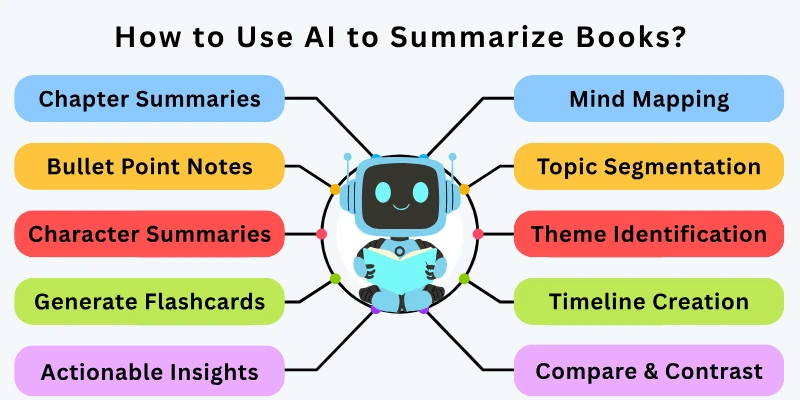
Here are 15 major ways to summarize books quickly and effectively:
- Chapter Summaries
- Key Takeaways Extraction
- Highlight Important Quotes
- Mind Mapping
- Bullet Point Notes
- Topic Segmentation
- Character Summaries
- Theme Identification
- Compare and Contrast
- Generate Flashcards
- Timeline Creation
- Create Study Questions
- Simplified Version Summary
- Actionable Insights
- Personalized Summary
Let us learn about each in detail.
1. Way 1: Chapter Summaries
Traditionally, people summarize a book chapter by chapter by reading each section carefully and taking notes. This can take hours and requires focus. Using AI, you can feed the chapter text and get a concise summary in seconds. AI highlights the main events, ideas, and messages clearly. You save time and still understand the flow of the book. This method is great for long novels or educational books where every chapter matters.
Prompts You Can Use:
- “Summarize this chapter in 5 sentences.”
- “Give the key points of this chapter.”
- “List the main events of this chapter.”
- “Explain this chapter simply for quick reading.”
- “Highlight important lessons from this chapter.”
- “Create a brief paragraph summary of this chapter.”
2. Way 2: Key Takeaways Extraction
Traditionally, extracting key takeaways requires careful reading and highlighting ideas manually. This is time-consuming and easy to miss details. Using AI, you can quickly get the most important points of a book. It condenses lessons, tips, or conclusions in short points. You can use it for business, self-help, or educational books. AI ensures you don’t miss critical information.
Prompts You Can Use:
- “List the key takeaways from this book.”
- “Highlight the most important lessons.”
- “Give 10 main points from this book.”
- “Summarize the lessons from this chapter.”
- “Extract actionable tips from this book.”
- “Create a short key idea summary.”
3. Way 3: Highlight Important Quotes
Traditionally, readers note down meaningful quotes while reading, which takes time and memory. AI can automatically detect impactful sentences or quotes from the text. You get a list of quotes ready for reflection or sharing. This is helpful for inspirational, educational, or leadership books. You can also organize quotes by theme or chapter. AI makes it faster and more accurate.
Prompts You Can Use:
- “Find the important quotes from this chapter.”
- “Highlight 5 inspiring quotes from this book.”
- “List key sentences that summarize ideas.”
- “Pick quotes useful for notes or presentation.”
- “Extract impactful statements from this book.”
- “Give me memorable sentences from this chapter.”
4. Way 4: Mind Mapping
Traditionally, mind maps are created manually by writing ideas on paper and connecting them visually. This is helpful but slow and requires effort. AI can convert a book into a structured mind map quickly. It shows connections between chapters, themes, and characters. This is useful for study, project planning, or revising books fast. You can visually understand the flow without reading every word.
Prompts You Can Use:
- “Create a mind map for this book.”
- “Show connections between main ideas.”
- “Summarize chapters visually.”
- “Map the themes and characters.”
- “Organize this book into a diagram.”
- “Give a visual flow of the main points.”
5. Way 5: Bullet Point Notes
Traditionally, taking bullet notes requires reading and rewriting in points manually. It is effective but slow. AI can create concise bullet notes of the book or chapters instantly. You get a clear list of important points for quick revision. Bullet points are great for study guides or presentations. AI ensures all essential points are included.
Prompts You Can Use:
- “Convert this chapter into bullet points.”
- “List main ideas in short points.”
- “Summarize lessons in bullets.”
- “Give chapter highlights in point form.”
- “Create quick reference notes.”
- “Make a simple bullet summary for this book.”
6. Way 6: Topic Segmentation
Traditionally, readers categorize sections manually under topics, which is slow and error-prone. AI can identify major topics in the book automatically. It separates sections based on ideas, themes, or chapters. You can quickly focus on topics you want to study or review. This method works well for textbooks, research, or non-fiction. AI makes topic segmentation fast and accurate.
Prompts You Can Use:
- “Segment this book by main topics.”
- “List themes covered in this book.”
- “Divide chapters by subject.”
- “Highlight sections by topics.”
- “Organize ideas under categories.”
- “Provide a topic-wise summary of this book.”
7. Way 7: Character Summaries
Traditionally, readers write character notes manually for novels or plays. AI can automatically summarize each character’s role, traits, and arc. You get quick insights into main and supporting characters. This is helpful for literature study, book reviews, or discussions. AI saves time and avoids missing details.
Prompts You Can Use:
- “Summarize main characters from this book.”
- “List character traits and roles.”
- “Give a short description of each character.”
- “Highlight character relationships.”
- “Create a character chart for this book.”
- “Describe important characters in one paragraph.”
8. Way 8: Theme Identification
Traditionally, identifying themes requires analysis and note-taking. AI can detect recurring themes automatically. You get a clear understanding of the main ideas of the book. It is helpful for essays, reviews, or study guides. AI highlights patterns you might miss. This makes theme analysis faster and easier.
Prompts You Can Use:
- “Identify main themes of this book.”
- “List recurring ideas and concepts.”
- “Highlight central messages in this book.”
- “Summarize themes in each chapter.”
- “Explain the main idea behind the story.”
- “Provide thematic analysis for this book.”
9. Way 9: Compare and Contrast
Traditionally, comparing books or characters is manual and time-consuming. AI can compare characters, plots, or ideas across books instantly. You get clear similarities and differences in points or paragraphs. This is helpful for literature, research, or learning purposes. AI provides organized insights quickly.
Prompts You Can Use:
- “Compare this book with another book.”
- “List similarities and differences in characters.”
- “Highlight contrasting ideas in chapters.”
- “Summarize differences between plots.”
- “Compare themes and messages.”
- “Show comparison points in a table.”
10. Way 10: Generate Flashcards
Traditionally, creating flashcards is manual and slow. AI can generate digital flashcards with key points, quotes, or questions. You can use them for study, revision, or memorization. AI saves time and ensures you cover all important points. Flashcards make learning faster and structured.
Prompts You Can Use:
- “Create flashcards from this book.”
- “Make Q&A flashcards for each chapter.”
- “Generate memory cards for key points.”
- “Summarize lessons into flashcards.”
- “Highlight quotes in flashcard format.”
- “Make study cards for this book.”
Way 11: Timeline Creation
Traditionally, timelines are drawn manually to track events. AI can create a timeline of events, chapters, or story flow automatically. This helps understand sequence and chronology. It is useful for historical, fiction, or educational books. AI saves time and shows clear order of events.
Prompts You Can Use:
- “Create a timeline of events in this book.”
- “List chapter events chronologically.”
- “Summarize story flow in order.”
- “Highlight key events with dates or order.”
- “Make a simple timeline for revision.”
- “Show chapter events visually.”
Way 12: Create Study Questions
Traditionally, creating questions from books takes careful reading. AI can generate study questions automatically. You can use these for self-test or group study. It ensures coverage of important points. AI makes studying easier and faster.
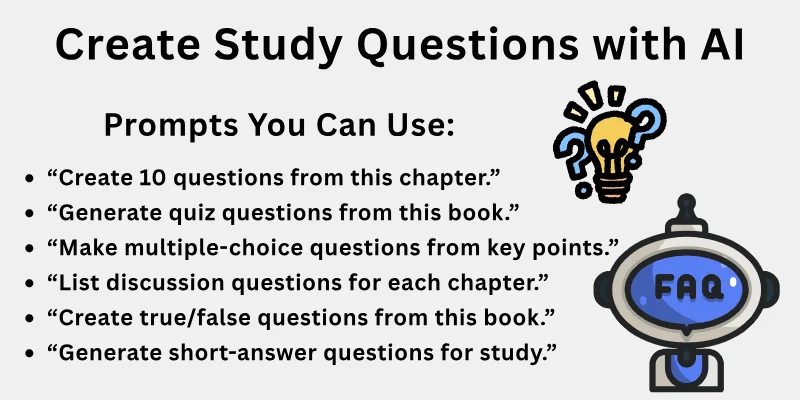
Prompts You Can Use:
- “Create 10 questions from this chapter.”
- “Generate quiz questions from this book.”
- “Make multiple-choice questions from key points.”
- “List discussion questions for each chapter.”
- “Create true/false questions from this book.”
- “Generate short-answer questions for study.”
Way 13: Simplified Version Summary
Traditionally, readers rewrite complex texts in simple words manually. AI can generate a simplified summary of the book. You get easy-to-read explanations without losing meaning. This is helpful for learners, students, or busy readers. AI makes understanding fast and accessible.
Prompts You Can Use:
- “Simplify this chapter for easy reading.”
- “Explain this book in simple words.”
- “Create a short version of this book.”
- “Summarize complex ideas simply.”
- “Make key points easier to understand.”
- “Provide a beginner-friendly summary.”
Way 14: Actionable Insights
Traditionally, readers extract lessons manually for application. AI can generate actionable points from the book. You get practical steps to implement ideas or advice. This is helpful for self-help, business, or personal growth books. AI saves time and makes learning applicable.
Prompts You Can Use:
- “Give actionable lessons from this book.”
- “List practical tips from each chapter.”
- “Summarize advice I can use immediately.”
- “Highlight steps to apply the ideas.”
- “Provide quick action points from this book.”
- “Make a short list of useful takeaways.”
Way 15: Personalized Summary
Traditionally, personal notes take time and effort. AI can create a summary based on your focus or goals. You can highlight chapters, themes, or ideas most relevant to you. AI tailors the summary to your preference. This saves time and gives you exactly what you need.
Prompts You Can Use:
- “Summarize this book focusing on leadership.”
- “Create a short summary for study purposes.”
- “Highlight chapters important for business ideas.”
- “Make a personalized summary of this book.”
- “Focus on key lessons I can use personally.”
- “Generate a summary based on my goals.”
Best AI Tools for Summarizing Books
Here are AI tools for book summarization you can use to quickly get key insights from books and long texts:
- GitMind AI Book Summarizer: AI summarizer that turns books into structured summaries and mind maps by uploading files like PDF/EPUB.
- Docsummarizer Book Summarizer: Free online tool to generate instant book summaries from text or uploaded documents.
- NoteGPT Book Summary: AI tool that summarizes books and documents quickly with support for various file formats.
- Noiz AI Book Summarizer: Generates customizable summaries in different formats (bullet points, narrative, etc.) for books and PDFs.
- Texta.ai Book Summary Generator: AI-powered book summarizer that lets you create concise or detailed summaries.
- Scholarcy: AI tool that analyzes documents and books to create structured summaries and interactive study flashcards.
- Blinkist: Popular app providing short text and audio summaries of non‑fiction books (great for quick learning).
- Shortform: Detailed AI book summaries with deeper analysis and guides beyond core points.
- Summarist.ai: AI‑powered book summary generator that gives quick, easy‑to‑read summaries across genres.
- Booknotes (ChatGPT‑based): App that uses AI like ChatGPT to create summaries, key ideas, and quotes from books.
Final Note
In this guide we covered how to use AI to summarize books in multiple ways. You learned about chapter summaries, key takeaways, bullet points, mind maps, flashcards, timelines, and more. My advice is to start with one or two methods that fit your reading style. Apply these regularly to save time and learn faster.
Keep your summaries short, organized, and easy to review. Enjoy reading smarter and more effectively.
FAQs
Here are some commonly asked questions related to how to use AI to summarize books:
You can summarize by focusing on chapters, key points, and main ideas. Use bullet points, timelines, or flashcards. AI can speed up this process. You save hours while understanding the book.
Yes, AI can extract actionable insights from any book. It highlights tips, steps, or advice you can use. You can implement them immediately. It makes reading practical.
Yes, you can focus AI on themes, chapters, or topics that matter to you. It creates summaries based on your goals. You get what is relevant quickly. It saves time and effort.
AI can highlight lessons, main points, or conclusions automatically. You get a concise list of important ideas. This works for study, work, or personal growth. It ensures nothing important is missed.
Yes, it can convert key points, quotes, or lessons into flashcards. You can use them for revision or memory practice. It saves time and organizes ideas clearly.
Yes, AI can create visual mind maps from book chapters. It shows ideas, themes, and connections clearly. This is helpful for study or planning. You understand flow easily.
Yes, AI can detect recurring ideas or messages in books. You get a clear understanding of the main themes. It saves time analyzing manually. You focus on important concepts.
AI can condense chapters into short paragraphs or bullet points. You understand key events or lessons fast. It saves reading time. You get the essence without missing details.
Yes, AI can summarize character roles, traits, and arcs. You can track story flow clearly. This is useful for novels or plays. You get a complete picture quickly.
Yes, AI-generated summaries are safe to use. They are quick and accurate. You can cross-check with the book if needed. It helps you learn efficiently.




- Be Respectful
- Stay Relevant
- Stay Positive
- True Feedback
- Encourage Discussion
- Avoid Spamming
- No Fake News
- Don't Copy-Paste
- No Personal Attacks
- Be Respectful
- Stay Relevant
- Stay Positive
- True Feedback
- Encourage Discussion
- Avoid Spamming
- No Fake News
- Don't Copy-Paste
- No Personal Attacks
