AI For Small Businesses – Complete Guide
Published: 19 Jun 2026
Small businesses now use AI faster than ever before. Recent reports show that more than 75% of small business owners already use AI tools for marketing, customer support, content writing, and daily operations.
I have personally seen many small businesses save hours of manual work every week after adding simple AI tools to their workflow. This shift helps small teams work faster without increasing costs. AI for small businesses is no longer a future trend.
It has become a practical solution for companies that want better productivity, faster growth, and smarter decision-making. Even small local businesses now compete with larger brands by using automation, AI chatbots, and data-driven tools.
In this article, we will discuss AI for small businesses in detail. You will also learn how to use AI tools, reduce manual work, improve marketing, and grow your business step by step.
AI in Businesses
Artificial Intelligence (AI) refers to software systems that can perform tasks that normally require human thinking, such as understanding language, recognizing patterns, making predictions, generating content, or automating decisions.
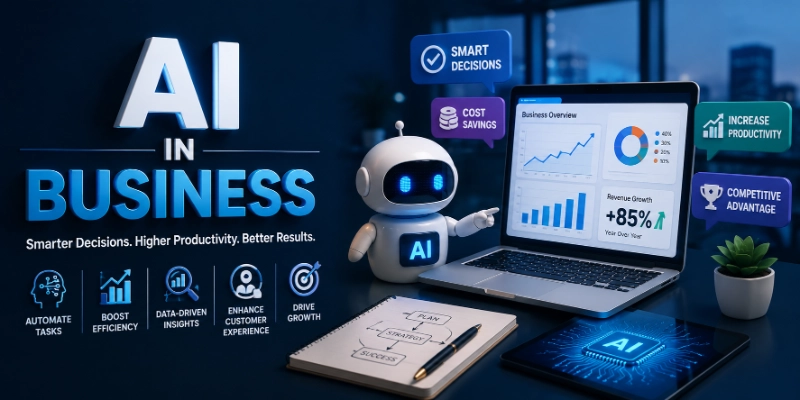
For small businesses, AI is less about robots or futuristic machines and more about practical tools that save time, reduce costs, and improve customer service.
Examples include:
- Chatbots answering customer questions
- Tools that write emails or social media posts
- Software that predicts inventory needs
- Systems that organize invoices automatically
- AI-powered marketing and advertising tools
Many modern business tools now include AI features built directly into their platforms.
Popular examples include:
- OpenAI for AI writing and automation
- Shopify for AI-assisted e-commerce
- QuickBooks for smart accounting automation
- HubSpot for AI-powered CRM and marketing
- Canva for AI design tools
How AI Works in Everyday Business Operations
Artificial Intelligence (AI) is now becoming a normal part of daily business work. Small businesses use AI tools to save time, reduce manual effort, and improve customer service. Instead of doing repetitive tasks manually, AI can handle many operations automatically and help business owners make better decisions quickly.
Today, AI is used in almost every department of a business such as customer support, marketing, sales, accounting, inventory management, and human resources. Modern AI tools are simple to use, and many businesses already use them without needing advanced technical knowledge.
1. Customer Service Operations
AI is helping businesses provide faster and better customer support. Many companies now use AI chatbots and virtual assistants to answer customer questions 24/7. These systems can handle common queries instantly without needing a human employee every time.
For example, AI can:
- Reply to customer messages automatically
- Track orders and delivery updates
- Book appointments online
- Solve common customer problems
- Send instant responses on websites or social media
This improves customer satisfaction because people get quick replies at any time of the day. It also reduces workload for support teams and helps businesses save operational costs.
2. Marketing and Advertising
AI has completely changed digital marketing for small businesses. AI tools can now create marketing content, analyze customer behavior, and run targeted advertising campaigns more effectively than traditional methods.
Businesses use AI for:
- Writing social media captions
- Creating email marketing campaigns
- Generating blog content
- Running Facebook and Google ads
- Understanding customer interests
AI also studies customer data and shows businesses which products people are most interested in. This helps companies create personalized marketing that increases sales and customer engagement.
3. Sales and Lead Management
AI helps businesses improve sales processes by organizing customer information and predicting buying behavior. Many businesses now use AI-powered CRM systems to manage leads and follow up with customers automatically.
AI can help sales teams by:
- Identifying potential customers
- Sending automatic follow-up emails
- Recommending products to customers
- Predicting future sales trends
- Tracking customer interactions
This allows businesses to focus more on closing deals instead of spending time on repetitive administrative work. AI also helps improve conversion rates by understanding customer preferences better.
4. Accounting and Financial Management
Managing finances manually takes a lot of time, especially for small businesses. AI accounting tools can automate financial tasks and reduce human errors in bookkeeping and reporting.
AI is commonly used for:
- Automatic invoice creation
- Expense tracking
- Financial reporting
- Tax calculations
- Fraud detection
These tools can quickly organize financial records and provide business owners with real-time insights about profits, expenses, and cash flow. This helps businesses make smarter financial decisions faster.
5. Inventory and Stock Management
Retail stores and e-commerce businesses use AI to manage inventory more efficiently. AI systems can study sales patterns and predict which products will be needed in the future.
AI helps businesses:
- Avoid overstocking products
- Prevent stock shortages
- Predict customer demand
- Track inventory automatically
- Optimize product pricing
For example, if a product sells more during certain seasons, AI can identify the pattern and suggest increasing stock before demand rises. This reduces losses and improves overall business efficiency.
6. Human Resource Management
AI is also improving HR operations by making hiring and employee management easier. Many companies now use AI tools to speed up recruitment and reduce manual HR work.
Businesses use AI for:
- Screening job applications
- Scheduling interviews
- Managing employee records
- Tracking attendance
- Recommending employee training
AI can quickly scan hundreds of resumes and identify the most suitable candidates based on skills and experience. This saves HR teams a lot of time and improves hiring accuracy.
7. Business Decision-Making
One of the biggest advantages of AI is its ability to analyze large amounts of data quickly. AI tools help business owners understand trends and make better decisions based on real information.
AI supports decision-making by:
- Analyzing business performance
- Predicting future market trends
- Finding customer behavior patterns
- Identifying business risks
- Generating business reports
Instead of depending only on guesswork, businesses can use AI insights to plan smarter strategies and improve long-term growth.
8. E-commerce and Online Business Operations
Online businesses use AI to improve customer shopping experiences and increase sales. AI systems can personalize websites and recommend products based on customer interests.
Common e-commerce AI features include:
- Product recommendations
- Smart search systems
- AI-powered customer support
- Personalized shopping experiences
- Automated order management
For example, when customers visit an online store, AI can show products based on their previous searches or purchases. This increases customer engagement and boosts sales.
9. Social Media Management
Managing social media manually can be difficult for small businesses. AI tools now help companies create content, schedule posts, and analyze audience engagement automatically.
Businesses use AI for:
- Creating social media posts
- Generating hashtags
- Scheduling content
- Monitoring audience activity
- Tracking campaign performance
AI can also suggest the best posting times and identify which content performs better. This helps businesses grow their online presence more effectively.
10. Cybersecurity and Data Protection
As businesses become more digital, protecting customer data is becoming very important. AI helps companies improve cybersecurity by detecting unusual activity and preventing online threats.
AI security systems can:
- Detect suspicious logins
- Identify fraud attempts
- Monitor network activity
- Block cyber attacks
- Protect customer information
These systems work continuously in the background and respond faster than manual security monitoring methods.
Benefits of AI for Small Businesses
The following are some major benefits of AI for small businesses that help improve efficiency, productivity, and customer satisfaction:
- Saving Time Through Automation: AI automates repetitive tasks like data entry, scheduling, and email replies, helping businesses save valuable time.
- Reducing Operational Costs: AI reduces the need for manual work and improves efficiency, which helps businesses lower daily operating expenses.
- Improving Customer Support: AI chatbots and virtual assistants provide instant customer responses and support services 24/7.
- Faster Content Creation and Marketing: AI tools quickly create social media posts, emails, ads, and marketing content with less effort.
- Better Decision-Making With Data Insights: AI analyzes business data and provides useful insights to help owners make smarter decisions.
- Increasing Productivity Without Hiring More Staff: AI allows small teams to handle more work efficiently without increasing employee costs.
- Enhancing Customer Experience: AI personalizes customer interactions by recommending products and providing faster, more accurate service.
How Small Businesses Are Using AI Today
Today, small businesses are using AI in many different areas to improve efficiency, save time, reduce costs, and provide better customer experiences.
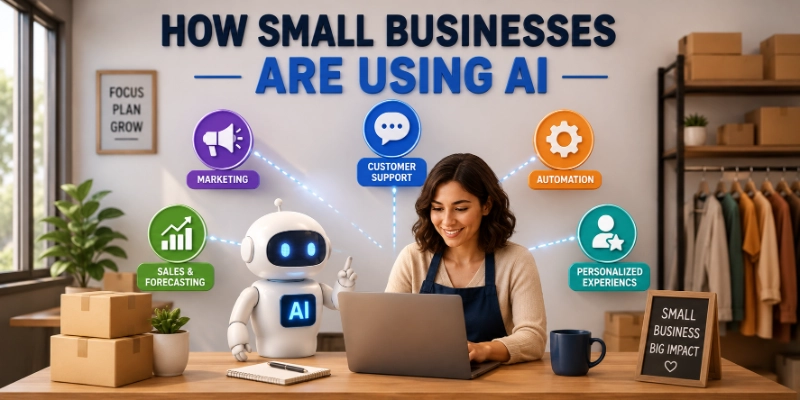
The following are some of the most common ways businesses are using AI in their daily operations.
1. AI for Marketing and Advertising
AI helps businesses create smarter and more targeted marketing campaigns to attract customers and increase sales.
AI is commonly used for:
- Creating digital advertisements
- Analyzing customer behavior
- Running targeted marketing campaigns
- Generating marketing content
- Improving ad performance
2. AI for Customer Service and Chatbots
AI-powered chatbots help businesses provide instant customer support and improve response times.
Businesses use AI chatbots for:
- Answering customer questions
- Providing 24/7 support
- Handling FAQs automatically
- Booking appointments
- Managing customer inquiries
3. AI for Sales and Lead Generation
AI helps businesses identify potential customers and improve the sales process more efficiently.
AI supports sales teams by:
- Finding quality leads
- Sending automated follow-ups
- Tracking customer interactions
- Predicting customer interests
- Improving conversion rates
4. AI for Social Media Management
AI tools help businesses manage social media platforms more effectively and save time on content creation.
Businesses use AI for:
- Creating social media posts
- Scheduling content automatically
- Generating hashtags
- Analyzing audience engagement
- Tracking campaign performance
5. AI for Email Marketing
AI improves email marketing by creating personalized campaigns and increasing customer engagement.
AI helps businesses:
- Write marketing emails
- Personalize email content
- Optimize subject lines
- Schedule emails automatically
- Analyze email performance
6. AI for Accounting and Finance
AI simplifies financial management by automating accounting tasks and reducing manual errors.
Businesses use AI for:
- Expense tracking
- Invoice management
- Financial reporting
- Tax calculations
- Fraud detection
7. AI for HR and Recruitment
AI helps HR departments manage hiring processes and employee records more efficiently.
AI tools assist with:
- Resume screening
- Interview scheduling
- Employee management
- Attendance tracking
- Training recommendations
8. AI for Inventory and Operations Management
AI helps businesses manage inventory and daily operations with better accuracy and planning.
AI is used for:
- Inventory tracking
- Demand forecasting
- Stock management
- Supply chain monitoring
- Operational automation
9. AI for Website Optimization
AI improves website performance and helps businesses provide better user experiences online.
Businesses use AI to:
- Improve website speed
- Personalize website content
- Track visitor behavior
- Increase user engagement
- Optimize customer journeys
10. AI for SEO and Content Writing
AI tools help businesses create SEO-friendly content and improve search engine rankings.
AI supports SEO and content creation by:
- Writing blog posts
- Generating website content
- Finding SEO keywords
- Creating meta descriptions
- Optimizing content for search engines
Best AI Tools for Small Businesses
The following are some of the best AI tools that small businesses are using in 2026 to improve productivity, marketing, automation, customer support, and content creation.
1. AI Writing and Content Creation Tools
These AI tools help businesses create high-quality content quickly and efficiently.
- OpenAI’s ChatGPT – Helps with content writing, brainstorming, customer support, and business communication.
- Jasper – Popular for AI copywriting, blog creation, and marketing content.
- Copy.ai – Used for creating ads, emails, captions, and sales copy.
- Grammarly – Improves grammar, tone, clarity, and professional writing quality.
2. AI Design Tools
These tools help businesses create professional graphics, images, and visual content easily.
- Canva AI – Helps create presentations, social media posts, logos, and marketing visuals.
- Adobe’s Adobe Firefly – Used for AI image generation and creative design editing.
3. AI Marketing Tools
These AI platforms help businesses improve marketing performance and SEO strategies.
- HubSpot AI – Supports email marketing, customer management, and automated campaigns.
- Surfer SEO – Helps optimize website content for better Google rankings.
- Semrush AI Features – Provides keyword research, SEO analysis, and competitor insights.
4. AI Automation Tools
These tools automate repetitive business tasks and improve workflow efficiency.
- Zapier AI – Connects apps and automates workflows without coding.
- Make.com – Automates business operations and integrates multiple applications.
5. AI Customer Support Tools
These AI tools improve customer communication and support services.
- Intercom AI – Provides AI chatbots and automated customer support solutions.
- Drift – Helps businesses automate conversations and lead generation.
- Tidio – Combines live chat and AI chatbot support for businesses.
6. AI Video and Image Tools
These AI tools help businesses create professional videos and visual content quickly.
- Opus Clip – Converts long videos into short social media clips automatically.
- Synthesia – Creates AI-generated videos using virtual avatars and voiceovers.
7. AI Productivity Tools
These AI productivity tools help businesses organize work and improve team collaboration.
- Notion AI – Assists with note-taking, task management, and content organization.
- ClickUp AI – Helps teams manage projects, automate tasks, and improve productivity.
How to Choose the Right AI Tool for Your Business
The following are some important factors to consider when choosing the right AI tool for your business needs and goals.
- Define Your Business Goals – Clearly identify what you want to achieve with AI, such as improving marketing, customer service, or productivity.
- Identify Repetitive Tasks – Choose AI tools that can automate daily repetitive tasks and save valuable business time.
- Compare Pricing and Features – Analyze different AI tools based on their cost, features, and value for your business budget.
- Check Ease of Use – Select tools that are user-friendly and easy for your team to learn and manage.
- Consider Scalability – Choose AI solutions that can grow with your business as your operations expand.
- Evaluate Integration Options – Make sure the AI tool can connect smoothly with your existing software and business systems.
- Review Data Privacy and Security – Check whether the AI platform protects customer data and follows strong security standards.
Real Examples of Small Businesses Using AI
The following are some real-world examples of how small businesses are successfully using AI to improve efficiency, marketing, and customer experience.
- Case Study: Local Store Improving Marketing With AI – A local retail store used AI marketing tools to create targeted ads and increase customer engagement online.
- Case Study: Freelancer Automating Content Creation – A freelance writer used AI content tools to generate blog ideas, social media posts, and client content faster.
- Case Study: E-commerce Brand Using AI Chatbots – An online store implemented AI chatbots to provide instant customer support and improve sales conversions.
- Lessons Learned From Early AI Adoption – Small businesses learned that starting with simple AI tools and gradual implementation leads to better long-term results.
Step-by-Step Guide to Implementing AI in a Small Business
The following steps can help small businesses successfully implement AI tools and improve daily business operations efficiently.
- Step 1: Identify Business Problems – First, identify the areas where your business faces challenges, such as slow processes, customer support issues, or repetitive manual tasks.
- Step 2: Start With One AI Tool – Begin with a single AI tool that solves a specific problem instead of trying to automate everything at once.
- Step 3: Train Your Team – Provide basic training so employees can understand how to use AI tools effectively in daily work.
- Step 4: Automate Repetitive Tasks – Use AI to automate routine tasks like scheduling, email replies, data entry, and reporting to save time.
- Step 5: Measure Results and ROI – Track business performance, productivity improvements, and cost savings to evaluate the success of AI implementation.
- Step 6: Scale AI Across Departments – After successful results, expand AI usage to other departments like marketing, sales, finance, and customer service.
Why AI Adoption Is Growing Among Small Businesses
Several major changes have made AI more accessible and affordable.
1. Lower Costs
In the past, AI required:
- large IT teams,
- expensive infrastructure,
- custom development.
Today, cloud-based AI services are affordable subscriptions.
Examples:
- Google Workspace AI features
- Microsoft Copilot
- Zapier AI
2. Easy-to-Use Tools
Modern AI tools are designed for non-technical users.
Many work through:
- drag-and-drop interfaces,
- simple prompts,
- automated workflows.
Business owners no longer need programming knowledge to use AI effectively.
3. Increased Competition
Small businesses use AI to compete with larger companies by:
- automating repetitive work,
- responding faster to customers,
- improving marketing efficiency,
- reducing operational costs.
4. Better Customer Expectations
Customers now expect:
- instant replies,
- personalized experiences,
- fast service,
- accurate recommendations.
AI helps small businesses meet these expectations without hiring large teams.
5. Remote and Digital Business Growth
As businesses move online, AI helps manage:
- e-commerce operations,
- digital marketing,
- customer communication,
- virtual support systems
Common Challenges of AI for Small Businesses
The following are some common challenges small businesses may face when implementing and using AI tools in their daily operations.
- Lack of Technical Knowledge – Many small business owners and employees may not have enough technical skills to fully understand or manage AI tools.
- Budget Limitations – Some advanced AI tools and software subscriptions can be expensive for small businesses with limited budgets.
- Data Privacy Concerns – Businesses may worry about protecting customer data and maintaining privacy while using AI platforms.
- Over-Reliance on AI – Depending too much on AI can reduce human creativity, decision-making, and personal customer interaction.
- Generic AI Content Problems – AI-generated content can sometimes sound repetitive, less original, or lacking a human touch.
- Employee Resistance to AI Adoption – Some employees may fear job replacement or feel uncomfortable adapting to new AI technologies.
- Choosing the Wrong AI Tools – Selecting AI tools without proper research can lead to poor results, wasted money, and low productivity.
Future of AI for Small Businesses
As technology continues to improve, AI for small businesses will become more powerful, affordable, and easier to use. Here are some important future trends businesses should watch:
- AI-powered automation will handle more daily business tasks
- AI chatbots will provide faster and smarter customer support
- Personalized marketing will improve customer engagement
- AI tools will help businesses make better decisions with real-time data
- Voice AI and virtual assistants will become more common
- Small businesses will use AI for advanced SEO and content creation
- Predictive analytics will help businesses understand customer behavior
- AI-driven cybersecurity tools will improve data protection
- AI agents will manage workflows with minimal human effort
- More affordable AI solutions will help small businesses compete with larger brands
Conclusion
In this guide, we have covered “AI for Small Businesses.” We discussed how AI helps small businesses automate tasks, improve productivity, reduce costs, and compete with larger companies. We also explored different AI tools, business use cases, future trends, and practical ways to start using AI effectively.
AI continues to change the way businesses operate, and small businesses that adopt AI early can gain a strong competitive advantage. With the right strategy and tools, even a small team can improve customer experience, increase efficiency, and grow faster in today’s digital market.
Personal Recommendation: I recommend starting with one simple AI tool instead of trying multiple tools at once. Focus on solving one real business problem first, then gradually expand your AI usage as your business grows.
Thank you for reading this article. I hope this guide helps you understand and use AI for your small business successfully.
FAQs
Below are some frequently asked questions that help explain how AI works for small businesses in a simple and beginner-friendly way.
AI for small businesses refers to using smart software tools that can automate tasks, analyze data, and improve decision-making. It helps business owners save time and reduce manual work. In simple terms, it makes daily operations faster and more efficient.
Small businesses use AI in many areas such as marketing, customer service, sales, and accounting. It can automate repetitive tasks and improve productivity. This allows owners to focus more on business growth instead of manual work.
No, many AI tools are affordable and even offer free plans for beginners. Small businesses can start with basic tools and upgrade later as they grow. The cost is usually lower than hiring extra staff for the same tasks.
The following are the best tools for business marketing:
- ChatGPT for content creation
- HubSpot for automation
- Canva for visuals
These tools help create ads, posts, and marketing campaigns easily. They also improve customer engagement and brand visibility.
AI cannot fully replace employees, but it can support them by handling repetitive tasks. Humans are still needed for creativity, decision-making, and customer relationships. AI works more like an assistant rather than a replacement.
AI improves customer service by providing instant replies through chatbots and automated systems. It works 24/7, so customers can get help anytime. This increases customer satisfaction and reduces workload on support teams.
AI can sometimes produce inaccurate or generic results if not used properly. There are also concerns about data privacy and over-dependence on technology. Businesses should always monitor AI output and use it carefully.
Start by identifying one problem in your business that AI can solve. Then choose a simple tool and test it before scaling. This step-by-step approach reduces risk and makes adoption easier.
- AI helps write blog posts and website content faster
- It improves keyword optimization for better rankings
- It saves time while creating SEO-friendly content
AI makes it easier for small businesses to compete online. It also improves visibility on search engines like Google.
AI will become more advanced, affordable, and easier to use in the coming years. More small businesses will adopt AI for automation and decision-making. It will play a major role in business growth and digital transformation.






- Be Respectful
- Stay Relevant
- Stay Positive
- True Feedback
- Encourage Discussion
- Avoid Spamming
- No Fake News
- Don't Copy-Paste
- No Personal Attacks
- Be Respectful
- Stay Relevant
- Stay Positive
- True Feedback
- Encourage Discussion
- Avoid Spamming
- No Fake News
- Don't Copy-Paste
- No Personal Attacks
