Main Components of Artificial Intelligence – Full Guide
Published: 20 Jun 2026
Have you ever wondered why some AI systems can recognize images, answer questions, or make recommendations within seconds? Many people use AI-powered tools every day, but they often do not understand what makes these systems work behind the scenes. This confusion leads many beginners to struggle when learning AI concepts.
The answer lies in the main components of artificial intelligence. These components act as the building blocks that help AI learn from data, understand information, make decisions, and perform tasks. Once you understand these core elements, the entire concept of AI becomes much easier to follow.
In this article, we will discuss the main components of artificial intelligence in detail. We will also look at real-world examples that show how each component contributes to the success of AI applications.
Components of Artificial Intelligence
The main components of artificial intelligence work together to help machines perform tasks that usually require human intelligence. Each component has a specific role in learning, understanding information, making decisions, and solving problems.
Understanding these components provides a strong foundation for learning how AI systems operate in the real world.
- Learning
- Reasoning
- Problem Solving
- Perception
- Natural Language Processing (NLP)
- Knowledge Representation
- Planning
- Decision Making
- Neural Networks
- Data
1. Learning: The Foundation of AI
Learning is one of the most important key components of artificial intelligence. It allows AI systems to gain knowledge from data, identify patterns, and improve their performance over time. Without learning, AI systems cannot adapt to new information or make accurate predictions.
What Is Learning in AI?
Learning in AI refers to the process through which machines analyze data and use past experiences to perform tasks more effectively. Instead of following fixed instructions, AI systems learn from examples and continuously improve their results as they process more data.
Types of AI Learning
AI uses several learning methods depending on the type of data and the problem it needs to solve. These methods are part of modern AI components:
Supervised Learning
- Uses labeled data for training.
- Learns from input and correct output examples.
- Helps predict future outcomes.
- Commonly used in spam detection and sales forecasting.
Unsupervised Learning
- Uses data without predefined labels.
- Identifies hidden patterns and relationships.
- Groups similar data into clusters.
- Commonly used in customer segmentation and market analysis.
Reinforcement Learning
- Learns through rewards and penalties.
- Improves decisions based on feedback.
- Focuses on achieving the best possible outcome.
- Used in robotics, gaming, and autonomous vehicles.
Deep Learning
- Uses multi-layered neural networks.
- Processes large amounts of complex data.
- Improves image recognition and speech processing.
- Powers many modern AI applications.
Self-Supervised Learning
- Creates labels from existing data.
- Reduces the need for manually labeled datasets.
- Learns useful representations from raw information.
- Supports advanced language and vision models.
Real-World Examples of AI Learning
AI learning appears in many technologies that use components of artificial intelligence, including:
- Email spam filters that detect unwanted messages.
- Streaming platforms that recommend movies and shows.
- Online stores that suggest products based on user behavior.
- Voice assistants that understand spoken commands.
- Navigation apps that predict the fastest travel routes.
- Fraud detection systems used by banks and financial institutions.
These examples show how learning enables components of AI to become more accurate, efficient, and useful over time.
2. Reasoning: How AI Makes Logical Decisions
Reasoning is a core component of artificial intelligence that helps machines process information and make logical decisions. It enables AI systems to analyze facts, evaluate situations, and reach conclusions based on available data. Through reasoning, AI can solve problems and support decision-making in various applications.
What Is AI Reasoning?
AI reasoning is the ability of a machine to use information, rules, and knowledge to draw conclusions and make decisions. It helps AI systems understand relationships between different pieces of information and determine the most appropriate action for a given situation.
Types of Reasoning
AI uses different reasoning methods depending on the type of problem it needs to solve. The following are the main types of AI reasoning:
Deductive Reasoning
- Starts with general rules or facts.
- Reaches specific conclusions from known information.
- Produces logically certain outcomes when the rules are correct.
- Commonly used in expert systems and rule-based applications.
Inductive Reasoning
- Starts with specific observations or examples.
- Identifies patterns and trends in data.
- Forms general conclusions based on evidence.
- Widely used in machine learning and predictive analytics.
Probabilistic Reasoning
- Deals with uncertainty and incomplete information.
- Calculates the likelihood of different outcomes.
- Helps AI make decisions when exact answers are unavailable.
- Commonly used in risk assessment and medical diagnosis systems.
Real-World Applications
AI reasoning supports many technologies and services used today, including:
- Medical systems that assist doctors in diagnosing diseases.
- Financial tools that evaluate credit and investment risks.
- Customer support chatbots that provide relevant responses.
- Fraud detection systems that identify suspicious activities.
- Autonomous vehicles that make driving decisions in real time.
- Recommendation systems that suggest products, movies, or content.
These applications show how reasoning helps AI systems analyze information, make informed decisions, and perform tasks with greater accuracy and efficiency.
3. Problem Solving in Artificial Intelligence
Problem-solving is an essential component of artificial intelligence that enables machines to find solutions to complex challenges. AI systems analyze available information, evaluate different options, and select the most effective solution. This ability helps AI perform tasks efficiently in various real-world situations. It is also considered one of the core components of artificial intelligence.
What Is Problem Solving?
Problem solving in AI refers to the process of identifying a challenge, analyzing possible solutions, and choosing the best course of action. AI systems use logical methods and data-driven approaches to solve problems that may be difficult or time-consuming for humans.
Common AI Problem-Solving Techniques
AI uses several techniques to solve different types of problems. The following are some of the most common problem-solving methods:
Search Algorithms
- Explore different possible solutions systematically.
- Help AI find the most suitable path or answer.
- Work efficiently in large problem spaces.
- Commonly used in navigation systems and game-playing applications.
Optimization Methods
- Focus on finding the best possible solution.
- Improve efficiency while reducing costs or errors.
- Evaluate multiple options to achieve desired goals.
- Used in logistics, scheduling, and resource management.
Heuristic Approaches
- Use practical rules and shortcuts to solve problems faster.
- Reduce the time required to find solutions.
- Work well when exact solutions are difficult to obtain.
- Frequently used in search engines and recommendation systems.
Examples in Everyday Technology
Problem-solving capabilities appear in many technologies that use key components of artificial intelligence, including:
- GPS applications that calculate the fastest travel routes.
- Search engines that deliver the most relevant results.
- Online shopping platforms that recommend suitable products.
- Ride-sharing apps that match drivers with passengers efficiently.
- Smart assistants that answer questions and complete tasks.
- Video games that use intelligent opponents and decision-making systems.
These examples demonstrate how AI problem-solving techniques help machines handle challenges, improve efficiency, and provide better user experiences.
4. Perception: Helping AI Understand the World
Perception is a key component of artificial intelligence that allows machines to gather and interpret information from their surroundings. It helps AI systems understand visual, audio, and sensory data, enabling them to interact more effectively with the world. Through perception, AI can recognize objects, understand speech, and respond to environmental changes. It is widely considered one of the important components of AI.
What Is AI Perception?
AI perception refers to a machine’s ability to collect information from its environment and convert that information into meaningful insights. It allows AI systems to identify patterns, recognize objects, process sounds, and understand visual content in a way that supports intelligent decision-making. This is a core part of AI components.
Key Areas of AI Perception
AI perception includes several technologies that help machines understand different types of data. The following are the main areas of AI perception:
Computer Vision
- Enables machines to interpret visual information.
- Analyzes images and videos automatically.
- Identifies patterns, shapes, and movements.
- Commonly used in security systems and medical imaging.
Speech Recognition
- Converts spoken language into text or commands.
- Helps machines understand human speech.
- Improves communication between users and AI systems.
- Used in voice assistants and customer support systems.
Image Recognition
- Identifies people, places, objects, and scenes in images.
- Classifies visual content accurately.
- Supports automated image analysis.
- Commonly used in social media and photo management applications.
Object Detection
- Locates and identifies multiple objects within an image or video.
- Tracks object movement in real time.
- Improves situational awareness for AI systems.
- Widely used in autonomous vehicles and surveillance systems.
Practical Examples
AI perception plays an important role in many everyday technologies, including:
- Facial recognition systems used for device security.
- Voice assistants that respond to spoken commands.
- Self-driving vehicles that detect roads, signs, and obstacles.
- Medical imaging tools that help identify health conditions.
- Security cameras that monitor and analyze activity.
- Social media platforms that automatically tag people in photos.
These examples show how perception helps AI systems understand their environment, process information accurately, and perform intelligent tasks in real-world situations.
5. Natural Language Processing (NLP)
Natural Language Processing, commonly known as NLP, is an important component of artificial intelligence that enables machines to understand, interpret, and generate human language. It helps computers communicate with people in a more natural way by processing text and speech. NLP plays a major role in improving interactions between humans and AI systems.
What Is NLP?
NLP is a branch of artificial intelligence that helps machines understand written and spoken language. It combines linguistic rules and machine learning techniques to process text data. This makes it an essential part of artificial intelligence components.
Key NLP Functions
NLP performs several important functions that allow machines to process and understand language effectively. The following are the main functions of NLP:
Language Understanding
- Interprets the meaning of words and sentences.
- Identifies user intent and context.
- Processes questions, commands, and conversations.
- Helps AI provide relevant and accurate responses.
Language Generation
- Creates human-like text and responses.
- Produces summaries, reports, and conversations.
- Supports chatbots and virtual assistants.
- Helps automate content creation tasks.
Sentiment Analysis
- Identifies emotions and opinions in text.
- Determines whether content is positive, negative, or neutral.
- Helps businesses understand customer feedback.
- Supports market research and brand monitoring.
Machine Translation
- Converts text from one language to another.
- Preserves the meaning of the original content.
- Enables communication across different languages.
- Improves accessibility for global audiences.
Examples of NLP in Daily Life
NLP powers many applications that people use every day, including:
- Voice assistants that understand spoken commands.
- Chatbots that answer customer questions.
- Email filters that detect spam messages.
- Translation tools that convert text between languages.
- Search engines that understand user queries.
- Social media platforms that analyze user comments and feedback.
These examples show how NLP helps AI systems understand human language, improve communication, and deliver more useful and personalized experiences.
6. Knowledge Representation
Knowledge representation is an important part of artificial intelligence that helps machines store and organize information. It is one of the basic components of artificial intelligence that supports reasoning and decision-making.
What Is Knowledge Representation?
It is the process of structuring information so AI systems can understand and use it effectively. This is a foundational part of AI components.
Why AI Needs Structured Knowledge
AI systems require structured knowledge for several reasons, including:
- Organizing large amounts of information efficiently.
- Improving decision-making and reasoning abilities.
- Helping machines understand relationships between concepts.
- Supporting accurate problem-solving processes.
- Enabling faster retrieval and processing of information.
Common Representation Methods
AI uses different methods to represent and manage knowledge. The following are some of the most widely used approaches:
Semantic Networks
- Represent knowledge using connected concepts and relationships.
- Show how different pieces of information relate to each other.
- Help AI understand associations between objects and ideas.
- Commonly used in knowledge-based systems.
Knowledge Graphs
- Store information as interconnected entities and relationships.
- Provide a clear structure for complex data.
- Improve information retrieval and search capabilities.
- Widely used by search engines and recommendation systems.
Rules and Ontologies
- Define concepts, categories, and relationships within a domain.
- Use logical rules to guide decision-making.
- Help AI understand specific areas of knowledge.
- Support expert systems and intelligent applications.
Real-World Examples
Knowledge representation plays a major role in many AI-powered technologies, including:
- Search engines that organize and connect information.
- Virtual assistants that answer user questions accurately.
- Medical systems that store and analyze healthcare knowledge.
- Recommendation systems that understand user preferences.
- Customer support platforms that provide intelligent solutions.
- Educational tools that organize and deliver learning content.
These examples show how knowledge representation helps AI systems structure information, understand relationships, and make smarter decisions in real-world applications.
7. Planning in Artificial Intelligence
Planning is an important component of artificial intelligence that helps machines determine the steps needed to achieve a specific goal.
It allows AI systems to analyze situations, evaluate possible actions, and create organized strategies. Through planning, AI can perform tasks efficiently while adapting to changing conditions.
What Is AI Planning?
AI planning is the process of creating a sequence of actions that leads to a desired outcome. It enables machines to identify goals, assess available resources, and choose the most effective path to complete a task. Planning helps AI systems make decisions before taking action, which improves accuracy and efficiency.
How AI Creates Action Plans
AI follows a structured process when creating action plans. This process typically includes:
- Identifying a specific goal or objective.
- Analyzing the current situation and available information.
- Evaluating possible actions and outcomes.
- Selecting the most suitable sequence of steps.
- Adjusting plans when conditions or requirements change.
Planning Algorithms
AI uses different planning algorithms to create and optimize action plans. Some common planning approaches include:
- Goal-based planning that focuses on achieving specific objectives.
- State-space planning that explores possible paths from the current state to the goal state.
- Hierarchical planning that breaks large tasks into smaller and manageable steps.
- Automated planning techniques that generate solutions with minimal human intervention.
These algorithms help AI systems make efficient decisions and complete tasks successfully.
Examples in Robotics and Automation
AI planning plays a critical role in many robotics and automation applications, including:
- Warehouse robots that organize and move inventory efficiently.
- Self-driving vehicles that plan routes and avoid obstacles.
- Manufacturing robots that perform production tasks in the correct sequence.
- Delivery robots that navigate locations and complete deliveries.
- Smart home systems that automate household activities.
- Industrial automation systems that coordinate complex operations.
These examples show how planning enables AI systems to organize actions, achieve goals efficiently, and perform complex tasks in dynamic environments.
8. Decision-Making Systems
Decision-making is a fundamental component of artificial intelligence that enables machines to choose the best action from multiple options. AI systems analyze available information, evaluate possible outcomes, and select decisions that help achieve specific goals. This capability allows AI to operate effectively in dynamic and complex environments.
What Is AI Decision-Making?
AI decision-making is the process through which machines assess data, compare alternatives, and determine the most suitable course of action. It helps AI systems respond to different situations, solve problems, and improve performance based on available information and predefined objectives.
Factors Affecting Decisions
Several factors influence how AI systems make decisions, including:
- The quality and accuracy of available data.
- The objectives or goals of the system.
- Environmental conditions and changing circumstances.
- Risks associated with different choices.
- Historical information and past outcomes.
- Rules and constraints defined within the system.
Decision Trees
Decision trees are one of the most common decision-making methods used in AI.
- Organize decisions in a tree-like structure.
- Break complex problems into smaller choices.
- Evaluate different outcomes step by step.
- Support classification and prediction tasks.
- Commonly used in healthcare, finance, and business analytics.
Utility-Based Decisions
Utility-based decision making helps AI select actions that provide the greatest benefit.
- Measures the value of different outcomes.
- Compares potential rewards and risks.
- Chooses actions that maximize overall usefulness.
- Handles situations with multiple possible solutions.
- Frequently used in robotics, automation, and resource management.
Real-World Use Cases
AI decision-making systems support many technologies and services used today, including:
- Fraud detection systems that identify suspicious transactions.
- Recommendation engines that suggest products and content.
- Autonomous vehicles that make driving decisions in real time.
- Healthcare applications that assist in treatment planning.
- Financial systems that evaluate investment opportunities.
- Smart assistants that provide personalized responses and recommendations.
These examples demonstrate how AI decision-making systems analyze information, evaluate options, and choose actions that improve efficiency, accuracy, and overall performance.
9. Neural Networks: The Brain Behind Modern AI
Neural networks are one of the most powerful technologies in modern artificial intelligence. They help machines recognize patterns, process large amounts of data, and perform complex tasks that were once difficult for computers.
Neural networks play a major role in many AI systems, including image recognition, language processing, and predictive analytics.
What Are Neural Networks?
Neural networks are computer systems inspired by the structure of the human brain. They consist of interconnected units called artificial neurons that work together to process information.
These networks learn from data by identifying patterns and improving their performance through repeated training.
How Artificial Neurons Work
Artificial neurons are the basic building blocks of neural networks. They receive information, process it, and produce an output that is passed to other neurons.
- Receive input data from different sources.
- Process information using mathematical calculations.
- Apply activation functions to determine outputs.
- Pass results to the next layer of neurons.
- Improve performance through continuous learning and training.
Types of Neural Networks
Different types of neural networks are designed to handle specific tasks and data structures. The following are some of the most commonly used neural networks:
CNNs (Convolutional Neural Networks)
- Specialize in processing images and visual data.
- Detect patterns such as shapes, edges, and objects.
- Improve image classification and recognition tasks.
- Commonly used in facial recognition and medical imaging.
RNNs (Recurrent Neural Networks)
- Process sequential and time-based data.
- Remember information from previous inputs.
- Analyze text, speech, and time-series data.
- Often used in language processing and speech recognition.
Transformers
- Handle large amounts of sequential data efficiently.
- Understand relationships between words and concepts.
- Improve language understanding and text generation.
- Power many advanced AI language applications.
Applications of Neural Networks
Neural networks support a wide range of AI-powered technologies, including:
- Image and facial recognition systems.
- Voice assistants and speech recognition tools.
- Language translation applications.
- Recommendation systems used by streaming and shopping platforms.
- Medical diagnosis and healthcare analysis tools.
- Fraud detection and financial forecasting systems.
These applications show how neural networks help AI systems learn from data, recognize patterns, and perform intelligent tasks with high levels of accuracy and efficiency.
Data: The Fuel of Artificial Intelligence
Data is one of the most important components of artificial intelligence. It provides the information that AI systems need to learn, identify patterns, and make decisions.
Without data, AI cannot train models, improve performance, or generate accurate results. The quality and quantity of data directly affect how well an AI system performs.
Why Data Is Important
AI systems rely on data to understand the world and perform intelligent tasks. Data serves as the foundation for training algorithms and improving predictions over time.
- Helps AI learn from examples and experiences.
- Supports accurate decision-making and problem-solving.
- Enables pattern recognition and trend analysis.
- Improves the performance of machine learning models.
- Allows AI systems to adapt to new situations.
Types of Data Used in AI
AI uses different types of data depending on the application and the problem being solved. The following are the main categories of data used in AI:
Structured Data
- Organized in a fixed format such as rows and columns.
- Easy to store, search, and analyze.
- Commonly found in spreadsheets and databases.
- Used in financial records, customer information, and inventory systems.
Unstructured Data
- Does not follow a predefined format.
- Includes text, images, videos, and audio files.
- Requires advanced processing techniques for analysis.
- Represents a large portion of the data generated today.
Semi-Structured Data
- Contains elements of both structured and unstructured data.
- Uses tags, labels, or markers to organize information.
- Easier to analyze than completely unstructured data.
- Common examples include XML and JSON files.
Data Quality and AI Performance
The quality of data plays a critical role in the success of AI systems. High-quality data helps AI produce accurate and reliable results, while poor-quality data can lead to incorrect predictions and decisions.
- Accurate data improves model performance.
- Complete data reduces errors and missing information.
- Consistent data supports reliable analysis.
- Relevant data increases prediction accuracy.
- Clean data helps prevent biased or misleading outcomes.
A well-designed AI system depends on high-quality data to learn effectively, make better decisions, and deliver valuable results across different applications.
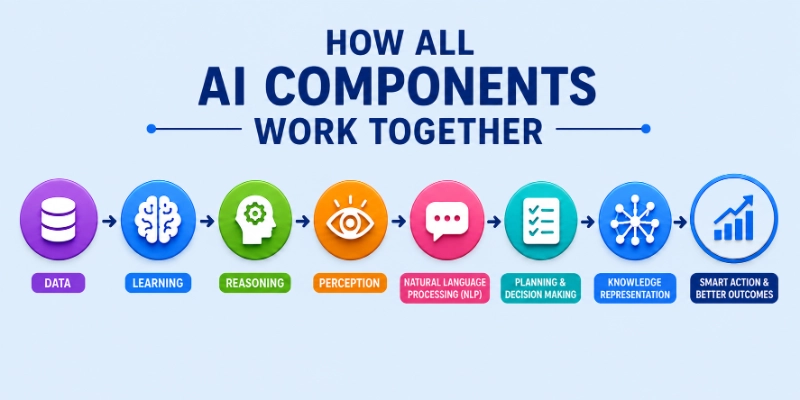
How All AI Components Work Together
All AI components work together in a structured process to help machines analyze information, make decisions, and generate useful results.
The following are the key steps involved in this workflow:
- Data Collection: AI gathers information from various sources such as databases, sensors, images, videos, and user interactions.
- Learning: AI analyzes the collected data to identify patterns and improve its understanding over time.
- Reasoning: AI evaluates information and applies logic to draw conclusions and solve problems.
- Decision Making: AI compares different options and selects the most appropriate action based on available data.
- Output Generation: AI delivers the final result, prediction, recommendation, or response to the user.
Real-World Applications of AI Components
AI components work together to solve problems, automate tasks, and improve efficiency across various industries.
The following are some of the most common real-world applications of AI components:
- Healthcare: AI helps doctors diagnose diseases, analyze medical images, monitor patients, and recommend treatment plans.
- Finance: AI detects fraudulent transactions, assesses financial risks, automates trading, and provides personalized financial advice.
- Education: AI supports personalized learning, automates grading, provides virtual tutoring, and helps students learn more effectively.
- E-Commerce: AI recommends products, improves customer service, analyzes shopping behavior, and enhances the online shopping experience.
- Transportation: AI powers self-driving vehicles, optimizes routes, manages traffic flow, and improves transportation safety.
- Manufacturing: AI monitors production processes, predicts equipment failures, improves quality control, and increases operational efficiency.
Conclusion
In this guide, we have covered main components of artificial intelligence. We explored the key elements that enable AI systems to learn, reason, solve problems, understand information, and make intelligent decisions.
Understanding these components provides a strong foundation for learning how modern AI technologies work. As AI continues to evolve, knowledge of these core components will help you better understand its applications and future developments.
Personal Recommendation: I recommend focusing on the fundamental AI components before exploring advanced topics such as machine learning models and generative AI. A solid understanding of these building blocks will make learning artificial intelligence much easier and more effective.
Thank you for taking the time to read this guide. I hope it helped you gain a clearer understanding of this important topic.
💬 We’d love to hear your thoughts and experiences on this topic. Share your feedback in the discussion section below and join the conversation! 😊
FAQs
Below are the most common questions readers ask after learning about the main components of AI. These FAQs help you clear doubts and understand the topic in a simpler way.
The main components of artificial intelligence include learning, reasoning, problem solving, perception, natural language processing, knowledge representation, planning, decision making, neural networks, and data. These components work together to help AI systems perform intelligent tasks. Each component plays a unique role in how AI processes information and generates results.
The importance of AI components can be understood through the following points:
- They help AI systems learn from data.
- They support reasoning and decision-making.
- They improve problem-solving capabilities.
Together, these components form the foundation of modern artificial intelligence systems.
There is no single most important AI component because each one serves a different purpose. However, learning is often considered a core component because it allows AI systems to improve over time. Without learning, many AI applications would not function effectively.
The relationship can be explained through the following points:
- Machine learning is a subset of artificial intelligence.
- It enables AI systems to learn from data.
- It helps improve predictions and decision-making.
Machine learning is one of the key technologies that powers modern AI applications.
Data acts as the fuel that drives AI systems. AI uses data to learn patterns, identify trends, and make accurate decisions. The quality of data directly affects the performance of machine learning and AI models.
AI components are widely used in many industries, including:
- Healthcare for disease diagnosis.
- Finance for fraud detection.
- E-commerce for product recommendations.
They also support transportation, education, and manufacturing systems.
Neural networks help AI recognize patterns in large datasets. They process information through interconnected artificial neurons and improve accuracy through training. Many advanced AI systems rely on neural networks for image recognition, speech processing, and language understanding.
The difference can be summarized as follows:
- Learning helps AI acquire knowledge from data.
- Reasoning helps AI use that knowledge logically.
- Both work together to support intelligent decisions.
These two components are essential for building effective AI systems.
Yes, some AI systems can operate without NLP if they do not need to process human language. However, NLP is essential for applications such as chatbots, voice assistants, and language translation tools. It allows machines to understand and communicate with people more naturally.






- Be Respectful
- Stay Relevant
- Stay Positive
- True Feedback
- Encourage Discussion
- Avoid Spamming
- No Fake News
- Don't Copy-Paste
- No Personal Attacks
- Be Respectful
- Stay Relevant
- Stay Positive
- True Feedback
- Encourage Discussion
- Avoid Spamming
- No Fake News
- Don't Copy-Paste
- No Personal Attacks
