Use of Artificial Intelligence in Cyber Security
Published: 24 Jul 2026
Cybercrime continues to increase, and organizations face more advanced security threats than ever before. Because of this, the use of artificial intelligence in cyber security has become essential for detecting threats, analyzing large amounts of security data, and responding to attacks quickly.
Based on extensive research into AI technologies and their real-world applications, I have seen how AI helps businesses strengthen their cybersecurity and protect digital systems more effectively.
In this article, we will discuss the use of artificial intelligence in cybersecurity in detail. You will also learn its benefits, real-world applications, challenges, and future role in protecting digital systems.
What Is Artificial Intelligence in Cyber Security?
Cyber threats have become more advanced, making it difficult for traditional security systems to detect and stop every attack. To solve this problem, organizations now use artificial intelligence to monitor networks, identify suspicious activities, and respond to threats much faster. AI can analyze huge amounts of security data in real time, helping businesses protect their systems and sensitive information more effectively.

Definition: Artificial intelligence in cybersecurity is the use of AI technologies to detect, prevent, analyze, and respond to cyber threats automatically while improving the overall security of digital systems.
Relationship Between AI and Cybersecurity
The following points explain how artificial intelligence and cybersecurity work together:
- AI continuously monitors networks and devices for unusual activities.
- AI analyzes large amounts of security data much faster than humans.
- AI detects malware, phishing attempts, and other cyber threats in real time.
- AI helps automate threat detection and incident response.
- AI learns from previous attacks to improve future threat detection.
- AI supports cybersecurity professionals by reducing manual work and improving decision-making.
Why AI Has Become Important
The increasing number of sophisticated cyber attacks, growing volumes of digital data, and the need for faster threat detection have made artificial intelligence an essential part of modern cybersecurity.
How Artificial Intelligence Works in Cyber Security
Artificial intelligence follows a structured process to identify, analyze, and respond to cyber threats. It continuously collects and processes large amounts of security data to detect suspicious activities before they become serious attacks. Unlike traditional security systems that rely on fixed rules, AI learns from new data and improves its performance over time.
The following steps explain how artificial intelligence works in cyber security:
1. Data Collection
The process begins with collecting data from different sources across an organization’s digital environment. AI gathers information from networks, devices, servers, cloud platforms, emails, applications, and user activities to create a complete view of the system.
2. Pattern Recognition
After collecting data, AI analyzes it to identify normal and unusual behavior. It compares current activities with historical data to recognize patterns that may indicate suspicious or malicious actions.
3. Machine Learning Analysis
Machine learning algorithms examine the collected data to detect hidden relationships and potential threats. As the system processes more information, it becomes better at recognizing both known and previously unseen attack methods.
4. Threat Detection
When AI identifies suspicious behavior, it immediately flags potential threats such as malware, phishing attempts, ransomware, unauthorized access, or network intrusions. This allows security teams to respond much faster than with manual monitoring.
5. Risk Prediction
AI evaluates the severity of detected threats and predicts which vulnerabilities attackers are most likely to exploit. This helps organizations prioritize security risks and strengthen weak areas before an attack occurs.
6. Automated Response
Once a threat is confirmed, AI can automatically perform predefined security actions. It may isolate infected devices, block malicious IP addresses, disable compromised user accounts, or alert security teams to reduce the impact of an attack.
7. Continuous Learning
AI continuously learns from new threats, attack techniques, and security incidents. As more data becomes available, the system updates its models and improves its ability to detect future cyber attacks with greater accuracy.
Key Technologies Behind AI in Cyber Security
Artificial intelligence combines several advanced technologies to improve cybersecurity. Each technology performs a specific role, from detecting suspicious activities to predicting future threats and automating security tasks. Together, these technologies help organizations strengthen their overall cyber defense.
The following are the key technologies behind AI in cyber security:
Machine Learning
Machine learning enables security systems to learn from historical and real-time data without requiring constant manual updates. It identifies unusual patterns, detects malware, and improves threat detection as it processes more security information.
Machine learning helps cybersecurity in the following ways:
- Detects malware before it spreads across the network.
- Identifies suspicious login attempts and unusual user behavior.
- Reduces false alerts by learning normal system activities.
- Improves threat detection accuracy through continuous learning.
- Supports fraud detection in banking and online transactions.
Deep Learning
Deep learning uses advanced neural networks to analyze complex security data. It helps detect sophisticated cyber attacks, identify unknown malware, recognize malicious files, and improve the accuracy of threat detection.
Deep learning strengthens cybersecurity through the following capabilities:
- Detects advanced and previously unknown cyber threats.
- Identifies hidden attack patterns in large datasets.
- Improves malware classification and detection.
- Recognizes suspicious network traffic more accurately.
- Supports image and facial recognition for secure authentication.
Natural Language Processing (NLP)
Natural Language Processing, or NLP, helps AI understand and analyze human language. In cybersecurity, it can identify phishing emails, detect malicious messages, analyze security reports, and extract useful information from large amounts of text.
NLP improves cybersecurity in the following ways:
- Detects phishing emails by analyzing language patterns.
- Identifies suspicious messages and fake communications.
- Analyzes threat intelligence reports quickly.
- Monitors chat messages and emails for security risks.
- Helps security teams process large amounts of text-based data.
Behavioral Analytics
Behavioral analytics studies how users and devices normally behave within a network. If someone logs in from an unusual location, accesses sensitive files unexpectedly, or performs suspicious actions, AI quickly detects the abnormal behavior and alerts security teams.
Behavioral analytics provides the following security benefits:
- Detects insider threats before they cause damage.
- Identifies compromised user accounts.
- Monitors user activity in real time.
- Flags unusual device or network behavior.
- Supports identity and access management systems.
Predictive Analytics
Predictive analytics examines historical security data to identify possible future risks. It helps organizations detect vulnerabilities, estimate attack probabilities, and take preventive actions before cyber criminals exploit security weaknesses.
Predictive analytics helps organizations by:
- Predicting future cyber attack trends.
- Identifying high-risk vulnerabilities.
- Prioritizing security patches and updates.
- Supporting proactive risk management.
- Improving long-term cybersecurity planning.
Generative AI
Generative AI helps cybersecurity teams automate repetitive tasks, summarize security reports, generate threat intelligence, and assist in incident investigations. It can also help security analysts respond more quickly by providing recommendations based on large amounts of security data. However, organizations must use it carefully because attackers can also misuse generative AI to create phishing emails, malicious code, and other cyber threats.
Generative AI supports cybersecurity through the following applications:
- Generates security reports and incident summaries.
- Assists analysts during threat investigations.
- Automates documentation and repetitive security tasks.
- Creates realistic attack simulations for security testing.
- Helps security teams respond to incidents more quickly.
- Supports threat intelligence research and analysis.
Top Uses of Artificial Intelligence in Cyber Security
Artificial intelligence has transformed how organizations detect, prevent, and respond to cyber threats. Instead of relying only on manual monitoring, AI can analyze massive amounts of security data, identify suspicious activities, and take action within seconds. This helps businesses improve security while reducing response time and human effort.
The following are the most common uses of artificial intelligence in cyber security:
- Threat Detection: AI continuously monitors systems and identifies suspicious activities before they become serious security incidents.
- Malware Detection: AI detects known and unknown malware by analyzing file behavior instead of relying only on traditional virus signatures.
- Phishing Email Detection: AI identifies phishing emails by examining suspicious links, sender behavior, email content, and language patterns.
- Ransomware Prevention: AI detects ransomware behavior early and helps stop encryption attacks before they spread across the network.
- Network Traffic Monitoring: AI monitors network traffic in real time to identify unusual activities, unauthorized access, and potential cyber threats.
- Intrusion Detection Systems (IDS): AI strengthens intrusion detection systems by recognizing malicious network activities and alerting security teams immediately.
- Fraud Detection: AI analyzes user behavior and transaction patterns to detect financial fraud and other suspicious activities.
- Identity and Access Management (IAM): AI verifies user identities, detects unusual login attempts, and helps ensure that only authorized users access sensitive systems.
- Endpoint Security: AI protects laptops, desktops, mobile devices, and servers by detecting threats directly on endpoint devices.
- Cloud Security: AI monitors cloud environments to identify security risks, detect unauthorized access, and protect cloud-based applications and data.
- Vulnerability Management: AI identifies security weaknesses, prioritizes critical vulnerabilities, and recommends timely remediation actions.
- Security Information and Event Management (SIEM): AI analyzes security logs from multiple sources, identifies hidden threats, and helps security teams investigate incidents more efficiently.
- Security Operations Center (SOC) Automation: AI automates routine security tasks, allowing SOC analysts to focus on complex investigations and high-priority threats.
- User Behavior Analytics (UBA): AI studies normal user behavior and quickly detects unusual activities that may indicate insider threats or compromised accounts.
- Incident Response Automation: AI automatically performs actions such as isolating infected devices, blocking malicious users, and notifying security teams to minimize the impact of cyber attacks.
Real-World Examples of AI in Cyber Security
Many leading technology companies use artificial intelligence to strengthen cybersecurity and protect businesses from modern cyber threats. These AI-powered platforms can detect suspicious activities, analyze security data, automate threat responses, and improve overall protection across networks, devices, and cloud environments.
The following are some of the best real-world examples of AI in cyber security:
- Microsoft Defender: Microsoft Defender uses AI to detect malware, ransomware, phishing attacks, and other cyber threats in real time. It also provides automated investigation and response to help organizations reduce security risks.
- CrowdStrike Falcon: CrowdStrike Falcon is an AI-powered endpoint security platform that protects computers and servers from advanced cyber attacks. It uses machine learning to identify suspicious behavior and stop threats before they cause damage.
- Darktrace: Darktrace uses AI to learn normal network behavior and quickly detect unusual activities that may indicate cyber attacks. Its self-learning technology helps identify both known and previously unseen threats.
- IBM QRadar: IBM QRadar is a Security Information and Event Management (SIEM) platform that uses AI to analyze security logs, prioritize threats, and help security teams investigate incidents more efficiently.
- Google Security AI: Google Security AI applies artificial intelligence across Google Cloud security services to detect threats, analyze security events, identify vulnerabilities, and improve cloud protection through automated intelligence.
- Palo Alto Cortex XSIAM: Palo Alto Cortex XSIAM combines AI, automation, and security analytics to detect, investigate, and respond to cyber threats from a single platform. It helps reduce manual work and speeds up incident response for security teams.
Benefits of Using Artificial Intelligence in Cyber Security
Artificial intelligence helps organizations detect threats faster, automate security tasks, and improve overall protection. It also reduces manual work and enables security teams to respond more efficiently.
The table below shows the key benefits of using artificial intelligence in cyber security:
| Benefit | Explanation |
| Faster Detection | Detects cyber threats in real time. |
| 24/7 Monitoring | Monitors systems continuously without interruption. |
| Reduced False Positives | Filters unnecessary security alerts. |
| Automated Response | Responds to threats automatically. |
| Better Accuracy | Improves threat detection accuracy. |
| Predictive Security | Predicts risks before attacks occur. |
| Lower Operational Costs | Reduces manual work and security costs. |
| Improved Compliance | Supports security standards and compliance requirements. |
Challenges and Limitations of AI in Cyber Security
Although artificial intelligence improves cybersecurity, it also comes with several challenges. Organizations must address these limitations to ensure AI systems remain effective, accurate, and secure.
The following are the main challenges and limitations of AI in cyber security:
- High Implementation Cost: Deploying AI-powered security solutions often requires significant investment in software, infrastructure, and maintenance.
- Data Quality Issues: AI performs best with accurate and complete data. Poor-quality data can reduce detection accuracy and lead to incorrect decisions.
- False Positives: AI may sometimes identify normal activities as security threats, creating unnecessary alerts for security teams.
- AI Bias: Biased or incomplete training data can affect AI models and reduce the accuracy of threat detection.
- Privacy Concerns: AI systems process large amounts of user and business data, raising concerns about data privacy and regulatory compliance.
- Lack of Skilled Professionals: Many organizations face challenges in finding cybersecurity experts who can build, manage, and maintain AI-powered security systems.
- Adversarial AI Attacks: Cybercriminals can manipulate AI models with specially crafted inputs to bypass security detection or produce incorrect results.
- Overdependence on Automation: Relying entirely on AI can be risky because some complex threats still require human analysis and decision-making.
Risks of Artificial Intelligence in Cyber Security
Artificial intelligence strengthens cybersecurity by helping organizations detect and prevent cyber attacks. However, the same technology can also be used by cybercriminals to launch faster, smarter, and more convincing attacks. This makes it important for organizations to understand both the benefits and the risks of AI.
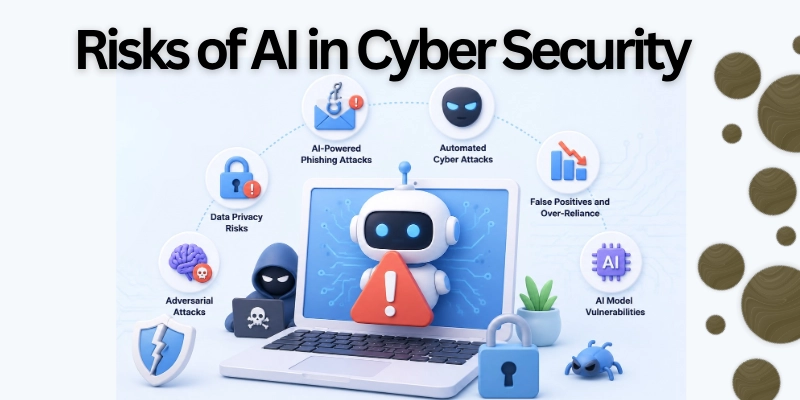
The following are the major risks of artificial intelligence in cyber security:
- AI-Generated Phishing: Attackers use AI to create realistic phishing emails and messages that are more difficult to identify.
- Deepfakes: AI can generate fake videos, images, or voices that criminals use for fraud, identity theft, and impersonation.
- Automated Hacking: AI can automate vulnerability scanning, password guessing, and other hacking activities, allowing attackers to target systems more efficiently.
- AI Malware: Cybercriminals can develop AI-powered malware that adapts to security defenses and avoids detection.
- Password Attacks: AI speeds up password cracking by analyzing common password patterns and testing combinations more efficiently.
- Social Engineering: AI helps attackers create personalized messages that trick people into sharing sensitive information or granting unauthorized access.
- Prompt Injection: Attackers manipulate AI systems with carefully crafted prompts to bypass security controls or produce unintended responses.
- Model Poisoning: Hackers intentionally add malicious or misleading data to AI training datasets, reducing the accuracy and reliability of AI security models.
Industries That Use AI in Cyber Security
Cyber threats affect almost every industry, making strong cybersecurity more important than ever. Organizations now use artificial intelligence to protect sensitive data, detect security threats, and reduce the risk of cyber attacks.
As digital transformation continues to grow, AI has become an essential part of modern cybersecurity strategies. It helps businesses monitor networks, automate threat detection, and respond to security incidents more quickly and accurately.
The following industries widely use AI in cyber security:
- Banking
- Healthcare
- Government
- Education
- Retail
- Manufacturing
- Telecom
- E-commerce
- Cloud Computing
Best Practices for Using Artificial Intelligence in Cyber Security
Artificial intelligence can improve cybersecurity, but it delivers the best results when organizations use it correctly. Following proven security practices helps improve AI performance, reduce risks, and strengthen overall protection against cyber threats.
Organizations should also remember that AI is a tool, not a complete replacement for human expertise. Regular monitoring, quality data, and strong security policies are essential for keeping AI-powered security systems reliable and effective.
Follow the best practices below to use artificial intelligence in cyber security effectively:
- Combine AI with human experts.
- Train AI models regularly.
- Monitor AI performance.
- Protect AI models from attacks.
- Keep software updated.
- Use quality datasets.
- Follow security compliance.
- Conduct regular audits.
Future of Artificial Intelligence in Cyber Security
Artificial intelligence will continue to play a bigger role in protecting digital systems as cyber threats become more advanced. Future AI technologies will help organizations detect attacks earlier, automate security operations, and make faster security decisions.
The following trends will shape the future of artificial intelligence in cyber security:
- Agentic AI: Agentic AI will perform security tasks independently while making decisions based on real-time threat analysis.
- Autonomous SOC: Autonomous Security Operations Centers will use AI to automate threat detection, investigation, and incident response with minimal human intervention.
- Predictive Cyber Defense: AI will predict potential cyber attacks before they happen, allowing organizations to strengthen security in advance.
- Explainable AI: Explainable AI will help security teams understand how AI reaches its decisions, improving transparency and trust.
- Zero Trust with AI: AI will strengthen Zero Trust security by continuously verifying users, devices, and access requests.
- AI-Powered Threat Hunting: AI will help security teams proactively search for hidden threats that traditional tools may overlook.
- Quantum-Resistant Security: AI will support the development of security solutions designed to protect data from future quantum computing threats.
- Human and AI Collaboration: AI will automate routine security tasks while cybersecurity professionals focus on complex investigations and strategic decision-making.
Conclusion
In this guide, we have covered use of artificial intelligence in cyber security. You learned how AI works in cybersecurity, its key technologies, real-world applications, benefits, challenges, risks, and future trends.
As cyber threats continue to evolve, AI will remain an important part of modern cybersecurity. However, the best results come from combining AI with skilled cybersecurity professionals and strong security practices.
Personal Recommendation: I recommend using AI as a powerful security assistant rather than relying on it completely. Combine AI-powered tools with regular security updates, employee awareness, and expert monitoring to build a stronger cybersecurity strategy.
Thank you for taking the time to read this guide. I hope it helped you better understand how artificial intelligence is transforming cybersecurity and how you can benefit from it.
💬 Have questions or thoughts about the use of artificial intelligence in cyber security? We’d love to hear from you. Share your experience or ask your questions in the comments below! 🚀
FAQs
If you still have questions about the use of artificial intelligence in cyber security, the following FAQs cover the most common queries to help you understand the topic more clearly.
The use of artificial intelligence in cyber security helps organizations detect, prevent, and respond to cyber threats more quickly. AI analyzes large amounts of security data, identifies suspicious activities, and automates many security tasks. This improves protection while reducing manual effort.
AI improves cybersecurity in the following ways:
- Detects threats in real time.
- Automates security monitoring and response.
- Predicts potential cyber attacks before they happen.
These capabilities help organizations strengthen their overall security.
No, AI cannot stop every cyber attack. It significantly improves threat detection and response, but cybercriminals continue to develop new attack methods. Organizations should combine AI with skilled cybersecurity professionals and strong security practices.
The main benefits of AI in cybersecurity include the following:
- Faster threat detection.
- Continuous security monitoring.
- Better accuracy with fewer false alerts.
- Automated incident response.
These advantages help businesses improve their overall cyber defense.
Many industries use AI to protect sensitive data and digital systems. Banking, healthcare, government, education, retail, manufacturing, telecom, e-commerce, and cloud computing all rely on AI-powered cybersecurity solutions.
Some common challenges include the following:
- High implementation costs.
- Data quality issues.
- Privacy concerns.
- AI bias and false positives.
Organizations must address these challenges to get the best results from AI.
Yes, cybercriminals can also use AI to create phishing emails, develop advanced malware, and automate cyber attacks. This is why organizations must continuously update their security systems and monitor new threats.
Artificial intelligence in cybersecurity includes the following technologies:
- Machine Learning
- Deep Learning
- Natural Language Processing (NLP)
- Behavioral Analytics
- Predictive Analytics
- Generative AI
Each technology helps improve threat detection and security automation.
Popular AI cybersecurity tools include Microsoft Defender, CrowdStrike Falcon, Darktrace, IBM QRadar, Google Security AI, and Palo Alto Cortex XSIAM. These tools help detect threats, monitor networks, and automate security operations.
The future of artificial intelligence in cyber security focuses on smarter automation, predictive defense, and faster threat response. Technologies such as Agentic AI, Autonomous SOC, and AI-powered threat hunting will help organizations defend against increasingly advanced cyber threats.






- Be Respectful
- Stay Relevant
- Stay Positive
- True Feedback
- Encourage Discussion
- Avoid Spamming
- No Fake News
- Don't Copy-Paste
- No Personal Attacks
- Be Respectful
- Stay Relevant
- Stay Positive
- True Feedback
- Encourage Discussion
- Avoid Spamming
- No Fake News
- Don't Copy-Paste
- No Personal Attacks
