Best AI for Writing Fiction: Find the Right Tool for Your Story
Published: 13 Oct 2026
Finding the best AI for writing fiction can feel confusing. One tool may promise to write complete stories, while another focuses on brainstorming, characters, or long novels. So, which one actually helps you write better fiction, and which one simply gives you more text to edit?
The answer depends on what kind of writer you are and what support you need. Some AI tools work well when you are stuck on a plot, while others can help develop scenes, improve dialogue, or organize a longer story.
The best AI fiction writer for a short-story creator may not be the right choice for someone planning a full novel. That is why choosing an AI tool should not be about finding the most popular name. It should be about finding a tool that fits your creative process.
In this guide, we will explore what different AI tools can do, who they are best for, and how to choose one without losing your own imagination and writing voice.
What Is AI Fiction Writing?
AI fiction writing means using artificial intelligence to support the creative process of writing stories. Instead of replacing the writer completely, an AI tool can help generate ideas, suggest scenes, develop characters, improve dialogue, or continue a draft based on your instructions.
For someone looking for the best AI for fiction writing, it is important to understand that different tools offer different types of support. Some work better for brainstorming, while others are designed to handle longer projects or help writers revise existing text.
AI can assist fiction writers with tasks such as:
- Story ideas: Suggesting new concepts when you do not know what to write next.
- Plot development: Helping you explore possible events, conflicts, and story directions.
- Character creation: Generating personality traits, backgrounds, goals, and motivations.
- Scene writing: Creating a starting draft for a particular moment or situation.
- Dialogue support: Suggesting conversations between characters.
- Rewriting: Changing the tone, length, or wording of an existing passage.
The key point is that AI works best as a creative assistant. You provide the direction, make the important decisions, and shape the final story with your own imagination.
How AI Helps Fiction Writers
AI fiction writing does not mean you press a button and publish a complete novel. Its real value becomes clear when you face a problem during the writing process. Maybe you cannot figure out the next scene, a character feels flat, or the ending feels weak.
For example, imagine you have written five chapters but suddenly do not know what your main character should do next. Instead of asking AI to take over, you can ask it for five possible directions. The best AI tools for fiction writing can work like a creative sounding board, giving you options that you can accept, reject, or completely change.
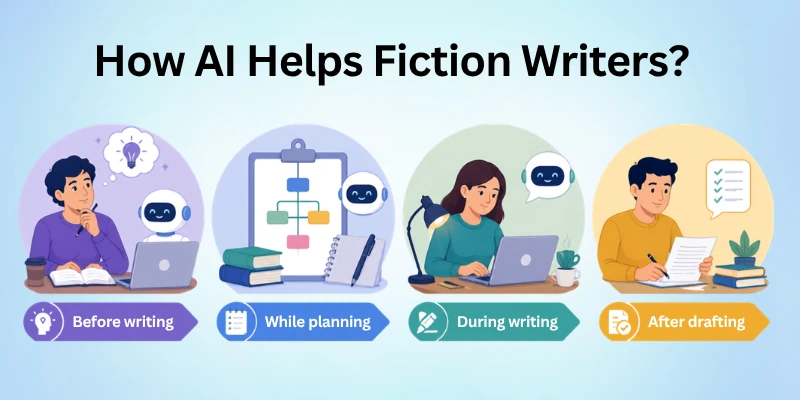
AI can be useful at different stages:
- Before writing: Explore story ideas, characters, settings, and conflicts.
- During writing: Find possible scene directions when you feel stuck.
- While planning: Test whether a plot idea creates enough tension.
- After drafting: Rewrite awkward sentences or explore stronger dialogue.
The biggest benefit is not that AI writes faster than you. It gives you something to react to. Sometimes, one unexpected suggestion can lead you toward an idea you would not have considered on your own.
That is why the best AI to write fiction is not necessarily the one that produces the most words. A useful tool should support your imagination while leaving the story, decisions, and final voice in your hands.
Best AI Tools for Fiction Writing
Finding the right AI tool can make fiction writing easier, but every tool supports the creative process in a different way. Some are built for generating stories, while others help with planning, organizing, or improving an existing draft.
Below are the main AI tools we will compare in this section. Each one has a different purpose, so understanding what it does can help you choose the right option for your writing needs.
- Sudowrite
- Novelcrafter
- NovelAI
- Squibler
- ChatGPT
- Claude
- ProWritingAid
Let’s check these tools in detail:
1. Sudowrite
Sudowrite is designed specifically for creative and fiction writers. It can support the writing process from the first idea to drafting, rewriting, and editing. Its features include brainstorming, sensory descriptions, scene generation, story planning, and tools for continuing a story when you get stuck.
One of its useful features is the Story Bible, where writers can organize details about characters, genre, worldbuilding, and story direction. Its Write feature can also use surrounding text and project context to suggest what should come next.
What Sudowrite Can Help You Do
- Generate story and worldbuilding ideas
- Develop characters and plot twists
- Add richer descriptions to scenes
- Continue an unfinished passage
- Expand rushed moments
- Rewrite text for better flow or tone
- Plan scenes and generate longer drafts
Best for: Writers who want AI support throughout the complete fiction-writing process. Sudowrite is especially useful for brainstorming, scene development, and getting unstuck during a draft.
2. Novelcrafter
Novelcrafter takes a different approach. It focuses heavily on helping writers organize a large story while allowing them to choose how much AI assistance they want. Its Codex works like a story wiki for characters, places, lore, and other important information.
This makes Novelcrafter particularly useful for writers handling complex novels or large fictional worlds. Instead of repeatedly explaining your characters and settings, you can organize that information in the Codex and use it as part of your wider writing workflow.
What Novelcrafter Can Help You Do
- Store character and world details
- Track story information in one place
- Plan scenes and chapters
- Spot possible plot holes or inconsistencies
- Share story information across a book series
- Brainstorm, write, or review with AI
- Connect with different AI models
Best for: Novel writers who need stronger planning, story organization, and long-term control over a complex project.
3. NovelAI
NovelAI is built around AI-powered storytelling and gives writers more control over how text is generated. Its text tools include story generation, adjustable output settings, different models and modules, and features such as Lorebook for managing story-related information. It also supports Storyteller and Text Adventure experiences.
NovelAI can suit writers who want to experiment with AI output instead of using a simple one-click generator. Its adjustable settings give you more influence over how the story develops, which can be useful for writers who enjoy testing different creative directions.
What NovelAI Can Help You Do
- Continue an existing story
- Generate new scenes and passages
- Adjust AI output settings
- Choose different models and writing modules
- Store story information through Lorebook
- Explore interactive storytelling
- Customize the writing interface
Best for: Fiction writers who want deeper control over AI-generated text and enjoy interactive storytelling or experimenting with different generation settings.
4. Squibler
Squibler combines AI writing with tools for planning and managing longer projects. It can help writers generate outlines, scenes, chapters, and complete drafts while keeping characters, settings, plot details, and other project information in one workspace.
Its main strength is keeping the writing process together in one place. You can move from an early idea to planning, drafting, organizing, and revising without constantly switching between separate tools.
What Squibler Can Help You Do
- Create story outlines
- Generate scenes and chapter drafts
- Develop characters and settings
- Organize chapters and scenes
- Track writing goals and progress
- Rewrite and improve existing sections
- Export finished projects in different formats
Best for: Writers who want an all-in-one workspace for planning, writing, organizing, and developing longer fiction projects.
5. ChatGPT
ChatGPT is a general AI assistant, but it can be useful for many parts of fiction writing. You can use it to brainstorm ideas, develop characters, plan plots, write scenes, improve dialogue, and rewrite drafts. Its main strength is flexibility because you can guide the conversation and keep developing an idea through follow-up questions.
ChatGPT can work well when you want a flexible writing partner rather than software built only for one part of fiction writing. You can start with a simple idea and gradually turn it into a more detailed story through conversation.
What ChatGPT Can Help You Do
- Brainstorm story ideas
- Develop characters and backstories
- Plan plots and story arcs
- Explore different scene directions
- Improve dialogue
- Rewrite existing passages
- Generate ideas for short stories or novels
Best for: Writers who want one flexible AI tool for brainstorming, planning, drafting, rewriting, and exploring creative ideas.
6. Claude
Claude is another general AI assistant that can be helpful for fiction writers, particularly when working with large amounts of text and detailed project context. Its long-context capabilities can make it useful for reviewing extensive material and discussing information across a longer piece of writing.
Claude can be especially useful when your fiction project contains many chapters, characters, or connected ideas. You can provide substantial context and ask focused questions about specific parts of the work instead of explaining every detail again from the beginning.
What Claude Can Help You Do
- Review longer pieces of writing
- Discuss complex story ideas
- Analyze characters and relationships
- Check plot consistency
- Help organize large amounts of story information
- Rewrite scenes and passages
- Follow detailed writing instructions
Best for: Writers working on longer fiction projects who need help reviewing, discussing, and organizing a large amount of story material.
7. ProWritingAid
ProWritingAid is different from the other tools because its main purpose is not to create your entire story. Instead, it helps you review and improve the writing you have already produced. It can analyze areas such as grammar, style, readability, repeated words, and sentence structure.
This makes it useful after you have written a scene, chapter, or complete draft. Rather than asking AI to decide what happens in your story, you can use the feedback to improve how your story is written while keeping your own ideas and creative direction.
What ProWritingAid Can Help You Do
- Check grammar and spelling
- Find repeated words and phrases
- Improve sentence structure
- Review writing style
- Highlight readability issues
- Analyze dialogue and pacing
- Suggest areas that may need revision
Best for: Fiction writers who already have a draft and want detailed feedback to polish their language, improve readability, and catch repeated or weak writing before sharing their work.
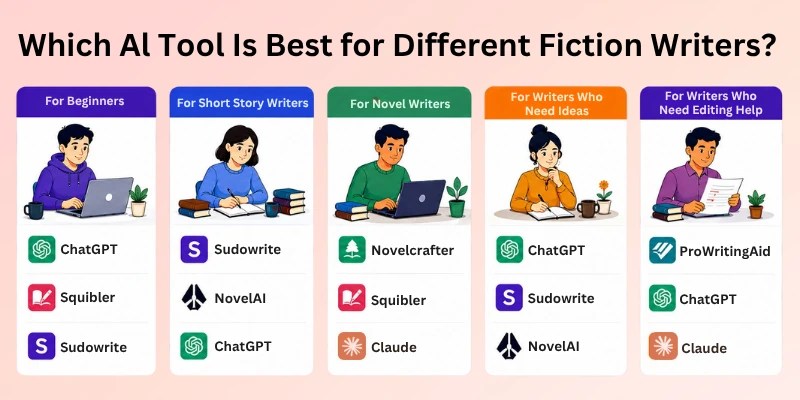
Which AI Tool Is Best for Different Fiction Writers?
There is no single tool that works perfectly for every fiction writer. The right choice depends on what you write, where you need help, and how much control you want during the creative process.
Here is a simple way to match each type of writer with the right tool:
For Beginners
If you are new to AI writing, start with a simple and flexible tool.
- ChatGPT for brainstorming and general writing help
- Squibler for an organized writing workspace
- Sudowrite for creative, fiction-focused support
For Short Story Writers
Short stories often need strong ideas, quick scene development, and clear endings.
- Sudowrite for creative scenes
- NovelAI for story generation control
- ChatGPT for testing different ideas
For Novel Writers
Long projects need better planning and consistency across many chapters.
- Novelcrafter for story organization
- Squibler for managing a larger project
- Claude for reviewing extensive story material
For Writers Who Need Ideas
If your biggest problem is not knowing what to write next, choose a tool that works well as a creative partner.
- ChatGPT for brainstorming
- Sudowrite for imaginative suggestions
- NovelAI for exploring different story directions
For Writers Who Need Editing Help
When your story already exists but the writing needs improvement, editing tools can become more useful than story generators.
- ProWritingAid for detailed writing feedback
- ChatGPT for rewriting selected passages
- Claude for reviewing larger sections of a draft
Simple takeaway: Choose the tool based on your biggest writing need. The best option for creating ideas may not be the best one for editing or managing a complete novel.
Can AI Actually Write Good Fiction?
AI can produce fiction that sounds interesting, descriptive, and well-structured. It can create scenes, suggest dialogue, build characters, and even continue a story from a small idea. However, generating good sentences is not always the same as creating a memorable story.
The strongest fiction usually comes from human choices. A writer decides which emotions matter, what a character truly wants, and why a particular moment should affect the reader. AI can suggest possibilities, but it may not fully understand the personal meaning behind your story in the same way you do.
What AI Can Do Well
- Generate ideas when you feel stuck
- Create first drafts quickly
- Suggest plot possibilities
- Help develop scenes and dialogue
- Offer different versions of the same idea
- Improve or rewrite selected text
Where You Still Need Human Creativity
- Creating a personal writing voice
- Making important creative decisions
- Adding genuine emotional depth
- Choosing meaningful story details
- Deciding what belongs in the final draft
AI can be a useful creative assistant, but it works best when the writer stays in control. The tool can give you material to work with, while your imagination turns that material into a story that feels personal and original.
Final Thoughts
Finding the best AI for writing fiction is not about choosing the tool that writes the most words. The right choice depends on what you need help with. Some writers need fresh ideas, others need support with planning a novel, and some simply want help improving a finished draft.
In my view, AI works best when it supports your creativity instead of replacing it. Use it to explore a new plot, develop a difficult character, test different scenes, or improve weak writing. But keep the important decisions in your own hands. Your experiences, imagination, and unique voice are what can make a story truly yours.
So, try the tools that match your writing style and see how they fit into your process. Keep what helps, ignore what does not, and never feel forced to use every AI suggestion. The best result comes when you use AI as a creative assistant while remaining the real storyteller behind every important choice.
Frequently Asked Questions
Choosing an AI writing tool can raise many questions, especially when every tool offers something different. Below are 10 common questions to help you understand how AI can support your fiction-writing process.
The best AI for fiction writing depends on your goal. Some tools are better for brainstorming and scenes, while others help with novel planning, story organization, or editing.
Choose a tool based on the specific problem you want to solve rather than looking for one tool that does everything.
Yes, the best AI to write fiction can generate a complete draft from your instructions. However, you should review and revise the result because the story may lack consistency, originality, or the emotional depth you want.
The best AI for writing stories should help you brainstorm instead of simply giving you one finished answer. You can ask for different premises, conflicts, characters, or endings and build your own idea from the options.
Yes. If you need the best AI for writing novels, look for features that support chapters, characters, plot details, and long-term story organization.
For a large project, useful support may include:
- Chapter planning
- Character tracking
- Story memory
- Plot organization
A good best AI novel writing tool for beginners should feel simple and easy to control. Start with a tool that helps you brainstorm and organize ideas without making the writing process feel overwhelming.
Try a few options and choose the one that fits your natural writing habit.
Some AI tools offer project memory or story organization features that help track characters and important details. Still, you should check important facts yourself because AI can sometimes lose context or create inconsistencies.
The best AI for writing short stories should help you develop a strong idea quickly. It can support scene creation, character conflict, dialogue, and possible endings without requiring extensive project-management features.
No tool automatically replaces human creativity. The best AI story writer can generate ideas and text quickly, but you bring personal imagination, judgment, and emotional choices to the story.
The strongest approach is often using AI as support while keeping yourself in control.
The best AI software for fiction writers depends on whether you need help with writing, planning, organization, or editing. There is no single perfect option for every writer.
Think about your biggest challenge first, then choose software designed to help with that specific part of your process.
AI can follow style instructions and adjust tone, but you should always review the output before using it. The best AI tools for fiction writing can support your voice, but your personal choices and editing help keep the final story truly yours.






- Be Respectful
- Stay Relevant
- Stay Positive
- True Feedback
- Encourage Discussion
- Avoid Spamming
- No Fake News
- Don't Copy-Paste
- No Personal Attacks
- Be Respectful
- Stay Relevant
- Stay Positive
- True Feedback
- Encourage Discussion
- Avoid Spamming
- No Fake News
- Don't Copy-Paste
- No Personal Attacks
