AI for Media: How AI is Changing Content Forever
Published: 5 Oct 2026
The media industry is changing fast, and AI is becoming a big part of that change. From writing news stories to creating videos, images, and social media posts, AI for media is helping teams create content faster and manage large amounts of information.
But how is AI really changing the way media works? It can help media professionals save time, understand their audience, and create more personalized content. At the same time, it brings new questions about accuracy, copyright, and the role of humans in media.
In this guide, we’ll explore how AI in media works, where it is being used, its key benefits, common challenges, and what the future may look like.
What is AI for Media?
AI for media means using artificial intelligence to create, manage, analyze, and improve media content. It helps media teams handle tasks that often take a lot of time, such as writing, editing, research, and audience analysis.
Artificial intelligence for media can work with text, images, video, audio, and large amounts of data. For example, a news team can use AI to organize research, while a video team can use it to create captions or edit content faster.
AI is now used across many areas of media, including:
- Content creation: Helps create articles, scripts, captions, and other content.
- Content editing: Finds grammar, spelling, and style issues.
- Audience analysis: Helps teams understand what people watch, read, or share.
- Content recommendations: Suggests content based on user interests.
- Media production: Supports video, image, and audio creation.
- Research: Helps collect and organize information quickly.
The main goal is not simply to replace human workers. AI can handle repetitive tasks while media professionals focus on ideas, creativity, storytelling, and important decisions.
For example, a journalist can use AI to organize a large set of interview notes. The journalist can then check the information, add context, and write the final story. This shows how AI can support human work instead of doing everything alone.
How Does AI for Media Work?
Artificial intelligence for media works by using computer systems to process large amounts of information, identify patterns, and complete tasks. It can work with text, images, audio, video, and audience data.
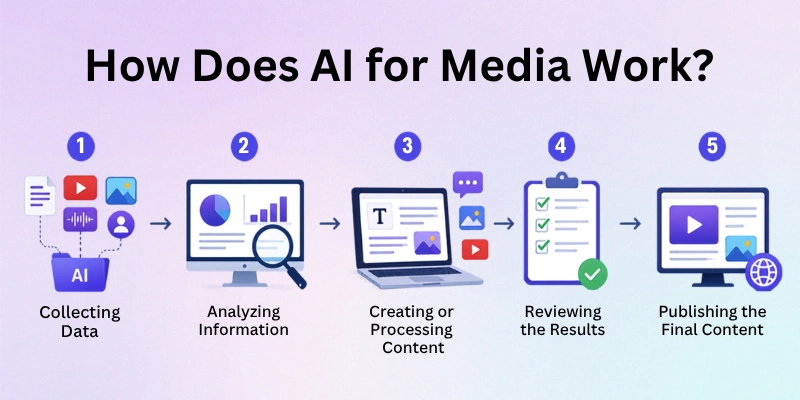
The process starts when a media team gives AI some information and a specific task. The system processes the input and creates an output that a person can review, edit, and improve. This makes AI in media useful for both creative and repetitive work.
The process usually includes these steps:
- Collecting Data: AI receives information such as articles, images, videos, audio, or audience data.
- Processing Information: It studies the input and identifies useful patterns, topics, or details.
- Creating Results: AI can produce drafts, summaries, captions, ideas, or other useful outputs.
- Human Review: A media professional checks the result for accuracy, quality, and relevance.
- Final Preparation: The approved content is edited and prepared for the target audience.
For example, a news team may have thousands of comments about a recent story. AI can group those comments by topic and identify common opinions. The team can then review the results and use them to plan future content.
This process shows how AI for digital media can save time while allowing people to focus more on creativity, judgment, and storytelling.
How Is AI Used in Media?
AI media technology is used in many parts of the media industry. It can help with research, content planning, audience analysis, personalization, editing, and information management.
Common AI media applications include:
News Research and Reporting
AI can process large amounts of information and help journalists organize research. It can summarize documents, identify useful details, and find patterns in large datasets.
It can help with:
- Summarizing long documents
- Organizing research notes
- Finding useful information
- Analyzing large datasets
- Identifying trends
For AI for news media, human fact-checking is still important because AI can misunderstand information or produce incorrect results.
Audience Analysis
Media companies can use AI to study how people interact with their content. It can identify patterns in views, clicks, comments, and other forms of engagement.
Media teams can use this information to understand:
- Which topics attract attention
- What content audiences prefer
- When users are most active
- Which formats perform well
- How interests change over time
This helps AI in the media industry support better content planning and audience decisions.
Content Personalization
AI can study user behavior and recommend content that matches individual interests. It can look at activities such as views, clicks, searches, and reading history to understand what users may prefer.
Media platforms can use this information to:
- Recommend relevant articles
- Suggest videos based on interests
- Personalize news feeds
- Show related content
- Improve user engagement
For example, someone who often watches sports videos may receive more sports-related recommendations.
Media Management
Large media companies often handle thousands of articles, images, videos, and audio files. AI can help organize this information and make important content easier to find.
It can help with:
- Classifying content
- Organizing files
- Creating summaries
- Finding specific information
- Monitoring large content collections
The AI and media industry connection is also growing as companies use these systems to manage information more efficiently.
AI Tools for Media Content Creation
AI tools for media help creators produce and manage different types of content. Each tool can focus on a specific task, such as writing, video editing, image creation, audio processing, or research.
AI Writing Tools
AI writing tools can help create drafts, headlines, scripts, captions, and content ideas. They can also improve grammar, spelling, and sentence structure.
They can help with:
- Article drafts
- Headlines
- Video scripts
- Social media captions
- Content ideas
- Grammar and editing
For example, a writer can provide a topic and key points and ask AI to create a first draft. The writer can then check the information and add their own ideas.
AI Video and Image Tools
AI can support many visual content tasks. It can help edit videos, create captions, remove backgrounds, improve images, and develop visual ideas.
Common uses include:
- Video editing
- Automatic captions
- Subtitle creation
- Image generation
- Background removal
- Image enhancement
For example, a video team can use AI to create subtitles for a long interview and then select useful clips for social media.
These tools support AI media content creation by reducing repetitive work and giving creators more time for creative decisions.
AI Audio Tools
AI audio tools can help creators work with podcasts, interviews, videos, and other recordings. They can process audio and complete tasks that may take a long time manually.
They can help with:
- Audio cleanup
- Transcription
- Noise removal
- Voiceovers
- Podcast editing
- Audio summaries
For example, a podcast team can use AI to create a transcript from an interview and remove unwanted background noise before preparing the final recording.
AI Research Tools
AI research tools can help media professionals organize information and understand large amounts of material. They can process documents quickly and make important details easier to find.
They can help with:
- Summarizing long documents
- Identifying key points
- Organizing research notes
- Finding useful information
- Analyzing large amounts of data
- Preparing background research
For example, a journalist researching a complex topic can use AI to organize background information before writing. Important facts should still be checked using reliable sources.
Overall, AI for media content can make the production process faster, but people should remain responsible for accuracy, quality, creativity, and final decisions.
Benefits of AI for Media
AI can make media work faster, easier, and more organized. It helps teams handle repetitive tasks while giving creators more time to focus on ideas, storytelling, and audience needs.
The Benefits of AI in media can be seen across content creation, research, editing, and audience management. However, teams should still review AI-generated work before publishing it.
- Faster Content Production: AI can create drafts, captions, summaries, and other basic content quickly.
- Lower Production Costs: AI can reduce the time spent on repetitive tasks and help small teams handle more work.
- Better Audience Targeting: AI can study audience behavior and help teams understand what content people prefer.
- Easier Content Personalization: Media platforms can use AI to suggest content based on user interests.
- Improved Workflow: AI can help organize research, edit content, create transcripts, and manage other routine tasks.
- More Content Ideas: AI can suggest topics, headlines, scripts, and creative ideas when teams need inspiration.
- Quick Data Analysis: AI can process large amounts of information and highlight useful patterns.
- Better Accessibility: AI can create captions, transcripts, and audio versions that make content easier for more people to access.
AI for News Media
AI is changing how news organizations research, create, and share stories. It can help journalists handle large amounts of information, find useful details, and complete repetitive tasks faster.
However, AI should support journalists rather than replace them. Human reporters still need to check facts, understand context, interview people, and make final decisions before publishing a story.
Automated News Writing
AI can create simple news drafts from structured information, such as sports scores, financial data, or weather updates. This can help news teams publish basic reports quickly.
For example, a sports website can use AI to create a short match report from verified scores and statistics.
It can help with:
- First drafts
- Sports updates
- Financial reports
- Weather updates
- News summaries
News Research
AI can help journalists organize large amounts of information during research. It can summarize documents and highlight important details.
For example, a journalist working on a long report can use AI to organize hundreds of pages of documents into useful sections.
It can support:
- Document summaries
- Data organization
- Research notes
- Trend identification
- Information sorting
Fact-Checking Support
AI can help journalists review large amounts of information and identify claims that may need further checking. It can compare details, find possible conflicts, and highlight information that needs a closer look.
However, AI should not replace human fact-checking. Journalists should always confirm important claims using trusted sources before publishing them.
AI can help with:
- Checking claims
- Comparing information
- Finding missing details
- Spotting inconsistencies
- Organizing sources.
- Supporting journalists
News Personalization
AI can help news platforms show readers stories based on their interests and reading habits. This can make news feeds more relevant to each user.
For example, someone who often reads technology stories may see more technology-related articles in their news feed.
It can help with:
- Personalized news feeds
- Article recommendations
- Topic suggestions
- Audience interests
- Content discovery
AI in Digital Media
Digital media produces a large amount of content every day. AI can help teams create, organize, and improve this content across websites, social platforms, video channels, and other digital platforms.
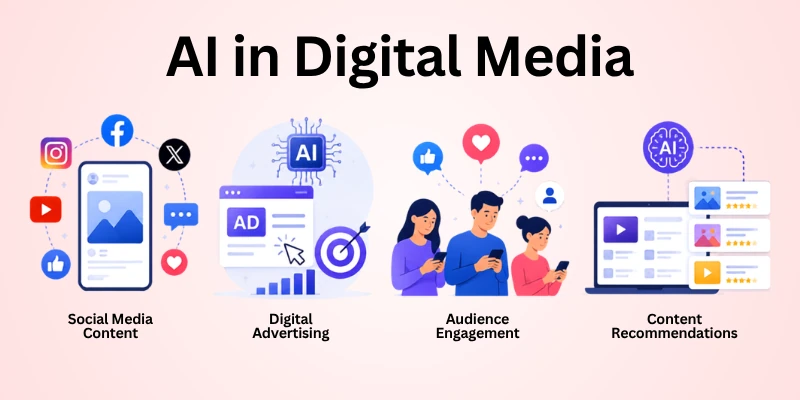
It can also help media teams understand how people interact with content. This information can guide teams when they plan new content or decide what to show to different audiences.
Social Media Content
AI can help social media teams create posts, captions, headlines, and content ideas. It can also help adapt one piece of content for different platforms.
For example, a media company can turn a long article into short social media posts. A team member can then review the posts and adjust them for the brand.
It can help with:
- Post ideas
- Captions
- Headlines
- Content summaries
- Short-form content
Digital Advertising
AI can help media companies improve online advertising by studying audience data and campaign results. It can help teams understand which content and messages get more attention.
For example, an online publisher can use audience data to show more relevant ads to different groups of readers.
AI can support:
- Audience targeting
- Ad content ideas
- Campaign analysis
- Performance tracking
- Audience segmentation
Audience Engagement
AI can help digital media platforms interact with users more quickly. Chatbots and recommendation systems can answer simple questions or guide users toward useful content.
For example, a news website can use an AI chatbot to help readers find articles about a specific topic.
It can support:
- AI chatbots
- User recommendations
- Content discovery
- Automated responses
- User feedback analysis
Content Recommendations
AI can study what users read, watch, or listen to and suggest similar content. This can help people discover stories that match their interests.
For example, a person who often watches technology videos may receive more videos about smartphones, software, or new gadgets.
Content recommendations can help:
- Increase content discovery
- Keep users engaged
- Personalize user experiences
- Suggest relevant articles
- Recommend videos and podcasts
AI in Mass Media
AI in mass media is changing how traditional and modern media organizations create, manage, and deliver content. Television, radio, newspapers, and online platforms can use AI to handle repetitive tasks and understand what their audiences want.
AI can also help media companies work with large amounts of information. For example, a television channel can use AI to analyze viewer behavior, while a newspaper can use it to organize stories and suggest related content.
Television
AI can support television teams in both production and audience management. It can help create captions, edit videos, analyze viewer data, and recommend programs.
It can help with:
- Automatic subtitles
- Video editing
- Audience analysis
- Content recommendations
- Program scheduling
Radio
Radio stations can use AI to improve audio production and understand listener preferences. AI can also help with transcription and other routine tasks.
Common uses include:
- Audio editing
- Voice generation
- Transcription
- Music recommendations
- Listener analysis
Newspapers
Newspapers can use AI to speed up research, organize information, and support basic news writing. It can also help editors find trends in large amounts of data.
AI can support:
- News research
- Article summaries
- Headline ideas
- Data analysis
- Content recommendations
Online Media
Online media platforms produce content around the clock. AI can help them manage this large content flow and deliver more relevant information to users.
It can help with:
- Personalized content
- Article recommendations
- Audience analysis
- Social media content
- Digital advertising
AI can make mass media more efficient, but human judgment remains important. Media professionals should check AI-generated content for accuracy, fairness, and quality before sharing it with the public.
Challenges of Using AI in Media
AI can make media work faster, but it also brings some challenges. Media teams need to use AI carefully and keep human review as an important part of the process.
- Accuracy and Misinformation: AI can sometimes create incorrect or misleading information. Media professionals should verify important facts before publishing.
- Copyright Concerns: AI-generated content may raise questions about copyright and ownership. Teams should check the source and usage rights of content before using it.
- Job Changes: AI can automate some routine media tasks. This may change the type of work people do and increase the need for new digital skills.
- Human Oversight: AI cannot fully understand human emotions, context, or ethical issues. People should review important content before it reaches the audience.
- Privacy Risks: AI systems may process large amounts of user data. Media companies should protect personal information and follow privacy rules.
- Biased Results: AI can produce biased results when its training data contains bias. Teams should check AI output for fairness and balance.
Media companies can reduce these risks by setting clear rules for AI use and reviewing content before publication. A balanced approach helps teams benefit from AI while protecting accuracy, privacy, and human creativity.
Conclusion
The growth of AI for media is creating new opportunities for journalists, writers, editors, designers, and media companies. AI can help teams create content faster, understand audience behavior, and manage large amounts of information.
It can also make many routine tasks easier. For example, AI can create captions, summarize documents, suggest content ideas, and help with basic editing. This gives media professionals more time to focus on work that needs human creativity and judgment.
My recommendation is to start small and use AI for tasks that take a lot of time. Always check the results before using them in your final content. This helps you get the benefits of AI while keeping your content accurate and trustworthy.
The future of media will likely involve both AI and human skills. The teams that learn how to use AI wisely can save time while still keeping their own creative voice.
Want to stay ready for the future of media? Start using AI for media today and discover how it can improve your content workflow.
FAQs
Still have questions about how AI is changing the media industry? Here are some common questions with simple answers to help you understand its uses, benefits, and challenges.
AI for media means using artificial intelligence to create, manage, analyze, and improve media content and data. It can process large amounts of information quickly and support tasks like writing, editing, research, and audience analysis.
It can also help with video production, content recommendations, and other media tasks. By handling repetitive work, AI allows media professionals to spend more time on creativity, storytelling, and decision-making.
AI is used for many tasks across the media industry. It can help with:
- Writing and editing
- News research
- Video and image creation
- Audience analysis
- Content recommendations
- Social media content
AI can help media teams save time and complete repetitive tasks faster. It can also support content creation, audience targeting, and data analysis.
For example, a news team can use AI to summarize long documents before a journalist reviews the information. This can make research faster and more organized.
Yes, AI can help create different types of media content. It can generate drafts, scripts, captions, images, audio, and video content.
However, people should review AI-generated content before publishing it. This helps catch mistakes and keep the content accurate
AI can automate some repetitive media tasks, but it cannot fully replace human creativity and judgment. Journalists, writers, editors, and designers still play an important role.
AI works best as a support tool. People should handle important decisions, fact-checking, storytelling, and creative direction.
AI can help news teams with research, summaries, basic reports, and content recommendations. It can also process large amounts of information quickly.
For example, AI can organize data from a large report and highlight important points. A journalist can then verify the information and create the final story.
AI can produce incorrect information, biased results, or content that raises copyright concerns. It may also create privacy risks when it processes personal data.
Media teams should check AI output carefully and follow copyright and privacy rules. Human review is important before publishing AI-generated content.
AI can study user behavior and help media platforms recommend content that matches people’s interests. This can make the user experience more relevant.
For example, a person who often reads technology articles may receive more technology-related content. This can help users discover content they are more likely to enjoy.
The best tool depends on the task you want to complete. Some tools focus on writing, while others support video, images, audio, research, or audience analysis.
Before choosing a tool, check its features, ease of use, cost, privacy practices, and output quality. Always test a tool before using it for important media work.
AI will likely become a bigger part of content creation, research, editing, and audience management. Media teams may use AI to handle more routine tasks while people focus on creative and strategic work.
The strongest results will come from combining AI with human skills. Learning how to use AI responsibly can help media professionals stay ready for future changes.






- Be Respectful
- Stay Relevant
- Stay Positive
- True Feedback
- Encourage Discussion
- Avoid Spamming
- No Fake News
- Don't Copy-Paste
- No Personal Attacks
- Be Respectful
- Stay Relevant
- Stay Positive
- True Feedback
- Encourage Discussion
- Avoid Spamming
- No Fake News
- Don't Copy-Paste
- No Personal Attacks
