How AI Helps in Market Research and Competitor Analysis
Published: 7 Mar 2026
AI has changed the way companies study markets and understand competitors. In the past, teams spent weeks collecting data manually through surveys, interviews, spreadsheets, and long reports. Today, AI does this in minutes with better accuracy. It pulls information from thousands of online sources, studies patterns, predicts trends, and exposes competitor moves in real time.
This detailed guide explains exactly how AI helps in market research and competitor analysis, how it improves business decisions, and why companies now depend on AI-driven insights to win in competitive industries.
What Is AI in Market Research?
AI takes raw data from many sources, Google search trends, social media posts, online reviews, competitor websites, industry blogs, customer forums, and sales records, and turns it into meaningful insights.
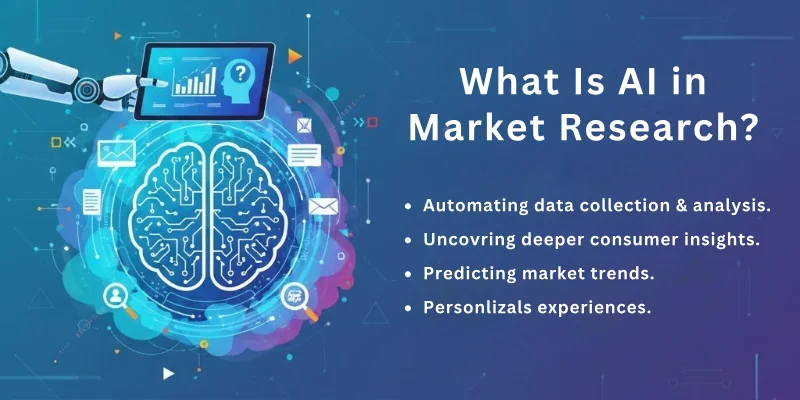
AI tools read text, understand emotion, classify feedback, detect patterns, and highlight gaps in the market.
It does the work of an entire research team in a fraction of the time. AI can:
- Detect early market shifts
- Show rising customer demands
- Predict future behavior based on past patterns
- Reveal hidden issues customers don’t say directly
- Highlight new opportunities for products
AI removes guesswork and gives businesses accurate, data-backed insights that help them move faster and smarter.
Why AI Matters in Competitor Analysis
Traditional competitor research usually depends on manual checking—visiting websites, reading reviews, comparing prices, browsing ads, or checking social media. This is slow and misses important details.
AI, however:
- Scans competitor websites every hour
- Tracks price changes instantly
- Compares product features continuously
- Collects customer complaints from their reviews
- Analyzes competitor ads from multiple platforms
- Measures their social media growth
- Detects new marketing campaigns
- Reports any major update in real time
This gives your business a full 360-degree view of the market. AI acts like a digital analyst who works 24/7. It watches every move your competitors make and sends alerts when something important happens. You always stay one step ahead because you know exactly what the competition is doing.
How AI Helps in Market Research and Competitor Analysis
AI gathers data from places humans cannot manually track quickly. It reads millions of lines of text, finds hidden patterns, compares competitor activities, and predicts future outcomes.
Here is how AI does that:
- NLP (Natural Language Processing): AI reads text from reviews, posts, comments, and websites to understand meaning and emotion.
- Machine Learning: AI learns from previous data and improves accuracy over time.
- Predictive Analytics: AI forecasts future trends and customer behavior.
- Automation: AI completes tasks like scraping websites, generating reports, and classifying data without human effort.
- Real-Time Tracking: AI keeps monitoring all competitor signals around the clock.
This makes AI a complete research assistant that works continuously and gives clear, accurate, and fast insights.
Major Benefits of AI in Market Research
Some major advantages of using artificial intelligence in market research are:
1. Ultra-Fast Data Collection
Instead of manually checking every platform, AI scans thousands of pages at once. It collects customer opinions, reviews, trends, keywords, complaints, and preferences. This gives you updated insights instantly. You never fall behind because AI keeps data fresh and relevant.
2. Highly Accurate Insights Without Bias
Human research often carries personal interpretation. AI removes that. It applies fixed logic to detect real issues such as:
- Rising customer needs
- Product weaknesses
- Harmful trends
- Major complaint categories
- Changing market demand
Its insights are clean, neutral, and data-backed. This helps companies avoid wrong decisions.
3. Predicts Future Market Trends
AI looks at buying history, search activity, seasonal trends, social interest, and customer conversations. It identifies patterns that repeat each year or during specific situations. Businesses use this to plan product launches, stocking levels, marketing campaigns, and pricing strategies before competitors take action.
4. Deep Customer Segmentation
AI identifies micro-segments such as:
- Customers who buy only on sale
- Customers who prefer premium products
- Customers who want fast delivery
- Customers influenced by social trends
- Customers who read reviews before buying
This helps businesses target the right audience with the right message. It reduces marketing waste and increases conversion rates.
5. Real-Time Competitor Tracking
AI detects:
- Price drops
- New product releases
- Changes in packaging
- Promotions and deals
- Sudden increase in ads
- New social content
- Customer complaints
- Website updates
- Brand mentions
This real-time competitor analysis helps companies act quickly. You can change strategy the same day something happens.
6. Strong Product Development Insights
AI analyzes customer reviews from:
- Amazon
- Social media
- Competitor websites
- Online forums
It highlights:
- Most requested features
- Common complaints
- Strengths of competitor products
- Weaknesses customers hate
- Missing features in the market
This helps companies design better products that meet real demand.
How AI Tools Work in Competitor Analysis
Here is the working of AI tools in competitor analysis:
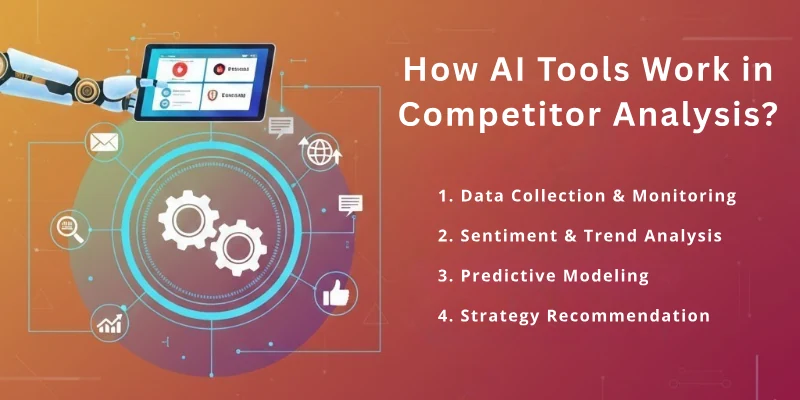
1. Web Scraping & Data Extraction
AI scrapes product details, pricing, descriptions, reviews, and ratings. It compares them across brands and creates structured reports. It highlights which features competitors offer that you don’t.
2. Sentiment Analysis
AI reads customer emotions. AI detects if customers feel happy, frustrated, disappointed, or excited. This emotional data helps businesses understand competitor weaknesses. It shows where customers are losing trust or interest.
3. Keyword and Search Trend Tracking
AI monitors keywords customers search for. It identifies:
- Trending keywords
- Rising topics
- Seasonal search spikes
- Keywords competitors rank for
- Long-tail keywords with high potential
This boosts SEO, content strategy, and product positioning.
4. Social Media Intelligence
AI analyzes all competitor activity on social platforms. AI tracks hashtags, engagement, viral posts, negative comments, and customer reactions. It identifies what type of content performs best and what messages fail. Businesses use this to refine their own social strategy.
5. Ad Monitoring
AI scans competitor ads across Google, Facebook, Instagram, TikTok, YouTube, and more. It identifies:
- Best-performing ad creatives
- Targeting strategy
- Ad frequency
- Messaging style
- Offers and discounts
This helps you create stronger, data-backed campaigns.
Real Business Use Cases of AI in Market Research
Major roles of AI in market research and competitor analysis are:
- Finding New Opportunities: AI reveals unmet customer needs and rising trends long before competitors notice.
- Optimizing Pricing: AI analyzes demand and competitor pricing to suggest perfect price points.
- Reducing New Product Risk: AI predicts product success based on data patterns.
- Improving Customer Personas: AI gives a deep understanding of customer motivations and behaviors.
Challenges of AI in Market Research
Here are some of the major challenges of AI in market research, the major three:
- AI Needs Clean Data: If the data is poor, AI insights become weak.
- Cannot Read Deep Human Emotion: AI understands emotion, but not personal context.
- Requires Technical Skill: Teams need training to use AI tools properly.
Future of AI in Market Research and Competitor Analysis
AI will become more predictive, more human-like, and more context-aware. It will automatically generate reports, monitor markets in real time, and forecast competitor actions before they happen. Businesses will rely fully on AI to guide strategy, pricing, product development, and branding decisions.
Conclusion
In this guide, we have covered how AI helps in market research and competitor analysis in detail. You learned how AI collects and analyzes data, predicts market trends, tracks competitors in real time, and provides actionable insights that help businesses make smarter decisions.
Personal Recommendation: Start by using AI for one area, like competitor tracking or customer trend analysis, and gradually expand to full-scale market research. This step-by-step approach ensures you get accurate insights without overwhelming your team. Focus on clean data and continuously update your AI tools to stay ahead of the competition.
Thank you for reading! To explore more and clear remaining doubts, see the FAQs below.
FAQs: AI in Market Research and Competitor Analysis
Here are some of the most commonly asked questions related to the how AI helps in market research and competitor analysis:
AI collects data from thousands of sources simultaneously and analyzes patterns without human bias. It spots trends, customer preferences, and potential gaps in the market. This ensures businesses base decisions on real insights, not assumptions.
Yes, AI tracks competitor pricing, new products, ad campaigns, and social media activity. It highlights shifts in strategy and predicts potential market moves. This helps businesses react faster and gain a competitive advantage.
AI automates repetitive tasks like data collection, analysis, and reporting. What used to take weeks now happens in minutes. Teams can focus on strategy instead of manual research.
Yes, AI detects emerging trends and customer demands by analyzing search patterns, social discussions, and competitor activity. Businesses use these insights to launch products or enter new markets successfully.
AI groups customers based on behavior, interests, demographics, and purchase history. It helps businesses target the right audience with personalized campaigns. This increases engagement and conversion rates.
Absolutely. AI monitors competitor ad campaigns across platforms like Google, Facebook, Instagram, and TikTok. It identifies which ads perform best, what offers attract customers, and which messaging works. This allows businesses to improve their own marketing strategies.
AI needs clean, updated data to provide accurate results. It cannot fully replace human judgment in creative decision-making or understanding complex customer emotions. Teams still need to interpret insights and make strategic choices.



- Be Respectful
- Stay Relevant
- Stay Positive
- True Feedback
- Encourage Discussion
- Avoid Spamming
- No Fake News
- Don't Copy-Paste
- No Personal Attacks
- Be Respectful
- Stay Relevant
- Stay Positive
- True Feedback
- Encourage Discussion
- Avoid Spamming
- No Fake News
- Don't Copy-Paste
- No Personal Attacks
