How to Start a Career in AI – Complete Guide
Published: 18 Apr 2026
Artificial Intelligence is one of the fastest-growing and most exciting fields today. From self-driving cars to smart assistants, AI is transforming industries worldwide. Many students, professionals, and tech enthusiasts want to enter AI but feel overwhelmed.
In this guide, you will learn how to start a career in AI step by step. We will cover the skills to learn, tools to master, projects to build, and how to plan your career for long-term growth. By the end, you will feel confident taking your first steps in AI.
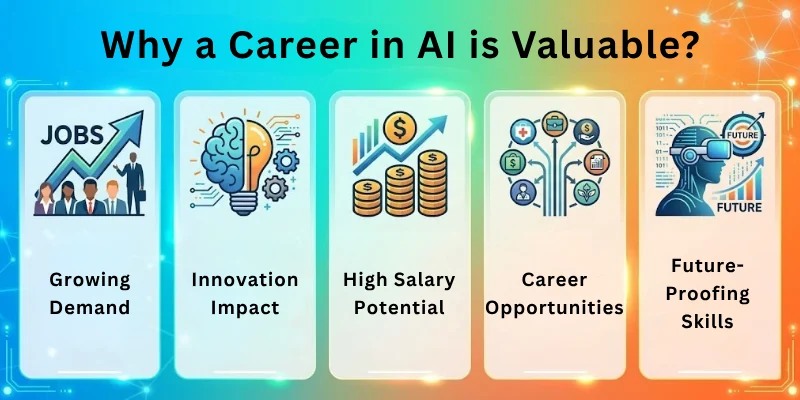
Why a Career in AI is Valuable
AI is not just a trend; it is shaping the future.
- AI professionals are in high demand across tech, finance, healthcare, and marketing.
- Salaries in AI roles are higher than many other tech roles.
- Working in AI allows you to solve real-world problems with innovative solutions.
- Continuous AI advancements ensure long-term career opportunities.
A career in AI is rewarding, creative, and full of potential.
Essential Skills Needed to Start a Career in AI
Before you start, you need to build certain skills:
- Mathematics and Statistics → Linear algebra, calculus, probability, and statistics are essential.
- Programming → Python is the most common language; R is also useful.
- Data Handling → Understanding datasets, cleaning data, and basic visualization.
- Machine Learning Basics → Algorithms, supervised/unsupervised learning, and evaluation metrics.
- Problem-Solving → Ability to approach challenges logically and analytically.
- Communication → Explain your findings and models clearly.
These skills form the foundation for learning and working in AI.
Steps to Start a Career in AI
Here is a roadmap for beginners:
- Learn the basics of mathematics and statistics
- Learn programming languages (Python or R)
- Understand data handling and data science fundamentals
- Study AI concepts and machine learning algorithms
- Work on small AI projects to gain practical experience
- Learn AI frameworks and tools
- Take online courses, certifications, or attend workshops
- Build a strong portfolio of projects
- Apply for internships or entry-level AI roles
- Keep learning and follow AI trends regularly
Let’s go through each step in detail.
Step 1: Learn the Basics of Mathematics and Statistics
Math is the backbone of AI.
- Focus on linear algebra, including vectors and matrices.
- Learn calculus, especially derivatives and integrals.
- Study probability and statistics, including distributions, mean, median, variance, and correlation.
- Understanding these topics helps you grasp how AI algorithms work internally.
Without math, it is difficult to implement or understand advanced AI techniques.
Step 2: Learn Programming Languages
Programming lets you bring AI ideas to life.
- Python → Simple and has libraries like NumPy, Pandas, Scikit-learn, TensorFlow, and PyTorch.
- R → Useful for statistical computing and data analysis.
- Practice coding regularly on platforms like LeetCode or HackerRank.
- Focus on data manipulation, loops, functions, and object-oriented programming.
Programming skills are essential for building AI models and running experiments.
Step 3: Understand Data Handling and Data Science Fundamentals
Data is at the heart of AI.
- Learn how to clean, preprocess, and visualize datasets using Python libraries.
- Understand descriptive statistics and exploratory data analysis.
- Study how to handle missing data, duplicates, and outliers.
- Knowing data science helps you prepare inputs for AI models effectively.
Strong data handling skills make you confident in building AI solutions.
Step 4: Study AI Concepts and Machine Learning Algorithms
Before diving into coding, understand AI basics.
- Learn the types of AI: narrow AI, general AI, and superintelligence.
- Study machine learning concepts like supervised, unsupervised, and reinforcement learning.
- Understand algorithms: linear regression, logistic regression, decision trees, clustering, and neural networks.
- Learn evaluation metrics like accuracy, precision, recall, and F1-score.
This foundational knowledge is crucial before implementing AI in projects.
Step 5: Work on Small AI Projects
Practical experience is key.
- Start with beginner-friendly projects like predicting housing prices or image classification.
- Apply machine learning models on datasets from Kaggle or UCI Machine Learning Repository.
- Document your work, showing the problem, solution, model used, and results.
- Real projects improve problem-solving skills and make your resume stronger.
Hands-on experience helps you understand how theory applies in real scenarios.
Step 6: Learn AI Frameworks and Tools
Frameworks make AI implementation easier and faster.
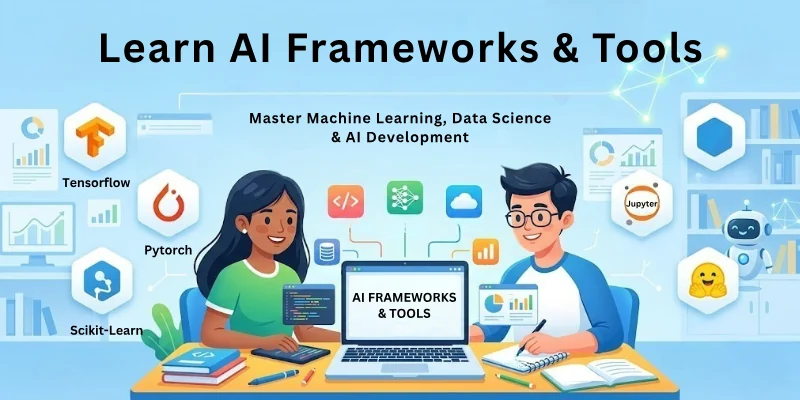
- TensorFlow → Popular deep learning library for neural networks.
- PyTorch → Flexible and widely used for research projects.
- Keras → High-level API for building deep learning models.
- Scikit-learn → For machine learning algorithms and data preprocessing.
- Pandas & NumPy → For data manipulation and mathematical computations.
Familiarity with these tools lets you work professionally on AI projects.
Step 7: Take Online Courses, Certifications, or Attend Workshops
Structured learning builds credibility.
- Platforms like Coursera, Udemy, edX, and MIT OpenCourseWare offer AI courses.
- Get certifications in machine learning, data science, or AI applications.
- Attend workshops, webinars, or AI competitions to gain practical insights.
Certifications and guided learning demonstrate your dedication to AI.
Step 8: Build a Strong Portfolio of AI Projects
A portfolio showcases your skills to employers.
- Include projects on data analysis, machine learning, and AI applications.
- Share code on GitHub or personal websites.
- Provide explanations of your approach, algorithms used, and outcomes.
A portfolio is critical for landing internships and entry-level AI roles.
Step 9: Apply for Internships or Entry-Level AI Roles
Real-world experience accelerates growth.
- Look for internships or junior roles in AI, data science, or machine learning.
- Join startups, research labs, or tech companies to gain practical experience.
- Use LinkedIn, job boards, and networking to find opportunities.
Early professional experience is the fastest way to build expertise.
Step 10: Keep Learning and Follow AI Trends Regularly
AI evolves constantly.
- Read AI blogs, research papers, and industry news.
- Learn new algorithms, tools, and frameworks regularly.
- Join AI communities and forums to exchange knowledge and stay updated.
Continuous learning ensures long-term growth and career success.
Top 10 Tools to Learn AI
Here are essential tools for beginners:
- Python → Programming and AI implementation
- R → Statistical analysis and data handling
- TensorFlow → Deep learning framework
- PyTorch → Flexible neural network library
- Keras → Simplified deep learning models
- Scikit-learn → Machine learning algorithms
- Pandas → Data cleaning and analysis
- NumPy → Arrays and mathematical operations
- Matplotlib & Seaborn → Data visualization
- Jupyter Notebook → Interactive coding environment
Common Mistakes to Avoid
Here are some of the most common mistakes to avoid from:
- Ignoring mathematics and statistics fundamentals
- Skipping programming practice
- Focusing only on theory without hands-on projects
- Not building a portfolio of projects
- Overlooking internships and real-world experience
Avoiding these mistakes sets a strong foundation for an AI career.
Final Note
In this guide, we have covered how to start a career in AI in great detail. You now know the skills, tools, projects, and steps required to begin your journey.
Remember, success in AI comes from continuous learning, practice, and persistence. Start small, focus on building practical skills, and stay updated with the latest trends. Your AI career can be exciting, rewarding, and full of opportunities. Good luck, and enjoy learning!
FAQs: How to Start Career in AI
Here are some of the most commonly asked questions related to how to start career in artificial intelligence:
To start a career in AI, you need strong skills in mathematics, statistics, and programming. Learning Python, R, and data handling is essential. Understanding AI fundamentals and machine learning basics completes the skill set.
Begin by learning AI concepts through online courses and tutorials. Start small projects to gain practical experience. Building a portfolio and getting internships will help you enter the field.
Python is the most popular language for AI due to its libraries like TensorFlow and PyTorch. R is useful for statistics and data analysis. Learning these languages helps you implement AI models effectively.
A degree in computer science, mathematics, or engineering is helpful but not mandatory. Online courses, certifications, and projects can demonstrate your skills. Employers value practical knowledge and portfolio more than formal degrees.
Data is the backbone of AI, and knowing how to clean, process, and visualize it is critical. AI models depend on quality data to perform accurately. Mastering data skills makes your AI projects effective and reliable.
Platforms like Coursera, Udemy, edX, and MIT OpenCourseWare offer beginner to advanced AI courses. Many provide certifications that boost your resume. These platforms also offer hands-on projects to practice skills.
Work on small AI projects using datasets from Kaggle or UCI Machine Learning Repository. Implement machine learning algorithms and document your results. Sharing your projects on GitHub builds credibility and a professional portfolio.
Yes, internships give real-world experience and expose you to professional AI projects. They help you understand practical challenges and solutions. Internships also improve your chances of landing a full-time AI role.
Follow AI blogs, research papers, and industry news regularly. Join online communities, forums, and AI groups on LinkedIn or Discord. Continuous learning ensures your knowledge remains current and competitive.
Yes, you can learn AI part-time through online courses and projects. Start with small projects and gradually build your portfolio. With consistent effort, you can transition to a full-time AI career.



- Be Respectful
- Stay Relevant
- Stay Positive
- True Feedback
- Encourage Discussion
- Avoid Spamming
- No Fake News
- Don't Copy-Paste
- No Personal Attacks
- Be Respectful
- Stay Relevant
- Stay Positive
- True Feedback
- Encourage Discussion
- Avoid Spamming
- No Fake News
- Don't Copy-Paste
- No Personal Attacks
