What Are the Pros and Cons of AI? Detailed Guide
Published: 25 Dec 2025
Artificial Intelligence means teaching machines to think, learn, and make decisions like humans. It helps computers and robots solve problems, understand language, and do tasks on their own. We see it in phones, hospitals, cars, schools, and even in games.
In this guide, we will talk about the advantages and disadvantages of artificial intelligence in the easiest way. You will learn both the good and bad sides of AI with examples you can relate to in daily life.
Advantages of Artificial Intelligence
AI has a lot of benefits in our world today. It makes life easy, saves time, and improves the quality of work. From helping students learn faster to helping doctors save lives, AI does many amazing things.
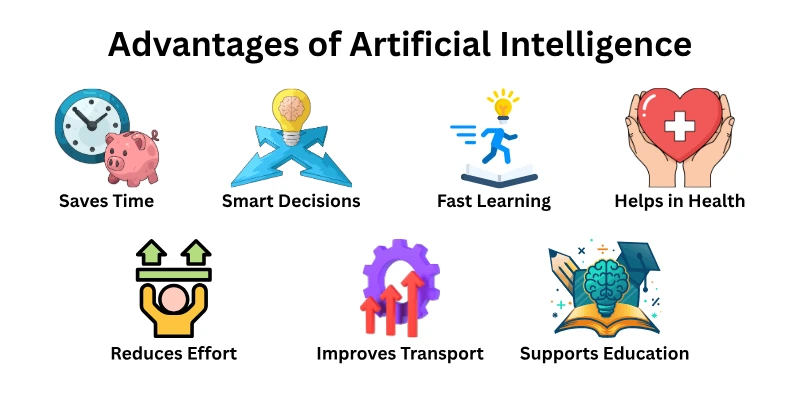
Here is the list of all the advantages of AI in short:
- Saves Time
- Works All Day
- Fewer Mistakes
- Smart Decisions
- Fast Learning
- Helps in Health
- Better Safety
- Reduces Effort
- Supports Education
- Improves Transport
Let us now cover all the advantages of AI in great detail.
1. Saves Time
AI can finish tasks much faster than humans. For example, computers can check thousands of documents in seconds, while a person might take hours. This helps companies and people save a lot of time.
Imagine a doctor using AI to find a disease in seconds instead of spending long hours studying reports. It makes work faster and easier. AI also saves time in homes by automating cleaning or cooking reminders. This is one of the main AI advantages that people love the most.
2. Works All Day
Unlike humans, AI does not need sleep or rest. It can work all day and night without getting tired. This is why many companies use AI chatbots to answer customer questions even at midnight.
It also keeps machines running smoothly in factories when humans are off duty. For example, online stores work 24 hours with AI support systems. This helps businesses stay active every hour and serve people anytime they want.
3. Fewer Mistakes
AI follows exact instructions and rules. It does not forget things or make careless errors. This helps in areas where accuracy is very important, like hospitals or banks.
For example, AI can read patient scans and find small details that a human might miss. It can also handle large amounts of data without mixing anything up. Because of this, many people trust AI for perfect and quick results.
4. Smart Decisions
AI can study a large amount of information and help people make better choices. For example, it can help a farmer decide when to water crops by checking weather and soil data. It can also help drivers find shorter and safer routes.
AI tools in business suggest what to sell and what to avoid. This saves time and helps avoid costly mistakes. By using AI, humans can make smarter and faster decisions in daily life.
5. Fast Learning
AI learns from the data it gets every day. The more it works, the more it improves. Voice assistants like Alexa or Google Assistant learn how people talk and understand them better with time. In schools, AI learning tools help students understand lessons at their own speed. It keeps getting smarter with every use. This fast learning makes AI very useful in almost every field.
6. Helps in Health
AI plays a big role in healthcare today. Doctors use it to detect diseases early and suggest better treatments.
For example, AI can look at X-rays and tell where the problem is within seconds. It can also remind patients to take their medicines on time. AI robots help during surgeries by keeping their movements steady and safe. These uses show how AI can truly save lives and improve human health.
7. Better Safety
AI can do dangerous jobs that humans should avoid. For example, robots can enter fire zones or handle harmful chemicals.
This keeps people safe from getting hurt. In cars, AI sensors help drivers avoid accidents. It also helps police and security teams find suspicious activities faster. When used properly, AI keeps both people and places safer than before.
8. Reduces Effort
AI makes hard work simple. Robots clean homes, answer questions, and help with daily chores. This saves human energy and time. People can focus on creative work instead of doing the same boring tasks.
For example, typing assistants fix spelling mistakes automatically. AI helps humans do more in less time, and that makes life easier for everyone.
9. Supports Education
AI helps students learn better by offering personal lessons. Learning apps can understand what a child finds hard and adjust lessons for them.
Teachers can track student progress easily using AI tools. It can also translate lessons into other languages for students around the world. This makes learning fun and open for everyone. Education has become more interesting and helpful with AI tools.
10. Improves Transport
AI helps make travel smoother and safer. Navigation apps tell drivers which routes have less traffic. Self-driving cars use AI to stop safely and move smartly.
Airlines use AI to plan flight paths and save fuel. Public transport also gets better with smart ticketing and tracking systems. It saves time, money, and helps the environment too.
Disadvantages of Artificial Intelligence
While AI is full of benefits, it also has many problems. Sometimes it replaces human jobs or makes people too dependent on machines. It also brings privacy and security concerns. These are the limitations of artificial intelligence we need to be careful about.
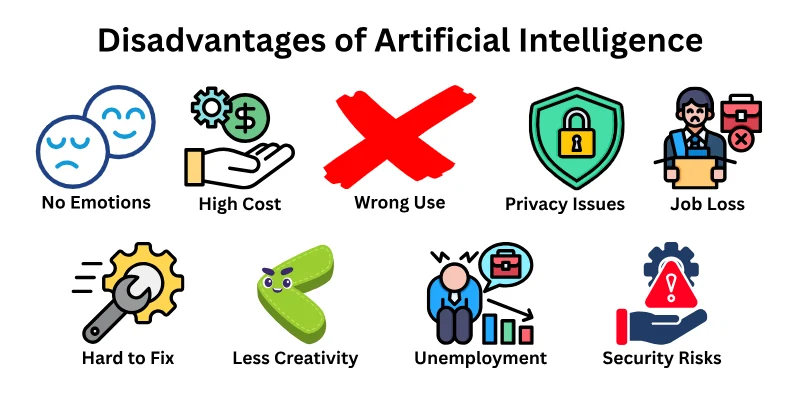
Here is the list of all the disadvantages of AI in daily life:
- Job Loss
- High Cost
- No Emotions
- Privacy Issues
- Wrong Use
- Overdependence
- Hard to Fix
- Less Creativity
- Unemployment
- Security Risks
Let us now cover all the disadvantages of AI in detail.
1. Job Loss
AI is taking over many human jobs. Machines in factories now build cars and pack items faster than humans. This means many workers lose their jobs and income.
For example, self-checkout systems in stores reduce the need for cashiers. While this saves money for companies, it hurts people who depend on those jobs. It is one of the biggest cons for AI that we see today.
2. High Cost
Building and maintaining AI systems is very expensive. It needs strong computers, skilled workers, and regular updates. Not every company can afford it.
For example, hospitals use AI machines that cost millions. If something breaks, it costs a lot to fix it. This high cost limits its use for smaller businesses.
3. No Emotions
AI has no feelings. It cannot understand human emotions or show care. For example, a chatbot may answer your question, but it cannot feel your pain or joy.
In jobs where emotion is important, like counseling or teaching, AI can never replace humans. This lack of feeling is one major limitation of artificial intelligence.
4. Privacy Issues
AI collects a lot of personal data to work better. This can become risky if the data is stolen or misused. For example, face recognition systems store your pictures and details.
If someone hacks it, your privacy is gone. People must be careful about what information they share. Privacy is one of the biggest AI risks and benefits balance problems today.
5. Wrong Use
AI can be used in the wrong way by bad people. Hackers use AI to make fake videos or spread false news. This can harm others or damage reputations.
For example, fake voice clips can be made to trick people into believing lies. This wrong use shows the good and bad of AI together in our society.
6. Overdependence
People are starting to depend too much on AI. They ask machines to do even small tasks, like setting reminders or doing math. This can make our brains lazy.
For example, if you always use a calculator, you forget simple math. Depending too much on AI may make people less skilled over time.
7. Hard to Fix
When AI systems fail, they are hard to repair. You need experts to find the problem, and it can take days or weeks.
For example, if an AI-powered factory stops, the whole production line can be delayed. It is not as easy to fix as a normal machine. This makes people more worried about using AI for critical work.
8. Less Creativity
AI can only follow data and rules. It cannot think like an artist or come up with new ideas. For example, it can draw a picture but cannot feel emotions behind it. Humans use imagination, but AI just copies patterns. That is why creative jobs still need humans.
9. Unemployment
When machines do human work, people lose their jobs. Drivers, factory workers, and office clerks are already being replaced by smart systems.
This increases unemployment rates in many countries. It also makes poor families struggle more. It is one of the serious negative sides of AI in daily life.
10. Security Risks
AI systems can be hacked easily if not protected. Hackers can break into them and control machines.
For example, if someone hacks a self-driving car, it can cause danger. AI is powerful, but when used by the wrong hands, it becomes a big risk. This shows that along with benefits, AI brings many dangers too.
The Future of AI
The future of AI looks both exciting and challenging. It will keep growing and improving in schools, hospitals, and transport.
But people must also set strong rules to use it safely. Governments should train workers for new jobs that come with AI. The goal should be to use AI for good and protect humans from its risks. If used wisely, it can make the world a better and smarter place.
Final Note
In this guide, we have covered the advantages and disadvantages of artificial intelligence in simple words. AI is powerful, but like every tool, it depends on how humans use it. It can bring both joy and danger if not handled carefully. In my opinion, AI should help humans, not replace them. If we keep a balance, AI can be our best friend.
Goodbye and stay curious about the future of technology!
FAQs
Here are the major asked questions about AI:
AI helps in saving time, making smart decisions, and improving safety. But it can also cause job loss and privacy issues. So it has both good and bad sides.
AI helps in phones, cars, schools, hospitals, and even cleaning robots. It makes life easy and fast. We use AI many times without even knowing it.
It can be safe if used wisely. But if people misuse it, it can cause harm. That’s why rules and human control are important.
The benefits include speed and accuracy, while the risks include job loss and wrong use. People should balance both sides to use it safely.
No, AI cannot fully replace humans. It can do tasks but cannot think, feel, or create like us. Humans are still needed to guide AI.
AI cannot think on its own. It works only on the data we give it. Without human input, it cannot act or make moral decisions.
Some fear AI because it might take jobs or be used wrongly. Others worry about robots controlling humans. These fears are real but can be managed.
People depend too much on it, lose jobs, and face privacy risks. It can also make people lazy and reduce human contact.
AI helps students learn better and faster. It gives personal lessons, checks homework, and supports teachers in managing classes.
The good is that AI saves time, improves work, and helps people. The bad is that it can take jobs, spread fake news, and cause privacy problems.


- Be Respectful
- Stay Relevant
- Stay Positive
- True Feedback
- Encourage Discussion
- Avoid Spamming
- No Fake News
- Don't Copy-Paste
- No Personal Attacks
- Be Respectful
- Stay Relevant
- Stay Positive
- True Feedback
- Encourage Discussion
- Avoid Spamming
- No Fake News
- Don't Copy-Paste
- No Personal Attacks
