Types of AI Agents: Explained Simply
Published: 5 Apr 2026
You might have heard the term AI agents in technology discussions. But what are they exactly? AI agents are software programs or systems that can perceive their environment, make decisions, and take actions to achieve specific goals.
In this guide, we will explain all major types of AI agents, their working, examples, applications, advantages, and challenges in simple language, so even beginners can understand.
Types of AI Agents
Here is a list of all the major types of AI agents used in modern AI systems:
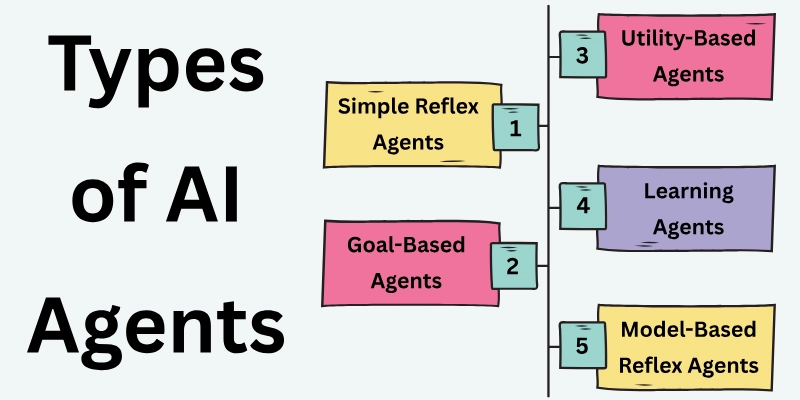
- Simple Reflex Agents
- Model-Based Reflex Agents
- Goal-Based Agents
- Utility-Based Agents
- Learning Agents
Let us cover all of them in detail.
1. Simple Reflex Agents
Simple Reflex Agents are the most basic type of AI agent. They react to the current situation or input without considering the past or future. These agents follow simple rules like “if this condition, then do that action.” They are fast and easy to build but limited in complex situations.
Major Points:
- React only to current input
- Use simple condition-action rules
- Cannot remember past states
- Cannot plan for the future
- Very fast and simple to design
Example: A thermostat that switches on the heater when the temperature drops is a simple reflex agent.
2. Model-Based Reflex Agents
Model-Based Reflex Agents are more advanced than simple reflex agents. They maintain an internal state or model of the environment. This helps them make decisions even when they cannot see the full environment.
Major Points:
- Keep track of internal state
- Combine current input with stored knowledge
- Can handle partially observable environments
- Follow rules with memory of past events
- More flexible than simple reflex agents
Example: A vacuum robot that remembers which areas it has cleaned uses a model-based reflex agent approach.
3. Goal-Based Agents
Goal-Based Agents focus on achieving specific goals instead of just reacting. They evaluate possible actions based on how well they help achieve a target. These agents are intelligent because they can plan multiple steps ahead.
Major Points:
- Make decisions to achieve defined goals
- Evaluate different actions before choosing
- Can plan sequences of actions
- Better for complex problem-solving
- Common in robotics and AI planning systems
Example: A delivery drone planning the fastest route to deliver packages is a goal-based agent.
4. Utility-Based Agents
Utility-Based Agents measure how useful or valuable each action is using a utility function. They not only aim for goals but also try to maximize overall performance or satisfaction. They are highly flexible and can make decisions in dynamic environments.
Major Points:
- Use utility functions to evaluate choices
- Consider both goals and overall performance
- Make decisions to maximize benefits
- Work well in uncertain environments
- Common in recommendation systems and self-driving cars
Example: An online shopping recommendation engine suggesting products based on user preferences uses a utility-based agent.
5. Learning Agents
Learning Agents improve their performance over time by learning from experience. They have a learning element, a performance element, and a feedback mechanism. These agents adapt to new situations and become more effective with time.
Major Points:
- Learn from past experiences
- Continuously improve performance
- Adapt to new environments
- Use feedback to refine actions
- Widely used in machine learning applications
Example: A virtual assistant that learns user preferences and improves responses over time is a learning agent.
Applications of AI Agents
AI agents are used in many real-world systems to automate decisions and perform complex tasks. They make systems smarter, faster, and more efficient.
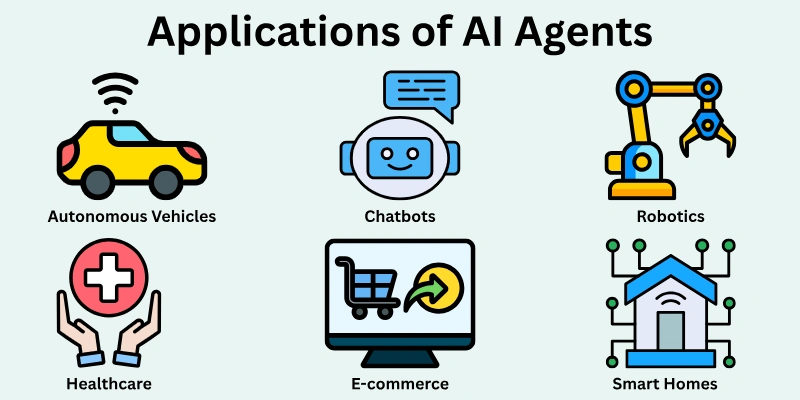
Key Applications:
- Chatbots and Virtual Assistants: Respond to user queries intelligently
- Autonomous Vehicles: Self-driving cars detect objects and make driving decisions
- Robotics: Robots perform tasks in factories, homes, and hospitals
- E-commerce: Product recommendation engines improve shopping experience
- Healthcare: AI agents help diagnose diseases from medical images
- Smart Homes: Manage lighting, temperature, and security automatically
Benefits of AI Agents
AI agents make technology more intelligent and efficient. They reduce human effort and improve accuracy.
Key Benefits:
- Automate repetitive or complex tasks
- Make fast and accurate decisions
- Adapt to changing environments
- Reduce human errors
- Help in learning and improving over time
Challenges of AI Agents
AI agents are powerful but have challenges that need attention.
Key Challenges:
- Designing complex agents can be difficult
- Depend on accurate and up-to-date data
- Can fail in unpredictable situations
- Risk of biased or unfair decisions if not monitored
- Require continuous maintenance and monitoring
Future of AI Agents
AI agents are evolving rapidly. The future involves more intelligent, autonomous, and adaptable agents.
Future Trends:
- Smarter learning agents that can self-improve
- More integration with robotics and automation
- Better decision-making in uncertain environments
- Ethical and responsible AI agent development
- AI agents that work collaboratively with humans
Final Note
In this guide, we have covered types of AI agents explained in detail, including simple reflex, model-based reflex, goal-based, utility-based, and learning agents. You now understand how these agents work, their applications, advantages, challenges, and future trends.
AI agents are the backbone of intelligent systems, helping machines learn, make decisions, and solve real-world problems. Start observing them around you, explore how they work, and stay curious.
Remember, understanding types of AI agents is the first step toward mastering intelligent systems. Goodbye and enjoy your journey into the fascinating world of AI!
FAQs: AI Agent Types
Here are some of the most commonly asked questions related to different types of artificial intelligence agents:
AI agents are systems that observe their surroundings and take actions to reach a goal. They can make decisions without human help. This idea is important when learning the types of AI agents because each type behaves differently.
There are five major types of AI agents used in smart systems. These include simple reflex, model based reflex, goal based, utility based, and learning agents. Each type plays a different role in AI agents explained for beginners.
The simplest type is the simple reflex agent. It reacts only to the current situation and follows fixed rules. This basic design helps beginners understand the foundation of agent types in AI.
Goal based agents are able to plan steps toward a target. They study different choices and pick the one that helps them reach the goal faster. These agents show how advanced types of AI agents can think beyond simple reactions.
Learning agents improve their performance through experience. They use feedback from the environment to adjust their decisions. This concept is important when exploring intelligent agents that grow smarter over time.
Utility based agents are used in systems where choices must give the highest satisfaction or best result. They measure the value of each option and select the one with the most benefit. This helps readers understand how types of AI agents explained apply to real life.
Different tasks require different decision styles. Some tasks need fast reactions while others need long planning or learning abilities. This is why many types of AI agents exist in modern technology.
Utility based agents and learning agents work best in uncertain or changing environments. They adjust decisions using past experiences or value based thinking. These agent types in AI help systems stay stable even when conditions shift.
A cleaning robot that remembers which areas were cleaned before is a good example. It stores past information and uses it to guide current actions. This shows how different types of AI agents can use memory to work smarter.
Goal based and utility based agents come closest because they compare choices and pick the best action. They think beyond simple rules and consider overall outcomes. These intelligent agents help explain how advanced decision systems work today.




- Be Respectful
- Stay Relevant
- Stay Positive
- True Feedback
- Encourage Discussion
- Avoid Spamming
- No Fake News
- Don't Copy-Paste
- No Personal Attacks
- Be Respectful
- Stay Relevant
- Stay Positive
- True Feedback
- Encourage Discussion
- Avoid Spamming
- No Fake News
- Don't Copy-Paste
- No Personal Attacks
