What is Data Annotation in AI: How it Works & Explained
Published: 4 Apr 2026
You may have heard that AI models need data to learn, but not just any data, they need labeled or annotated data. In this guide, we will explain what data annotation is, why it is essential, types of annotation, how it is done, the tools used, applications, advantages, challenges, best practices, and future trends.
By the end, you will understand why data annotation is the backbone of AI learning.
What is Data Annotation in AI?
This section explains the basic meaning of data annotation.
Data Annotation in AI is the process of adding labels, tags, or metadata to raw data so that AI models can understand it. This helps models learn patterns, recognize objects, or process text and speech accurately.
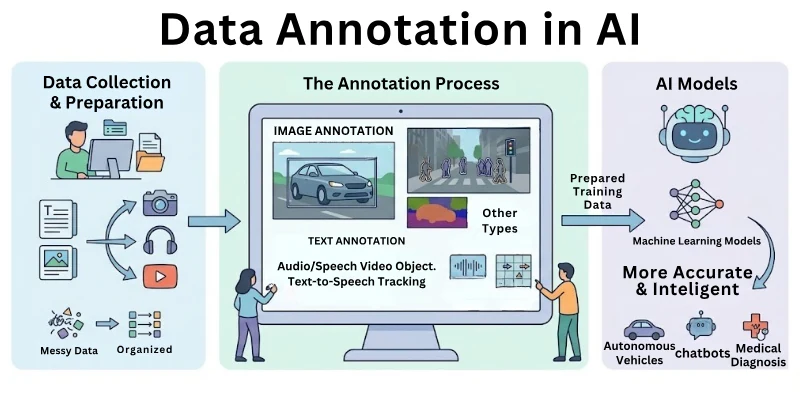
Key Points
- Data annotation gives meaning to raw data.
- Helps AI models recognize patterns and make decisions.
- Required for supervised learning and certain types of machine learning.
- Can be applied to text, images, audio, and video data.
- High-quality annotation improves AI accuracy significantly.
Why Data Annotation is Important
This section explains why data annotation matters.
AI models cannot learn from raw data alone, they need context. Annotated data provides that context, making AI smarter and more reliable.
Importance
- Enables AI to learn specific tasks accurately.
- Reduces errors and improves prediction quality.
- Helps in object recognition, sentiment analysis, speech recognition, and more.
- Essential for training supervised AI models.
- Ensures models can generalize to new data effectively.
Types of Data Annotation
This section explains different ways data can be annotated.
1. Image Annotation
- Adding bounding boxes, labels, or masks to images.
- Example: Labeling cats and dogs in photos for an image recognition AI.
2. Text Annotation
- Tagging words, sentences, or paragraphs for tasks like sentiment analysis or named entity recognition.
- Example: Marking “New York” as a location in a text.
3. Audio Annotation
- Adding transcriptions or labels to audio clips.
- Example: Labeling spoken commands for voice assistants.
4. Video Annotation
- Labeling objects, actions, or scenes in video frames.
- Example: Tagging vehicles in traffic videos for self-driving car AI.
5. Semantic Annotation
- Providing meaning or context to data beyond simple labels.
- Example: Linking words to their meanings or relationships in a text.
6. 3D Point Cloud Annotation
- Annotating 3D objects from LiDAR or depth sensors for robotics or autonomous driving.
How Data Annotation is Done
This section explains the steps involved in annotating data.
Annotation Steps
- Data Collection: Gather raw data from sensors, databases, or the internet.
- Data Cleaning: Remove duplicates, errors, and irrelevant information.
- Labeling: Assign appropriate labels or tags to data points.
- Quality Check: Ensure annotations are accurate and consistent.
- Formatting: Convert annotated data into a format AI models can use.
- Integration: Feed the labeled data into AI training pipelines.
Example: For a self-driving car AI, images of roads are labeled with cars, pedestrians, traffic signs, and lanes, helping the model detect these objects accurately.
Tools Used for Data Annotation
This section explains popular tools and platforms for annotation.
Annotation Tools
- LabelImg: Free tool for image annotation using bounding boxes.
- VGG Image Annotator (VIA): Annotates images and videos online.
- Prodigy: Commercial tool for text and NLP annotations.
- Amazon SageMaker Ground Truth: Cloud platform for large-scale annotation.
- SuperAnnotate: For image and video annotation with collaboration features.
- RectLabel: Mac-based tool for labeling images for AI projects.
Applications of Data Annotation
This section explains where annotated data is used in real-world AI systems.
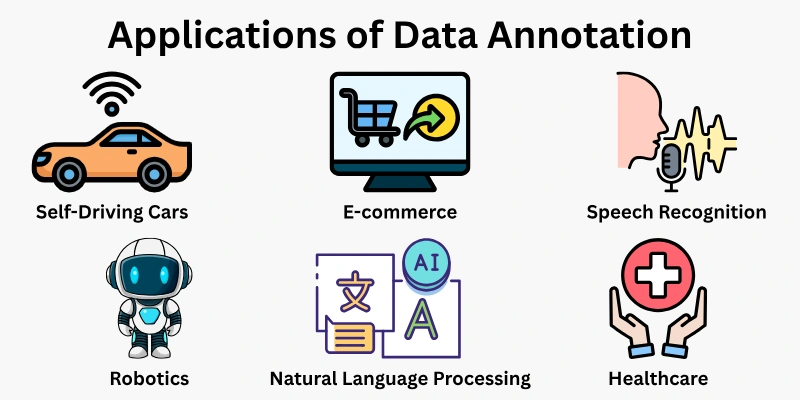
Key Applications
- Self-Driving Cars: Annotated images and videos for object detection.
- Healthcare: Labeling medical images for disease detection.
- Speech Recognition: Transcribing and labeling audio for virtual assistants.
- Natural Language Processing: Annotated text for chatbots, translation, and sentiment analysis.
- E-commerce: Product image labeling for recommendation systems.
- Robotics: Teaching robots to recognize objects and interact with environments.
Advantages of Data Annotation
This section explains why annotated data is valuable.
Key Advantages
- Improves accuracy and reliability of AI models.
- Enables AI to perform specific tasks effectively.
- Reduces errors and false predictions.
- Supports supervised learning and model training.
- Makes AI systems adaptive and scalable with better data quality.
Challenges of Data Annotation
This section explains common challenges in annotation projects.
Main Challenges
- Can be time-consuming and labor-intensive.
- Requires high accuracy and consistency.
- Large datasets need significant resources and storage.
- Human annotators may introduce errors or bias.
- Annotating complex data like video or 3D requires specialized tools.
Best Practices for Data Annotation
This section explains how to annotate data effectively.
Best Practices
- Use clear guidelines for annotators.
- Perform quality checks and validation regularly.
- Include diverse and representative samples in datasets.
- Use a mix of manual and automated annotation for efficiency.
- Continuously update annotations as new data or errors are found.
Future of Data Annotation
This section explains trends and innovations in annotation.
Future Trends
- Increased use of AI-assisted annotation tools to speed up labeling.
- Growth in automated quality control and verification.
- More focus on ethical and unbiased labeling.
- Better support for complex data like 3D and video streams.
- Integration with active learning pipelines to reduce human effort.
Final Note
In this guide, we have covered what data annotation in AI is in great detail. You now understand its meaning, importance, types, methods, tools, applications, advantages, challenges, best practices, and future trends. Data annotation is the foundation of every AI model, and accurate labeling ensures AI systems are reliable, fair, and effective.
Even beginners can now see why quality annotation matters for successful AI projects. Stay curious, practice, and explore how annotated data shapes the intelligent systems we use every day.
Goodbye and keep learning the exciting world of AI data!
FAQs: Data Annotation in Artificial Intelligence
Here are some of the most commonly asked questions related to the what is data annotation in AI:
Data annotation in AI is the process of adding labels, tags, or metadata to raw data so that AI models can learn from it. It helps the AI recognize patterns in text, images, audio, and video.
It is important because AI cannot understand raw data on its own. Annotated data provides context, improving model accuracy and making predictions more reliable.
The main types include image, text, audio, video, semantic, and 3D point cloud annotation. Each type serves different AI tasks and learning methods.
Data annotation is done by collecting raw data, cleaning it, labeling it accurately, performing quality checks, and formatting it for AI models. This ensures the AI learns correctly from the dataset.
Popular tools include LabelImg, VGG Image Annotator, Prodigy, Amazon SageMaker Ground Truth, SuperAnnotate, and RectLabel. These tools make annotation faster, more accurate, and scalable.
Annotated images help AI identify objects, faces, or scenes. For example, labeling cars, pedestrians, and traffic signs helps self-driving cars recognize objects on the road.
Annotated text allows AI to understand sentiment, entities, and language structure. For example, tagging names, locations, or emotions in a sentence helps chatbots and translation systems work correctly.
Challenges include high labor requirements, maintaining accuracy, handling large datasets, and avoiding human bias. Complex data like video or 3D requires even more resources.
Data annotation improves AI accuracy, reliability, task-specific performance, and generalization. It also supports supervised learning and reduces errors in AI predictions.
The future includes AI-assisted annotation, automated quality checks, ethical labeling, support for complex data, and integration with active learning pipelines. These trends will make annotation faster and more efficient.


- Be Respectful
- Stay Relevant
- Stay Positive
- True Feedback
- Encourage Discussion
- Avoid Spamming
- No Fake News
- Don't Copy-Paste
- No Personal Attacks
- Be Respectful
- Stay Relevant
- Stay Positive
- True Feedback
- Encourage Discussion
- Avoid Spamming
- No Fake News
- Don't Copy-Paste
- No Personal Attacks
