What is Deep Neural Network: How it Works & Explained
Published: 27 Mar 2026
You may have heard the term “Deep Neural Network” and wondered how it is different from a normal neural network.
In this guide, we will explain what a Deep Neural Network is, how it works, its types, applications, advantages, limitations, and future. By the end, you will clearly understand this advanced concept in simple words.
What is Deep Neural Network?
In this section, we will explain the basic meaning of Deep Neural Network and why it is called “deep”.
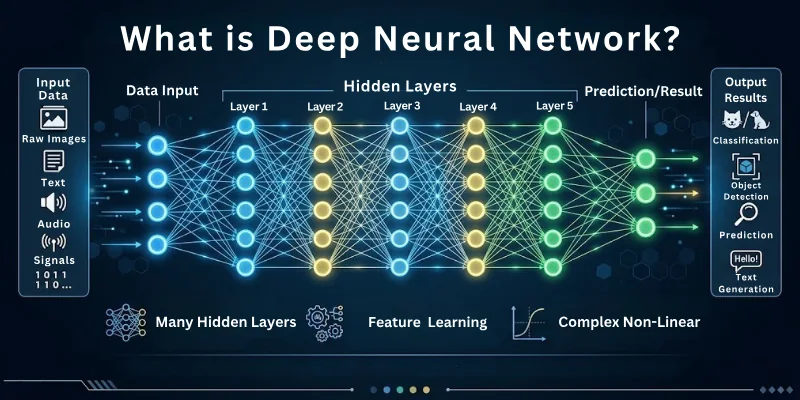
A Deep Neural Network (DNN) is a type of Artificial Neural Network with multiple hidden layers between the input and output layers. These extra layers allow it to analyze complex data and learn intricate patterns that a normal neural network cannot.
Key Points
- A type of Artificial Neural Network with many hidden layers.
- Learns complex patterns from large datasets.
- Can perform advanced tasks like image recognition and natural language processing.
- More accurate for complex predictions than shallow networks.
- Widely used in modern technology for advanced tasks.
How Deep Neural Networks Work
This section explains how DNNs process data, why the hidden layers are important, and how learning happens.
Deep Neural Networks work by passing data through multiple layers of neurons. Each layer extracts features and processes the information to produce a final output.
Main Steps
- Input Layer: Receives raw data such as images, text, or numbers.
- Hidden Layers: Many layers that process and transform data.
- Output Layer: Produces predictions, classifications, or decisions.
- Learning Process: Adjusts weights and biases to reduce errors in output.
- Iteration: Repeats the process many times to improve accuracy.
Example: A DNN can analyze medical scans to detect cancer. Each hidden layer identifies different features like edges, shapes, and patterns until the final layer predicts whether the scan shows a tumor.
Components of Deep Neural Networks
In this section, we will discuss all the main parts of a DNN and their roles.
1. Neurons: Basic units of the network that process information.
2. Layers:
- Input layer: receives data.
- Hidden layers: process data deeply.
- Output layer: produces final result.
3. Weights and Bias
- Weights control the importance of each input.
- Bias allows neurons to adjust outputs for better accuracy.
4. Activation Functions
- Decide if a neuron should activate or not.
- Handle non-linear relationships in data.
Types of Deep Neural Networks
This section explains different types of DNNs and where each is used.
1. Feedforward Deep Neural Network
- Data flows in one direction from input to output.
- Used for tasks like image recognition and classification.
2. Convolutional Neural Network (CNN)
- Designed for image and video processing.
- Detects patterns like shapes, edges, and textures in visuals.
3. Recurrent Neural Network (RNN)
- Data flows in loops to remember past information.
- Used for text, speech, and time-series prediction.
4. Autoencoders
- Learn efficient data representations.
- Used for data compression, denoising, and feature extraction.
Applications of Deep Neural Networks
This section explains where DNNs are applied in real life and why they are important.
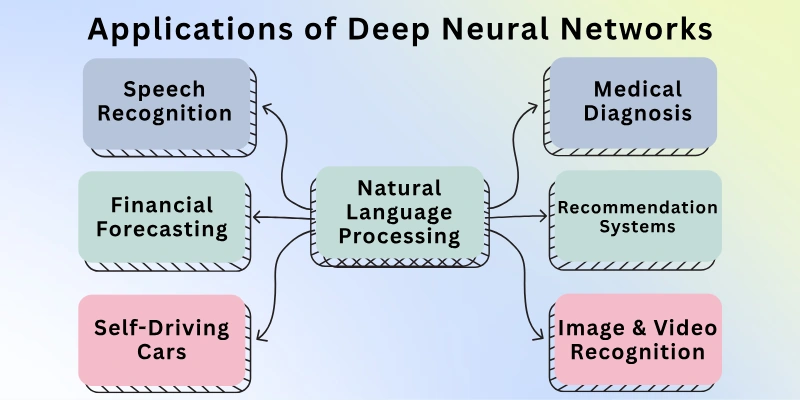
Main Applications
- Image and Video Recognition: Detecting faces, objects, or activities.
- Medical Diagnosis: Detecting diseases from scans or test results.
- Speech Recognition: Translating voice to text accurately.
- Self-driving Cars: Recognizing roads, traffic, and obstacles.
- Natural Language Processing: Language translation and chatbots.
- Financial Forecasting: Predicting stock market trends.
- Recommendation Systems: Suggesting products or videos on platforms.
Advantages of Deep Neural Networks
This section explains why DNNs are widely used and their main benefits.
Key Advantages
- Can learn complex patterns from large datasets.
- Higher accuracy for advanced tasks than shallow networks.
- Handles unstructured data like images, text, and audio.
- Automates tasks that were previously difficult for humans.
- Scalable for small or large datasets.
Limitations of Deep Neural Networks
This section explains the challenges and drawbacks of using DNNs.
Main Limitations
- Requires large amounts of labeled data for training.
- Needs high computing power for deep networks.
- Training can be time-consuming for very deep networks.
- Hard to interpret decisions (black-box problem).
- Overfitting can occur if not trained properly.
Future of Deep Neural Networks
This section discusses how DNNs are evolving and what we can expect in the future.
Future Possibilities
- Smarter healthcare systems for faster diagnosis.
- Advanced autonomous vehicles with better navigation.
- Improved speech and language assistants.
- Enhanced predictive analytics in business and science.
- Integration with robotics and IoT for intelligent automation.
Final Note
In this guide, we have covered what is Deep Neural Network in great detail. You now understand its meaning, working process, components, types, applications, advantages, limitations, and future. Deep Neural Networks may seem complex, but they are the foundation of many advanced technologies we use today.
Learning step by step makes this technology simple. Stay curious, explore more, and use this knowledge to understand how intelligent systems work in the real world.
Goodbye and keep discovering the exciting world of deep learning!
FAQs: Deep Neural Network
Here are some of the most commonly asked questions related to the deep neural network:
A Deep Neural Network is a type of neural network with many hidden layers. It can learn complex patterns from large data and make predictions. DNNs are widely used in tasks like image recognition, speech processing, and recommendation systems.
It works by passing data through multiple layers of neurons. Each layer extracts features and processes the information. The final layer produces predictions or classifications based on what the network learned.
The main components are neurons, layers, weights, biases, and activation functions. Neurons process data, layers transform it, weights and biases help accuracy, and activation functions handle complex patterns.
There are types like Feedforward Neural Networks, Convolutional Neural Networks (CNNs), Recurrent Neural Networks (RNNs), and Autoencoders. Each type is used for different tasks like images, text, or time-series data.
They are used in medical diagnosis, self-driving cars, speech recognition, recommendation systems, and financial forecasting. DNNs help solve complex problems that ordinary programs cannot handle.
They can learn from large datasets and recognize complex patterns. DNNs handle unstructured data like images, text, and audio and can automate tasks that were previously difficult for humans.
They require large amounts of data and high computing power. Training can take a long time, and their decision-making is sometimes hard to interpret. Overfitting may occur if not trained properly.
No, DNNs cannot truly think like humans. They can analyze patterns and make predictions, but they do not have consciousness or emotions.
They learn by adjusting weights and biases to minimize errors in predictions. The network processes data repeatedly and improves accuracy over time through a process called training.
They will become smarter and more efficient in healthcare, autonomous vehicles, robotics, language assistants, and predictive analytics. DNNs will play a bigger role in daily life and technology in the coming years.





- Be Respectful
- Stay Relevant
- Stay Positive
- True Feedback
- Encourage Discussion
- Avoid Spamming
- No Fake News
- Don't Copy-Paste
- No Personal Attacks
- Be Respectful
- Stay Relevant
- Stay Positive
- True Feedback
- Encourage Discussion
- Avoid Spamming
- No Fake News
- Don't Copy-Paste
- No Personal Attacks
