What is Weak AI: How it Works & Key Examples
Published: 24 Mar 2026
You may have heard about “Weak AI” and wondered what it really means. Many people confuse it with machines that can think like humans. In this guide, we will explain what is weak AI in simple words, how it works, where it is used, its advantages and limitations, and why it matters in daily life.
By the end, you will clearly understand this concept without confusion.
Meaning of Weak AI
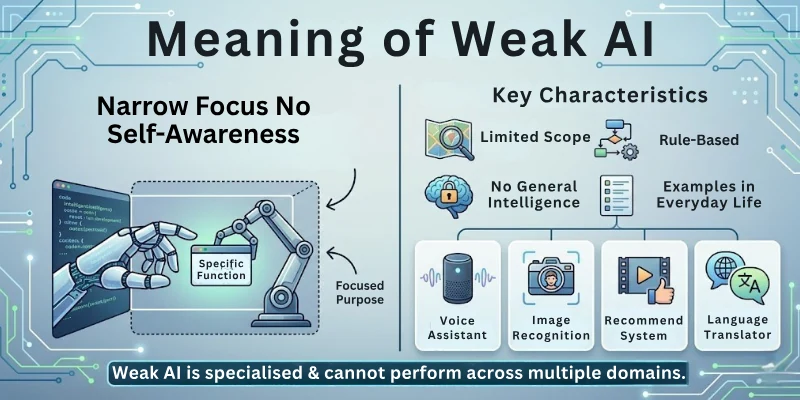
Weak AI is a type of computer system that can perform specific tasks but cannot think or understand like humans. It follows rules and instructions designed by humans. Unlike a human mind or advanced systems, it cannot adapt beyond its programming.
Key Points
- Performs only one task at a time.
- Follows pre-set rules and instructions.
- Cannot think independently or creatively.
- Cannot feel emotions or understand context.
- Works efficiently in narrow areas.
Is Weak AI the Same as Narrow AI?
Weak AI is often called Narrow AI because it is limited to one specific task at a time. It cannot adapt to new tasks or think like humans.
Key Points
- Weak AI = Narrow AI (both focus on specific tasks).
- Cannot learn outside its programmed area.
- Works efficiently within its narrow domain.
- Most real-life AI tools today are Weak/Narrow AI.
- Examples include chatbots, spam filters, and recommendation systems.
How Weak AI Works
Weak AI operates by processing input data using predefined rules or algorithms. It cannot learn or improve on its own outside its programmed domain.
Main Steps
- Receives data or input from a user or environment.
- Processes the data using pre-set rules or algorithms.
- Produces an output or response based on programming.
- Cannot adapt to tasks it was not trained for.
- Performs efficiently in its limited domain.
Example: A voice assistant recognizes your command to play music but cannot help with homework or book a doctor’s appointment unless specifically programmed.
Examples of Weak AI
Even though it sounds simple, Weak AI is everywhere in daily life. Here are some examples:
Common Examples
- Voice assistants like Siri or Alexa performing simple commands.
- Chatbots answering basic customer service questions.
- Recommendation systems in Netflix or YouTube suggesting videos.
- Email spam filters detecting unwanted messages.
- Navigation apps like Google Maps providing directions.
- Online shopping suggestions showing products you may like.
- Basic predictive text in messaging apps.
- Smart home devices controlling lights or temperature.
Why These Examples Matter: They show that Weak AI is practical, helpful, and widely used even though it cannot think like humans.
Weak AI vs Strong AI
Weak AI is often compared to Strong AI, which is still theoretical and aims to think like humans.
Comparison
Here is an short easy comparison:
- Weak AI performs specific tasks, Strong AI can handle any task.
- Weak AI cannot reason, Strong AI can understand and adapt.
- Weak AI does not improve itself, Strong AI could learn and innovate.
- Weak AI is safe and predictable, Strong AI may be unpredictable.
- Weak AI is common in real life, Strong AI does not yet exist.
Advantages of Weak AI
Weak AI has many advantages because it is focused, fast, and reliable.
Key Advantages
- Performs repetitive tasks quickly and accurately.
- Operates 24/7 without fatigue.
- Reduces human effort in routine work.
- Increases efficiency in businesses and daily life.
- Is easy to design, control, and maintain compared to advanced systems.
- Supports humans in making better decisions.
- Improves user experiences in apps and services.
Limitations of Weak AI
Despite its usefulness, Weak AI has clear limitations.
Main Limitations
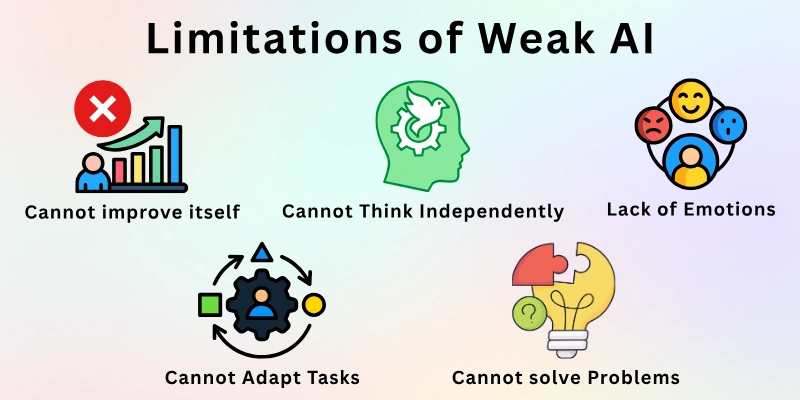
- Cannot think independently or generate original ideas.
- Cannot adapt to tasks outside its programming.
- Lacks common sense, emotions, and context understanding.
- Cannot improve itself without human intervention.
- Cannot solve completely new problems.
Why Limitations Matter: These limitations explain why Weak AI is practical but not intelligent in the human sense.
Why Weak AI is Important
Weak AI may not think like humans, but it plays a crucial role in everyday life.
Reasons:
- Reduces human workload in repetitive tasks.
- Improves efficiency and accuracy in business and personal life.
- Forms the foundation for developing future intelligent systems.
- Offers predictable, safe, and controlled solutions.
- Helps people focus on creative and strategic tasks instead of mundane work.
Future of Weak AI
Weak AI will continue to evolve and become smarter in narrow tasks, supporting humans more efficiently.
Future Possibilities
- More advanced chatbots for customer support.
- Smarter recommendation systems in shopping and entertainment.
- Improved automation in industries and logistics.
- Better predictive tools in healthcare and finance.
- Integration with everyday devices for convenience.
- Enhanced learning tools in education.
- Improved virtual assistants for personal and professional tasks.
Final Note
In this guide, we have covered what is Weak AI in simple words in great detail. You now understand its meaning, working process, examples, advantages, limitations, and applications. Weak AI is everywhere in daily life and makes routine tasks faster and easier, even though it cannot think like humans.
Remember, learning step by step makes technology simple and useful. Stay curious, explore more, and use this knowledge to make smarter decisions.
Goodbye, and keep discovering new things!
FAQs: What is Weak AI
Here are some of the most commonly asked questions related to the weak artificial intelligence:
Weak AI is a computer system that can do a specific task very well. It cannot think or understand like a human. It only follows instructions and works within a narrow domain.
Yes, many tools are examples of Weak AI. Voice assistants like Siri or Alexa, chatbots for customer support, and spam filters in email are common examples of weak artificial intelligence. These tools do their task efficiently but cannot do other tasks.
Weak AI works on one specific task, while Strong AI aims to think like humans across many tasks. Weak AI cannot reason, create ideas, or understand context. Strong AI is still theoretical, while Weak AI is used in real life.
Almost all Weak AI systems are Narrow AI because they focus on one task. Example of Narrow AI includes recommendation systems on Netflix or YouTube. They cannot perform other unrelated tasks.
No, Weak AI cannot learn new tasks outside its design. It only follows rules and patterns given by humans. For example, a chatbot can answer questions but cannot drive a car.
Weak AI helps businesses save time and money. It can answer customer questions, filter spam, and suggest products automatically. Many companies rely on examples of weak artificial intelligence to improve efficiency.
Weak AI is everywhere in daily life. Navigation apps, virtual assistants, and online recommendations all use it. These simple tools make life faster and easier without thinking like humans.
Weak AI cannot think creatively or solve problems it was not programmed for. It cannot feel emotions or understand context. Its capabilities are limited to the specific task it was designed for.
Weak AI vs Strong AI shows the difference between specific task systems and systems that can think like humans. Weak AI is practical, safe, and widely used. Strong AI is hypothetical and can adapt to any problem in theory.
Weak AI may replace simple repetitive tasks but cannot replace human thinking. It supports humans in decision making and efficiency. Many people compare example of narrow AI tools like chatbots or recommendation engines to see how it helps without replacing humans.


- Be Respectful
- Stay Relevant
- Stay Positive
- True Feedback
- Encourage Discussion
- Avoid Spamming
- No Fake News
- Don't Copy-Paste
- No Personal Attacks
- Be Respectful
- Stay Relevant
- Stay Positive
- True Feedback
- Encourage Discussion
- Avoid Spamming
- No Fake News
- Don't Copy-Paste
- No Personal Attacks
