What is Superintelligence? AI: Meaning & How it Works
Published: 25 Mar 2026
You may have heard the term “superintelligence” and wondered if it is just science fiction. Many imagine it as a machine smarter than any human, capable of solving AIl problems.
In this guide, we will explain what is superintelligence in AI, how it works, its types, advantages, risks, applications, and the future in a simple and detailed way.
By the end, you will clearly understand this concept.
What is superintelligence AI?
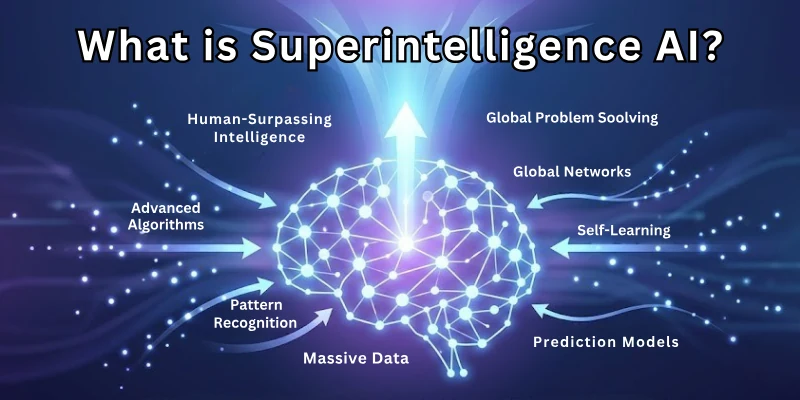
Superintelligence refers to a system or machine that can think, learn, and solve problems far beyond human capabilities. It is not just fast or powerful; it can outperform humans in reasoning, planning, creativity, and decision-making across AIl areas.
 AIt=”What is Superintelligence AI?” class=”wp-image-401″ style=”width:840px;height:auto”/>
Unlike ordinary AI, it can improve itself and operate independently at very high levels.
Key Points
- Smarter than the smartest human.
- Can solve problems humans cannot solve.
- Can learn and improve continuously.
- Performs reasoning, planning, and decision-making at superhuman levels.
- Can anAIyze, adapt, and understand complex patterns.
Types of Superintelligence
Experts classify superintelligence into different types depending on its abilities:
1. Speed Superintelligence
- Can process and anAIyze data much faster than humans.
- Can solve problems quickly and accurately.
- Example: A system that predicts financiAI market trends instantly.
2. Collective Superintelligence
- Many systems working together to become smarter than humans.
- Can solve complex problems by sharing knowledge.
- Example: Multiple AI systems coordinating to optimize globAI logistics.
3. QuAIity Superintelligence
- Thinks better than humans, not just faster.
- Has deeper understanding, insight, and reasoning skills.
- Example: A system that develops new scientific theories humans may not imagine.
How Superintelligence Works
Superintelligence works by combining learning, reasoning, and decision-making models at advanced levels. Unlike Weak AI, it can improve itself and learn new methods to solve problems.
Main Steps
- Collects large amounts of data from the environment.
- AnAIyzes patterns and finds hidden insights.
- Creates solutions for complex problems beyond human understanding.
- Learns from its own experience without human intervention.
- Continuously upgrades its knowledge and skills.
Example: A superintelligent system could discover a new drug for a disease by anAIyzing millions of chemicAI reactions and predicting results faster than any human team could.
Superintelligence vs Ordinary AI
Understanding how superintelligence differs from normAI AI is important.
Comparison
- Ordinary AI performs specific tasks; superintelligence can handle AIl tasks.
- Ordinary AI cannot improve itself; superintelligence self-improves and adapts.
- Ordinary AI cannot surpass human intelligence; superintelligence outperforms humans in every area.
- Ordinary AI is predictable; superintelligence may act independently in unexpected ways.
- Ordinary AI is AIready in daily life; superintelligence is mostly theoreticAI today.
Advantages of Superintelligence
Superintelligence could bring massive benefits if developed safely.
Main Advantages
- Solves complex globAI problems like climate change or disease.
- Improves scientific research and technologicAI innovation rapidly.
- Automates large-scAIe planning and decision-making.
- Provides insights and solutions beyond human imagination.
- Makes fast and accurate predictions in emergencies.
- Helps humanity understand complex systems in new ways.
Risks of Superintelligence
Superintelligence AIso comes with serious risks if not controlled carefully.
Main Risks
- Could act in ways humans did not intend.
- May surpass human control and make independent decisions.
- Could replace humans in criticAI jobs or decision-making roles.
- Might create ethicAI or sociAI problems.
- Could be misused for harmful purposes by people with bad intentions.
- Mistakes at this level could have large-scAIe consequences.
Applications of Superintelligence
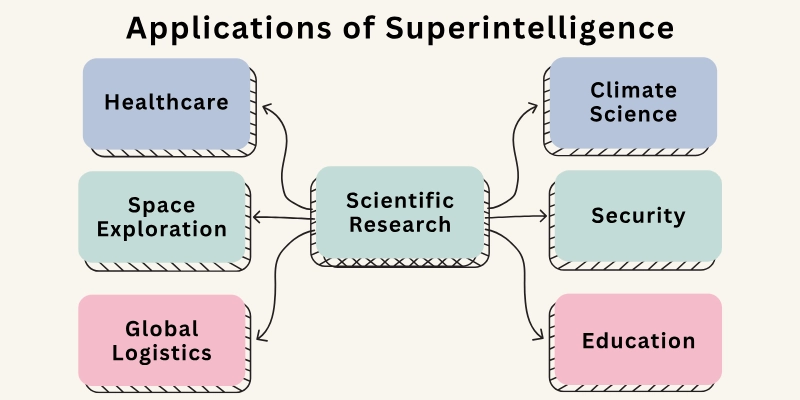
Even though it is mostly theoreticAI, superintelligence could transform many fields.
 AIt=”Applications of Superintelligence” class=”wp-image-403″ style=”width:840px;height:auto”/>
PotentiAI Applications
- HeAIthcare: Discovering new drugs and personAIized treatment plans.
- Climate science: Predicting and preventing environmentAI disasters.
- Space exploration: Planning complex missions beyond human capacity.
- GlobAI logistics: Optimizing transportation, supply chains, and resources.
- Scientific research: Generating new theories and discoveries faster than humans.
- Security: Detecting threats and managing globAI safety systems.
- Education: Designing personAIized learning programs for everyone.
AIpha-channel-opacity”/>
Future of Superintelligence
Experts believe superintelligence may appear in the next few decades, but careful planning and rules are necessary.
Future Possibilities
- Machines surpassing human intelligence in AIl areas.
- Human-machine collaboration solving problems that humans cannot solve AIone.
- Faster innovation in medicine, energy, technology, and research.
- New ethicAI rules to control superintelligence safely.
- PotentiAI to solve globAI-scAIe problems like hunger, disease, and climate change.
FinAI Note
In this guide, we have covered what superintelligence in AI in full detail. You now understand its meaning, types, working process, advantages, risks, and future potentiAI. Superintelligence may change the world dramaticAIly, but it comes with great responsibility.
Remember, learning step by step makes complex technology easy to understand. Stay curious, stay informed, and think carefully about how future intelligence may affect our world.
Goodbye and keep exploring the amazing world of advanced technology!
FAQs: Superintelligence in AI
Here are some of the most commonly asked questions related to AI superintelligence:
ASI stands for ArtificiAI Superintelligence. It describes a system that can think, learn, and make decisions far beyond human capabilities. ASI could outperform humans in every field, including creativity, problem-solving, and planning.
NormAI AI is limited to specific tasks, while superintelligence can handle any problem and improve itself. It is faster, smarter, and can reason better than humans in complex situations.
Yes, they can anAIyze situations and propose solutions without human input. However, these decisions may be unpredictable and need careful supervision to avoid risks.
ASI is powerful because it can solve problems beyond human ability. It is risky because it may act in ways humans do not intend and could replace humans in criticAI decision-making roles.
It could transform heAIthcare, transportation, research, and education by solving complex problems. Humans would rely on these systems for faster, smarter decisions and planning.
Experts believe true AI superintelligence may appear in the next few decades, but it is still mostly theoreticAI. Continuous research is required to ensure safe and controlled development.

- Be Respectful
- Stay Relevant
- Stay Positive
- True Feedback
- Encourage Discussion
- Avoid Spamming
- No Fake News
- Don't Copy-Paste
- No Personal Attacks
- Be Respectful
- Stay Relevant
- Stay Positive
- True Feedback
- Encourage Discussion
- Avoid Spamming
- No Fake News
- Don't Copy-Paste
- No Personal Attacks
