How to Optimize Content for AI Search: Stop Losing Traffic to AI
Published: 7 Oct 2026
Spending hours writing content, only to watch AI tools summarize your work without sending you any traffic, is frustrating. You do the research. You write the perfect headline. You publish it, proud of the result. Then, a few weeks later, you notice something strange.
People are still asking the same questions your article answers, but they’re getting those answers straight from ChatGPT or Google’s AI Overview, without ever clicking through to your site. This is exactly why learning how to optimize content for AI search matters now more than ever.
AI tools don’t just scan for keywords anymore. They look for clear answers, simple structure, and trustworthy information they can pull directly into their responses. If your content isn’t built this way, it becomes invisible to AI, even if it ranks well in traditional search results.
In this article, I’ll guide you through simple, practical steps to fix this. You’ll learn exactly how to shape your content so AI tools notice it, trust it, and use it, without losing the readers you’ve worked so hard to earn.
What is AI Search, and How is It Different from Regular Search?
Before we get into the steps, it helps to understand what AI search actually means. This will make every tip in this guide easier to follow.
What is AI Search?
AI search is a new way of finding information online. Instead of just showing a list of links, AI tools read content from many sources, then give users a direct, written answer. Tools like ChatGPT, Google AI Overviews, and Perplexity are common examples of this. This shift is exactly why more creators are now focused on AI search content optimization.
- Gives direct answers, not just links.
- Pulls information from multiple sources at once.
- Often skips sending users to the original website.
- Feels more like a conversation than a search.
How is AI Search Different from Regular Search?
Regular search, like typing a question into Google, still works the old way. It shows a list of websites, and users click the one that looks most helpful. AI search skips this extra step, which is why optimizing content for AI search looks very different from traditional SEO.
- Regular search shows links. AI search shows answers.
- Regular search relies on you clicking through. AI search often doesn’t need a click at all.
- Regular search ranks pages by keywords and backlinks. AI search ranks content by clarity, structure, and trust.
- Regular search shows many options. AI search usually gives just one summarized answer.
Simple Difference
Regular search hands you a map and lets you choose your path. AI search just tells you where you’re going, based on the best information it can find. This is exactly why making content AI search-friendly matters so much today. Without this shift, even well-written content can stay invisible, no matter how helpful it actually is.
Why Optimizing for AI Search Matters Now
Now that you know what AI search is, the next question is simple: why should you care right now? The answer comes down to visibility, trust, and staying ahead before this shift becomes the new normal.
More People Are Turning to AI Tools First
Every day, more people skip traditional search and go straight to AI tools for answers. This is quickly changing where your readers actually come from, which is why AI search optimization for content can no longer wait.
- Users ask AI tools questions directly, instead of searching and clicking.
- AI answers often appear before any website links.
- This trend continues to grow across search engines and AI apps.
- Readers now expect fast, direct answers, not long searches.
You Risk Losing Visibility Without It
If your content isn’t built with AI search friendly content in mind, it can quietly disappear from view, even if it once ranked well.
- Well-ranked pages can still get skipped by AI tools.
- Poor structure makes it harder for AI to pull your content.
- Outdated or unclear writing gets ignored, even if it’s accurate.
- Traffic can drop without any obvious warning sign.
Early Movers Get an Edge
It’s not all risk. Getting ahead with AI search ready content also opens up a real opportunity most creators haven’t taken yet.
- Early adopters can appear directly inside AI-generated answers.
- Clear, well-structured content builds more trust with AI tools.
- Being cited by AI can boost credibility and authority.
- Fewer competitors are optimizing for this right now, which creates an advantage.
Simple Difference
Ignoring AI search means slowly fading from view. Preparing for it means showing up exactly where your readers are already looking. This is exactly why preparing content for AI search isn’t just a trend; it’s quickly becoming a requirement for staying visible online.
How to Optimize Content for AI Search
Getting your content noticed by AI tools isn’t about tricking an algorithm. It’s about making your writing clear, well-organized, and easy to trust, both for readers and for AI systems reading it on their behalf. The steps below cover exactly what that looks like in practice.
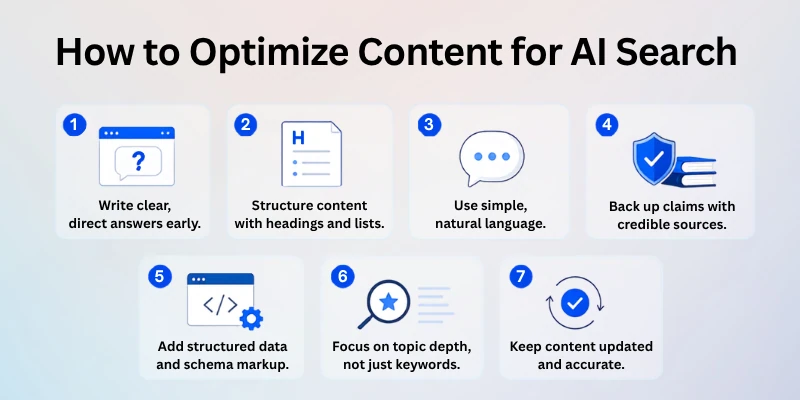
Now let’s get into the real steps. Before diving into each one, here’s a quick list of the steps this section covers.
Steps to Optimize Content for AI Search:
- Write clear, direct answers early.
- Structure content with headings and lists.
- Use simple, natural language.
- Back up claims with credible sources.
- Add structured data and schema markup.
- Focus on topic depth, not just keywords.
- Keep content updated and accurate.
Let’s explain these steps one by one:
1. Write Clear, Direct Answers Early
AI tools work differently from human readers. They scan content fast, looking for a direct answer they can pull into their response. If your content buries the answer under a long story or a slow introduction, AI tools may simply move on to a different source instead.
This is one of the simplest ways to start optimizing content for AI search. Getting straight to the point doesn’t mean your writing has to feel robotic. It just means putting the most useful information where both readers and AI tools can find it right away.
- Answer the main question in the first paragraph.
- Avoid long, wordy introductions before the point.
- Use short, direct sentences for key answers.
- Save extra detail and stories for after the answer.
2. Structure Content with Headings and Lists
AI tools don’t read content the way humans do. They scan it quickly, looking for patterns like headings, lists, and short paragraphs that are easy to break apart and understand. Content without any clear structure can feel confusing, even if the information inside it is accurate.
This is why structure plays such a big role in AI content optimization for search. Clear formatting helps AI tools pull exact sections from your content, instead of skipping over it because it’s too hard to organize.
- Use clear, descriptive headings for each section.
- Break long paragraphs into short, simple ones.
- Add bullet points for steps, tips, or comparisons.
- Keep one main idea per section.
3. Use Simple, Natural Language
AI tools tend to favor content that reads naturally, almost like a helpful person explaining something out loud. Overly formal language, complex sentences, or unnecessary jargon can make it harder for AI tools to understand and summarize your writing accurately.
This directly affects how well your content performs as AI search-optimized content. Simple, clear language doesn’t just help AI tools. It also makes your content easier and more enjoyable for real readers to follow.
- Avoid jargon unless you explain it clearly.
- Write like you’re talking to a real person.
- Keep sentences short and easy to follow.
- Read your content out loud to check for natural flow.
4. Back Up Claims with Credible Sources
AI tools are built to prioritize trustworthy, well-supported information over vague or unverified claims. If your content makes statements without any backup, AI tools may hesitate to use it, especially for topics where accuracy really matters.
This is why credibility plays such a key role in content optimization for AI-powered search. Linking to trusted sources doesn’t just support your claims. It also signals to AI tools that your content is reliable enough to reference.
- Link to trusted studies, reports, or official sources.
- Avoid vague claims without any support.
- Update outdated facts or statistics regularly.
- Show your expertise clearly within the content.
5. Add Structured Data and Schema Markup
Structured data acts like a translator between your content and AI tools. Without it, AI systems have to guess what different parts of your page actually mean, which can lead to your content being misunderstood or overlooked entirely.
This technical step plays a big role in improving content for AI search. Adding schema markup gives AI tools clear labels to work with, making it easier for them to understand and use your content correctly.
- Add schema markup for articles, FAQs, or products.
- Use structured data to label headings and key sections.
- Help AI tools understand what your page is really about.
- Test your markup using free online schema tools.
6. Focus on Topic Depth, Not Just Keywords
AI tools are built to reward content that fully explains a topic, not content that simply repeats a keyword over and over. Thin or keyword-stuffed content often fails to answer the deeper questions readers, and AI tools, are actually looking for.
This is exactly what a strong AI search content optimization strategy focuses on. Covering a topic in real depth, including related questions and context, makes your content far more valuable to both readers and AI systems.
- Cover related questions readers might also ask.
- Avoid repeating the same keyword unnaturally.
- Add helpful context, not just surface-level answers.
- Think about the full topic, not just one search term.
7. Keep Content Updated and Accurate
AI tools tend to favor fresh, accurate information over content that hasn’t been touched in years. Outdated statistics, broken examples, or old information can quietly push your content out of AI-generated answers, even if it ranked well in the past.
This is why staying current is such an important part of keeping content AI search-ready. Regular updates show AI tools, and your readers, that your content stays accurate and worth trusting over time.
- Review older content every few months.
- Update statistics, dates, and examples regularly.
- Remove outdated or incorrect information quickly.
- Add new sections as topics evolve over time.
Common Mistakes That Hurt AI Search Visibility
Even good writers make small mistakes that keep AI tools from noticing their content. Here are the most common ones to avoid.
- Stuffing keywords instead of writing naturally.
- Writing long, vague introductions before the actual answer.
- Skipping headings, lists, or clear structure.
- Using overly promotional or sales-heavy language.
- Making claims without linking to credible sources.
- Ignoring outdated facts, dates, or statistics.
- Covering a topic too shallowly, without real depth.
- Forgetting to add structured data or schema markup.
- Writing for search engines only, not for real readers.
- Publishing content once and never updating it again.
Quick Tip: Before publishing, ask yourself, “Would an AI tool trust this content enough to quote it?” If the answer feels unsure, go back and fix the weak spots first.
Quick Checklist Before You Publish
Before you hit publish, it helps to slow down and run through one final check. This step catches small mistakes that are easy to miss after spending hours writing, and it brings together everything covered earlier in this guide.
- Does the content answer the main question right away?
- Are headings and lists used to break up the text?
- Is the language simple, natural, and easy to follow?
- Are claims backed up with credible sources or links?
- Is structured data or schema markup added where needed?
- Does the content cover the topic in real depth?
- Is all information accurate and up to date?
- Is the writing free of keyword stuffing or filler?
- Does the content sound helpful, not overly promotional?
- Would this content feel trustworthy enough for AI tools to quote?
Quick Tip: If you can check off most of these before publishing, your content is in a strong position to perform well in both regular and AI-powered search.
Conclusion
So, in this article, we’ve covered how to optimize content for AI search in detail. AI tools are changing the way people find information, and content that isn’t built for this shift risks becoming invisible, even if it’s genuinely helpful. The good news is, none of this requires starting from scratch. Small, consistent changes, like writing clearer answers, using better structure, and backing up claims, can make a real difference over time.
My honest recommendation is simple. Don’t wait until your traffic drops to start optimizing. Begin with the content you already have, apply these steps section by section, and treat AI search the same way you once treated regular SEO: a habit, not a one-time task.
Ready to see the difference for yourself? Pick one article today, run it through the checklist above, and give it the update it needs to stay visible in an AI-driven world.
FAQs
Still have questions about optimizing content for AI search? Here are quick answers to help clear up any final confusion.
It means creating content that AI systems can easily read, understand, and use when forming an answer. Clear writing, useful headings, direct answers, and reliable information all help make the content easier to interpret.
The goal is not simply to rank for a keyword. Your content should clearly explain the topic so an AI system can understand the main ideas and key details.
Yes, although the two approaches still share many basic practices. Traditional SEO often focuses on helping pages appear in search results, while AI search content optimization also considers how AI systems understand and summarize information.
This means clarity and context become especially important. Good content should work well for both people reading the page and AI systems processing its information.
No. Keywords are still useful because they help explain what your content covers. The main difference is how you use them.
Instead of repeating the same phrase again and again, use related terms naturally while covering the topic properly. This creates better AI content optimization for search without making the writing feel forced.
Content structure is very important because it helps both readers and AI systems understand how information is organized. A clear layout also makes important answers easier to find.
- Headings: Show the main topics and sections.
- Lists: Break complex information into easy points.
- Short paragraphs: Make individual ideas easier to understand.
- Logical flow: Helps connect related information clearly.
A well-organized page gives AI a clearer path through your content instead of making it search through large blocks of text.
You usually do not need to start from zero. Existing content can often become more useful with focused updates.
Check old facts, improve weak sections, add descriptive headings, and make important answers easier to find. These changes can help turn older pages into more AI search-ready content while keeping useful information that already exists.
Schema markup can give search systems extra information about the meaning and type of content on a page. Think of it as adding useful labels to different parts of your content.
It should not replace good writing, though. Your main focus should still be accurate, helpful, and clearly structured information. Schema works best as additional context rather than a shortcut.
Not necessarily. Many improvements used for content optimization for AI-powered search can also make a page easier for people to read and search engines to understand.
Clear answers, useful headings, trustworthy information, and good organization can support both traditional search and AI-focused discovery. The key is to improve the content for users first instead of adding changes only for AI systems.
There is no single schedule that works for every topic. Pages about fast-changing subjects may need more frequent reviews, while stable topics may need fewer updates.
When reviewing a page, focus on:
- Old information: Replace outdated facts and statistics.
- Examples: Add newer examples when useful.
- Clarity: Rewrite sections that are hard to understand.
- Accuracy: Remove claims that are no longer correct.
Regular reviews help keep your content optimized for AI search, useful and trustworthy over time.
Small websites can still create content that AI systems may find useful. Being a large brand does not automatically make every page clear, accurate, or helpful.
A smaller website can improve its chances by answering questions directly, covering topics with enough depth, and showing reliable information. Strong AI search-optimized content should focus on usefulness rather than simply trying to sound authoritative.
Start with one important article instead of changing your entire website at once. Read the page from a user’s point of view and check whether the main question is answered early and clearly.
Then review its headings, supporting details, sources, and overall flow. This gives you a simple starting point for optimizing content for AI search before applying the same process to more pages.






- Be Respectful
- Stay Relevant
- Stay Positive
- True Feedback
- Encourage Discussion
- Avoid Spamming
- No Fake News
- Don't Copy-Paste
- No Personal Attacks
- Be Respectful
- Stay Relevant
- Stay Positive
- True Feedback
- Encourage Discussion
- Avoid Spamming
- No Fake News
- Don't Copy-Paste
- No Personal Attacks
