How AI Helps in Customer Journey Mapping: 15 Best Ways
Published: 5 May 2026
Understanding the customer journey is crucial for any business aiming to improve engagement and conversions. Traditionally, mapping the journey relied on assumptions, manual data collection, and limited insights. This often resulted in gaps and missed opportunities.
Today, AI analyzes data, interactions, and behavior patterns to create accurate customer journey maps. This detailed guide explains how AI helps in customer journey mapping in a practical and easy-to-follow way.
Let us cover everything in detail so you can understand and optimize the customer journey with confidence.
How AI Helps in Customer Journey Mapping
Here are the 15 proven ways AI improves customer journey mapping for businesses and marketers:
- Customer Behavior Analysis
- Predictive Journey Mapping
- Segmentation of Journey Stages
- Multi-Channel Interaction Tracking
- Personalized Recommendations
- Touchpoint Optimization
- Churn Prediction
- Engagement Scoring
- Journey Path Visualization
- Sentiment Analysis
- Customer Lifetime Value Prediction
- Automated Journey Alerts
- Content Personalization Across Journey
- Conversion Probability Scoring
- Continuous Journey Optimization
Let us learn about each method in detail.
1. Customer Behavior Analysis
Traditionally, understanding customer behavior relied on surveys and limited tracking tools. These methods captured only partial insights. AI now analyzes click streams, browsing patterns, and purchase history. It identifies preferences and recurring actions accurately. This gives a full picture of customer behavior.
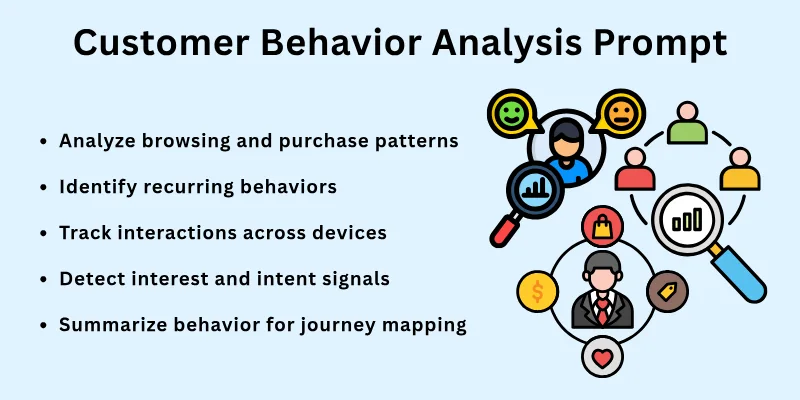
Prompts you can use:
- Analyze browsing and purchase patterns
- Identify recurring behaviors
- Track interactions across devices
- Detect interest and intent signals
- Summarize behavior for journey mapping
2. Predictive Journey Mapping
Earlier, mapping journeys depended on past interactions only. AI now predicts future customer steps using historical data. It anticipates likely actions at each stage. Businesses can prepare personalized interventions. This reduces drop-offs and improves engagement. Planning becomes proactive rather than reactive.
Prompts you can use:
- Predict next customer steps
- Identify potential drop-off points
- Anticipate high-value actions
- Suggest personalized touchpoints
- Improve proactive engagement
3. Segmentation of Journey Stages
Traditional segmentation grouped users based on demographics or simple actions. AI segments customers based on behavior, intent, and engagement. Each stage of the journey has tailored groups. Marketing messages match the segment. Engagement becomes more relevant.
Prompts you can use:
- Segment users by journey stage
- Identify high engagement segments
- Tailor messaging per segment
- Analyze segment behavior
- Adjust campaigns for each group
4. Multi-Channel Interaction Tracking
Previously, tracking interactions across email, social, and website was challenging. AI monitors all channels in real time. It captures touchpoints across platforms. Businesses see where customers interact most. Strategies adjust to active channels.
Prompts you can use:
- Track interactions on all channels
- Identify preferred channels
- Analyze cross-channel behavior
- Optimize multi-channel engagement
- Adjust campaigns accordingly
5. Personalized Recommendations
Traditional recommendations were generic or rule-based. AI now suggests personalized products or content based on behavior. Recommendations appear at the right stage of the journey. This increases engagement and satisfaction. Customers feel understood. Conversions improve naturally.
Prompts you can use:
- Recommend products per user behavior
- Suggest content based on engagement
- Optimize recommendations for journey stage
- Improve click-through rates
- Enhance customer satisfaction
6. Touchpoint Optimization
Earlier, businesses used static strategies at touchpoints. AI analyzes performance of each touchpoint. It identifies which interactions need improvement. Businesses can optimize messages and offers. Customer experience improves at every stage. Drop-offs reduce.
Prompts you can use:
- Evaluate performance of each touchpoint
- Suggest improvements
- Optimize communication
- Enhance user experience
- Reduce friction in journey
7. Churn Prediction
Traditional churn analysis relied on basic metrics and guesswork. AI predicts churn risk by analyzing engagement patterns and behavior. Businesses can identify at-risk customers early. Interventions prevent loss. Loyalty improves. Customer retention strategies become data-driven.
Prompts you can use:
- Identify customers likely to churn
- Analyze behavior patterns
- Recommend retention actions
- Prioritize high-value customers
- Reduce churn rates
8. Engagement Scoring
Engagement scoring was done manually or with limited metrics. AI calculates scores using multiple behaviors and interactions. It ranks customers by engagement level. Businesses focus on high and low engagement segments. Strategies adjust accordingly. Engagement becomes measurable and actionable.
Prompts you can use:
- Score customers based on activity
- Rank by engagement level
- Identify low engagement users
- Tailor campaigns for each score
- Monitor engagement trends
9. Journey Path Visualization
Mapping journey paths was manual and hard to interpret. AI visualizes complex journeys dynamically. Businesses see typical paths and deviations. Patterns and bottlenecks become clear. Planning interventions is easier. Teams make informed decisions.
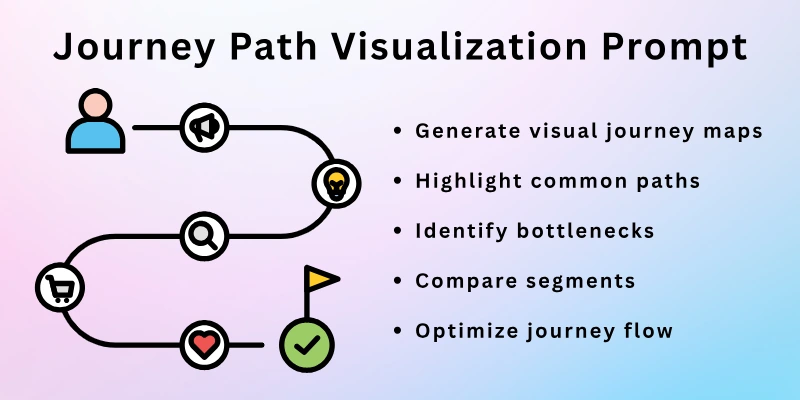
Prompts you can use:
- Generate visual journey maps
- Highlight common paths
- Identify bottlenecks
- Compare segments
- Optimize journey flow
10. Sentiment Analysis
Traditional feedback analysis relied on surveys and reviews. AI analyzes sentiment from text, reviews, and comments. It detects emotions, satisfaction, and pain points. Businesses understand customer feelings at each stage. Messaging and offers adjust accordingly.
Prompts you can use:
- Analyze sentiment from feedback
- Identify satisfaction trends
- Detect negative emotions
- Adjust communication strategies
- Improve overall experience
11. Customer Lifetime Value Prediction
Earlier, estimating lifetime value relied on averages. AI predicts CLV using purchase history and engagement. High-value customers are identified early. Marketing budgets allocate efficiently. Long-term strategies improve. ROI increases.
Prompts you can use:
- Predict CLV for each customer
- Segment high-value customers
- Plan targeted campaigns
- Optimize resource allocation
- Track value over time
12. Automated Journey Alerts
Monitoring journeys manually was slow. AI sends real-time alerts on important events. Teams respond quickly to drop-offs or opportunities. Customer interactions become timely. Actions become proactive. Journey management improves.
Prompts you can use:
- Set alerts for journey milestones
- Detect inactivity or drop-offs
- Notify teams of key events
- Trigger automated actions
- Improve response speed
13. Content Personalization Across Journey
Earlier, content was static and generic. AI personalizes content per stage and user profile. Messages align with needs at each touchpoint. Relevance improves. Engagement increases. Users progress smoothly.
Prompts you can use:
- Personalize emails and messages
- Recommend stage-specific content
- Adjust content dynamically
- Enhance user relevance
- Improve engagement rates
14. Conversion Probability Scoring
Conversion likelihood was estimated roughly. AI calculates probability for each customer using multiple factors. Teams prioritize high-probability leads. Marketing becomes efficient. Conversions improve. Resources are used wisely.
Prompts you can use:
- Score leads for conversion
- Predict likelihood based on behavior
- Prioritize interventions
- Improve campaign efficiency
- Track changes over time
15. Continuous Journey Optimization
Journey mapping was static once completed. AI continuously analyzes new data and updates maps. Bottlenecks are addressed immediately. Experiences evolve with customer needs. Planning stays current. Performance improves over time.
Prompts you can use:
- Monitor journey continuously
- Update touchpoints dynamically
- Identify new patterns
- Adjust strategies in real time
- Maintain optimal experiences
Best AI Tools for Customer Journey Mapping
Here are the 10 best AI tools for customer journey mapping:
- HubSpot Journey Analytics
- Salesforce Einstein for journey mapping
- Adobe Journey Optimizer
- Mixpanel for customer behavior
- Pendo for journey insights
- MoEngage for engagement tracking
- Segment for data integration
- Freshworks AI for journey automation
- Gainsight PX for experience mapping
- Optimove for predictive journeys
Final Note
In this guide, we explained how AI helps in customer journey mapping using practical and proven methods. We covered analysis, prediction, personalization, and optimization. Each method shows how AI improves understanding and engagement.
My personal advice is to map one journey at a time and refine continuously. Combine data insights with human intuition. This ensures journeys are accurate and actionable.
Thank you for reading. I hope this guide helps you optimize customer experiences and improve conversions.
FAQs
Here are some of the most commonly asked questions related to How AI helps in customer journey mapping:
AI customer journey mapping studies how customers interact with your brand. It tracks every touchpoint from first visit to purchase. Businesses see patterns and behaviors clearly. This helps improve overall customer experience. Mapping becomes more accurate and actionable.
AI analyzes data from multiple channels automatically. It identifies key moments and customer preferences. Businesses understand what works and what fails. Teams can make faster decisions. This leads to better engagement and higher satisfaction.
Yes, AI predicts what customers are likely to do next. It studies past actions and trends. Businesses can suggest relevant products or services. This reduces drop-offs and increases conversions. Predictions improve as AI collects more data.
Yes, AI works well for small businesses too. It saves time by tracking interactions automatically. Teams can spot trends without extra staff. Decisions become more data-driven. Even small teams can enhance the customer experience quickly.
Yes, AI identifies where customers may leave. It highlights friction points and areas for improvement. Businesses can take action early. Retention rates improve. Loyal customers spend more and return often.
AI works in real-time with collected data. Businesses see insights much faster than manual mapping. Teams can react quickly to issues or opportunities. Planning becomes more efficient. This accelerates marketing and sales strategies.
Yes, AI combines data from websites, social media, emails, and more. It creates a unified view of the customer journey. Businesses understand all touchpoints clearly. Insights become comprehensive. Decisions are more accurate across channels.
Yes, AI identifies individual preferences and behaviors. It helps deliver relevant content or offers at the right time. Personalization improves engagement. Customers feel more valued. This increases conversion rates and loyalty.
Many AI tools offer affordable plans. Even small teams can use them effectively. Cost is manageable compared to the benefits. ROI usually exceeds expenses. Businesses save money by targeting the right actions.
Yes, AI predicts trends and customer needs. It highlights opportunities for new campaigns or offers. Businesses can plan more confidently. Strategy becomes proactive instead of reactive. This improves growth and performance.



- Be Respectful
- Stay Relevant
- Stay Positive
- True Feedback
- Encourage Discussion
- Avoid Spamming
- No Fake News
- Don't Copy-Paste
- No Personal Attacks
- Be Respectful
- Stay Relevant
- Stay Positive
- True Feedback
- Encourage Discussion
- Avoid Spamming
- No Fake News
- Don't Copy-Paste
- No Personal Attacks
