AI in Healthcare – Transformation of AI in Healthcare
Published: 26 Dec 2025
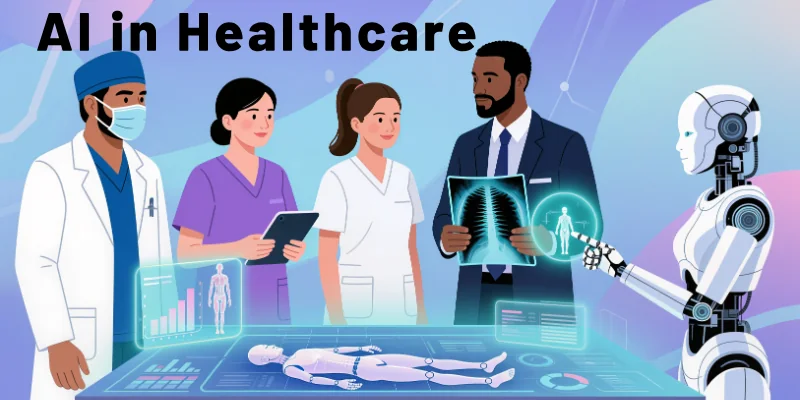
Artificial Intelligence (AI) is completely changing the world of healthcare and medical research. It is helping doctors diagnose diseases faster, improving patient care, and speeding up medical discoveries.
From hospitals to laboratories, AI is bringing smart, accurate, and data-driven solutions that were never possible before.
In this detailed guide, we will explain the role of AI in healthcare and medical research step by step.
1. AI Improves Disease Diagnosis
One of the biggest uses of AI in healthcare is disease diagnosis. AI algorithms can look at X-rays, CT scans, and MRIs and find patterns that doctors may miss.
How It Helps:
- AI can detect cancer, pneumonia, heart disease, and fractures with great accuracy.
- It can compare thousands of medical images in seconds.
- AI tools like DeepMind, IBM Watson Health, and PathAI help radiologists identify diseases at early stages.
- AI also reduces the time needed for diagnosis, helping patients start treatment faster.
Example: Google’s AI model for breast cancer screening showed accuracy levels even higher than expert radiologists.
2. AI in Drug Discovery and Development
Developing a new drug usually takes 10–15 years and billions of dollars. AI is changing that. AI systems can quickly study millions of chemical compounds and predict which ones could work against a certain disease.
How It Helps:
- AI can find potential drugs in months instead of years.
- It identifies which compounds are safe and effective.
- AI helps researchers design better clinical trials.
- It reduces the failure rate in the drug development process.
Example: During the COVID-19 pandemic, AI helped companies like Pfizer and Moderna speed up vaccine development by analyzing virus data quickly.
3. AI in Personalized Medicine
Not all patients respond the same way to treatment. This is where personalized medicine powered by AI becomes important.
How It Helps:
- AI studies a person’s DNA, genes, and lifestyle to create personalized treatment plans.
- It predicts how a person will respond to a specific medicine.
- Doctors can use this information to avoid side effects and improve recovery chances.
Example: IBM Watson uses AI to analyze patient data and suggest personalized treatment options for cancer patients.
4. AI in Predictive Analytics
AI helps predict diseases before they happen. This is called predictive analytics. By studying health records, wearable data, and test results, AI can warn doctors and patients about potential health risks.
How It Helps:
- AI tracks your heart rate, blood sugar, sleep, and activity levels.
- It alerts you if your health shows early signs of problems.
- Hospitals use predictive AI to plan treatments and prevent emergencies.
Example: Wearable devices like Apple Watch and Fitbit use AI to monitor your heart rate and detect irregular heartbeats before a heart problem occurs.
5. AI in Medical Imaging
AI-powered imaging tools are revolutionizing radiology and pathology. These tools can read images faster and more accurately than humans.
How It Helps:
- AI detects patterns in MRI, CT, and ultrasound scans.
- It reduces the time doctors spend reading images.
- It helps in early detection of diseases like cancer, tuberculosis, and stroke.
Example: AI tools like Aidoc and Zebra Medical Vision are being used in hospitals to detect abnormalities in medical scans in real time.
6. AI in Hospital Management and Administration
AI doesn’t only help doctors; it also helps hospitals run better.
How It Helps:
- AI chatbots handle appointment booking, patient queries, and reports.
- It helps manage patient records safely and efficiently.
- AI predicts the number of patients that might visit, helping hospitals plan staff and resources.
- It automates billing and administrative work.
Example: Many hospitals now use AI chatbots and voice assistants to answer patient questions and reduce waiting time.
7. AI in Medical Research
AI is a game changer in medical research.
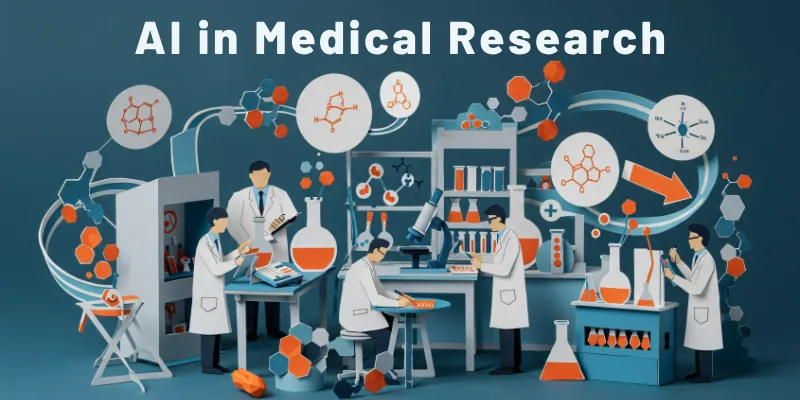
Researchers use AI to study diseases, genetics, and new treatment methods.
How It Helps:
- AI can process millions of research papers and summarize the results.
- It helps identify new drug targets and understand disease causes.
- AI reduces the time needed for clinical studies.
- It also helps in analyzing genetic data to study rare diseases.
Example: AI tools like AlphaFold by DeepMind helped scientists understand how proteins fold — a discovery that changed modern biology.
8. AI in Virtual Health Assistants
AI-powered virtual health assistants are becoming common in telemedicine and patient care.
How It Helps:
- They remind patients to take medicine on time.
- They answer basic health questions 24/7.
- They help doctors track patient progress remotely.
- Virtual assistants reduce hospital visits and save time.
Example: Apps like Ada, Babylon Health, and Google Health use AI to give health advice online.
Challenges of AI in Healthcare
Even though AI is powerful, it still faces challenges.
- Data privacy is a big issue — health data must be kept secure.
- Bias in AI models can lead to wrong results.
- High cost of AI tools can limit use in poor regions.
- Doctors still need to verify AI results before making medical decisions.
Future of AI in Healthcare and Medical Research
The future of AI in healthcare looks very bright. Experts believe AI will continue to grow and make medicine more accurate and personalized.
What to Expect:
- Fully automated hospitals using AI.
- Faster drug development using AI and machine learning.
- Smarter wearable devices that track health in real time.
- AI tools that detect diseases before symptoms appear.
In the coming years, AI will become a regular part of every hospital and lab, improving lives and saving countless people around the world.
Final Thoughts
AI is transforming healthcare and medical research in every possible way. It’s helping doctors make better decisions, speeding up new discoveries, and improving patient care worldwide. While there are still challenges to fix, the future of AI in healthcare is full of hope and innovation.
AI will continue to make medicine smarter, faster, and safer for everyone.
FAQs: AI in Healthcare
Here are some of the most commonly asked questions related to AI and healthcare:
AI helps hospitals manage both medical and administrative work. It assists doctors in diagnosing diseases, managing patient records, and predicting emergencies. AI chatbots handle appointment bookings and answer patient queries. Overall, it saves time and improves patient care.
In some cases, yes. AI can scan X-rays, CT scans, and lab results faster and with more accuracy than humans. It spots tiny patterns that may be missed by the human eye. Still, AI works best when used together with a doctor’s judgment.
AI speeds up research by analyzing large sets of medical data. It helps scientists discover new drugs, understand genetics, and study diseases in detail. AI can process thousands of studies in seconds and suggest the best directions for experiments. This saves time and improves research accuracy.
No, AI is not replacing doctors. It is a tool that supports them by handling repetitive tasks and data analysis. Doctors still make the final decisions and provide human care. AI simply helps them work faster and more accurately.
AI offers many benefits like faster diagnosis, fewer medical errors, and personalized treatments. Among the key benefits of ai are its ability to help doctors predict diseases early and improve patient outcomes. Hospitals also use AI to reduce costs and manage resources more effectively. These advantages make healthcare smarter and more efficient.
AI still faces problems like data privacy, limited access to medical data, and the high cost of AI systems. Sometimes, AI models can give biased results if trained with poor-quality data. Hospitals also need experts to handle these technologies safely. Fixing these issues is important for AI’s future success.
The future of AI in healthcare looks very bright. In the next few years, AI will help predict diseases before symptoms appear and make treatments more accurate. Smart hospitals will use AI for patient monitoring and quick decision-making. AI will become a trusted partner for doctors and patients alike.





- Be Respectful
- Stay Relevant
- Stay Positive
- True Feedback
- Encourage Discussion
- Avoid Spamming
- No Fake News
- Don't Copy-Paste
- No Personal Attacks
- Be Respectful
- Stay Relevant
- Stay Positive
- True Feedback
- Encourage Discussion
- Avoid Spamming
- No Fake News
- Don't Copy-Paste
- No Personal Attacks
