How to Use AI Tools for Keyword Research: Step-by-Step Guide
Published: 4 Oct 2026
Earlier, I used to spend hours searching for keywords manually, checking search volumes, competition, and trends, often feeling confused and overwhelmed. Many times, I was not sure if the keywords I chose would actually drive traffic or help my content rank. Things became much easier when I discovered artificial intelligence for keyword research.
In this guide, I will explain how to use AI tools for keyword research step by step. I will share practical tips, personal insights, and recommended tools, so you can confidently learn how to use AI tools for keyword research and save time while finding the best keywords for your content.
How to Use AI Tools for Keyword Research
Here are the how to use AI tools for keyword research methods I personally follow:
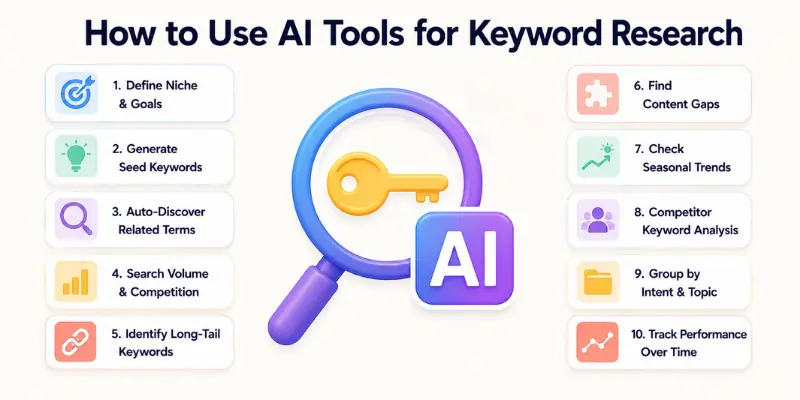
- Define Your Niche and Goals Clearly
- Generate a List of Seed Keywords
- Discover Related Keywords Automatically
- Analyze Search Volume and Competition
- Identify Long-Tail Keywords
- Find Keywords for Content Gaps
- Check Trends and Seasonal Keywords
- Analyze Competitor Keywords
- Group Keywords by Intent and Topic
- Track Keyword Performance Over Time
Let us cover all in detail.
1. Define Your Niche and Goals Clearly
I always start by defining the topic, niche, and goal for my content. AI tools help me refine my niche into specific target areas. I describe the audience, purpose, and expected result, and AI suggests relevant keyword directions. This step removes confusion and makes my research focused. When goals are clear, keyword selection becomes much more accurate. Personally, this step saves me from wasting time on irrelevant keywords.
Tools I use
- ChatGPT – helps brainstorm niche-specific ideas
- Notion AI – organizes niche and content goals
2. Generate a List of Seed Keywords
Seed keywords are the base of keyword research. I type my main topic into AI, and it generates a list of primary keyword ideas. This helps me start research without guessing. AI can also suggest multiple variations, making my list richer. I always review these suggestions to ensure relevance. This step makes the process faster and easier.
Tools I use
- Ubersuggest – generates seed keywords easily
- ChatGPT – creates topic-based keyword lists
3. Discover Related Keywords Automatically
After collecting seed keywords, I expand the list with related keywords. AI can suggest synonyms, LSI keywords, and variations that I might miss manually. This ensures I cover multiple angles of the topic. I personally find this step critical for creating content that ranks for more terms. It also helps me think like my audience.
Tools I use
- Ahrefs – keyword explorer for related keywords
- SEMRush – finds related terms and phrases
4. Analyze Search Volume and Competition
Next, I check the search volume and competition for each keyword. AI tools quickly provide accurate data so I can pick the most effective keywords. I avoid high-competition terms if I am starting and focus on ones with moderate traffic. Personally, this step prevents wasted effort on keywords that won’t perform. It helps me prioritize high-impact options.
Tools I use
- SEMRush – search volume and keyword difficulty
- Ahrefs – competition analysis and metrics
5. Identify Long-Tail Keywords
I love using AI to find long-tail keywords because they are easier to rank and attract targeted traffic. AI suggests specific phrases people actually search for. I use these for blog posts, videos, and guides. Long-tail keywords usually convert better because they match user intent. Personally, I see better results when I focus on long-tail phrases.
Tools I use
- KWFinder – finds low-competition long-tail keywords
- AnswerThePublic – visualizes long-tail queries
6. Find Keywords for Content Gaps
I use AI to identify keywords my competitors are ranking for, but I am not. This helps me fill content gaps. I also discover topics my audience is searching for but no one is covering well. Filling these gaps gives my content a competitive edge. Personally, this is one of my favorite steps because it uncovers hidden opportunities.
Tools I use
- Ahrefs Content Gap Tool – discover missing keywords
- SEMRush – competitor content keyword analysis
7.Check Trends and Seasonal Keywords
Some keywords perform better during certain seasons or events. AI tools help me spot trends, recent spikes, and seasonal patterns. I plan content around these trends for higher traffic. This is especially useful for evergreen and promotional content. Personally, I track trends weekly to stay ahead of competitors.
Tools I use
- Google Trends – track keyword popularity over time
- Exploding Topics – find trending keywords
8. Analyze Competitor Keywords
I always analyze what my competitors are ranking for. AI tools make it easy to see their high-performing keywords and strategies. I also check their content structure, meta titles, and descriptions.
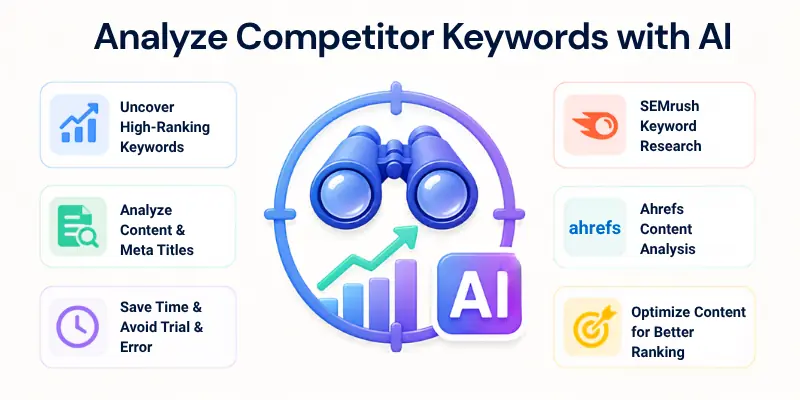
This helps me optimize my content better. Personally, learning from competitors saves me trial and error.
Tools I use
- SEMRush – competitor keyword research
- Ahrefs – competitor content analysis
9. Group Keywords by Intent and Topic
Not all keywords are equal. I group them by intent – informational, transactional, or navigational. AI tools help me categorize keywords for better content planning. This improves content relevance and ranking potential. Personally, this step makes my content structured and user-friendly.
Tools I use
- ClusterAi – AI-based keyword clustering
- Notion AI – organize keywords by topic
10. Track Keyword Performance Over Time
After publishing content, I track how my keywords perform. AI tools give me updates on rankings, clicks, and impressions. This helps me improve underperforming content. Personally, tracking keeps my strategy data-driven and efficient. I also adjust my keyword focus based on these insights.
Tools I use
- SEMRush Position Tracking – track keyword rankings
- Google Search Console – monitor performance
Why AI Tools Make Keyword Research Easier
For me, AI tools completely transformed how I do keyword research. Before, I would spend hours manually compiling lists, checking search volumes, and analyzing competition. Now, AI helps me get accurate data in minutes, saving time and effort. I feel more confident choosing keywords that actually bring traffic and engagement.
Another reason I love AI tools is they reveal opportunities I might miss manually. Long-tail keywords, content gaps, and trending topics are easier to find. AI also helps me organize and plan content logically. From my experience, using AI makes keyword research faster, smarter, and more efficient than ever.
Conclusion
In this guide, I have covered how to use AI tools for keyword research from planning to tracking in a clear, step-by-step way. I personally suggest starting with one or two AI tools and exploring more as you get comfortable. AI does not replace creativity, but it makes research faster and more accurate. Now that you understand how to use AI tools for keyword research, you can plan content confidently and grow your online presence.
FAQs About How to Use AI Tools for Keyword Research
Here are some of the most commonly asked questions related to how to use AI tools for keyword research:
It’s not difficult at all. I began by utilizing tools that were simple to operate, and I gradually gained knowledge. Through practice, conducting keyword research becomes a quick and easy process.
Yes, even novices will have no trouble using them. The vast majority of tools have straightforward user interfaces and instructions. From my own experience, I found them to be very helpful and suitable for beginners.
Indeed, the majority of tools offer trustworthy information regarding search volumes, trends, and competition. Important keywords are always subjected to a cross-check. Due to this, I am able to make intelligent choices.
They do, in fact, save a great deal of time. Tasks that used to take hours to complete now only take minutes. Because of this, I am able to concentrate on producing content rather than attempting to guess keywords.
There is no doubt that AI tools are fantastic for long-tail keywords. I make use of them to locate particular phrases that correspond to the user’s intent. In most cases, these keywords attract a greater amount of targeted traffic.
There is no doubt that AI makes competitor analysis simpler. Using this information, I am able to improve my own content strategy and see which keywords my competitors rank for. This provides an advantage over other competitors.
It is not always the case. A great number of tools offer free plans that are adequate for novices. Versions that require payment offer more advanced data and insights, which speeds up the process.
There is no doubt that they offer continuous performance data. This allows me to keep the content up to date and optimized. By tracking, I can ensure that my strategy continues to be data-driven and effective.





- Be Respectful
- Stay Relevant
- Stay Positive
- True Feedback
- Encourage Discussion
- Avoid Spamming
- No Fake News
- Don't Copy-Paste
- No Personal Attacks
- Be Respectful
- Stay Relevant
- Stay Positive
- True Feedback
- Encourage Discussion
- Avoid Spamming
- No Fake News
- Don't Copy-Paste
- No Personal Attacks
