Best AI Tools for Digital Marketing and Online Success
Published: 29 Jun 2026
Digital marketing now runs on speed, accuracy, and automation. Many businesses already use AI to reduce manual work in content creation, SEO, ads, and customer targeting. Studies from 2025 show that more than 70% of marketers now rely on AI tools in their daily workflow to improve results and save time.
The demand for smarter tools keeps rising because competition in online marketing grows every day. Marketers who use AI can test campaigns faster, create better content, and improve decision-making with real data.
In this article, we will discuss the best AI tools for digital marketing in detail. You will also learn how these tools help in SEO, content creation, ads, and automation to grow your business effectively.
Tools For Digital Marketing
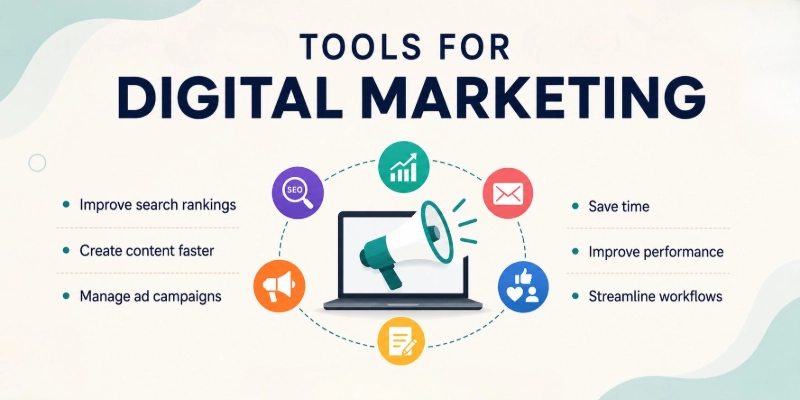
Digital marketing involves many different activities, from improving search rankings to creating content and managing advertising campaigns. To handle these tasks efficiently, marketers use specialized tools that help save time, improve performance, and streamline workflows.
Different tools serve different purposes, which is why understanding their roles can help you choose the right solutions for your marketing goals.
The following are some of the most commonly used tools for digital marketing:
- AI Tools for SEO
- AI Tools for Content Writing
- AI Tools for Social Media Marketing
- AI Tools for Email Marketing
- AI Tools for Paid Ads
- AI Tools for Analytics
- AI Tools for Video Marketing
- AI Chatbots & Customer Support Tools
- AI Tools for Conversion Rate Optimization (CRO)
- All-in-One AI Marketing Tools
1. AI Tools for SEO – Improve Rankings & Keyword Research
AI has completely changed how SEO works today. Instead of doing everything manually, marketers now use AI tools to speed up research, improve rankings, and understand what competitors are doing. These tools help you make smarter decisions based on real data instead of guesswork.
SEO AI tools mainly focus on helping you find the right keywords, study your competition, and optimize your content so it performs better on Google search results.
What these tools do:
These tools are mainly designed to support SEO tasks such as:
- Find profitable and low-competition keywords that can bring traffic
- Analyze competitor websites to understand their SEO strategy
- Optimize blog content so it ranks higher on search engines like Google
Tools used:
Below are some of the most widely used AI SEO tools:
- Ahrefs – Helps you analyze backlinks, track competitors, and discover strong keyword opportunities
- SEMrush – Used for keyword research, site audits, and complete SEO performance tracking
- Surfer SEO – Optimizes your content based on top-ranking pages and improves on-page SEO structure
- Frase – Creates AI-powered content briefs and helps you write SEO-friendly articles faster
2. AI Tools for Content Writing – Create Blogs, Articles & Copy
AI tools have made content creation much faster and more structured. Marketers no longer need to spend hours writing from scratch. These tools help generate high-quality content ideas, improve writing flow, and create ready-to-use drafts for blogs, ads, and landing pages.
Today, businesses use AI writing tools to produce consistent content at scale while maintaining quality and SEO performance. This helps them stay active online and publish content more regularly.
What these tools do:
These tools are commonly used for content creation tasks such as:
- Write blog posts and long-form articles in minutes
- Generate ad copy, sales pages, and landing page content
- Improve writing speed, clarity, and overall content quality
Tools used:
Here are some of the most popular AI writing tools:
- ChatGPT – Helps generate blog ideas, outlines, and full articles with flexible writing styles
- Jasper AI – Focuses on marketing copywriting, brand messaging, and persuasive content
- Copy.ai – Creates short-form content like captions, ads, and product descriptions
- Writesonic – Generates SEO-optimized blog posts and helps with structured content creation
3. AI Tools for Social Media Marketing – Posts, Captions & Scheduling
AI has made social media marketing faster and more consistent. Instead of manually creating every post, marketers now use AI tools to design content, write captions, and schedule posts automatically across different platforms.
These tools also help brands stay active online by keeping content regular and engaging without spending too much time on daily posting tasks.
What these tools do:
These tools mainly focus on improving daily social media workflow by:
- Create engaging social media posts in seconds
- Generate captions, hashtags, and content ideas
- Schedule posts automatically for different platforms
Tools used:
Some widely used platforms in this space include:
- Canva Magic Studio – Helps design social media posts with AI-powered templates and visuals
- Lately AI – Turns long-form content into multiple social media posts automatically
- Ocoya – Combines content creation, scheduling, and automation in one platform
4. AI Tools for Email Marketing – Automation & Personalization
Email marketing has become more effective with AI-driven automation and personalization. These tools help businesses send targeted emails, follow up with customers, and improve engagement rates with less manual effort.
Marketers now use AI to understand user behavior and deliver the right message at the right time, which increases open rates and conversions.
What these tools do:
In practical use, these tools are designed to:
- Create and manage email campaigns automatically
- Send follow-up emails based on customer actions
- Improve open rates with personalized messaging
Tools used:
Some of the most trusted email marketing tools are:
- Mailchimp AI – Automates email campaigns and improves audience targeting
- HubSpot AI – Combines CRM with email marketing and smart automation
- ActiveCampaign – Builds advanced email workflows and customer journeys
5. AI Tools for Paid Ads – Better PPC Performance
Paid advertising has become more data-driven with AI tools. These tools help marketers create better ads, target the right audience, and improve ad performance through smart optimization.
AI also reduces wasted ad spend by testing different versions and selecting the best-performing campaigns automatically. This makes ad campaigns more efficient and helps businesses get higher returns with lower costs.
What these tools do:
At their core, these platforms help marketers by:
- Generate high-converting ad copies
- Improve audience targeting for better results
- Optimize ad performance through real-time data
Tools used:
Some leading tools used in paid ads include:
- Google Ads AI – Uses smart bidding and automation to improve ad performance
- Meta Ads AI – Optimizes Facebook and Instagram ads for better reach and conversions
- AdCreative.ai – Generates high-quality ad creatives and visuals automatically
6. AI Tools for Analytics – Track Marketing Performance
AI analytics tools help marketers understand how their campaigns are performing. Instead of manually checking reports, these tools analyze data and provide clear insights in real time.
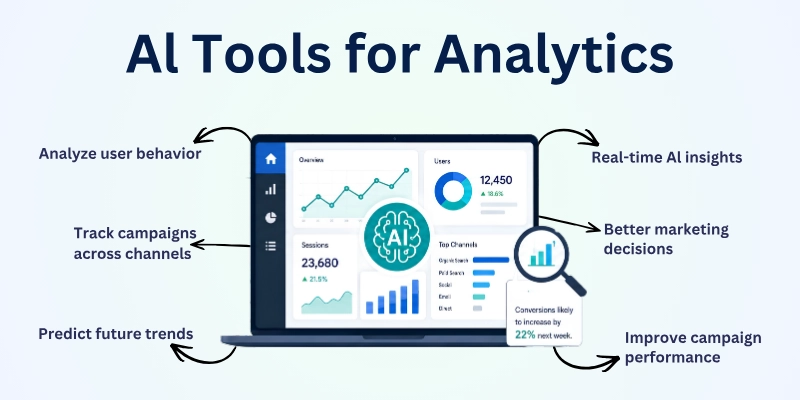
They help businesses make better decisions by showing what works, what does not, and where improvements are needed. This allows marketers to quickly adjust their strategies and improve overall campaign performance.
It also helps in predicting future trends so businesses can stay ahead of competition.
What these tools do:
In simple terms, these tools are built to:
- Analyze user behavior on websites and apps
- Track marketing campaigns across channels
- Predict future performance trends using data
Tools used:
Popular analytics solutions include:
- Google Analytics 4 – Tracks website traffic, user behavior, and conversions
- PaveAI – Converts analytics data into simple AI-driven reports
- Tableau AI – Provides advanced data visualization and marketing insights
7. All-in-One AI Marketing Tools – Everything in One Place
All-in-one AI tools help marketers manage multiple tasks from a single platform. Instead of using separate tools for SEO, content, and ads, these platforms combine everything together.
This saves time, reduces complexity, and improves overall marketing efficiency. It also allows marketers to manage complete campaigns from one dashboard without switching between different tools. As a result, teams can work faster and maintain better control over their marketing strategy.
What these tools do:
These platforms are generally built to:
- Combine SEO, content creation, and marketing automation
- Reduce the need for multiple separate tools
- Simplify marketing workflow and save time
Tools used:
Some powerful all-in-one solutions include:
- HubSpot AI – Complete marketing platform with CRM, email, and automation features
- SEMrush – Offers SEO, keyword research, content tools, and competitor analysis
- Writesonic – Supports content writing, ads creation, and blog generation in one place
8. AI Tools for Video Marketing – Create & Edit Videos Faster
Video marketing has become one of the most powerful ways to engage audiences, and AI tools have made the entire process much faster and easier. Instead of spending hours on editing and production, marketers now use AI to create professional-quality videos in less time.
These tools help businesses produce engaging video content for social media, ads, and branding while saving both time and effort.
What these tools do:
These tools mainly focus on improving video creation and editing by:
- Create engaging marketing videos automatically from text or scripts
- Edit videos quickly with AI-powered effects and templates
- Add captions, transitions, and voiceovers with less manual work
Tools used:
Below are some popular AI tools used in video marketing:
- Pictory AI – Converts scripts and blog content into engaging videos automatically
- Runway ML – Provides advanced AI video editing and visual effects
- Synthesia – Creates AI-generated videos with realistic virtual presenters
- InVideo AI – Helps create professional marketing videos using ready-made templates
9. AI Chatbots & Customer Support Tools – Improve Engagement
AI chatbots have transformed how businesses handle customer support by providing instant responses and 24/7 assistance. Instead of relying only on human agents, companies now use AI tools to manage customer queries faster and more efficiently.
These tools improve user experience by reducing waiting time, answering common questions automatically, and guiding customers through simple processes.
What these tools do:
These tools are mainly designed to improve customer communication and support by:
- Provide instant replies to customer queries at any time
- Handle frequently asked questions without human support
- Improve customer engagement through personalized responses
Tools used:
Below are some widely used AI chatbots and support tools:
- ChatGPT API / ChatGPT – Helps create intelligent chatbot responses and customer support automation
- Intercom – Provides AI-powered live chat and customer messaging solutions
- Drift – Focuses on conversational marketing and lead generation through chatbots
- Zendesk AI – Automates customer support tickets and improves response efficiency
10. AI Tools for Conversion Rate Optimization (CRO)
Conversion Rate Optimization focuses on improving the percentage of visitors who take action on a website, such as signing up, buying, or filling out a form. AI tools make this process easier by analyzing user behavior and suggesting changes that increase conversions.
These tools help businesses understand what users like, where they drop off, and how to improve landing pages for better performance.
What these tools do:
These tools mainly help improve website performance and user actions by:
- Analyze user behavior to find drop-off points on websites
- Test different versions of pages to improve conversions (A/B testing)
- Optimize landing pages for better user experience and results
Tools used:
Below are some popular AI tools used for CRO:
- Hotjar AI – Tracks user behavior using heatmaps and session recordings
- Optimizely – Runs A/B testing and helps improve website conversion rates
- VWO (Visual Website Optimizer) – Provides testing, analytics, and conversion insights
- Unbounce Smart Traffic – Automatically sends users to the best-performing landing page version
Which AI Tool Should You Use for Your Digital Marketing Needs?
Choosing the right AI tools depends on your experience level and marketing goals. Different tools work better for different tasks, so it is important to pick the right combination instead of using everything at once.
A simple setup can already give strong results if you match tools with your specific needs like content creation, SEO, ads, or automation.
Recommended tool combinations:
- For beginners: ChatGPT + Canva + Mailchimp
This combination helps you create content, design posts, and manage basic email marketing easily. - For SEO: SEMrush + Surfer SEO.
These tools help you find keywords, optimize content, and improve Google rankings effectively. - For agencies: HubSpot + Jasper + Ahrefs
This stack supports full-scale marketing, including CRM, content creation, and advanced SEO research. - For ads: AdCreative.ai + Google Ads AI
These tools help you create better ad creatives, target the right audience, and improve campaign performance.
Conclusion
In this guide, we have covered the best AI tools for digital marketing. We explored how different AI tools help with SEO, content writing, social media marketing, email campaigns, paid advertising, analytics, video marketing, customer support, and conversion rate optimization.
Choosing the right AI tools can help businesses save time, improve efficiency, and achieve better marketing results. By using the tools that match your goals, you can streamline your workflow and stay competitive in the digital marketing landscape.
Personal Recommendation: I recommend starting with a few essential AI tools rather than trying to use everything at once. Focus on tools that solve your biggest marketing challenges and gradually expand your toolkit as your needs grow.
Thank you for taking the time to read this guide. I hope it helps you find the right AI tools for your digital marketing success.
💬 We’d love to hear your thoughts! Share your experience or favorite AI marketing tool in the comments below and join the conversation. 🚀✨
Frequently Asked Questions (FAQs)
Below are some frequently asked questions about the AI tools for digital marketing and their practical uses.
The best AI tools for digital marketing depend on your goals. Popular options include ChatGPT for content creation, SEMrush for SEO, Canva for social media design, and HubSpot for marketing automation. These tools help marketers save time and improve campaign performance.
Yes, many AI marketing tools are beginner-friendly and require little technical knowledge.
Following are some beginner-friendly options:
- ChatGPT for content writing
- Canva for graphics and social media posts
- Mailchimp for email marketing
These tools offer simple interfaces and helpful templates.
AI SEO tools analyze keywords, competitors, and content performance. They help marketers identify ranking opportunities and optimize content for search engines. This can improve organic traffic and search visibility over time.
Several AI content writing tools are available for blogs, articles, and marketing copy.
Some commonly used tools include:
- ChatGPT for content generation
- Jasper AI for marketing copywriting
- Writesonic for SEO-focused articles
Each tool supports different content creation needs.
Yes, AI tools can make social media management more efficient. They help create posts, generate captions, suggest hashtags, and schedule content automatically. This allows marketers to maintain a consistent online presence.
When comparing AI marketing software, consider the following features:
- Automation capabilities
- SEO and analytics support
- Content creation tools
- Integration with other platforms
Choosing tools with these features can improve productivity and campaign results.
AI can significantly improve PPC campaigns by analyzing data and optimizing ads automatically. It helps marketers target the right audience and adjust bids based on performance. This often leads to better conversion rates and reduced ad costs.
Yes, many free AI tools for digital marketing are available for beginners and small businesses.
Popular free options include:
- ChatGPT free version
- Canva free plan
- Google Analytics 4
- Mailchimp free plan
These tools provide useful features without requiring a large budget.
AI analytics tools process large amounts of marketing data quickly. They identify trends, track customer behavior, and highlight areas that need improvement. This helps businesses make more informed marketing decisions.
Using multiple AI tools often delivers better results because each tool serves a different purpose. For example, a business may use SEMrush for SEO, ChatGPT for content creation, and HubSpot for automation. Combining the right tools creates a more effective digital marketing strategy.





- Be Respectful
- Stay Relevant
- Stay Positive
- True Feedback
- Encourage Discussion
- Avoid Spamming
- No Fake News
- Don't Copy-Paste
- No Personal Attacks
- Be Respectful
- Stay Relevant
- Stay Positive
- True Feedback
- Encourage Discussion
- Avoid Spamming
- No Fake News
- Don't Copy-Paste
- No Personal Attacks
