Copy.ai vs Writesonic: Which One Fits Your Content Needs?
Published: 25 Aug 2026
Choosing between Copy.ai vs Writesonic gets tricky when daily content writing already feels hard. It eats up your time. It drains your energy. And it’s easy to run out of fresh ideas. That’s why so many writers turn to AI tools for help. But picking the wrong one can waste your money and your time.
This Copy.ai vs Writesonic guide breaks down both tools clearly. You’ll learn which one actually solves your content problems, so you can stop guessing and start writing. Both tools promise speed and quality, but they don’t work the same way.
Copy.ai shines when you need quick, punchy copy like ads and product descriptions. Writesonic leans more toward long blog posts and SEO content. Knowing this difference matters. It saves you from picking a tool that doesn’t fit your daily work.
In the next sections, we’ll compare features, pricing, and ease of use side by side. That way, you can make a confident choice, not a guess.
What Is Copy.ai?
Copy.ai is an AI writing tool built for speed. It helps you create content in seconds using simple prompts. Instead of staring at a blank page, you type what you need, and Copy.ai gives you a draft to work with. It works well for people who write a lot of short content, like ads, emails, and product descriptions.
Many users pick Copy.ai for its ease of use. You don’t need any writing experience to get started. The tool guides you step by step, which makes it a strong choice if you’re searching for Copy.ai vs Writesonic for beginners. It also offers a range of ready-made templates, so you’re not starting from scratch every time.
Here’s what Copy.ai does best:
- Short-form copy: Ads, social captions, and product descriptions
- Brainstorming: Headlines, taglines, and content ideas
- Templates: Pre-built formats for common writing tasks
- Team tools: Options to collaborate and share content with others
- Multiple languages: Support for writing in different languages
If you often check Copy.ai vs Writesonic templates before picking a tool, Copy.ai stands out here. It offers a large library built for fast, repeatable tasks. This makes it a solid pick for marketers and small business owners who need quick content without a steep learning curve.
That said, Copy.ai isn’t built for long articles. If your main need is blog posts or in-depth guides, you may want a tool with stronger long-form support — which is exactly where the comparison gets interesting.
What Is Writesonic?
Writesonic is an AI writing tool built for longer content. It helps you create blog posts, articles, and website copy that’s ready to publish with light editing. Unlike tools made for short bursts of text, Writesonic focuses on structure. It can build full outlines, then turn them into complete articles.
This makes Writesonic a strong pick if you’re weighing Copy.ai vs Writesonic for SEO content. The tool includes features that help your content rank, like keyword suggestions and readability checks. Writers who publish blogs often or manage a content calendar find this useful, since it cuts down on planning time.
Here’s what Writesonic does best:
- Long-form articles: Full blog posts, guides, and landing pages
- SEO tools: Built-in keyword and ranking support
- Article outlines: Auto-generated structure before you write
- Bulk content: Create multiple pieces at once for larger projects
- Chatbot and ad copy: Extra tools beyond just blog writing
For teams that publish content regularly, Writesonic often comes up in searches for Writesonic vs Copy.ai for agencies. Agencies managing several clients benefit from its bulk content features and SEO focus, since it saves time across multiple projects.
Writesonic does have a learning curve. Because it offers more tools and settings, new users may need a bit more time to explore everything. But once you’re familiar with the layout, it becomes a strong tool for anyone focused on ongoing blog content.
Copy.ai vs Writesonic (Comparison Table)
Before going deeper into each feature, here’s a quick side-by-side view. This table gives you a fast answer if you’re short on time and just want the key facts.
| Feature | Copy.ai | Writesonic |
| Best for | Short-form copy, ads, brainstorming | Long-form blogs, SEO articles |
| Free plan | Yes, limited words | Yes, limited words |
| Ease of use | Very beginner-friendly | Slight learning curve |
| Templates | Large template library | Fewer templates, more structure tools |
| SEO tools | Basic | Strong, built-in SEO support |
| Team features | Yes, collaboration tools | Yes, bulk content tools |
| Support | Email and chat support | Email and chat support |
| Best user type | Marketers, small business owners | Bloggers, agencies, content teams |
This table answers the common question behind Copy.ai vs Writesonic pricing and Copy.ai vs Writesonic features at a glance. Both tools offer a free plan, so you can test them before paying. But your final choice really depends on what you write most.
Key Differences Between Copy.ai and Writesonic
Copy.ai and Writesonic both use AI to write content, but they solve different problems. One is built for speed and short bursts of text. The other is built for depth and long-form structure. Knowing these differences helps you avoid picking a tool that doesn’t match your daily work.
Here are the main points of difference:
- Content length focus
- Writing purpose and use case
- SEO capability
- Content structure and planning
- Speed vs depth
- Best fit by user type
1. Content Length Focus
When it comes to content length, Copy.ai and Writesonic take two different paths. Copy.ai works best in short bursts. It’s built to give you quick, punchy text that you can use right away, without much editing. Writesonic, on the other hand, is made for longer writing. It can hold structure and flow across hundreds or thousands of words, which is something short-form tools usually struggle with.
Copy.ai:
- Best for short text under 300 words
- Strong for one-liners, headlines, and captions
- Output feels quick and to the point
- Less focus on connecting ideas across paraAIaphs
Writesonic:
- Best for long-form content, often 1,000+ words
- Strong for blog posts, guides, and landing pages
- Output keeps structure across multiple sections
- More focus on flow from one idea to the next
If your daily work involves quick content like ads or captions, Copy.ai’s short-form strength saves you time. But if you’re writing full articles that need to stay organized from start to finish, Writesonic’s long-form design fits better.
2. Writing Purpose and Use Case
Beyond length, these tools also differ in why you’d use them. Copy.ai is built for speed-first tasks, where you need many quick options fast. Writesonic is built for depth-first tasks, where one piece of content needs to be well-researched and fully developed.
Copy.ai:
- Great for brainstorming multiple ad variations at once
- Useful for quick email subject lines or product blurbs
- Helps you test different tones and angles fast
- Works well when you need volume, not depth
Writesonic:
- Great for building a single, well-structured article
- Useful for guides that need research and clear sections
- Helps you stay on-topic across a long piece
- Works well when you need depth, not just volume
So the real question isn’t which tool is “better”; it’s which task you’re solving for. If you need ten quick options in five minutes, Copy.ai wins. If you need one strong, structured article that covers a topic fully, Writesonic wins.
3. SEO Capability
Search visibility is often the deciding factor for content teams, and this is where the two tools clearly separate. Writesonic builds SEO support directly into the writing process, so you’re checking rankings and readability as you go.
Copy.ai treats SEO as a smaller add-on, since its main strength lies elsewhere. If you’re comparing tools based on Copy.ai vs Writesonic for SEO content, this difference matters more than almost any other factor.
Copy.ai:
- Offers basic keyword input, but no deep SEO scoring
- Works fine for short content where ranking isn’t the main goal
- Doesn’t track readability or search performance in-depth
- Better suited for content that isn’t search-dependent, like ads
Writesonic:
- Includes built-in keyword and ranking checks while you write
- Shows readability scores to help content perform better in search
- Helps structure content around what search engines look for
- Strong fit for blogs and websites that rely on organic traffic
If ranking on Google matters to your content strategy, Writesonic’s built-in SEO tools give you a clear edge. This is one of the biggest reasons agencies and bloggers lean toward it over Copy.ai.
4. Content Structure and Planning
The second major gap between these tools is how they handle planning. Writesonic doesn’t just write; it plans first. It can generate a full outline before producing the article, which keeps long content organized from the very first draft.
Copy.ai skips this planning stage, since it’s designed for standalone pieces rather than multi-section articles. This is a key point if you often search Copy.ai vs Writesonic templates to see which tool gives you a head start.
Copy.ai:
- No built-in outline or planning step
- Templates focus on single pieces, not full articles
- Best for content that doesn’t need multiple sections
- Faster to start, since there’s no planning stage
Writesonic:
- Generates a structured outline before writing begins
- Helps organize long content into clear sections
- Reduces the risk of a disorganized or repetitive article
- Better for content that needs a logical flow from start to end
For quick, single-purpose content, skipping the planning step isn’t a problem. But for longer pieces, that missing structure can mean more editing work later, which is exactly what Writesonic’s outline-first approach helps you avoid.
5. Speed vs Depth
Every AI writing tool makes a trade-off between how fast it works and how much depth it delivers, and Copy.ai and Writesonic sit on opposite ends of that scale. Copy.ai is built to hand you a finished draft almost instantly, which works well when you need options fast.
Writesonic takes a little more time, since it’s generating longer, more connected content. This trade-off often comes up when people search Copy.ai vs Writesonic accuracy, since speed and depth both affect how polished the final draft feels.
Copy.ai:
- Delivers short drafts in just a few seconds
- Great when you need many quick versions to choose from
- Less time spent per piece, since output is brief
- Ideal for fast-moving tasks like daily social posts
Writesonic:
- Takes a bit longer to generate full articles
- Produces more developed, connected content per draft
- More time spent per piece, but less editing needed after
- Ideal for tasks where one strong draft matters more than many quick ones
Neither speed nor depth is “better” on its own. It depends on your task. If you’re pumping out daily content, Copy.ai’s speed saves you time. If you’re producing one important article a week, Writesonic’s depth saves you from heavy rewrites later.
6. Best Fit by User Type
The last major difference comes down to who each tool actually serves best. Copy.ai fits people who need variety and speed across many small tasks. Writesonic fits people who need one well-built piece of content, especially when that content needs to perform well over time.
This is often the deciding factor for anyone comparing Copy.ai vs Writesonic for beginners or checking Writesonic vs Copy.ai for agencies.
Copy.ai:
- Marketers running multiple ad campaigns
- Social media managers who post daily
- Small business owners writing product copy
- Beginners who want a simple, guided tool
Writesonic:
- Bloggers publishing long-form content regularly
- Agencies managing content for multiple clients
- SEO-focused teams tracking search performance
- Writers who prefer working from a structured outline
Neither tool is a universal winner. The right choice depends on your role and your content goals, which is exactly why this comparison matters more than picking based on price or popularity alone.
Which Tool Is Easier to Use?
Ease of use often decides which tool actually gets used daily, even if the other one has more features. Here’s how each tool holds up when it comes to simplicity and setup.
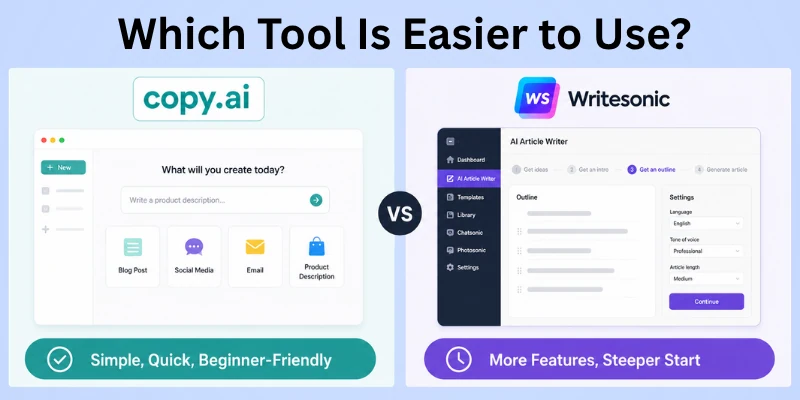
Copy.ai keeps things simple from the start. It has a clean, minimal interface built for quick results, so most users can jump in without any guidance.
- Clear prompts that are easy to understand
- Minimal setup, most templates work instantly
- Great for beginners with no learning curve
- Fast results within minutes of signing up
Writesonic takes a bit more time to get comfortable with, mainly because it offers more tools and settings in one place. Once you understand its workflow, though, it runs smoothly.
- More features visible, which can feel busy at first
- Short learning curve before everything feels familiar
- Outline-first workflow needs a little setup time
- Smooth and efficient once you know the layout
If you’re comparing Copy.ai vs Writesonic for beginners, Copy.ai is the easier starting point. Writesonic’s slightly steeper curve pays off once you’re used to it, especially for long-form work.
Conclusion
So guys, in this article, we’ve covered Copy.ai vs Writesonic in detail. After comparing both tools closely, I’d lean toward Writesonic if long-form, SEO-focused content is your main goal, since its outline-first approach and built-in SEO tools make the writing process smoother.
That said, Copy.ai still holds strong for anyone who needs fast, short content without a learning curve. When it comes to Copy.ai vs Writesonic, there’s no single winner; the right pick depends on your daily writing needs.
If you’re still unsure, test both tools on a real project this week and compare the results yourself. Go ahead and try Copy.ai or Writesonic now, and see which one fits your style.
Frequently Asked Questions
Here are the questions readers often ask after comparing Copy.ai vs Writesonic. These answers keep things short and simple, so you get quick clarity without digging through the whole article again.
It depends on what you write most. Copy.ai works best for short content like ads and captions. Writesonic works best for long-form blogs and SEO-focused articles.
Yes, Copy.ai is very beginner-friendly. It has a simple interface with ready-made templates, so you can start writing without any prior experience. This makes it a strong pick if you’re searching for Copy.ai vs Writesonic for beginners.
Yes, and this is one of its biggest strengths.
- It includes built-in keyword suggestions
- It shows readability scores as you write
- It helps structure content around search intent
- It’s a strong fit for anyone focused on Copy.ai vs Writesonic for SEO content
Both Copy.ai and Writesonic offer free plans with limited word counts. Copy.ai’s free plan suits short, quick tasks well. Writesonic’s free plan works fine for testing its long-form and SEO tools before committing to a paid plan.
Pricing depends on the plan and features you need.
Copy.ai tends to be more budget-friendly for users who only need short-form content, since its lower-tier plans cover most basic needs. Writesonic’s pricing can rise with long-form and bulk content features, but it often delivers strong value for teams producing regular blog content.
If cost is your main concern, compare Copy.ai vs Writesonic pricing plans directly on their sites, since offers can change often.
Yes, this is one of Writesonic’s core strengths. It can generate a full outline first, then build a complete blog post from that structure. This makes it a solid choice for bloggers and content teams publishing regularly.
Yes, Copy.ai works very well here.
- It offers templates built for captions and short posts
- It helps you test different tones quickly
- It’s fast, so you can create daily content without delay
- It suits marketers managing multiple social accounts
Copy.ai is generally easier to use right away, thanks to its clean, minimal interface. Writesonic has more features and settings, so it takes a bit more time to learn. Once you’re familiar with Writesonic, though, it runs smoothly for long-form work
Yes, there are several other AI writing tools on the market. If neither Copy.ai nor Writesonic fits your needs, it’s worth exploring other Copy.ai vs Writesonic alternatives, since some tools focus on niche use cases like technical writing, video scripts, or eCommerce copy.
Comparing a few options helps you find the best match for your specific workflow.
Yes, many users do exactly this. You can use Copy.ai for quick tasks like ads and captions, then switch to Writesonic for full blog posts and SEO content. This combination covers both short-form and long-form writing needs.






- Be Respectful
- Stay Relevant
- Stay Positive
- True Feedback
- Encourage Discussion
- Avoid Spamming
- No Fake News
- Don't Copy-Paste
- No Personal Attacks
- Be Respectful
- Stay Relevant
- Stay Positive
- True Feedback
- Encourage Discussion
- Avoid Spamming
- No Fake News
- Don't Copy-Paste
- No Personal Attacks
