AI Ideas for Small Business Owners: 10 Practical Ways to Grow
Published: 25 Aug 2026
Running a small business is exciting but often stressful because I have to manage everything myself. From marketing and sales to customer support and finances, there is always something to handle. Traditional methods are slow, error-prone, and sometimes guesswork.
I often struggled to analyze customer feedback, plan campaigns, or predict sales manually. This is where artificial intelligence (AI) becomes a game-changer. AI can automate repetitive tasks, analyze data, and provide smart insights to help me make faster and better decisions.
In this guide, I will share AI ideas for small business owners that can save time, increase efficiency, improve customer experience, and ultimately grow revenue.
AI Ideas for Small Business Owners
Here are the best AI ideas that small business owners can implement:
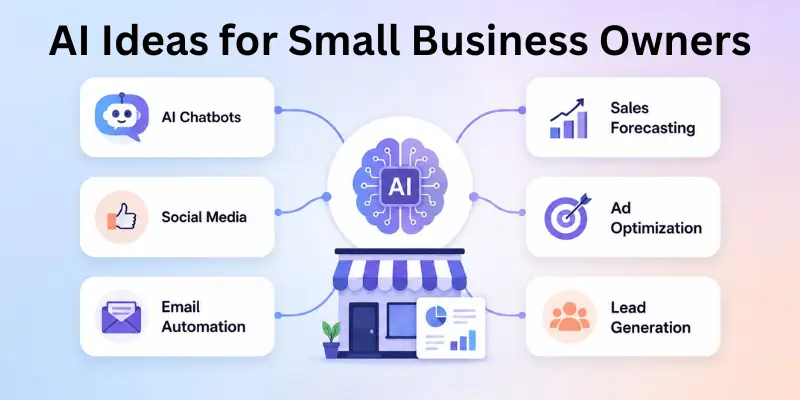
- AI Chatbots for Customer Support
- AI for Social Media Content Creation
- AI Email Marketing Automation
- AI Sales Forecasting
- AI Customer Feedback Analysis
- AI Website Personalization
- AI Ad Optimization
- AI Inventory Management
- AI Accounting and Expense Tracking
- AI Lead Generation and Qualification
Let us explore all of these in detail.
1. AI Chatbots for Customer Support
AI chatbots are like virtual assistants that I use to answer customer questions automatically. They work 24/7, so customers never have to wait for a reply. Chatbots handle common queries such as product details, pricing, order status, and return policies. This frees up my time so I can focus on more complex customer requests or business decisions. Over time, chatbots learn from conversations and get better at responding naturally.
Examples of tools I use:
- Tidio: For easy-to-setup chatbots for websites.
- ManyChat: Helps automate social media messaging.
- Drift: Supports conversational marketing and lead capture.
2. AI for Social Media Content Creation
AI can create social media posts, captions, hashtags, and even suggest trending topics. I no longer spend hours brainstorming content ideas. AI can generate hundreds of post ideas, keeping my brand active and engaging. It also analyzes which posts perform best, helping me improve reach and engagement. I find that content generated by AI saves a lot of time and increases consistency.
Examples of tools I use:
- Copy.ai: Generates captions, blog snippets, and post ideas.
- Lately.ai: Converts long content like blogs into multiple social posts.
- Canva AI: Helps design social media visuals quickly.
3. AI Email Marketing Automation
AI automates email campaigns based on customer behavior. I use it to send personalized emails when someone abandons a cart, signs up, or shows interest in a product. AI also predicts the best time to send emails for maximum engagement. This increases open rates, click-through rates, and conversions. Automated emails ensure no potential customer is forgotten, even if I am busy.
Examples of tools I use:
- Mailchimp: AI helps optimize email timing and subject lines.
- HubSpot: Provides behavior-driven email automation.
- Sender: AI suggests personalized campaigns to increase engagement.
4. AI Sales Forecasting
AI predicts future sales based on past trends and current market data. I use AI to plan inventory, promotions, and staffing more accurately. It reduces guesswork and ensures I do not overstock or understock products. AI sales forecasts help me make data-driven decisions and prepare for seasonal demand. Predictive insights also highlight which products are likely to sell more, improving my overall strategy.
Examples of tools I use:
- Zoho Analytics: Predicts sales trends for small businesses.
- Salesforce Einstein: AI-powered forecasting for sales teams.
- Foresight: Tracks patterns and predicts future customer behavior.
5. AI Customer Feedback Analysis
Reading hundreds of reviews, emails, or survey responses is exhausting. I use AI to automatically analyze customer feedback and identify positive, negative, or neutral sentiments. AI highlights recurring problems, feature requests, and praise. This helps me improve my products or services faster. I also use AI to create reports that show customer opinions at a glance, saving time and improving customer satisfaction.
Examples of tools I use:
- MonkeyLearn: Performs sentiment analysis and categorizes feedback.
- Lexalytics: Analyzes reviews, surveys, and social comments.
- Clarabridge: Converts feedback into actionable insights.
6. AI Website Personalization
AI helps me deliver personalized website experiences. For example, a returning customer sees recommended products based on previous visits, while a new visitor sees popular products or offers. Personalized experiences make customers feel valued and increase conversions.
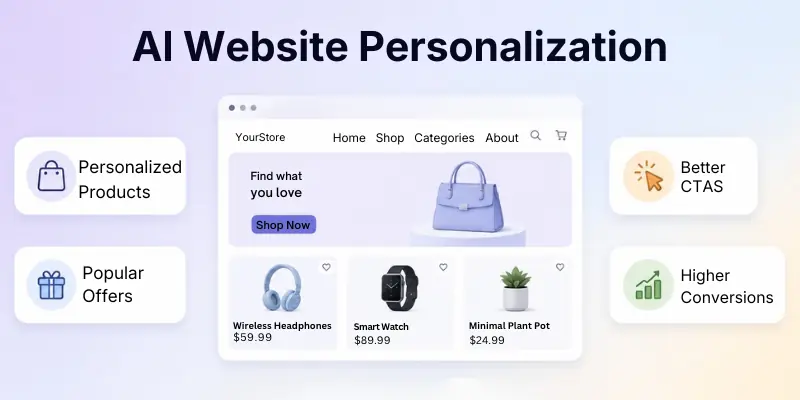
I also use AI to test layouts, headlines, and call-to-actions to see what performs best for different audiences. Over time, the website becomes smarter and more effective at converting visitors.
Examples of tools I use:
- Optimizely: AI-driven personalization and experimentation.
- Dynamic Yield: Customizes experiences based on user behavior.
- Adobe Target: Provides AI recommendations for website content.
7. AI Ad Optimization
AI optimizes online ad campaigns automatically. I use AI to test different creatives, target the right audience, and adjust budgets in real time. It identifies which ads bring the most conversions and which ones waste money. With AI, I can scale campaigns faster while spending less. AI also provides insights on audience behavior and ad performance, helping me refine strategies continuously.
Examples of tools I use:
- Google Ads Smart Bidding: AI optimizes bids for conversions.
- Facebook Ads Manager AI: Targets high-value audiences.
- Adzooma: Uses AI to improve ad campaigns and ROI.
8. AI Inventory Management
AI helps small business owners like me predict inventory needs accurately. It tracks sales patterns, seasonal trends, and product demand. This reduces overstock, stockouts, and wasted money. AI also alerts me when inventory levels are low or high. For businesses selling online or in-store, AI ensures smooth operations and better customer service.
Examples of tools I use:
- TradeGecko / QuickBooks Commerce: Automates stock tracking.
- DEAR Systems: Predicts inventory needs using AI.
- Zoho Inventory: Forecasts demand and manages orders.
9. AI Accounting and Expense Tracking
AI helps me track expenses, categorize costs, and manage cash flow automatically. I no longer spend hours reconciling accounts. AI identifies unusual transactions, flags errors, and predicts cash flow trends. This makes financial management easy and accurate. By keeping finances in order, I can focus on growth instead of bookkeeping stress.
Examples of tools I use:
- QuickBooks: AI categorizes transactions and predicts cash flow.
- Xero: AI-powered bank reconciliation and expense tracking.
- Wave Accounting: Offers AI insights for small business finances.
10. AI Lead Generation and Qualification
AI identifies potential customers based on behavior, interests, and engagement. I focus my efforts on leads that are most likely to convert. AI also scores leads automatically, so I know where to invest my time. This improves sales efficiency and helps grow my business faster. AI makes lead generation smarter and less time-consuming.
Examples of tools I use:
- HubSpot CRM: AI helps qualify and prioritize leads.
- Pipedrive: AI scoring for potential buyers.
- Leadiro: Identifies and qualifies new leads automatically.
Why AI Is Important for Small Business Growth
AI is no longer just for large companies. It helps small business owners like me compete by automating tasks, saving time, and improving decisions. AI allows me to understand customers better, personalize experiences, and grow revenue without hiring a large team.
Businesses that adopt AI early can scale faster, reduce errors, and deliver better products or services. AI provides insights I would never find manually and helps me stay ahead in a competitive market.
Conclusion
In this guide, I have shared practical AI ideas for small business owners that help automate tasks, improve customer experience, and increase revenue.
My advice is to start with one AI tool that solves the most pressing problem, learn it well, and expand gradually. AI works best when it aligns with real business needs and customer expectations. If you want to save time, improve efficiency, and grow your business faster, now is the perfect time to adopt AI.
Take action today and see how these tools can transform your business. Now, let us move on to the FAQs related to this topic.
FAQs
Here are some of the most commonly asked questions related to AI ideas for small business owners:
No, many AI tools are affordable and have flexible plans. I started with free or basic plans and upgraded later. AI saves time and money in the long run. It is a worthwhile investment for growth.
Absolutely not at all. The majority of AI tools are targeted toward novice users. Without having any knowledge of coding, I use them. The owners of businesses and marketers will find them simple to use.
Yes, AI helps target the right audience, personalize messages, and optimize campaigns. I have seen higher conversions and more repeat customers. AI makes marketing more effective.
Most AI platforms follow strict security standards. I always choose trusted tools with clear privacy policies. Data protection is important for business reputation.
I recommend chatbots or email automation first. These show quick results and are easy to manage. They also improve customer experience immediately.
No, AI supports human work instead of replacing it. I use AI to reduce repetitive tasks while focusing on strategy. Human decisions are still essential.
Yes, AI is perfect for local marketing, customer support, and online visibility. I use AI to target local audiences effectively. It improves engagement and sales.
Some results appear within days or weeks. I usually see improvements in efficiency and engagement quickly. Long-term benefits grow as AI learns from more data.




- Be Respectful
- Stay Relevant
- Stay Positive
- True Feedback
- Encourage Discussion
- Avoid Spamming
- No Fake News
- Don't Copy-Paste
- No Personal Attacks
- Be Respectful
- Stay Relevant
- Stay Positive
- True Feedback
- Encourage Discussion
- Avoid Spamming
- No Fake News
- Don't Copy-Paste
- No Personal Attacks
