What is Natural Language Processing: How it Works & Explained
Published: 29 Mar 2026
You may have heard the term “natural language processing” (NLP) and wondered how computers can understand human language.
In this guide, we will explain what natural language processing is, how it works, its components, types, applications, advantages, limitations, and future. By the end, even beginners will clearly understand how machines can interpret and use human language.
What is Natural Language Processing?
In this section, we will explain the basic meaning of NLP and why it is important in modern technology.
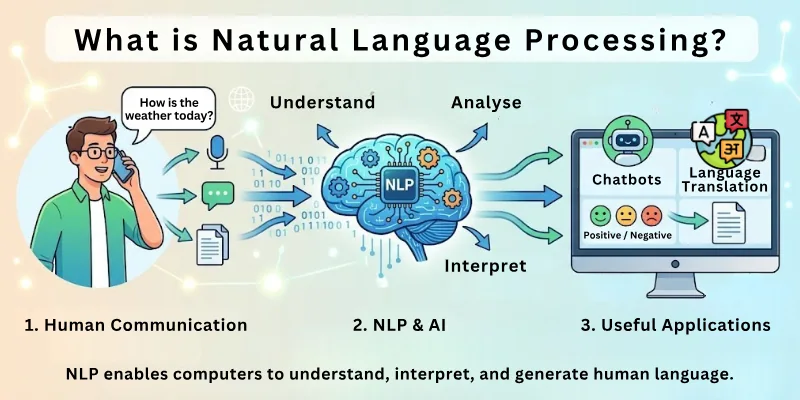
Natural language processing is a branch of computer science that allows machines to read, understand, interpret, and generate human language. It enables computers to communicate with humans naturally, whether through text, speech, or commands.
Key Points
- Helps machines understand human language.
- Can process both spoken and written language.
- Converts human language into data machines can use.
- Used in translation, chatbots, speech recognition, and more.
- Makes communication between humans and machines natural and efficient.
How Natural Language Processing Works
This section explains how NLP systems process human language from input to output.
NLP works by breaking down language into structured data that computers can analyze. It uses algorithms to understand context, meaning, and sentiment.
Main Steps
- Text or Speech Input: The system receives human language as text or audio.
- Preprocessing: Cleans and structures the language, removing errors or irrelevant information.
- Tokenization: Breaks text into smaller parts like words or sentences.
- Parsing and Analysis: Analyzes grammar, syntax, and meaning.
- Semantic Understanding: Determines the meaning, intent, or sentiment of the input.
- Output Generation: Produces responses, translations, predictions, or actions.
Example: A chatbot receives the message “Book me a flight to New York tomorrow.” NLP interprets the meaning, extracts relevant information, and guides the system to book the flight correctly.
Components of Natural Language Processing
This section explains the main components of NLP and what each does.
- Syntax Analysis: Checks grammar, sentence structure, and word order.
- Semantics: Understands the meaning of words and sentences.
- Tokenization: Breaks text into smaller units like words or phrases.
- Named Entity Recognition: Identifies names, places, dates, and other important entities.
- Sentiment Analysis: Determines the tone or emotion in text (positive, negative, neutral).
- Machine Translation: Converts text from one language to another while keeping meaning.
Types of Natural Language Processing
This section explains the different types of NLP systems and where they are used.
1. Rule-based NLP
- Follows predefined grammar rules.
- Used for simple text processing tasks.
2. Statistical NLP
- Uses probabilities and data patterns to understand language.
- Learns from large datasets to improve accuracy.
3. Machine Learning-based NLP
- Uses algorithms to train on datasets and predict outputs.
- Common in chatbots, translation, and sentiment analysis.
4. Deep Learning NLP
- Uses neural networks for advanced language understanding.
- Applied in virtual assistants, voice recognition, and AI writing tools.
Applications of Natural Language Processing
This section explains where NLP is applied in the real world and why it is important.
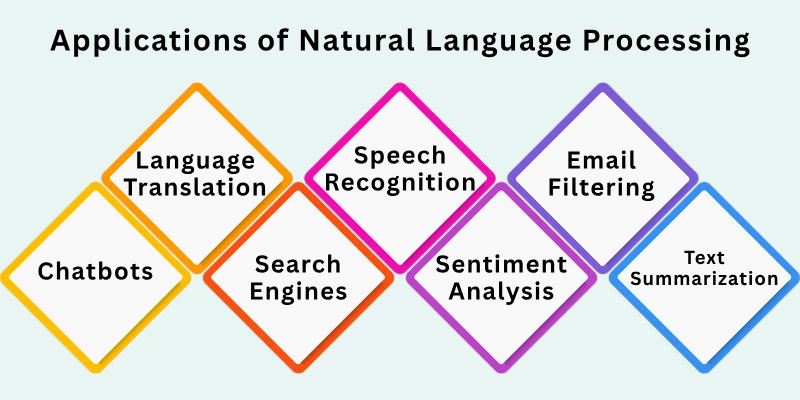
Main Applications
- Chatbots and Virtual Assistants: Siri, Alexa, Google Assistant.
- Language Translation: Google Translate, real-time translation tools.
- Sentiment Analysis: Understanding customer feedback on social media.
- Speech Recognition: Converting spoken words into text.
- Email Filtering: Detecting spam emails.
- Text Summarization: Summarizing long documents automatically.
- Search Engines: Improving query understanding and search results.
Advantages of Natural Language Processing
This section explains why NLP is valuable.
Key Advantages
- Helps machines understand human language naturally.
- Reduces manual effort in reading and processing text.
- Enables real-time communication between humans and computers.
- Improves customer experience with chatbots and assistants.
- Can process huge volumes of text or speech efficiently.
Limitations of Natural Language Processing
This section explains the challenges and drawbacks of NLP.
Main Limitations
- Difficult to fully understand context, sarcasm, and cultural nuances.
- Requires large, clean datasets for training.
- Complex grammar and slang can reduce accuracy.
- High computing power needed for deep learning NLP models.
- Can make mistakes in translation or sentiment interpretation.
Future of Natural Language Processing
This section explains how NLP is evolving and what to expect in the future.
Future Possibilities
- Smarter chatbots and virtual assistants with better context understanding.
- Advanced language translation in real-time across multiple languages.
- Improved sentiment analysis for businesses and social media monitoring.
- Integration with AI for personalized recommendations and human-computer interaction.
- More natural, human-like communication with machines.
Final Note
In this guide, we have covered what natural language processing is in great detail. You now understand its meaning, working process, components, types, applications, advantages, limitations, and future possibilities. NLP makes human-computer communication simple and efficient, and it is a cornerstone of many technologies we use every day.
Understanding step by step makes NLP easy, even for beginners. Stay curious, explore more, and see how language and technology are coming together in exciting ways.
Goodbye, and keep learning the amazing world of natural language processing!
FAQs: What is NLP?
Here are some of the most commonly asked questions related to the natural language processing:
Natural language processing is a technology that allows machines to understand, interpret, and generate human language. It is used in applications like chatbots, virtual assistants, and translation tools to make communication with computers easier.
NLP works by breaking down text or speech into smaller parts, analyzing grammar, meaning, and context. Algorithms then process this information to produce outputs like translations, predictions, or responses.
The key components are tokenization, syntax analysis, semantics, sentiment analysis, and named entity recognition. Each part helps the system understand the structure, meaning, and tone of the language.
Types include rule-based NLP, statistical NLP, machine learning-based NLP, and deep learning NLP. Each type has different methods to analyze text or speech and is used for specific tasks.
NLP is used in chatbots, virtual assistants, translation tools, email filtering, sentiment analysis, and search engines. It helps computers understand and respond to human language efficiently.
It enables machines to understand human language naturally, process large amounts of text quickly, and improve communication. NLP also reduces human effort in reading, analyzing, and responding to text or speech.
NLP struggles with context, sarcasm, slang, and cultural differences. It requires large datasets, high computing power and sometimes makes mistakes in understanding or translating language.
NLP helps chatbots and assistants like Siri, Alexa, and Google Assistant understand user requests, answer questions, and perform tasks. It allows machines to interact with humans naturally and efficiently.
NLP analyzes text from social media, reviews, or messages to detect emotions, opinions, or customer feelings. Businesses use this to improve products, services, and customer engagement.
The future includes smarter virtual assistants, advanced real-time translation, better sentiment detection, and more human-like communication. NLP will continue to improve how humans and machines interact daily.


- Be Respectful
- Stay Relevant
- Stay Positive
- True Feedback
- Encourage Discussion
- Avoid Spamming
- No Fake News
- Don't Copy-Paste
- No Personal Attacks
- Be Respectful
- Stay Relevant
- Stay Positive
- True Feedback
- Encourage Discussion
- Avoid Spamming
- No Fake News
- Don't Copy-Paste
- No Personal Attacks
