Will AI Replace Teachers? Future of Education Guide
Published: 10 May 2026
Artificial intelligence is revolutionizing education by automating tasks, providing personalized learning, and assisting with grading and administrative work. AI can now tutor students, generate lesson plans, and even answer questions in real time. This has sparked a common concern: Will AI replace teachers?
In this guide, we will explore how AI is changing teaching, whether it can fully replace educators, and how teachers can use AI as a powerful support tool.
Will AI Replace Teachers?
The short answer is: No, AI will not replace teachers, but it will transform their roles. AI enhances education by providing tools that support teaching, but human teachers bring empathy, creativity, and real-world experience that AI cannot replicate.
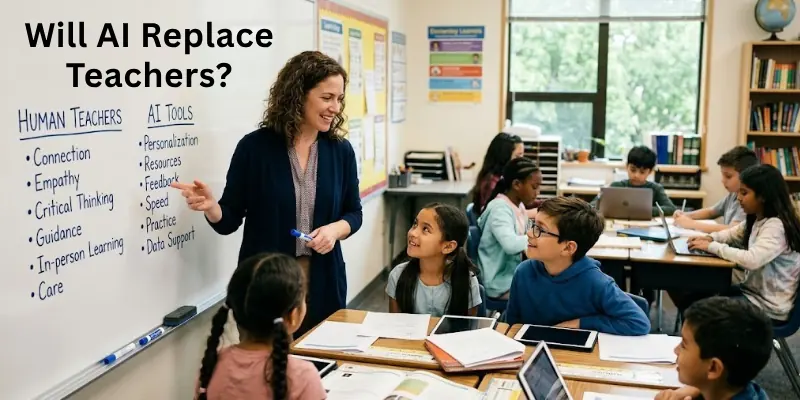
Here are the major ways AI is impacting the teaching profession:
- Personalized Learning Support
- Automated Grading And Feedback
- AI Tutoring And Assistance
- Lesson Plan Generation
- Data-Driven Insights On Student Performance
- Virtual Classrooms And Chatbots
- Administrative Task Automation
- Adaptive Learning Pathways
- Supporting Special Education
- Encouraging Collaborative Learning
- Enhancing Teacher Productivity
- AI Cannot Replace Emotional Guidance
So, let us explore each in detail.
1. Personalized Learning Support
AI can analyze student data to create personalized learning experiences. It identifies strengths, weaknesses, and learning preferences. Teachers can use this information to focus on students who need extra help.
How Teachers Can Use AI:
- Assign AI-generated customized exercises.
- Track student progress in real time.
- Provide additional resources based on AI analysis.
- Adjust teaching strategies for individual needs.
2. Automated Grading And Feedback
Artificial intelligence is capable of grading multiple-choice tests, assignments, and even essays in certain circumstances. This lessens the amount of work that teachers have to do and enables them to concentrate more on teaching rather than grading.
How Teachers Can Use AI:
- Use AI to grade routine assignments.
- Provide instant feedback to students.
- Track trends in student performance.
- Identify common mistakes for class discussion.
3. AI Tutoring And Assistance
Student learning can be facilitated through the use of AI-powered tutoring systems. They are able to provide practice problems, explain concepts, and provide solutions that contain step-by-step instructions.
How Teachers Can Use AI:
- Assign AI tutoring for homework support.
- Supplement classroom lessons with AI tools.
- Monitor student AI usage to ensure understanding.
- Encourage self-paced learning.
4. Lesson Plan Generation
Lesson plans, quizzes, and other learning materials can be quickly created with the assistance of artificial intelligence. In addition to ensuring that lessons are effectively structured, this helps save time.
How Teachers Can Use AI:
- Generate drafts of lesson outlines.
- Create quiz questions automatically.
- Customize content based on student level.
- Update lessons with the latest educational resources.
5. Data-Driven Insights On Student Performance
The results of AI’s analysis of attendance, grades, and engagement metrics can provide insights that can be put into action. In order to intervene early with students who are having difficulty, teachers can use this.
How Teachers Can Use AI:
- Identify students at risk of falling behind.
- Monitor engagement in virtual classes.
- Adjust teaching strategies based on trends.
- Share performance analytics with parents.
6. Virtual Classrooms And Chatbots
AI chatbots provide assistance in virtual classrooms and provide answers to common questions asked by students. This enables educators to concentrate on more difficult concepts and provide individualized assistance.
How Teachers Can Use AI:
- Deploy chatbots for FAQ handling.
- Track participation and engagement.
- Automate reminders for assignments or exams.
- Use virtual platforms for remote support.
7. Administrative Task Automation
Teachers can benefit from the use of AI in terms of scheduling, tracking attendance, and reporting. This lessens the burden of administrative work and frees up time for direct instruction.
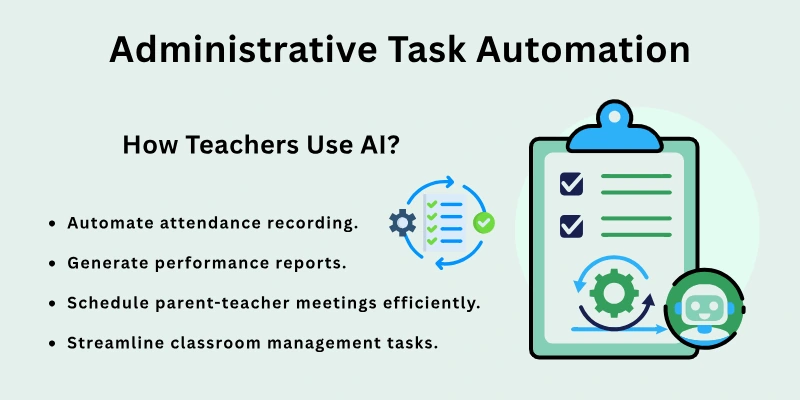
How Teachers Can Use AI:
- Automate attendance recording.
- Generate performance reports.
- Schedule parent-teacher meetings efficiently.
- Streamline classroom management tasks.
8. Adaptive Learning Pathways
AI has the ability to generate adaptive learning pathways based on the progress of students. This ensures that every student is able to move at their own pace while challenging themselves.
How Teachers Can Use AI:
- Assign adaptive exercises and quizzes.
- Monitor progress through AI dashboards.
- Intervene when students struggle.
- Encourage mastery of concepts before moving forward.
9. Supporting Special Education
Students who have special needs or learning disabilities can benefit from the use of AI tools. Personalized learning tools, speech-to-text, and text-to-speech technologies all contribute to making education more accessible.
How Teachers Can Use AI:
- Assign AI tools for students with reading or writing difficulties.
- Monitor their progress and engagement.
- Personalize lessons for special education requirements.
- Provide interactive and assistive learning experiences.
10. Encouraging Collaborative Learning
It is possible for AI to facilitate collaborative projects, peer review, and interactive learning. On the basis of their abilities and progress, it is able to pair students with collaborative projects.
How Teachers Can Use AI:
- Organize virtual group activities.
- Suggest groupings based on student strengths.
- Track collaborative performance.
- Promote teamwork through AI tools.
11. Enhancing Teacher Productivity
By reducing repetitive tasks and providing insights, artificial intelligence helps save time. Teachers are able to concentrate on developing creative lesson plans and interacting with students.
How Teachers Can Use AI:
- Automate grading and reports.
- Use AI for content research.
- Monitor student progress efficiently.
- Focus more on mentoring and guiding students.
12. AI Cannot Replace Emotional Guidance
Being a teacher is about more than just passing on information. Humans are superior to artificial intelligence in areas such as emotional support, mentorship, motivation, and empathy; therefore, AI cannot replace teachers in these roles.
Why Human Teachers Are Essential:
- Provide moral and emotional guidance.
- Understand student struggles beyond academics.
- Motivate and inspire students personally.
- Build relationships and classroom culture.
Future of AI in Teaching
AI will continue to grow as a teaching assistant, making education more personalized and efficient. Teachers who adapt to AI tools will benefit from enhanced productivity.
- AI-assisted teaching will become standard in classrooms.
- Data-driven insights will guide lesson planning.
- Virtual and augmented reality will integrate with AI for interactive learning.
- Teachers will focus more on creativity, mentoring, and emotional guidance.
- AI will help create fully personalized learning experiences.
AI will not replace teachers but will empower them to teach smarter and more efficiently.
Final Thoughts
In this guide, we have explored the question: Will AI replace teachers? AI cannot replace the human touch, creativity, and emotional guidance that teachers provide. Instead, it serves as a powerful assistant that enhances teaching and learning experiences.
As an expert recommendation, teachers should embrace AI tools to reduce repetitive work, personalize learning, and focus on mentorship. Combining AI efficiency with human empathy is the key to modern education.
FAQs
Here are some of the most commonly asked questions regarding whether artificial intelligence will replace teachers:
No, AI cannot replace teachers. It assists with tasks and personalized learning, but human guidance, empathy, and creativity are irreplaceable.
Teachers can use AI for grading, lesson planning, tutoring support, and tracking student performance. This allows more time for personal interaction and mentoring.
AI will not eliminate teaching jobs but may change job roles. Teachers who adopt AI tools will have enhanced productivity and more time for mentorship.
No, AI cannot provide genuine emotional guidance. Teachers remain essential for motivation, mentoring, and understanding student needs.
Costs vary. Many AI platforms offer affordable or free versions, and investment in AI is often offset by productivity gains and personalized learning benefits.
AI tracks student performance and suggests exercises, learning paths, and resources tailored to individual needs.
AI is reliable for objective assessments like multiple-choice or short-answer questions. Human review is still necessary for essays and subjective evaluation.
Yes, AI supports special education with tools like text-to-speech, speech-to-text, and adaptive learning exercises.
While AI will automate some tasks, classrooms will still rely on human teachers for mentoring, guidance, and emotional support.
Teachers should learn to integrate AI tools, analyze data, personalize learning, and focus on creativity and emotional guidance alongside AI support.


- Be Respectful
- Stay Relevant
- Stay Positive
- True Feedback
- Encourage Discussion
- Avoid Spamming
- No Fake News
- Don't Copy-Paste
- No Personal Attacks
- Be Respectful
- Stay Relevant
- Stay Positive
- True Feedback
- Encourage Discussion
- Avoid Spamming
- No Fake News
- Don't Copy-Paste
- No Personal Attacks
