How to Use AI to Write Essays Easily in 15 Ways
Published: 14 May 2026
Writing essays can take a lot of time, especially when you need to research, organize ideas, and edit your work carefully. Today, artificial intelligence helps students and professionals write essays faster and more effectively. Learning how to use AI to write essays can improve your productivity and writing quality. You can use AI for research, outlines, drafting, editing, and idea generation.
This guide explains different methods you can use to write essays quickly and efficiently with AI tools.
Let’s explore each method in detail so you can start using them today.
How to Use AI to Write Essays
Here are 15 effective ways to write essays using AI:
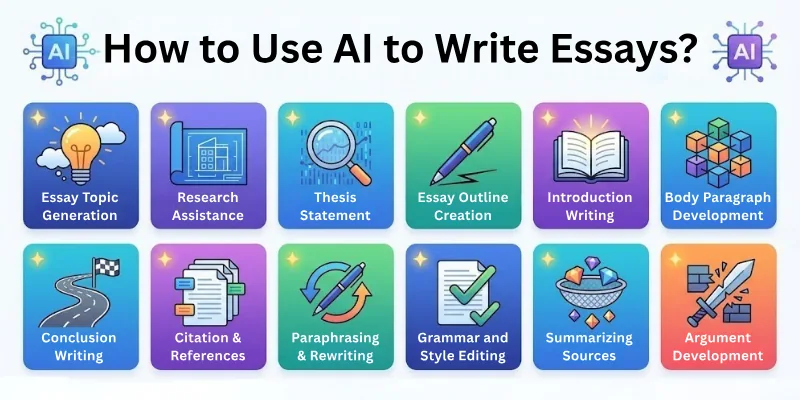
- Essay Topic Generation
- Essay Outline Creation
- Research Assistance
- Thesis Statement Generation
- Introduction Writing
- Body Paragraph Development
- Conclusion Writing
- Citation and References
- Paraphrasing and Rewriting
- Grammar and Style Editing
- Summarizing Sources
- Argument Development
- Example and Evidence Generation
- Essay Formatting
- Personalized Essay Assistance
Let us explore each method in detail.
1. Essay Topic Generation
Traditionally, students spend a lot of time brainstorming essay topics. Choosing the right topic can be challenging and sometimes confusing. AI can quickly generate relevant essay topics based on your subject or assignment requirements. You simply enter the subject or keywords, and AI suggests multiple topic ideas. This helps you start writing faster without wasting time searching for inspiration. It is especially useful for academic assignments and research essays.
Prompts You Can Use:
- “Generate 10 essay topics about climate change.”
- “Suggest argumentative essay topics for college students.”
- “Give unique essay ideas about technology in education.”
- “Create research essay topics about artificial intelligence.
- “List persuasive essay topics related to social media.”
- “Provide interesting essay topics for literature studies.”
2. Essay Outline Creation
Traditionally, creating an essay outline requires planning sections manually. Students must organize the introduction, body paragraphs, and conclusion themselves. AI can instantly generate a structured outline for your essay topic. It divides your essay into clear sections with suggested headings and key points. This helps you maintain logical flow and organization. AI outlines also make the writing process faster and easier.
Prompts You Can Use:
- “Create an essay outline for this topic.”
- “Generate a structured outline for a 1000-word essay.”
- “Organize this topic into introduction, body, and conclusion.”
- “Give a detailed outline with main arguments.”
- “Create a research essay structure.”
- “Provide a paragraph-by-paragraph outline.”
3. Research Assistance
Traditionally, research requires searching multiple sources and reading long articles. This process can be time-consuming and overwhelming. AI helps summarize research materials quickly and identify key information. You can gather facts, statistics, and supporting ideas easily. This makes research more efficient and organized. AI also helps you discover relevant perspectives on your topic.
Prompts You Can Use:
- “Provide research points for this essay topic.”
- “List important facts related to this subject.”
- “Summarize research findings about renewable energy.”
- “Give statistics for an essay about online learning.”
- “Provide sources and evidence for this topic.”
- “Explain important concepts related to this essay.”
4. Thesis Statement Generation
Traditionally, creating a strong thesis statement requires careful thinking and revision. Many students struggle to summarize their argument in one clear sentence. AI can generate strong thesis statements based on your topic and perspective. It helps clarify the main argument of your essay. A clear thesis improves essay structure and direction. AI can also provide multiple thesis options to choose from.
Prompts You Can Use:
- “Generate a thesis statement for this essay topic.”
- “Create a strong thesis about climate change solutions.”
- “Provide argumentative thesis statements.”
- “Give three thesis statement options.”
- “Write a clear thesis for this research topic.”
- “Summarize the main argument in one sentence.”
5. Introduction Writing
Traditionally, writing an introduction takes time because it must capture attention and introduce the topic clearly. AI can generate engaging introductions quickly. It can include a hook, background information, and thesis statement. This helps you start your essay confidently. AI introductions also improve readability and clarity.
Prompts You Can Use:
- “Write an introduction for this essay topic.”
- “Create an engaging opening paragraph.”
- “Start this essay with an interesting hook.”
- “Provide a short introduction with background context.”
- “Generate an academic essay introduction.”
- “Write a clear introduction for this topic.”
6. Body Paragraph Development
Traditionally, students develop body paragraphs by organizing ideas manually. AI can generate structured paragraphs based on key points or arguments. It helps expand ideas with explanations and examples. This improves clarity and depth in your essay. AI also ensures logical transitions between paragraphs.
Prompts You Can Use:
- “Write a body paragraph explaining this argument.”
- “Expand this idea into a paragraph.”
- “Develop a paragraph with examples.”
- “Explain this point in detail.”
- “Add supporting evidence for this argument.”
- “Write a paragraph explaining this concept.”
7. Conclusion Writing
Traditionally, writing a conclusion involves summarizing the essay and reinforcing the thesis. Many writers struggle to end their essays effectively. AI can generate concise and powerful conclusions. It summarizes the main arguments and provides final thoughts. This helps create a strong ending for your essay.
Prompts You Can Use:
- “Write a conclusion for this essay.”
- “Summarize the key arguments in the conclusion.”
- “Provide a closing paragraph for this topic.”
- “End this essay with a strong message.”
- “Generate a short academic conclusion.”
- “Restate the thesis and summarize the essay.”
8. Citation and References
Traditionally, formatting citations manually can be confusing and time-consuming. AI can generate citations automatically in different styles. You can create references in APA, MLA, or Chicago formats. This ensures academic accuracy and saves time. AI also helps organize your bibliography properly.
Prompts You Can Use:
- “Create APA citations for these sources.”
- “Generate MLA references for this article.”
- “Format these references correctly.”
- “Create a bibliography for this essay.”
- “Convert this source into an APA citation.”
- “Generate a reference list.”
9. Paraphrasing and Rewriting
Traditionally, paraphrasing requires careful rewriting to avoid plagiarism. AI can help rewrite sentences while maintaining the original meaning. This makes essays clearer and more unique. It is useful for simplifying complex information. AI ensures your content stays readable and original.
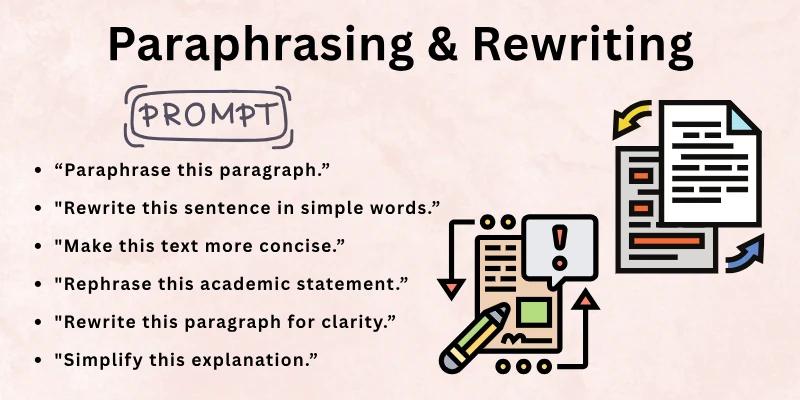
Prompts You Can Use:
- “Paraphrase this paragraph.”
- “Rewrite this sentence in simple words.”
- “Make this text more concise.”
- “Rephrase this academic statement.”
- “Rewrite this paragraph for clarity.”
- “Simplify this explanation.”
10. Grammar and Style Editing
Traditionally, editing essays requires reviewing grammar, punctuation, and sentence structure manually. AI tools can instantly detect errors and suggest corrections. This improves clarity, readability, and professionalism. AI also suggests better word choices and sentence flow.
Prompts You Can Use:
- “Check grammar and improve this paragraph.”
- “Edit this essay for clarity.”
- “Fix punctuation and grammar mistakes.”
- “Improve writing style.”
- “Make this paragraph more formal.”
- “Correct errors in this essay.”
11. Summarizing Sources
Traditionally, summarizing research papers takes time and careful reading. AI can quickly summarize articles, reports, or books. This helps you extract key information for your essay. You save time while understanding the important points.
Prompts You Can Use:
- “Summarize this research article.”
- “Provide key points from this paper.”
- “Explain the main ideas briefly.”
- “Create a short summary of this source.”
- “Extract important findings from this study.”
- “Summarize this report in 5 sentences.”
12. Argument Development
Traditionally, developing strong arguments requires critical thinking and evidence gathering. AI can suggest arguments and counterarguments related to your essay topic. This helps you strengthen your reasoning. It also improves the depth of your analysis.
Prompts You Can Use:
- “Provide arguments supporting this essay topic.”
- “Give counterarguments for this claim.”
- “Explain the pros and cons of this issue.”
- “Develop strong arguments for my essay.”
- “Suggest supporting points for this thesis.”
- “Expand this argument with examples.”
13. Example and Evidence Generation
Traditionally, writers search for examples and evidence to support arguments. AI can suggest examples, case studies, or statistics related to your topic. This makes essays more convincing and informative. AI also helps diversify your supporting evidence.
Prompts You Can Use:
- “Provide examples supporting this argument.”
- “Give real-world examples for this topic.”
- “Suggest case studies related to this issue.”
- “Add supporting evidence for this paragraph.”
- “Provide statistics for this essay topic.”
- “Give examples explaining this concept.”
14. Essay Formatting
Traditionally, formatting essays according to academic guidelines can take time. AI tools can organize headings, spacing, and structure automatically. You can ensure your essay follows academic standards. This is helpful for assignments and research papers.
Prompts You Can Use:
- “Format this essay in APA style.”
- “Organize headings for this essay.”
- “Structure this essay properly.”
- “Format paragraphs according to MLA guidelines.”
- “Arrange this essay for academic submission.”
- “Create proper headings and sections.”
15. Personalized Essay Assistance
Traditionally, students write essays without personalized feedback. AI can adapt writing suggestions based on your needs. You can focus on specific topics, arguments, or writing levels. AI tailors the essay content according to your goals. This makes writing more efficient and personalized.
Prompts You Can Use:
- “Write an essay suitable for college level.”
- “Create an essay focusing on environmental solutions.”
- “Generate a short essay for exam preparation.”
- “Focus on arguments related to technology.”
- “Create a personalized essay outline.”
- “Write an essay based on my topic and guidelines.”
Best AI Tools for Writing Essays
Here are AI tools you can use to write essays faster and improve writing quality:
- ChatGPT: AI assistant that helps generate essay ideas, outlines, and full drafts quickly.
- Grammarly: AI writing assistant that improves grammar, clarity, and tone.
- QuillBot: Paraphrasing and rewriting tool useful for improving essay structure.
- Jasper AI: Content generation tool for essays, articles, and long-form writing.
- Copy.ai: AI writing platform that helps generate ideas and paragraphs.
- Notion AI: AI tool that helps organize notes, research, and essay drafts.
- Writesonic: AI content generator for essays, blogs, and academic writing.
- Wordtune: AI tool that rewrites sentences and improves writing clarity.
- Paperpal: AI academic writing assistant designed for research papers and essays.
- Scholarcy: AI research tool that summarizes academic papers for essay writing.
Final Note
In this guide we covered how to use AI to write essays in different ways. You learned how AI can help with topic generation, research, thesis statements, outlines, drafting, editing, and formatting. These tools make essay writing faster and more efficient.
My advice is to use AI as a helper rather than a replacement for your thinking. Always review and refine the content to ensure it matches your ideas and assignment requirements.
Use AI wisely to improve your writing skills and complete essays more efficiently.
FAQs
Here are some commonly asked questions related to how to use AI to write essays:
Yes, AI can help generate outlines, research ideas, and paragraphs quickly. It speeds up the writing process significantly. You still need to review and edit the content. AI works best as a writing assistant.
Yes, it is safe if you use it responsibly. AI can help with ideas, structure, and editing. Always review the content and follow your academic guidelines.
Yes, AI can quickly create structured outlines for essays. It organizes ideas into introduction, body paragraphs, and conclusion. This makes writing easier and more organized.
Yes, AI can summarize articles, suggest research points, and explain complex topics. It saves time during the research process. You can use it to gather information quickly.
Yes, AI tools can detect grammar mistakes and suggest improvements. They also enhance sentence structure and clarity. This helps produce more professional essays.
Yes, AI can generate strong thesis statements based on your essay topic. It helps clarify the main argument of your essay. This improves the overall structure.
Yes, AI can rewrite sentences and paragraphs while keeping the meaning intact. This helps avoid repetition and improves readability.
Yes, AI can quickly summarize long research articles. It extracts key points and findings. This makes research easier and faster.
Yes, AI can provide examples, case studies, and statistics. These help strengthen your essay arguments and explanations.
Yes, always review and edit AI-generated content. This ensures accuracy and originality. Editing also helps match your personal writing style.






- Be Respectful
- Stay Relevant
- Stay Positive
- True Feedback
- Encourage Discussion
- Avoid Spamming
- No Fake News
- Don't Copy-Paste
- No Personal Attacks
- Be Respectful
- Stay Relevant
- Stay Positive
- True Feedback
- Encourage Discussion
- Avoid Spamming
- No Fake News
- Don't Copy-Paste
- No Personal Attacks
