AI Algorithms – Explained
Published: 1 Jul 2026
AI algorithms play a key role in modern technology systems. They help machines learn from data, make decisions, and improve performance without human instructions. From search engines to mobile apps, these algorithms run behind the scenes to process huge amounts of information every second.
Today, almost every digital service depends on AI algorithms to work faster and more accurately. They support automation in industries like healthcare, finance, and transportation.
In this article we will discuss about AI algorithms in detail and explain how they actually work in real-world systems.
AI Algorithms
AI algorithms are a set of computational methods that allow machines to learn from data, identify patterns, and make decisions with minimal human input. These algorithms form the backbone of modern artificial intelligence systems used in almost every digital application today, from search engines to recommendation systems. They help machines improve performance over time by analyzing large amounts of data.
Below are the main AI algorithms used in different areas of artificial intelligence:
- Supervised Learning Algorithms in AI
- Unsupervised Learning Algorithms in AI
- Reinforcement Learning Algorithms
- Deep Learning Algorithms in AI
- Probabilistic & Statistical AI Algorithms
- Optimization Algorithms in AI
- Natural Language Processing (NLP) Algorithms
- Computer Vision Algorithms
Let’s have a look at them in detail.
1. Supervised Learning Algorithms in AI
Supervised learning is one of the most widely used approaches in AI where models learn from labeled data.
This type of learning is mainly used for prediction and classification tasks in real-world systems like banking and healthcare.
- Linear Regression Algorithm: It predicts continuous values by finding a straight-line relationship between input and output data.
- Logistic Regression Algorithm: It is used for classification problems like yes/no or true/false outcomes.
- Decision Tree Algorithm: It splits data into branches to make simple and clear decisions step by step.
- Random Forest Algorithm: It combines multiple decision trees to improve accuracy and reduce errors.
- Support Vector Machine (SVM) Algorithm: It finds the best boundary to separate different classes in data.
- Naïve Bayes Algorithm: It uses probability to classify data based on prior knowledge and assumptions.
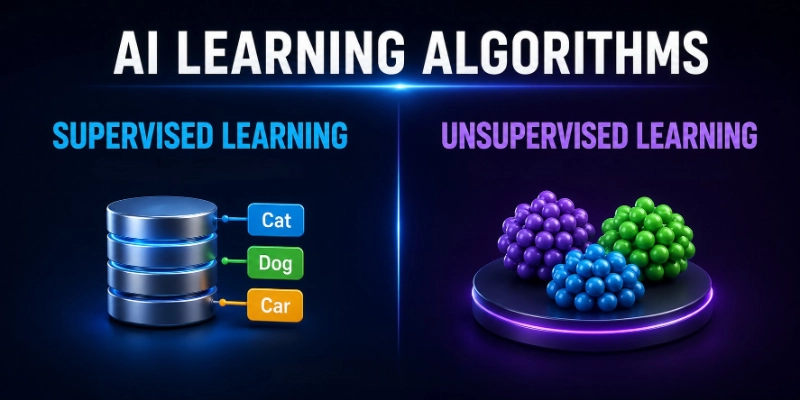
2. Unsupervised Learning Algorithms in AI
Unsupervised learning works with unlabeled data and focuses on finding hidden patterns.
This approach is widely used in clustering, segmentation, and market analysis.
- K-Means Clustering Algorithm: It groups similar data points into clusters based on distance.
- Hierarchical Clustering Algorithm: It builds a tree-like structure to organize data into clusters.
- DBSCAN Algorithm: It forms clusters based on density and detects outliers automatically.
- Principal Component Analysis (PCA) Algorithm: It reduces data complexity by selecting important features.
- Apriori Algorithm: It finds relationships between items in large datasets, often used in market basket analysis
3. Reinforcement Learning Algorithms
Reinforcement learning is based on reward-driven learning where an agent improves through experience.
This method is widely used in robotics, gaming, and self-driving systems.
- Q-Learning Algorithm: It learns the best actions by maximizing future rewards.
- Deep Q-Network (DQN) Algorithm: It combines Q-learning with deep neural networks for complex environments.
- SARSA Algorithm: It updates learning based on current actions and next actions taken.
- Policy Gradient Algorithm: It directly learns the best strategy to take actions in a system.
- Actor-Critic Methods: It uses two models: one to choose actions and one to evaluate them.
4. Deep Learning Algorithms in AI
Deep learning uses multi-layer neural networks to process large and complex datasets.
This approach powers modern AI applications like image recognition, speech processing, and generative AI.
- Artificial Neural Networks (ANN): They mimic the human brain to recognize patterns in data.
- Convolutional Neural Networks (CNN): It is mainly used for image and visual data processing.
- Recurrent Neural Networks (RNN): It processes sequential data like time series or text.
- Long Short-Term Memory (LSTM) Networks: They improve RNNs by remembering long-term dependencies.
- Transformers in Deep Learning: It uses attention mechanisms and powers modern AI like ChatGPT.
5. Probabilistic & Statistical AI Algorithms
These algorithms use probability models to handle uncertainty in data.
They are commonly used in prediction systems, speech recognition, and decision-making models.
- Bayesian Networks: It models relationships between variables using probability.
- Hidden Markov Models (HMM): It predicts sequences where states are hidden but observable outcomes exist.
- Gaussian Mixture Models (GMM): It represents data as a mixture of multiple Gaussian distributions.
6. Optimization Algorithms in AI
Optimization algorithms help AI models improve performance by reducing errors and finding the best solutions.
They are essential for training machine learning and deep learning models.
- Gradient Descent Algorithm: It minimizes errors by adjusting model parameters step by step.
- Stochastic Gradient Descent (SGD): It improves gradient descent by using small random data batches.
- Genetic Algorithms: It uses natural evolution concepts like selection and mutation to find solutions.
- Simulated Annealing: It searches for optimal solutions by gradually reducing randomness.
7. Natural Language Processing (NLP) Algorithms
NLP algorithms help machines understand, process, and generate human language.
They are widely used in chatbots, translation systems, and search engines.
- TF-IDF Algorithm: It measures the importance of words in a document.
- Word2Vec Algorithm: It converts words into numerical vectors based on meaning.
- Bag of Words (BoW): It represents text by counting word frequency.
- Transformer-Based Models: It uses attention mechanisms to understand context in language.
8. Computer Vision Algorithms
Computer vision algorithms enable machines to interpret and analyze images and videos.
They are widely used in security systems, autonomous vehicles, and medical imaging.
- Edge Detection Algorithms: It identifies boundaries and edges in images.
- Object Detection Algorithms: It detects and locates objects within images.
- Image Classification Algorithms: It assigns labels to images based on content.
- YOLO Algorithm: It detects objects in real time with high speed and accuracy.
Future of AI Algorithms
The future of AI algorithms is moving toward systems that are smarter, more transparent, and capable of adapting instantly to new data and environments.
- Self-Learning Algorithms: These algorithms improve automatically by learning from new data without needing constant human guidance.
- Explainable AI (XAI): These systems make AI decisions clear and understandable so users can trust how results are produced.
- Hybrid AI Models: These combine multiple approaches like rule-based logic and machine learning to improve accuracy and flexibility.
- Real-Time Adaptive Algorithms: These algorithms adjust their behavior instantly based on live data and changing conditions.
Conclusion
In this guide, we have covered AI algorithms, including their major types, how they work, and where they are used in real-world applications. Understanding these algorithms is essential because they form the backbone of modern artificial intelligence systems that power everything from search engines to self-driving cars.
Overall, AI algorithms continue to evolve and improve, making technology smarter, faster, and more efficient across industries. Their role will only become more important as data and automation grow in the future.
Personal Recommendation: From my perspective, it is highly valuable to start learning these algorithms step by step, especially if you are interested in AI, data science, or machine learning. Building a strong foundation in these concepts can open up excellent career opportunities in the tech field.
Thank you for reading. Wishing you the best on your learning journey—take care and stay curious.
💬 If you found this helpful, don’t forget to drop your thoughts in the comments below.
FAQs
Below are some commonly asked questions related to AI Algorithms that will help you understand the topic in a more simple and clear way.
AI algorithms are step-by-step instructions that help machines learn from data and make decisions. They allow computers to perform tasks like prediction, classification, and pattern recognition. In simple terms, they are the “thinking process” behind artificial intelligence systems.
AI algorithms are mainly divided into three categories:
- Supervised Learning
- Unsupervised Learning
- Reinforcement Learning
Each type works differently depending on the problem and data used. Together, they form the foundation of machine learning systems.
AI algorithms work by first collecting data and then cleaning it for processing. After that, the model is trained using patterns found in the data. Finally, it makes predictions or decisions based on new input.
Supervised learning algorithms learn from labeled data to make predictions. Common examples include linear regression, decision trees, and support vector machines (SVM). These are widely used in spam detection, price prediction, and classification tasks.
AI algorithms are a broad concept that includes all methods making machines intelligent. Machine learning algorithms are a subset of AI focused on learning from data. In short, all machine learning algorithms are AI algorithms, but not all AI algorithms are machine learning.
AI algorithms are used in many industries to improve efficiency and automation. For example:
- Healthcare for disease prediction
- Finance for fraud detection
- E-commerce for recommendations
They are also used in voice assistants and self-driving cars.
Beginners usually start with simple and easy-to-understand models. These include linear regression, logistic regression, and k-means clustering. They help build a strong foundation before moving to deep learning.
Deep learning algorithms are advanced AI methods based on neural networks. They are designed to handle complex tasks like image recognition and natural language processing. Examples include CNN, RNN, and transformers.
AI algorithms face several real-world challenges such as data bias, high computation cost, and lack of transparency. They also require large amounts of high-quality data to perform well. Despite this, continuous research is improving their efficiency.
The future of AI algorithms is moving toward smarter and more adaptive systems. New developments like explainable AI and hybrid models are improving performance and trust. These advancements will make AI more powerful and widely used across industries.





- Be Respectful
- Stay Relevant
- Stay Positive
- True Feedback
- Encourage Discussion
- Avoid Spamming
- No Fake News
- Don't Copy-Paste
- No Personal Attacks
- Be Respectful
- Stay Relevant
- Stay Positive
- True Feedback
- Encourage Discussion
- Avoid Spamming
- No Fake News
- Don't Copy-Paste
- No Personal Attacks
