What Is Turnitin? Complete Guide for Students
Published: 24 Sep 2026
Turnitin is an academic similarity-checking tool used by schools, colleges, and universities to compare student work with online content, academic publications, and previously submitted papers. It highlights text that matches other sources and generates a Similarity Report that helps students and instructors review citations, quotations, paraphrasing, and other similarities.
If you have ever submitted an assignment through your university, you may have seen a Turnitin report after submission. Understanding what the report means can help you use sources correctly and improve your academic writing.
In this guide, we will explain what is Turnitin, what Turnitin is used for, how it works, what it checks, how to understand its similarity score, and how its AI writing detection differs from similarity checking.
Turnitin Definition: What Is Turnitin?
The turnitin definition can be explained simply as an online academic similarity-checking tool that compares written work with content from websites, publications, journals, and previously submitted papers. It identifies matching or similar text and presents the results in a Similarity Report. Turnitin helps students and instructors review source use, but a similarity match does not automatically mean plagiarism.
How Does Turnitin Work?
Turnitin works by comparing submitted assignments with content from websites, academic publications, and previously submitted papers. It identifies matching or similar text and creates a Similarity Report for students and instructors to review.
The basic process includes:
- Assignment submission: You submit your paper through Turnitin or a connected learning management system.
- Text comparison: Turnitin processes the text and compares it with the sources available for that assignment.
- Matching text detection: The system highlights passages that match or closely resemble content in its databases.
- Report generation: Turnitin creates a Similarity Report showing the matching text, sources, and overall similarity percentage.
The report does not automatically determine plagiarism. An instructor reviews the matches and their context before making a final judgment.
For a complete explanation of each step, see our detailed guide on how to use the Turnitin AI detector
What Does Turnitin Check?
Turnitin checks submitted writing against different sources selected for the assignment. Its Similarity Report can compare content with billions of current and archived internet pages, publications, journals, and previously submitted works.
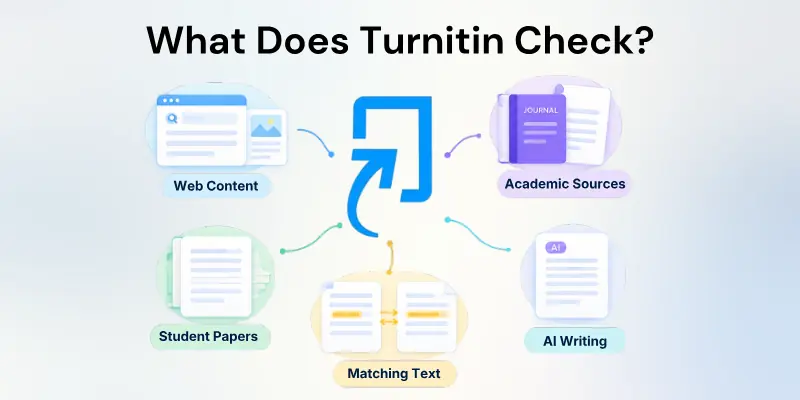
However, similarity checking and AI writing detection are different functions. Turnitin provides AI writing detection through a separate report for eligible accounts and supported submissions.
1. Websites and Online Content
Turnitin can compare submitted text with current and archived internet content available in its database. This includes publicly available web pages that its web crawler has collected over time. A match can appear when your wording resembles text found on an online source.
When checking online content, Turnitin may identify:
- Matching sentences
- Similar phrases
- Text from archived web pages
- Content from publicly available websites
- Multiple web sources containing similar wording
A web match does not automatically show that you copied the source. You still need to review the context and citation.
2. Academic Journals and Publications
Turnitin also compares submissions with academic and professional publications available through its supported content collections. These sources can include journals, periodicals, books, and other published material. This helps instructors identify similarities that may not appear in ordinary web searches.
The publication sources may include:
- Academic journal articles
- Periodicals
- Books and reference material
- Professional publications
- Other content available through Turnitin’s supported databases
This type of comparison can be especially useful for research papers that use a large number of academic sources.
3. Previously Submitted Student Papers
Turnitin can also compare a new submission with papers that students previously submitted to repositories available to the institution or account. These repositories can include an institution’s private collection, a group repository, or Turnitin’s general repository, depending on the account and assignment settings.
This comparison can identify similarities between student submissions, such as:
- Text reused from an earlier paper
- Similar passages between student assignments
- Content submitted in another class
- Material stored in an institution’s repository
The availability of these comparisons depends on how the instructor or institution configures the assignment.
4. Matching or Similar Text
Turnitin identifies text that matches or closely resembles content within its selected databases. The system highlights these passages and connects them with the relevant sources in the report. The resulting similarity score shows the proportion of text that matches, but it does not tell an instructor whether the match represents plagiarism.
For example, a match can come from:
- A correctly cited quotation
- A bibliography or reference
- A commonly used phrase
- A properly cited source
- Text that needs further review
That is why you should never judge an assignment only by its similarity percentage.
5. Potentially AI-Generated Writing
Turnitin can also provide an AI Writing Report for eligible accounts and submissions. This feature works separately from the standard similarity comparison and estimates the amount of qualifying text that may have been generated by AI. Turnitin’s current requirements include at least 300 words of qualifying prose, a maximum of 30,000 words, a file under 100 MB, and a supported language such as English, Spanish, Japanese, or Arabic.
There are a few important points about AI detection:
- AI detection is separate from the Similarity Report.
- It only works for eligible accounts and supported submissions.
- Turnitin does not treat the AI percentage as automatic proof of misconduct.
- Short-form content, bullet points, tables, and code do not reliably qualify for AI detection.
- Since August 2026, Turnitin’s AI Writing Report uses one unified blue category for likely AI-generated content, including content that may have been modified by AI paraphrasers or bypassers.
Does Turnitin Detect Plagiarism?
Turnitin can identify matching or similar text in an assignment, but it does not decide on its own whether plagiarism has occurred. Its Similarity Report shows the text that matches other sources and gives instructors information they can review.
An instructor checks each match to understand its context. A match may come from a properly cited quotation, a reference, common wording, or copied content without proper attribution. Therefore, a high similarity score does not automatically mean plagiarism. The instructor makes the final judgment based on the school’s academic integrity rules and the details of the submission.
Turnitin Similarity Score
A Turnitin similarity score is the percentage of text in a submission that matches content found in the selected comparison sources. Turnitin calculates the overall similarity based on the amount of matching text in relation to the total text of the document.
The score should always be interpreted in context. A higher percentage does not automatically mean plagiarism, and there is no single similarity percentage that is considered acceptable for every assignment or institution.
For example, a paper can have a higher score because it contains several correctly cited quotations, while another paper with a lower score could still contain improperly used material.
Does Turnitin Detect AI-Generated Text?
Yes, Turnitin offers AI writing detection for eligible accounts and supported submissions. However, this feature works separately from the Similarity Report. Instead of looking for copied content, the AI Writing Report estimates whether qualifying text may have come from an AI writing tool or may have been modified by an AI paraphrasing tool.
For a clearer understanding of Turnitin’s AI detection, keep these points in mind:
- AI detection is separate from similarity checking: The Similarity Report looks for matching text, while the AI Writing Report assesses text for possible AI-generated writing.
- It provides an estimate: The AI report estimates how much qualifying text may have been generated or modified by AI.
- It does not prove AI use: A positive AI detection result does not prove that a student used AI to write an assignment.
- False results can occur: Turnitin states that its AI detection may misidentify human-written or AI-generated text.
- Human review matters: Instructors should consider the AI report along with the assignment, writing context, and other evidence before making a decision.
Does Turnitin Detect ChatGPT?
Turnitin’s AI writing detection can assess qualifying text for signs that it may have been generated or modified by AI, including text produced with tools such as ChatGPT. However, it cannot reliably prove that a particular piece of writing was created by ChatGPT.
An AI detection result should therefore be treated as an indication that requires further review rather than definitive evidence of AI use. Turnitin recommends considering the report alongside other relevant information before making an academic decision.
Difference Between Turnitin Similarity and AI Detection?
Turnitin’s Similarity Report and AI Writing Report serve different purposes.
Here is a simple comparison:
| Feature | Similarity Check | AI Writing Detection |
| Main purpose | Finds matching or similar text | Estimates potentially AI-generated text |
| Compares against sources | Yes | No, it uses a different analysis |
| Shows a percentage | Yes | Yes, when available |
| Proves misconduct | No | No |
| Needs human review | Yes | Yes |
| Main report | Similarity Report | AI Writing Report |
What Is Turnitin Used For?
Students and instructors use Turnitin for several academic purposes. It can help identify similarities, review source use, improve citation practices, and support academic integrity.
For Students
Students may use Turnitin to:
- Review matching text in their assignments
- Check whether sources are properly cited
- Improve paraphrasing
- Identify accidental similarities
- Understand academic writing practices
When students have access to draft checking, they may also use the Similarity Report to review their work before final submission.
For Teachers and Instructors
Instructors can use Turnitin to:
- Review student submissions
- Examine matching sources
- Identify passages that need further review
- Provide feedback on source use
- Support academic integrity policies
Turnitin is therefore not simply a plagiarism checker. It can also be used as a learning and feedback tool to help students develop better academic writing habits.
Is Turnitin Free?
Turnitin is generally provided through educational institutions rather than as a free plagiarism checker for individual students. Students usually access Turnitin through their school, college, or university when the institution has an appropriate Turnitin subscription.
If your institution does not provide access, you should check its academic support or library services to see whether Turnitin is available to students.
Is Turnitin Accurate?
Turnitin can be useful for identifying text similarities within the sources available to it, but its results still require human interpretation. A similarity match can represent a quotation, citation, common phrase, or potentially inappropriate copying.
The same applies to AI writing detection: an AI result is an estimate and should not be treated as conclusive proof. Turnitin recommends reviewing the context and other relevant information before reaching a conclusion.
Who Can Use Turnitin?
Turnitin supports different users across education and academic research. Access and available features depend on the institution’s Turnitin account and subscription.
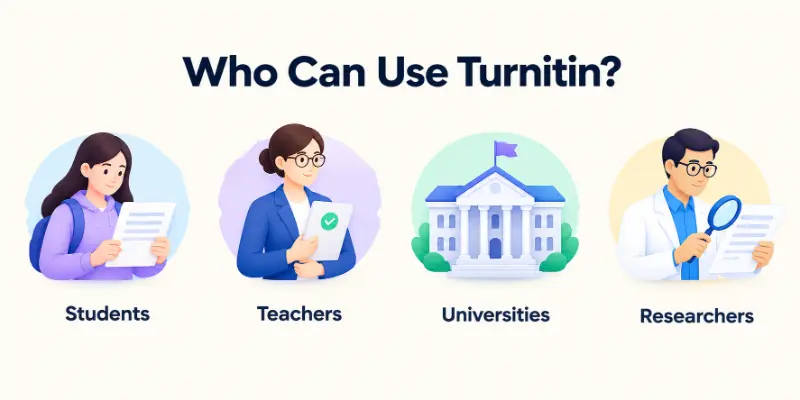
The following groups commonly use Turnitin:
- Students: Submit assignments and review similarity results when their institution gives them access.
- Teachers and instructors: Review student submissions, matching sources, and similarity reports.
- Universities and colleges: Use Turnitin to support academic integrity and manage assignment submissions.
- Researchers and academic institutions: Use Turnitin’s services to review written work and identify similarities in academic content.
Limitations of Turnitin
Turnitin can help identify similarities in academic work, but its reports have limitations. A similarity score or AI detection result does not give a final answer by itself. Students and instructors should always review the highlighted text, sources, and context before making a judgment. Turnitin also warns that its AI writing assessment can misidentify human-written and AI-generated text.
The main limitations include:
- A similarity score does not automatically prove plagiarism.
- Correctly cited quotations can still appear as matches.
- Common phrases and technical terminology can contribute to similarity.
- A low similarity score does not guarantee that all work is original.
- AI detection provides an estimate rather than definite proof of AI use.
- The sources available for comparison depend on the assignment and institution.
- Human review is necessary when making decisions about plagiarism or academic misconduct.
When Was Turnitin Created?
Turnitin was founded more than 25 years ago after a group of University of California students developed a peer-review application and noticed the challenge of identifying text similarities in student work. The company later developed its services around academic integrity and similarity checking.
Today, Turnitin serves educational institutions around the world and reports supporting more than 71 million students across over 16,000 institutions in more than 185 countries.
Conclusion
In this guide, we have covered what Turnitin is and explained how Turnitin works, what it checks, how its Similarity Report is created, and how AI writing detection differs from similarity checking. Turnitin is mainly a tool that helps identify matching or potentially AI-generated content, but its results should always be reviewed carefully rather than treated as automatic proof of plagiarism or academic misconduct.
Overall, Turnitin can be a useful tool for students and instructors when it is used correctly and understood in the right context. My personal recommendation is to use Turnitin as a learning tool to improve citations, paraphrasing, and academic writing rather than focusing only on achieving a low similarity score.
Thank you for reading this guide, and I hope you found it helpful and easy to understand. Goodbye, and best wishes for your academic journey!
💬 Have any questions or experiences with Turnitin? Feel free to share them in the comments below; we’d love to hear from you! 😊
FAQs
Below are some common questions about Turnitin, along with simple answers:
Turnitin is mainly used to check academic work for matching or similar text. It helps students and teachers identify passages that may need better citation or paraphrasing. It is commonly used for assignments, essays, research papers, and other academic submissions.
After an assignment is submitted, Turnitin compares its text with content from selected online and academic sources. It then highlights matching passages and generates a Turnitin similarity report. The report helps instructors review the sources and context of the matches.
A Turnitin similarity score shows the percentage of text that matches content in the sources checked by Turnitin. A higher score does not automatically mean plagiarism because properly cited quotations and common phrases can also create matches. Always review the highlighted sections instead of judging an assignment by the percentage alone.
Yes, but with an important distinction: Turnitin detects text similarities rather than making a final plagiarism decision. An instructor reviews the matching passages and their sources to determine whether the material was used appropriately.
Therefore, a Turnitin plagiarism check should be understood as a tool for identifying similarities, not as automatic proof of academic misconduct.
Turnitin offers an AI writing detection feature for eligible accounts and supported submissions. It estimates whether qualifying text may have been generated or modified by AI rather than simply comparing it with existing sources. Because AI detection can produce inaccurate results, the report should be reviewed carefully by a human.
Turnitin checks submitted text against sources available in its comparison databases, including internet content, publications, and previously submitted works. When similar wording is found, the system highlights the relevant passages and identifies potential sources. This process produces a Turnitin plagiarism report that instructors can examine.
Yes, Turnitin can compare submitted work with current and archived internet content available in its database. This means that text from websites can appear as a match in the Similarity Report. However, only content included in Turnitin’s available comparison sources can be identified.
Students may be able to check their work before final submission if their school or instructor provides access to a draft Turnitin assignment. This allows them to review similarities and improve citations or paraphrasing. Turnitin access for students depends on the settings and policies of the institution.
Turnitin’s AI writing detection can assess eligible text for signs that it may have been generated or modified by AI, including writing produced with AI tools. However, it does not simply identify every piece of text written by ChatGPT with certainty. An AI detection result should be treated as an indication for review rather than definitive proof of AI use.
There is no universal good turnitin similarity score because acceptable similarity levels vary by assignment, subject, and institution. A report with a higher percentage can still be acceptable when the matching material consists of properly cited quotations or references. Instead of aiming for a specific number, students should focus on using sources correctly and citing them properly.
There is no fixed good Turnitin score, as acceptable similarity levels vary by assignment and institution. A higher score does not always mean plagiarism, so always review the highlighted matches and citations carefully.

- Be Respectful
- Stay Relevant
- Stay Positive
- True Feedback
- Encourage Discussion
- Avoid Spamming
- No Fake News
- Don't Copy-Paste
- No Personal Attacks
- Be Respectful
- Stay Relevant
- Stay Positive
- True Feedback
- Encourage Discussion
- Avoid Spamming
- No Fake News
- Don't Copy-Paste
- No Personal Attacks
