How to Use AI for Language Learning: 12+ Practical Ways
Published: 26 Apr 2026
Learning a new language can be exciting but challenging. People often struggle with vocabulary, grammar, speaking, and practice consistency.
Learning how to use AI for language learning can make the process faster, more engaging, and structured. AI tools help you practice speaking, understand grammar rules, translate sentences, and even track progress. This guide will show practical ways to improve your language skills efficiently. You will also get prompts to apply each strategy immediately.
Let’s explore how to make language learning simpler and more effective.
How to Use AI for Language Learning
Here are major ways you can improve your language skills using how to use AI for language learning:
- Practice Daily Conversations
- Translate Sentences Instantly
- Improve Grammar
- Expand Vocabulary
- Listen and Repeat Exercises
- Read Short Articles in Target Language
- Write Short Paragraphs
- Track Progress and Scores
- Correct Pronunciation
- Play Language Games
- Learn Idioms and Phrases
- Set Daily Language Goals
- Understand Cultural Context
- Summarize Stories or Articles
- Join Virtual Language Challenges
Let us learn about each in detail.
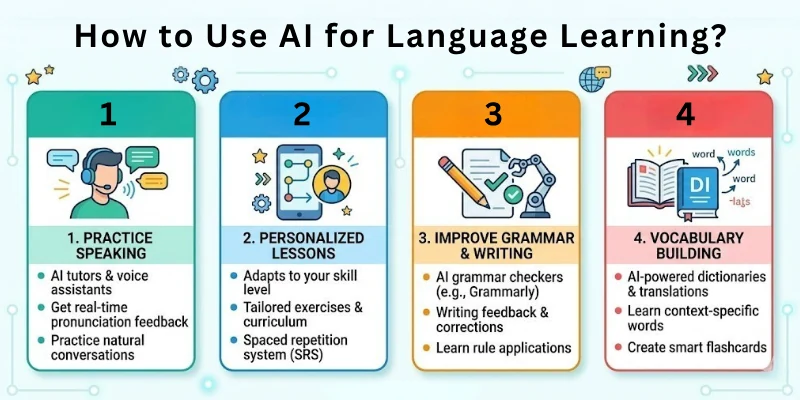
1. Way 1: Practice Daily Conversations
Traditionally, people relied on teachers or language partners for speaking practice. This limited the number of conversations and feedback. Now, AI can simulate real conversations anytime. You can ask questions, answer prompts, and get instant feedback. It helps build confidence and fluency gradually. Regular daily practice makes learning faster and more natural.
Prompts you can use:
- Start a daily conversation in Spanish about food.
- Ask questions in French and get responses.
- Practice introducing yourself in German.
- Simulate a conversation about travel in Italian.
- Reply to questions in English for practice.
- Practice polite greetings in Japanese.
2. Way 2: Translate Sentences Instantly
Traditionally, people used dictionaries or online translation tools, which were slow. AI now translates sentences instantly with context accuracy. You can check meanings and usage in real-time. It also explains grammar rules within translations. This helps learn faster and avoid misunderstandings.
Prompts you can use:
- Translate this English sentence into French.
- Explain the grammar behind this Spanish sentence.
- Translate German idioms into English.
- Check if my Japanese sentence is correct.
- Suggest a natural alternative in Italian.
- Translate multiple sentences from English to Arabic.
3. Way 3: Improve Grammar
Traditionally, grammar learning required textbooks and long practice exercises. AI tools check your writing for grammar mistakes instantly. They explain corrections and suggest improvements. You can learn rules and patterns as you write. This makes grammar learning interactive and easier.
Prompts you can use:
- Check grammar in my Spanish paragraph.
- Correct mistakes in this French sentence.
- Explain why this German sentence is wrong.
- Suggest improvements for my English writing.
- Highlight repeated grammar mistakes.
- Teach me a grammar rule using an example.
4. Way 4: Expand Vocabulary
Learning new words manually can be slow and forgettable. AI can suggest daily vocabulary based on your skill level. You can learn words in context and see examples. Tools can create flashcards for repetition. This helps you remember and use new words naturally.
Prompts you can use:
- Suggest 10 new French words for beginners.
- Create flashcards for German vocabulary.
- Show usage examples of Spanish words.
- Teach 5 advanced English words daily.
- Quiz me on Italian vocabulary.
- Recommend synonyms and antonyms in Japanese.
5. Way 5: Listen and Repeat Exercises
Listening and speaking skills are essential for fluency. Traditionally, audio CDs or videos were used for practice. AI can provide interactive listening exercises with immediate feedback. You can repeat phrases and get corrections instantly. This helps improve pronunciation and comprehension.
Prompts you can use:
- Play a Spanish audio sentence and ask me to repeat.
- Check my pronunciation in German.
- Provide listening exercises for Italian beginners.
- Suggest phrases to repeat in Japanese daily.
- Correct my English speaking errors.
- Give me audio quizzes for vocabulary listening.
6. Way 6: Read Short Articles in Target Language
Reading helps understand structure and context. Traditionally, learners relied on books with limited explanations. AI can provide short, level-appropriate articles. It highlights new words and explains sentences. This makes reading fun and educational.
Prompts you can use:
- Provide a short French article for beginners.
- Highlight new words in a Spanish text.
- Explain difficult sentences in German.
- Summarize a short Italian story.
- Give comprehension questions after reading.
- Translate tricky sentences in Japanese.
7. Way 7: Write Short Paragraphs
Writing practice was often limited to assignments or journals. AI can help you write short paragraphs and provide corrections. You learn to structure sentences and apply grammar rules. Feedback is instant, so improvement is faster. This helps improve both writing and thinking in the language.
Prompts you can use:
- Write a 5-sentence paragraph in French and correct it.
- Suggest improvements for my Spanish paragraph.
- Check grammar in my German writing.
- Provide vocabulary alternatives in Italian.
- Rewrite sentences to make them fluent in English.
- Give feedback on my Japanese paragraph.
Way 8: Track Progress and Scores
Tracking progress manually is hard and inconsistent. AI can score exercises, track vocabulary learned, and monitor speaking practice. You can see improvement over time and adjust goals. This motivates you to stay consistent. Tracking results ensures steady learning.
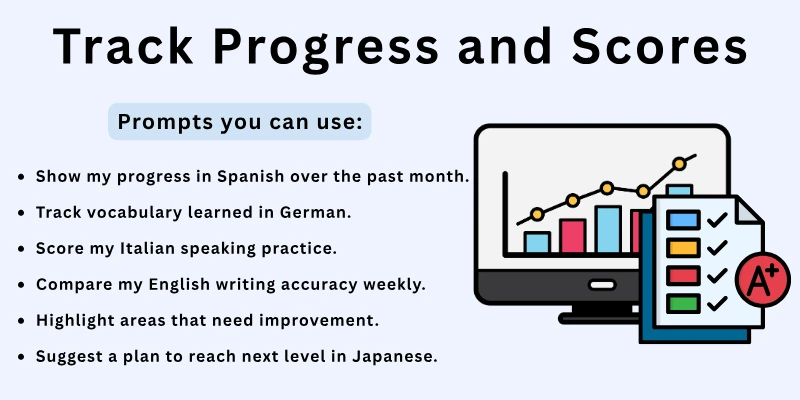
Prompts you can use:
- Show my progress in Spanish over the past month.
- Track vocabulary learned in German.
- Score my Italian speaking practice.
- Compare my English writing accuracy weekly.
- Highlight areas that need improvement.
- Suggest a plan to reach next level in Japanese.
9. Way 9: Correct Pronunciation
Pronunciation was traditionally corrected by teachers or language partners. AI can now detect pronunciation errors instantly. You can repeat words or sentences and get feedback. This helps you speak clearly and confidently. Consistent practice ensures fluency.
Prompts you can use:
- Check my French pronunciation for this sentence.
- Correct German words I pronounce incorrectly.
- Give Italian pronunciation exercises.
- Suggest tongue twisters in English to improve pronunciation.
- Repeat Japanese phrases until correct.
- Highlight words I frequently mispronounce.
10. Way 10: Play Language Games
Learning through games makes practice fun and engaging. Traditionally, games were limited or offline. AI provides interactive quizzes, word puzzles, and challenges. You can compete with yourself or others. This improves vocabulary, grammar, and comprehension while keeping learning enjoyable.
Prompts you can use:
- Create a vocabulary quiz in Spanish.
- Play a grammar challenge in French.
- Suggest language puzzles in German.
- Track my scores in Italian word games.
- Give daily challenges in Japanese.
- Test my sentence formation skills in English.
11. Way 11: Learn Idioms and Phrases
Understanding idioms is hard from books alone. AI can provide common idioms with context and examples. You learn to use phrases naturally in conversation. It also explains cultural meaning behind idioms. This improves fluency and understanding of native expressions.
Prompts you can use:
- Teach 5 common French idioms and their usage.
- Explain German phrases with examples.
- Show Spanish idioms and translation.
- Suggest Italian expressions for daily conversation.
- Quiz me on Japanese idioms.
- Highlight English idioms in context.
12. Way 12: Set Daily Language Goals
Consistency is key to language learning. AI can suggest realistic daily targets for vocabulary, reading, listening, or speaking. You can track completion and adjust difficulty. This keeps you motivated and disciplined. Small daily progress adds up to fluency.
Prompts you can use:
- Set a goal to learn 10 new French words today.
- Practice speaking German for 15 minutes.
- Read one Italian article daily.
- Write a short paragraph in Spanish every day.
- Track my completion of daily Japanese goals.
- Suggest achievable daily targets in English.
13. Way 13: Understand Cultural Context
Learning a language also means understanding culture. Traditionally, learners read books or watched videos. AI can explain cultural context, customs, and phrases. You learn language naturally and appropriately. This helps avoid misunderstandings while speaking.
Prompts you can use:
- Explain cultural context of this French phrase.
- Show how to greet formally in Japanese.
- Teach German etiquette in conversation.
- Explain Italian expressions in cultural situations.
- Compare English idioms with native usage.
- Highlight cultural differences in communication.
14. Way 14: Summarize Stories or Articles
Reading full stories takes time for beginners. AI can summarize stories or articles in simple language. You understand main ideas and vocabulary faster. It also allows practice in comprehension and discussion. This makes reading less intimidating and more effective.
Prompts you can use:
- Summarize this Spanish article in 5 sentences.
- Highlight key points in a French story.
- Translate summary into English.
- Ask comprehension questions for practice.
- Summarize German short stories for learning.
- Explain new vocabulary in context.
15. Way 15: Join Virtual Language Challenges
People rarely have consistent speaking partners. AI can provide challenges, competitions, or timed exercises. You practice daily, measure performance, and stay motivated. Challenges keep learning exciting and competitive. This accelerates language mastery effectively.
Prompts you can use:
- Suggest a 7-day French speaking challenge.
- Create a German vocabulary challenge.
- Provide daily Italian listening exercises.
- Track progress in English challenges.
- Compete in Japanese grammar quizzes.
- Suggest language games with friends online.
Best AI Tools for Language Learning
Here are 10 of the best AI tools for language learning you can use to practice vocabulary, grammar, speaking, and more:
- Duolingo Max – AI‑enhanced version of Duolingo with interactive chat and smart explanations.
- Memrise AI Tutor – Conversational AI and spaced repetition for natural language practice.
- LingQ (AI‑powered) – Turns real content (articles, podcasts) into lessons with personalized learning.
- Elsa Speak – AI speech recognition tool for pronunciation and accent improvement.
- Babbel (AI features) – Practical lessons with AI‑driven speech and grammar feedback.
- Talkpal – AI chatbots for real‑world conversational language practice.
- ChatGPT for Language Practice – Use AI to roleplay dialogues, generate exercises, and get grammar help.
- Busuu (AI‑supported) – Personalized study plans with feedback from AI and community.
- Mondly AI – Conversational AI and AR scenarios for immersive learning.
- Praktika AI – App with AI and animated avatars for spoken conversation practice.
Final Note
In this guide, we covered how to use AI for language learning in 15 practical ways. You learned to practice speaking, improve grammar, expand vocabulary, and track progress. My advice is to start with 2–3 strategies first and gradually include more. Consistency is key, so set daily goals and review progress regularly. Small, consistent steps make language learning effective and enjoyable.
Have fun while mastering a new language every day.
FAQs
Here are some of the most commonly asked questions related to the how to use AI tools for language learning:
Yes, it simulates conversations and provides feedback. You can practice anytime. This improves fluency and confidence naturally. Daily practice also helps you think directly in the new language.
Yes, it detects errors and explains corrections. You learn rules while practicing. This ensures clear and professional writing. Correct grammar builds strong communication skills over time.
Yes, it suggests words, examples, and quizzes. You can learn new words daily. Repetition helps you remember and use them effectively. Expanding vocabulary boosts confidence in speaking and writing.
Yes, it listens to your speech and provides corrections. You can repeat phrases until accurate. This ensures clear and understandable speech. Proper pronunciation makes conversations more natural.
Yes, it translates multiple languages accurately. It also explains grammar and context. You can learn meaning and usage simultaneously. Translation helps you understand and practice effectively.
Yes, it scores exercises and tracks vocabulary or writing practice. You can monitor improvement over time. Tracking keeps motivation high. Reviewing progress shows how far you have improved.
Yes, it provides short summaries and highlights new words. This makes reading easier. You understand content faster and retain key ideas. Summaries also save time while learning efficiently.
Yes, it explains customs, idioms, and proper usage. You learn to communicate naturally. This prevents misunderstandings in conversations. Understanding culture helps you use the language confidently.
Yes, it sets achievable targets for vocabulary, writing, listening, or speaking. You can adjust difficulty over time. Goals maintain consistency in practice. Daily goals make learning structured and measurable.
Yes, it offers games, quizzes, challenges, and interactive exercises. Learning becomes engaging and motivating. This helps you stay consistent and enjoy the process. Fun activities increase retention and make practice enjoyable.




- Be Respectful
- Stay Relevant
- Stay Positive
- True Feedback
- Encourage Discussion
- Avoid Spamming
- No Fake News
- Don't Copy-Paste
- No Personal Attacks
- Be Respectful
- Stay Relevant
- Stay Positive
- True Feedback
- Encourage Discussion
- Avoid Spamming
- No Fake News
- Don't Copy-Paste
- No Personal Attacks
