Pictionary Vs AI: What’s the Difference and Which Is Better?
Published: 15 Oct 2026
Have you ever wondered whether an AI can understand your drawings better than your friends? Pictionary vs AI creates an interesting challenge by replacing human guessing with artificial intelligence. Many people think AI can recognize every image perfectly, but the reality is that even smart systems can struggle with unclear or creative sketches.
This game creates curiosity because it allows players to compare human imagination with machine learning. While humans use emotions, experiences, and creativity to guess drawings, AI depends on data and visual patterns.
This comparison helps us understand both the power and limits of modern AI.
Overview of Both
In this section, I will first explain what Pictionary is and how the classic drawing game works. I will also discuss how players use simple drawings to communicate words and ideas without speaking. Then, I will look at how AI becomes part of the game and changes the way drawings are understood and guessed.

This comparison will help show the main difference between human guessing in traditional Pictionary and AI-powered drawing recognition.
What Is Pictionary?
Pictionary is a drawing and guessing game where one player draws a given word while the other players try to identify it. The player does not simply tell the answer but uses pictures, shapes, and visual clues to communicate the idea.
The game is more about creativity and quick thinking than perfect artwork. A simple sketch can be enough when players understand the clue and connect the drawing with the right word.
Examples: drawing a bicycle, house, animal, food item, or everyday object for others to guess.
What Is AI in Pictionary?
AI adds technology to the traditional drawing experience by allowing a system to look at sketches and make guesses. Instead of depending only on human players, the drawing becomes something that artificial intelligence can analyze.
AI studies visual details such as lines, shapes, and patterns before choosing a possible answer. This makes the game a simple way to see how machine recognition works in a fun setting.
Examples: an AI system may look at a rough drawing of a cat and try to identify it from the visual patterns.
How Pictionary Vs AI Changes the Classic Game
Pictionary is traditionally about one person drawing a word while other players try to guess it. With, the main change is that AI becomes the one trying to understand the drawing instead of relying only on human guesses.
This changes the way players think while drawing. You are no longer drawing only for another person. You also need to consider whether your sketch gives AI enough visual clues to identify the word.
- AI becomes the guesser: Players draw their assigned words while AI analyzes the sketches and tries to identify them.
- Drawing becomes a new challenge: Players may need to make their sketches clear enough for an AI system to recognize.
- Unexpected guesses add fun: AI may sometimes understand a drawing differently from what the player intended.
- The classic format gets a modern twist: The familiar drawing-and-guessing idea now combines human creativity with artificial intelligence.
- Players can test AI’s ability: The game creates curiosity because players get to see how well AI understands their drawings.
In short, does not remove the creative part of the classic game. Instead, it changes the guessing experience by making AI part of the gameplay.
Difference Between Pictionary and AI
Pictionary and AI can both be connected through drawing and recognition, but they approach the task in different ways. Humans use imagination, experience, and context, while AI depends on patterns and learned information.
These differences can help explain why a person and a machine may look at the same drawing and reach different answers. Let’s see.
- Purpose
- Guessing Method
- Creativity
- Accuracy
- Speed
- Human Interaction
- Challenge Level
- Learning Experience
Let’s discuss further in detail:
1. Purpose
Both approaches involve understanding drawings, but their main purpose is not exactly the same. Traditional Pictionary focuses on entertainment and communication, while AI adds a technology-based guessing challenge.
Pictionary
- Gives players a fun drawing and guessing activity.
- Encourages people to communicate without directly saying the answer.
- Builds interaction between friends, families, or teams.
- Makes creativity part of the gameplay.
AI
- Uses technology to recognize visual information.
- Attempts to identify what a drawing represents.
- Shows how machines process visual patterns.
- Adds a technology challenge to the familiar game.
Quick Difference: Pictionary focuses on human fun, communication, and creativity, while AI focuses on recognizing drawings through technology.
2. Guessing Method
The guessing process is one of the clearest areas when we compare Pictionary and AI. Human players can think about the situation and use clues that may not appear directly in the drawing.
AI follows a different process. It examines the visual information and searches for patterns that may match the object or idea.
Pictionary
- Players use imagination to understand a sketch.
- People can ask themselves what the drawing might represent.
- Previous experiences can help with difficult guesses.
- Players may understand unusual drawings through context.
AI
- AI examines lines, shapes, and other visual details.
- It compares patterns with information it has learned.
- It selects a likely answer based on its analysis.
- It does not use human emotions or personal experiences in the same way.
Quick Difference: Pictionary uses human imagination and context to guess, while AI analyzes visual patterns to find a likely answer.
3. Creativity
Creativity plays a major role in drawing games. A person can create an unusual sketch and still understand what it means, even when the picture does not look perfect.
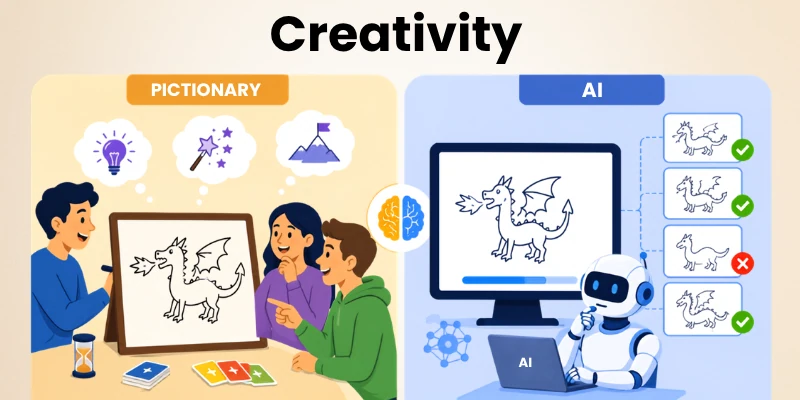
AI can recognize creative drawings, but its ability depends on the patterns and examples it has learned. This makes human imagination an important part of the Pictionary experience.
Pictionary
- Players can use their own drawing style.
- A rough picture can still communicate a clear idea.
- People can use creative visual clues.
- Imagination helps players handle unusual drawings.
AI
- Looks for recognizable visual patterns.
- Works best when the drawing contains familiar clues.
- May struggle with highly unusual sketches.
- Recognition depends on learned information.
Quick Difference: Pictionary gives players more freedom to use imagination, while AI works better with clear and familiar visual clues.
4. Accuracy
Accuracy can change from one drawing to another. A clear sketch may be easy for both humans and AI, while a confusing picture can produce completely different guesses.
This is why ai vs pictionary is not simply about deciding which one always gets the right answer. The result depends on the drawing, the available clues, and how the guess is made.
Pictionary
- Humans can understand incomplete drawings.
- Players can use context to make educated guesses.
- Team members may build on each other’s ideas.
- A funny or unusual sketch can still be understood.
AI
- Clear visual patterns can improve recognition.
- Familiar objects may be easier for AI to identify.
- Unusual drawings can create incorrect guesses.
- Results depend on how well the drawing matches learned patterns.
Quick Difference: Humans can use context to understand unclear drawings, while AI depends more on how closely the sketch matches learned patterns.
5. Speed
Speed also changes the way the game feels. A human player may spend time looking at the drawing and thinking about different possibilities before giving an answer.
AI can process visual information very quickly. This allows it to make a prediction without going through the same human thought process.
Pictionary
- Players may need a few moments to understand the sketch.
- Difficult drawings can take longer to solve.
- Team discussion can influence the final guess.
- The extra thinking time can create funny moments.
AI
- Can analyze a drawing quickly.
- Processes visual details without needing a conversation.
- Can produce a prediction within a short time.
- Fast recognition adds a different challenge to the game.
Quick Difference: Human players may need time to think and discuss, while AI can analyze visual information and give a quick prediction.
6. Human Interaction
One major part of traditional Pictionary is the interaction between players. People laugh, discuss possible answers, and react to each other’s drawings during the game.
AI changes this part by becoming another guessing element. It can make the experience interesting, but human interaction remains important because players still create and react to the drawings.
Pictionary
- Encourages players to communicate.
- Creates teamwork between participants.
- Makes guessing a social activity.
- Funny mistakes often become part of the fun.
AI
- Adds a machine-based guessing experience.
- Gives players a new way to test their drawings.
- Can create surprising guesses.
- Combines a social game with modern technology.
Quick Difference: Pictionary creates direct communication and teamwork, while AI adds a machine-based guessing experience to the game.
7. Challenge Level
The challenge becomes different when AI joins the game. Players are not only trying to make their teammates understand a drawing but may also wonder whether a machine can recognize it.
This creates an extra layer of excitement. A player may draw something very simple and still be surprised by the answer produced by AI.
Pictionary
- Players challenge each other through drawing and guessing.
- Difficult words can require more creative thinking.
- Team members can use communication to improve their guesses.
- The challenge comes mainly from understanding another person’s drawing.
AI
- Players test whether technology can recognize their sketches.
- Unclear drawings can become harder for the system.
- The result may be difficult to predict.
- Players can become curious about what AI will guess next.
Quick Difference: Pictionary challenges players to understand each other’s drawings, while AI challenges players to create sketches that a machine can recognize.
8. Learning Experience
A drawing game can also teach us something about communication and technology. Traditional Pictionary shows how people use simple visual clues, while AI-based gameplay gives us a basic look at machine recognition.
I think this makes the experience useful beyond simple entertainment. Players can notice how the same drawing may be interpreted differently by a person and a machine.
Pictionary
- Encourages creative thinking.
- Helps players communicate ideas visually.
- Improves quick thinking.
- Shows the importance of simple visual clues.
AI
- Introduces players to image recognition.
- Shows how machines identify visual patterns.
- Helps people understand that AI can make mistakes.
- Makes technology easier to explore through play.
Quick Difference: Pictionary develops creativity, communication, and quick thinking, while AI introduces players to visual recognition and how machines interpret patterns.
Comparison Table: Pictionary Vs AI
Want to see the pictionary vs ai comparison at a glance? This table makes the main differences easier to understand without going through every detail again.
| Key Aspect | Pictionary | AI |
| Main Focus | Human drawing and guessing | Machine recognition |
| Guessing Method | Imagination and context | Visual patterns and learned data |
| Creativity | High human creativity | Depends on learned patterns |
| Speed | Depends on the players | Usually processes quickly |
| Accuracy | Depends on human understanding | Depends on drawing and training |
| Interaction | Strong player interaction | Adds technology to gameplay |
| Challenge | Guess another player’s drawing | Test whether AI understands the sketch |
| Learning | Creativity and communication | Basic understanding of AI recognition |
Pictionary Vs AI: Which Is Better for Different Players?
Choosing between Pictionary and AI depends on what kind of experience you want from the game. Traditional Pictionary focuses on human interaction, creativity, and guessing, while Pictionary Vs AI adds a different challenge by making AI responsible for recognizing the drawings.
For me, there is no single winner because different players may enjoy different parts of the experience. Here is how I would compare both options for different types of players.
For Players Who Love Group Games
Traditional Pictionary can be a great choice for players who enjoy talking, laughing, and guessing together. The focus stays on people and their reactions.
- More direct interaction between players.
- Easy to enjoy with friends and family.
- Encourages teamwork and communication.
- Funny guesses can make the game more entertaining.
For Players Who Enjoy Technology
Pictionary Vs AI may be more interesting for people who want to add technology to a classic game. Players draw their words while AI tries to recognize the sketches.
- Adds an AI-based challenge.
- Makes players curious about AI’s guesses.
- Combines drawing with technology.
- Creates unexpected results.
For Creative Players
Creative players may enjoy pictionary vs ai because the game gives them a chance to turn simple ideas into drawings. The challenge becomes more interesting when they have to think about how both people and AI might understand their sketch.
- Players can use their own style instead of trying to create perfect artwork.
- They need to find simple ways to show difficult words through pictures.
- Players can see whether their creative sketch is clear enough for AI to recognize.
- AI may give a surprising answer, which can make the game more fun.
For Beginners
Beginners can enjoy the game because they do not need professional drawing skills to take part. The main goal is to communicate an idea clearly, not to create a perfect picture.
- The basic idea is to draw a word and let AI try to guess it.
- Simple shapes and basic drawings can be enough.
- New players can learn how to make drawings easier for AI to recognize.
- Wrong guesses can become part of the entertainment instead of making the game difficult.
Final Thoughts
So guys, in this article, we’ve covered pictionary Vs Ai in detail. From the way players draw and guess to the way AI studies a sketch, both options offer a different experience. Traditional Pictionary depends more on human creativity, communication, and quick thinking, while AI brings a fresh challenge by trying to understand the same drawings through technology.
If you ask me which one I would choose, I would give AI a try because I find it interesting to see how a machine reacts to creative human drawings. However, Pictionary remains my choice when I want a simple and fun game with friends or family.
In the end, the better option depends on what kind of experience you want. Now it’s your turn—try both, choose your winner, and share your experience with us!
FAQs
If you are comparing Pictionary with AI, you may still have a few questions about how both work. Here are the most common questions readers may have before choosing between them.
Pictionary Vs AI brings the classic drawing game together with artificial intelligence in a fun and interesting way. Players draw a word, object, or idea, and AI tries to understand what they have created.
The game shows how well AI can recognize drawings, even when they are simple or unclear. It also makes the traditional Pictionary experience more interactive by adding a new challenge between human creativity and AI understanding
AI looks at the lines, shapes, and visual clues in a drawing. It then uses these details to predict what the sketch represents.
This process can be very quick, but the result may change when the drawing is unclear or unusual. AI may compare different parts of the drawing before making its guess. Simple and clear drawings are usually easier for AI to understand. However, creative or messy sketches can make the prediction more difficult.
The main difference comes from how each side understands a drawing. Pictionary depends on human thinking, while AI depends on visual recognition.
- Pictionary: Uses imagination and human understanding.
- AI: Uses patterns and learned visual information.
- Pictionary: Focuses more on social guessing.
- AI: Adds a technology-based challenge.
No, AI cannot understand every drawing correctly. A simple sketch may be easy to recognize, but an unusual or unclear drawing can confuse the system.
Humans can sometimes understand such drawings by using context and imagination, which gives them a different advantage.
Regular Pictionary mainly involves people drawing and guessing together. Pictionary Vs AI adds artificial intelligence to the experience.
This means players also get to see whether a machine can understand their drawing, which creates a new type of challenge.
A clear drawing gives AI better visual clues to work with. You do not need to create perfect artwork, but the main idea should be easy to identify.
- Keep the main object clear.
- Use simple and recognizable shapes.
- Avoid adding too many confusing details.
Yes, beginners can easily enjoy the game because drawing skill is not the main requirement. The fun comes from trying to communicate an idea through a simple sketch.
AI reads visual patterns rather than understanding the drawing exactly like a person. If the sketch has unusual shapes or limited clues, the system may connect it with a completely different idea.
That unexpected answer can actually make the game more entertaining.
Pictionary can be a better choice when the main goal is social interaction and teamwork. Players can laugh, discuss guesses, and enjoy each other’s drawing styles.
AI can still make group play interesting by adding another guessing challenge. It gives everyone something different to test and discuss.
There is no single winner for everyone. Pictionary is stronger when you want human interaction and creativity, while AI adds technology and a new way to test drawing skills.
So, the better option depends on whether you prefer a classic social game or a modern AI-based experience.





- Be Respectful
- Stay Relevant
- Stay Positive
- True Feedback
- Encourage Discussion
- Avoid Spamming
- No Fake News
- Don't Copy-Paste
- No Personal Attacks
- Be Respectful
- Stay Relevant
- Stay Positive
- True Feedback
- Encourage Discussion
- Avoid Spamming
- No Fake News
- Don't Copy-Paste
- No Personal Attacks
