Generative AI vs OpenAI: What’s the Real Difference?
Published: 26 Aug 2026
Generative AI vs OpenAI is a comparison that trips up a lot of people, especially when AI terms keep piling up faster than anyone can track. New tools launch every week, and words like “generative AI” and “OpenAI” often get used like they mean the same thing.
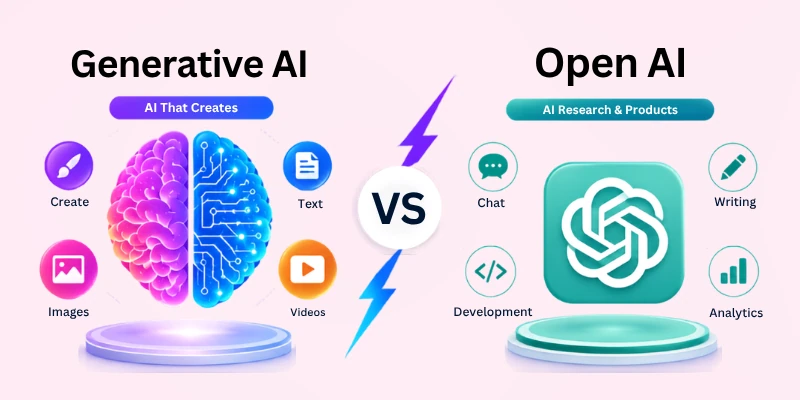
That mix-up makes it harder to pick the right tools or explain AI to others with confidence. This guide clears up the difference in simple terms, so you stop second-guessing every AI conversation. Generative AI is a broad type of technology that creates text, images, code, and more.
OpenAI is one company that builds tools using this technology, with ChatGPT being its most well-known product. Knowing this difference matters, since it changes how you evaluate tools and understand AI news.
In the next sections, we’ll break down exactly how these two connect, so you walk away with real clarity, not just more confusion.
What Is Generative AI?
Generative AI is a type of technology that creates new content instead of just analyzing existing data. It learns patterns from huge amounts of text, images, or audio, then uses those patterns to produce something new. Unlike older AI systems that only sort or predict, generative AI actually builds fresh output on its own.
This technology powers many of the tools you already use or hear about daily. If you’ve searched Generative AI vs OpenAI explained, this is the starting point: generative AI is the broad category, and tools like ChatGPT are just one product built on top of it.
Here’s what generative AI can create:
- Text: Articles, emails, summaries, and conversations
- Images: Artwork, product photos, and design concepts
- Code: Programming snippets and full functions
- Audio: Voiceovers, music, and sound effects
- Video: Short clips and animations from text prompts
Generative AI isn’t tied to one company or one tool. Many businesses build their own generative AI models, each trained for different tasks. This is why understanding Generative AI vs OpenAI models matters — OpenAI’s models are well-known, but they’re only one set of examples within a much larger field.
In short, generative AI is the technology itself. It’s the engine, not the car. Companies like OpenAI build specific products using this engine, which is exactly what the next section covers.
What Is OpenAI?
OpenAI is a company that builds products using generative AI technology. It doesn’t own the concept of generative AI, but it’s one of the most well-known names in the space, thanks to tools like ChatGPT. OpenAI trains its own models, then turns them into products people can use directly, whether for writing, coding, or answering questions.
If you’ve searched is OpenAI a generative AI company, the short answer is yes, but with a distinction: OpenAI is a company that applies generative AI, not the technology itself. This is the core difference that trips up a lot of readers.
Here are some of OpenAI’s key products:
- ChatGPT: A conversational AI tool for writing, answering questions, and more
- DALL-E: A tool that generates images from text prompts
- Codex: A model built to help with writing and understanding code
- Whisper: A tool for converting speech into text
- API access: Lets developers build their own apps using OpenAI’s models
OpenAI’s popularity often leads people to search OpenAI generative AI examples, expecting a broad list of tools. In reality, OpenAI’s products are examples of generative AI in action, not the full picture of what generative AI can do across the industry.
Key Differences Between Generative AI and OpenAI
Generative AI and OpenAI aren’t really competitors, so comparing them works a bit differently than comparing two tools. One is a broad technology, and the other is a company that builds specific products with it. Still, breaking down their differences helps clear up the confusion that brings most readers to this topic in the first place.
Here are the main points of difference:
- Scope and definition
- Ownership and control
- Range of applications
- Access and availability
- Innovation and development speed
- Public perception and recognition
- Pricing and business model
- Customization and flexibility
- Underlying technology vs finished product
Let’s discuss further in detail, one by one:
1. Scope and Definition
Understanding this comparison starts with one simple fact: generative AI and OpenAI aren’t the same type of thing at all. Generative AI is a technology category, while OpenAI is a company. Mixing these up is the root cause of most confusion around this topic, so getting this distinction clear first makes everything else easier to follow.
Generative AI:
- A broad category of technology, not a single product
- Covers any system that creates new content from learned patterns
- Includes text, image, audio, video, and code generation
- Used and developed by many companies across the tech industry
OpenAI:
- A single company, not a technology category
- Builds specific products using generative AI technology
- Best known for tools like ChatGPT, DALL-E, and Codex
- One player among many working in the generative AI space
Once this distinction is clear, a lot of the confusion around Generative AI vs OpenAI naturally clears up too. You’re not comparing two competitors; you’re comparing a field of technology to one company working inside that field.
2. Ownership and Control
The second key difference is about who actually owns and controls each side of this comparison. This matters especially if you’re trying to understand how generative AI tools are built, priced, and released to the public.
Generative AI:
- Not owned by any single company or organization
- Developed openly across universities, research labs, and businesses
- Available through many providers, not locked to one source
- Growth and improvement come from contributions across the whole field
OpenAI:
- Fully owns and controls its own models and products
- Decides its own release schedule, pricing, and usage rules
- Sets specific limits on how its tools can be accessed or used
- Operates independently, even while using generative AI as its foundation
This difference explains why generative AI feels more open and widespread, while OpenAI feels more structured and controlled. Neither approach is wrong; they’re just different levels of the same larger picture, which is exactly why the comparison matters.
3. Range of Applications
The third difference shows up in how widely each side is actually used. Generative AI applications stretch across almost every industry, while OpenAI’s applications are limited to what the company itself has chosen to build and release.
Generative AI:
- Used in healthcare, for drug discovery and medical research
- Used in gaming, for character design and virtual worlds
- Used in marketing, for content creation and personalization
- Used in software development, across many different companies
OpenAI:
- Focused mainly on conversational AI, through ChatGPT
- Focused on image generation, through DALL-E
- Focused on code assistance, through Codex and API tools
- Focused on speech-to-text, through Whisper
This is one of the clearest ways to understand Generative AI vs OpenAI applications. Generative AI shows up almost everywhere, while OpenAI represents a specific, well-defined set of products within that much larger picture.
4. Access and Availability
The fourth difference is about how you actually reach and use each one. This matters if you’re deciding where to start learning or building with AI tools.
Generative AI:
- Available through many companies, not just one source
- Includes open-source models anyone can download and use
- Offered through different platforms with different pricing
- Not limited by one company’s rules or release schedule
OpenAI:
- Accessed only through OpenAI’s own platforms and apps
- Offered through a website, mobile app, and developer API
- Comes with its own free and paid usage tiers
- Controlled entirely by OpenAI’s own policies and limits
So while generative AI gives you many doors to walk through, OpenAI is just one specific door, even if it’s the most well-known one. Both are valid starting points, but they lead to very different experiences depending on what you’re trying to do.
5. Innovation and Development Speed
The fifth difference is about how fast progress happens on each side. This affects how quickly new capabilities show up, and where those improvements come from.
Generative AI:
- Improves through work from many labs and companies worldwide
- Moves forward through shared research papers and open competition
- Not tied to one company’s timeline or internal goals
- Progress continues even if one company slows down
OpenAI:
- Improves based on its own internal research and funding
- Releases updates on its own schedule, not the industry’s
- Progress depends on the company’s specific priorities
- Has driven several major breakthroughs, but works independently
This shows why generative AI as a field keeps moving even during quiet periods for any single company, while OpenAI’s progress is shaped by its own internal decisions and resources.
6. Public Perception and Recognition
The sixth difference comes down to familiarity. This one plays a big role in why people mix up the two terms in the first place.
Generative AI:
- Still sounds technical or unfamiliar to many everyday users
- Rarely mentioned by name outside of tech or business discussions
- Understood mostly by people working closely with AI tools
- Often explained only when someone specifically asks about it
OpenAI:
- Widely recognized, largely thanks to ChatGPT’s fast growth
- Mentioned often in news, social media, and everyday conversation
- Familiar even to people who don’t follow AI closely
- Sometimes used, incorrectly, as a stand-in for all AI tools
This gap in recognition is one of the biggest reasons the confusion exists. One term feels distant and technical, while the other feels familiar and specific, which naturally leads people to blur the line between them.
7. Pricing and Business Model
The seventh difference is about cost, and how each side actually charges for use. This matters if you’re trying to budget for AI tools or services.
Generative AI:
- No single pricing model, since it depends on the provider
- Some tools are free and open-source, with no cost at all
- Others charge based on usage, subscriptions, or licensing
- Pricing varies widely across companies and platforms
OpenAI:
- Offers a clear, published pricing structure
- Provides free access with usage limits on some tools
- Charges for paid plans with higher limits and more features
- Prices its API separately, based on usage volume
Because generative AI spans so many providers, there’s no single answer to “how much does it cost.” OpenAI, on the other hand, makes its pricing easy to find and compare, since it’s all managed under one company.
8. Customization and Flexibility
The eighth difference is about how much each side can be shaped to fit specific needs. This matters most for businesses building their own AI-powered products.
Generative AI:
- Can be fine-tuned differently by every company that uses it
- Supports fully custom models built for niche industries
- Offers open-source options that allow deep customization
- Flexibility depends on which provider or model you choose
OpenAI:
- Allows customization mainly through its API and settings
- Lets developers adjust prompts, parameters, and use cases
- Customization stays within the limits OpenAI sets
- Less flexible than fully open-source generative AI options
Generative AI as a whole offers far more room to customize, simply because so many providers and models exist. OpenAI still allows meaningful customization, but it operates within one company’s boundaries rather than the open landscape of the wider field.
9. Underlying Technology vs Finished Product
The ninth and final difference is really the heart of this whole comparison. It’s the idea that ties every other point together, so it works well as the closing piece of this breakdown.
Generative AI:
- The core technology and methods behind content generation
- The foundation that many companies build their products on
- Exists as research, models, and techniques, not a single app
- Powers tools people use, without being a product itself
OpenAI:
- A finished, packaged product built using generative AI
- Turns complex technology into something easy to use
- Delivered through apps, websites, and simple interfaces
- One example of generative AI put into practical use
This is the clearest way to sum up the entire comparison: generative AI is the foundation, and OpenAI is something built on top of that foundation. Once this clicks, every other difference on this list makes a lot more sense, since they all trace back to this one core idea.
Generative AI vs OpenAI: Quick Comparison Table
Before moving deeper into how these two connect, here’s a quick side-by-side view for anyone who just wants the key facts fast
| Feature | Generative AI | OpenAI |
| What it is | A broad technology category | A company that builds AI products |
| Scope | Covers text, image, audio, video, and code generation | Focused on specific products like ChatGPT, DALL-E, Codex |
| Ownership | Not owned by any single company | Fully owned and controlled by OpenAI |
| Access | Available through many providers, including open-source | Available only through OpenAI’s own platforms |
| Pricing | Varies widely by provider, some free and open-source | Clear pricing with free and paid tiers |
| Customization | Highly flexible across many models and providers | Customization limited to OpenAI’s API and settings |
| Public recognition | Less familiar, sounds technical to most people | Widely recognized, especially through ChatGPT |
| Development pace | Driven by many labs and companies worldwide | Driven by OpenAI’s own research and priorities |
| Best understood as | The underlying technology | A finished product built on that technology |
This table makes one thing clear: this isn’t really a competition between two rivals. It’s a comparison between a broad field of technology and one well-known company working inside that field. The next section breaks down exactly how the two connect in practice.
Other Generative AI Companies Besides OpenAI
OpenAI often gets the spotlight, but it’s far from the only company building generative AI tools. Several other companies have their own strong models, each with different strengths. Knowing these options gives you a fuller picture beyond just one name.
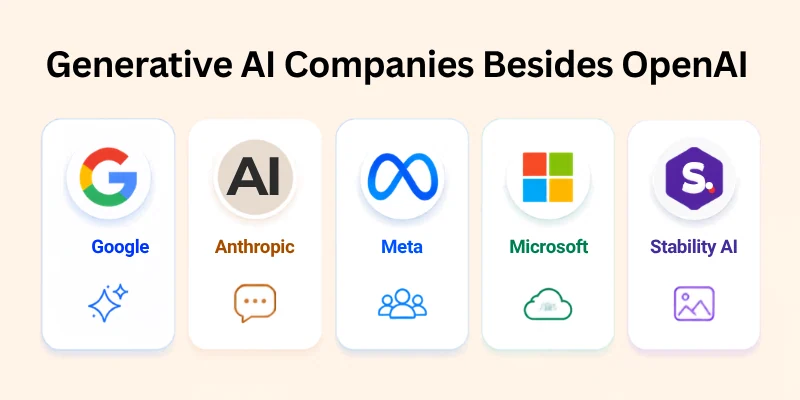
Here are some other notable generative AI companies:
- Google: Builds generative AI tools like Gemini, used for text, image, and code generation across Google’s products
- Anthropic: Focused on building safe, helpful AI assistants, known for its Claude models
- Meta: Develops open-source generative AI models under its Llama family, widely used by developers
- Microsoft: Integrates generative AI across its products, partly through its partnership with OpenAI, and also through its own research
- Stability AI: Known for open-source image generation tools, popular among designers and developers
Each of these companies takes a slightly different approach. Some focus on open-source access, letting developers customize models freely. Others focus on tightly controlled, ready-to-use products, similar to OpenAI’s approach with ChatGPT.
Final Thought
So guys, in this article, we’ve covered Generative AI vs OpenAI in detail. Generative AI is the broad technology that makes content creation possible, while OpenAI is one company that builds specific products using that technology, like ChatGPT and DALL-E. Understanding this difference helps you make sense of AI news, tools, and conversations without getting the two mixed up.
My honest recommendation: if you’re just starting to learn about AI, begin with generative AI as a concept, since it gives you the bigger picture. Once that clicks, exploring OpenAI’s specific tools will make a lot more sense, and you’ll also be ready to compare other companies in the space, like Google or Anthropic.
There’s no need to keep guessing which term means what. Start applying this knowledge today, explore a generative AI tool that fits your needs, whether that’s OpenAI’s ChatGPT or another provider, and see the difference clarity makes in how you use AI going forward.
Frequently Asked Questions
Here are the questions readers often ask after comparing generative AI vs OpenAI. These answers keep things short and simple, so you get quick clarity without re-reading the whole article.
No, they’re not the same thing. Generative AI is a broad technology category, while OpenAI is one company that builds products using that technology. This is the core point behind Generative AI vs OpenAI explained.
Generative AI is the underlying technology that creates new content, like text and images. OpenAI is a company that packages this technology into specific products, such as ChatGPT and DALL-E. One is a field, the other is a business built inside that field.
Yes, several companies build their own generative AI models.
- Google builds tools like Gemini
- Anthropic focuses on safe AI assistants like Claude
- Meta offers open-source models under Llama
- Microsoft integrates generative AI across its products
ChatGPT is both, but in different ways. It’s an example of generative AI in action, and it’s also a specific product built by OpenAI. This dual identity is a common source of confusion in the Generative AI vs ChatGPT comparison.
Yes, absolutely. Businesses can choose from many generative AI providers, including Google, Anthropic, Meta, and open-source options.
This gives companies flexibility in pricing, customization, and features, without needing to rely on OpenAI specifically. Choosing the right provider depends on the business’s exact goals and budget.
It depends on the provider. Some generative AI tools are free and open-source, while others charge based on usage or subscriptions.
Pricing varies widely across the field, unlike OpenAI, which has one clear, published pricing structure.
This mostly comes down to recognition. OpenAI’s tools, especially ChatGPT, became so popular so quickly that many people started using the company name to describe all AI tools. Generative AI, as a broader term, is less familiar to everyday users, which adds to the mix-up.
OpenAI is one of the most recognized names in generative AI, especially because of ChatGPT’s popularity.
That said, it isn’t the only leader. Companies like Google, Anthropic, and Meta also contribute major advances to the field. Progress in generative AI overall comes from many companies working in parallel, not just one.
Generative AI is used far beyond chatbots and conversation tools. Healthcare uses it for research and drug discovery. Gaming uses it for character and world design.
Marketing uses it for content creation, and software development uses it for coding assistance across many companies.
Beginners often find it easier to start with OpenAI’s tools, like ChatGPT, since they’re simple and ready to use right away. Once comfortable, learning about generative AI as a broader concept helps make sense of other tools and companies in the space. Starting with one specific tool, then widening your understanding, tends to work well.





- Be Respectful
- Stay Relevant
- Stay Positive
- True Feedback
- Encourage Discussion
- Avoid Spamming
- No Fake News
- Don't Copy-Paste
- No Personal Attacks
- Be Respectful
- Stay Relevant
- Stay Positive
- True Feedback
- Encourage Discussion
- Avoid Spamming
- No Fake News
- Don't Copy-Paste
- No Personal Attacks
