AI Applications in Business for Growth and Success
Published: 7 Jul 2026
Why are so many businesses suddenly investing in AI? Is AI only for big companies, or can small businesses use it too? Many people hear about AI every day, but they still do not fully understand how it actually helps businesses grow and save time.
I often notice that business owners feel confused when choosing AI tools or understanding where AI fits into their work. Some think AI will replace everything, while others believe it is too expensive or difficult to use. In reality, many businesses already use AI in simple ways without even realizing it.
In this article, we will discuss AI applications in business in detail. We will also look at how different industries use AI and how businesses can start using it step by step.
Artificial Intelligence in Business
Artificial Intelligence (AI) in business refers to the use of smart technologies that help companies perform tasks that normally require human intelligence, such as decision-making, problem-solving, and data analysis.
AI helps businesses improve efficiency, reduce costs, and provide better customer experiences. It is widely used in customer support, marketing, finance, and business operations.
To better understand AI in business, it is important to know the differences between AI, machine learning, and automation.
- Artificial Intelligence (AI): Technology that enables machines to think and make decisions like humans.
- Machine Learning (ML): A branch of AI that allows systems to learn from data and improve over time.
- Automation: Technology used to complete repetitive tasks automatically without human involvement.
Major AI Applications in Business
Artificial Intelligence (AI) is transforming modern businesses by improving efficiency, reducing costs, and enhancing decision-making.
Companies across different industries use AI to automate tasks, analyze data, and deliver better customer experiences. Below are the major applications of AI in business sectors.
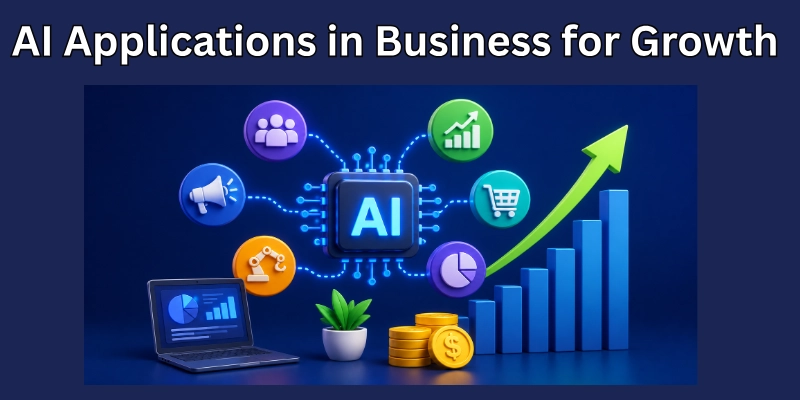
Below are some of the major applications of artificial intelligence that are transforming modern businesses and improving different business operations.
- AI in Customer Service
- AI in Marketing
- AI in Sales
- AI in Human Resources
- AI in Finance and Banking
- AI in Healthcare Businesses
- AI in Retail and E-commerce
- AI in Manufacturing
- AI in Cybersecurity
- AI in Logistics and Supply Chain
Now, let us have a detailed look at these important AI applications in business.
1. AI in Customer Service
AI has improved customer service by providing quick and accurate support to customers. Businesses use AI systems to handle customer questions, reduce waiting time, and improve customer satisfaction. These technologies help companies provide support services more efficiently and continuously.
To understand how AI improves customer service, the following applications are commonly used:
- AI Chatbots: Chatbots answer customer questions instantly without human support.
- Virtual Assistants: AI assistants help customers complete tasks and solve problems.
- 24/7 Customer Support: AI systems provide customer service at any time of the day.
- Automated Responses: Businesses use AI to send fast and automatic replies to customers.
- Real-World Examples: Companies like banks and e-commerce platforms use AI chatbots for customer support.
2. AI in Marketing
AI has changed modern marketing by helping businesses understand customer interests and behaviors. It allows companies to create smarter marketing campaigns, improve customer engagement, and increase sales. AI tools also save time by automating different marketing activities.
The following are the major AI applications in marketing:
- Personalized Advertising: AI shows customized ads based on customer preferences.
- Email Marketing Automation: AI automatically sends marketing emails to targeted users.
- Customer Behavior Analysis: AI studies customer activities and buying patterns.
- AI Content Generation: Businesses use AI to create blogs, ads, and social media content.
- Social Media Optimization: AI improves social media marketing strategies and engagement.
3. AI in Sales
AI helps businesses improve sales performance and customer management. Companies use AI tools to identify potential customers, predict sales trends, and understand customer needs more effectively. This increases sales opportunities and business growth.
The following applications explain the role of AI in sales:
- Lead Scoring: AI identifies customers who are more likely to buy products.
- Sales Forecasting: AI predicts future sales and market trends.
- CRM Automation: AI automates customer relationship management processes.
- Customer Insights: AI provides useful information about customer preferences.
- Predictive Selling: AI recommends products based on customer behavior.
4. AI in Human Resources
AI is helping HR departments improve recruitment and employee management processes. Businesses use AI to save time, reduce manual work, and make better hiring decisions. AI also supports employee training and performance evaluation.
The following are important AI applications in human resources:
- AI Recruitment Tools: AI helps companies find suitable job candidates quickly.
- Resume Screening: AI automatically checks and filters resumes.
- Employee Monitoring: Businesses use AI to monitor employee productivity.
- Performance Analysis: AI evaluates employee performance using data analysis.
- AI-Powered Training Systems: AI provides personalized employee training programs.
5. AI in Finance and Banking
The finance and banking industry uses AI to improve security, reduce risks, and automate financial operations. AI systems help financial institutions detect fraud, manage customer accounts, and provide better financial services.
The following applications show the importance of AI in finance and banking:
- Fraud Detection: AI identifies suspicious financial transactions quickly.
- Risk Management: AI helps banks analyze and reduce financial risks.
- Automated Accounting: AI automates accounting and bookkeeping tasks.
- AI Financial Assistants: AI chatbots provide financial guidance to customers.
- Credit Scoring Systems: AI evaluates customer creditworthiness for loans.
6. AI in Healthcare Businesses
AI is transforming healthcare businesses by improving medical services and patient care. Healthcare organizations use AI for disease diagnosis, patient data management, and medical research. AI technologies also improve healthcare accessibility and efficiency.
The following are major AI applications in healthcare businesses:
- Medical Diagnosis Support: AI assists doctors in identifying diseases accurately.
- Patient Data Management: AI organizes and manages patient records efficiently.
- AI-Powered Healthcare Apps: Healthcare apps use AI for health monitoring and guidance.
- Drug Discovery: AI helps researchers develop medicines faster.
- Virtual Healthcare Assistants: AI assistants provide healthcare support to patients remotely.
7. AI in Retail and E-commerce
Retail and e-commerce businesses use AI to improve customer experiences and business operations. AI technologies help companies understand customer preferences, manage inventory, and increase online sales.
The following applications explain the role of AI in retail and e-commerce:
- Product Recommendations: AI suggests products based on customer interests.
- Smart Inventory Management: AI helps businesses manage stock efficiently.
- Dynamic Pricing: AI changes product prices according to market demand.
- Customer Shopping Behavior Analysis: AI studies customer buying habits.
- AI-Powered Search Systems: AI improves product search results on e-commerce websites.
8. AI in Manufacturing
AI is improving manufacturing processes by increasing productivity and reducing operational costs. Manufacturing companies use AI systems to automate production, monitor equipment, and improve product quality.
The following are key AI applications in manufacturing:
- Predictive Maintenance: AI predicts machine failures before they happen.
- Robotics Automation: AI-powered robots perform manufacturing tasks efficiently.
- Quality Control Systems: AI detects defects in products during production.
- Supply Chain Optimization: AI improves supply chain planning and management.
- Smart Factories: AI supports automated and connected factory operations.
9. AI in Cybersecurity
AI plays an important role in protecting businesses from cyber threats and online attacks. AI systems monitor networks continuously and detect suspicious activities in real time. This helps organizations improve digital security and reduce risks.
The following applications highlight the role of AI in cybersecurity:
- Threat Detection: AI identifies cyber threats quickly and accurately.
- Real-Time Monitoring: AI monitors systems continuously for unusual activities.
- Automated Security Systems: AI responds to security threats automatically.
- Spam and Phishing Detection: AI blocks harmful emails and fake websites.
10. AI in Logistics and Supply Chain
AI helps logistics and supply chain businesses improve efficiency, reduce delivery costs, and manage operations effectively. Companies use AI to optimize transportation, automate warehouses, and improve delivery services.
The following are major AI applications in logistics and supply chain management:
- Route Optimization: AI selects the fastest and most efficient delivery routes.
- Demand Forecasting: AI predicts product demand using market data.
- Warehouse Automation: AI automates storage and inventory handling tasks.
- Delivery Tracking Systems: AI provides real-time tracking information for deliveries.
Types of AI Technologies Used in Business
Below are some of the most important AI technologies that businesses use to improve operations, automate tasks, and support decision-making processes.
- Machine Learning: AI technology that learns from data and improves performance over time.
- Natural Language Processing (NLP): Helps machines understand and respond to human language.
- Computer Vision: Enables AI systems to recognize and analyze images and videos.
- Robotic Process Automation (RPA): Automates repetitive business tasks using software robots.
- Generative AI: Creates content such as text, images, videos, and designs automatically.
- Predictive Analytics: Uses data analysis to predict future trends and business outcomes.
- Deep Learning: Advanced AI technology that mimics the human brain using neural networks.
Why Businesses are Investing in AI
Businesses are investing in artificial intelligence (AI) because it helps improve productivity, reduce operational costs, and support better business decisions. AI technologies allow companies to automate tasks, analyze large amounts of data, and provide better services to customers. As competition continues to grow, businesses use AI to stay innovative and achieve long-term success.
The following factors explain why businesses are increasingly adopting AI technologies:
- Efficiency Improvement: AI automates repetitive tasks and improves work productivity.
- Cost Reduction: AI reduces labor costs and minimizes human errors in operations.
- Faster Decision Making: AI analyzes data quickly to support accurate business decisions.
- Better Customer Experience: AI improves customer service through personalized support and faster responses.
- Competitive Advantage: Businesses use AI to stay ahead of competitors and improve market performance.
- Improved Data Analysis: AI processes large amounts of data and provides valuable business insights.
- Business Growth and Innovation: AI helps companies develop new products, services, and business strategies.
Future of AI Applications in Business
Below are some key future trends of artificial intelligence that will shape how businesses operate, make decisions, and grow in the coming years.
- AI-Powered Decision Making: AI will help businesses make faster and more accurate decisions using real-time data.
- Hyper Automation: Advanced automation that combines AI and multiple technologies to automate entire business processes.
- AI and Remote Work: AI tools will support virtual teams, communication, and productivity in remote working environments.
- AI in Small Businesses: Small businesses will increasingly use AI to compete with larger companies and improve efficiency.
- Ethical AI Development: Focus on developing fair, transparent, and responsible AI systems for safe use.
- AI-Driven Business Innovation: AI will help create new products, services, and business models.
- Future Business Trends with AI: AI will continue to transform industries and redefine how businesses operate globally.
Conclusion
In this guide, we have covered AI applications in business. We explored how artificial intelligence is transforming different industries such as customer service, marketing, sales, healthcare, finance, and many others. AI is becoming an essential part of modern business because it improves efficiency, reduces costs, enhances decision-making, and provides better customer experiences. It also helps companies stay competitive in a fast-changing digital world.
AI is no longer just an advanced technology; it is now a core part of how modern businesses operate and grow. Its impact will continue to increase as more companies adopt digital transformation strategies.
Personal Recommendation: Personally, I recommend businesses and students to deeply understand AI applications because this technology is not just the future, but it is already shaping today’s business environment. Learning and adopting AI skills can open many career and business opportunities.
Thank you very much for reading this article. It was a pleasure to share this information with you.
Don’t forget to leave a comment.
FAQs
Below are some frequently asked questions (FAQs) about AI applications in business that will help you better understand this topic in a simple and clear way.
Below are some AI applications in business.
- AI applications in business refer to the use of artificial intelligence technologies to improve business operations.
- These include automation, data analysis, customer service, and decision-making.
- AI helps companies work faster and more efficiently.
AI is used in business for tasks like customer support, marketing automation, sales forecasting, and fraud detection. It analyzes large amounts of data to support better decisions. Many companies use AI to save time and reduce costs.
AI is important because it improves productivity and reduces human effort. It helps businesses make smarter and faster decisions. AI also enhances customer experience and business growth.
The main benefits of artificial intelligence in business include several important advantages that help companies grow and perform better. Below are the key benefits explained in simple points:
- Cost Reduction
- Efficiency Improvement
- Better Decision-Making
- Personalized Customer Service
- Competitive Advantage
The following are common types of AI used in business:
- Machine Learning
- Natural Language Processing (NLP)
- Computer Vision
- Generative AI
- Predictive Analytics
AI improves customer service through chatbots and virtual assistants. These tools provide instant replies and 24/7 support. This leads to higher customer satisfaction and faster problem-solving.
Yes, small businesses can easily use AI tools for marketing, sales, and customer management. Many AI tools are affordable and user-friendly. They help small businesses compete with larger companies.
The future of AI in business includes automation, smarter decision-making, and innovation. AI will become more advanced and widely used in all industries. It will continue to transform how businesses operate.
AI is not fully replacing jobs but changing how work is done. It automates repetitive tasks while creating new job roles. Employees are needed to manage and work with AI systems. Businesses also use AI to improve productivity and support workers instead of completely replacing them.
Industries like healthcare, finance, retail, manufacturing, and marketing use AI the most. These industries rely on AI for data analysis and automation. AI helps them improve efficiency and customer experience.




- Be Respectful
- Stay Relevant
- Stay Positive
- True Feedback
- Encourage Discussion
- Avoid Spamming
- No Fake News
- Don't Copy-Paste
- No Personal Attacks
- Be Respectful
- Stay Relevant
- Stay Positive
- True Feedback
- Encourage Discussion
- Avoid Spamming
- No Fake News
- Don't Copy-Paste
- No Personal Attacks
